Should you open a DPC or an insurance-based practice?
Both are legitimate ways to practice primary care, and neither is the "right" answer for every doctor. Direct primary care fits best when you want a small panel, long visits and almost no claims work, and when enough patients or employers in your area can pay a monthly fee. An insurance-based practice fits best when your patients depend on Medicare, Medicaid or commercial coverage for primary care, and when you would rather be paid per visit by payers than build revenue one membership at a time. Many doctors end up with a hybrid that does some of each.
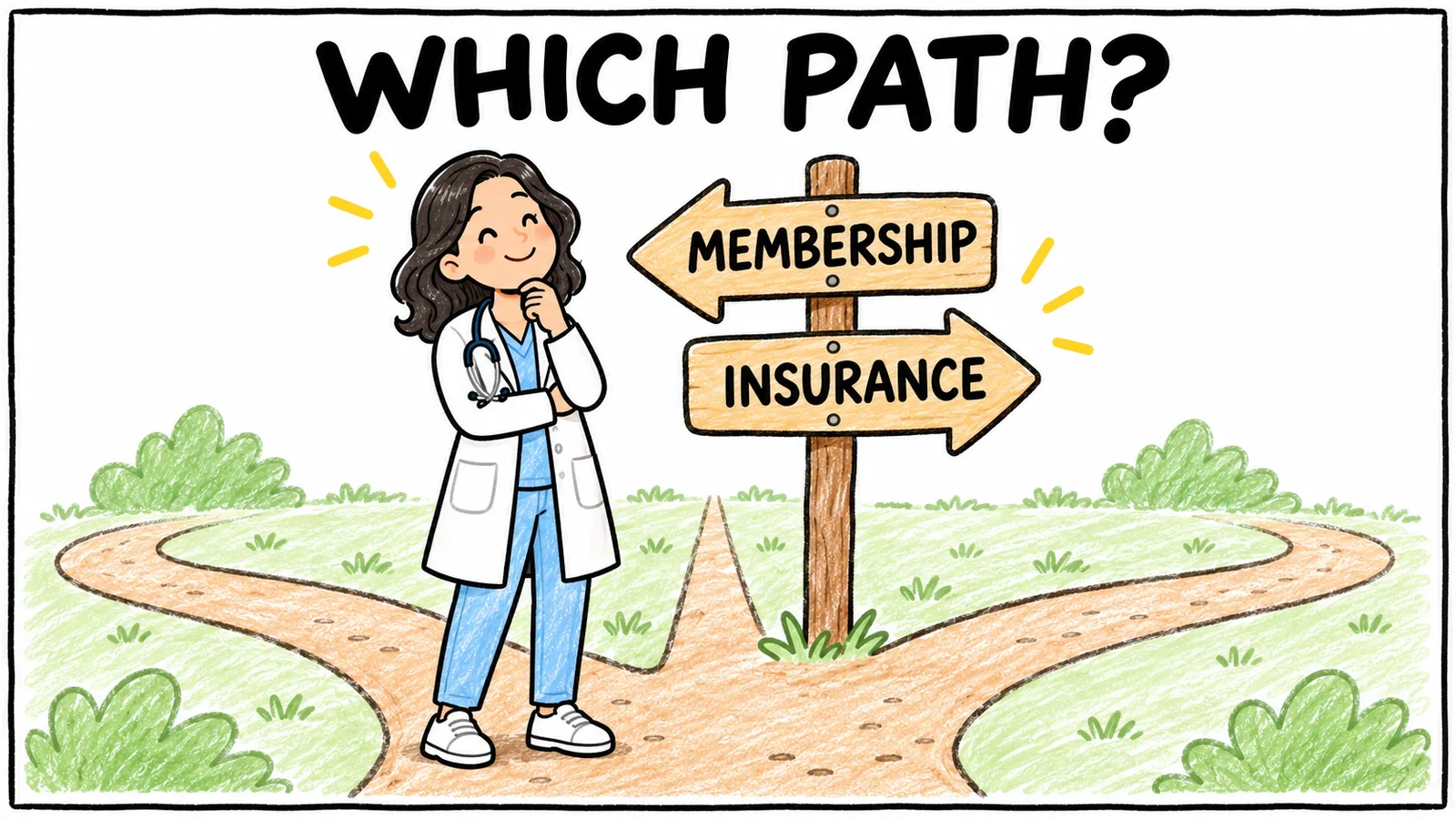
The decision usually comes down to seven things, and this guide takes them one at a time. They are who pays for care in your area today, what local incomes can support, how long you can go before revenue covers costs, how much administrative work you are willing to carry, what you want to do about Medicare patients, how many patients you want to care for, and whether a hybrid would let you keep the best of both. If you already run an insurance-based practice and are weighing a change, our step-by-step guide on converting a practice to direct primary care picks up where this one leaves off.
DPC vs insurance-based practice at a glance
Here is the short version of how the two models compare on the factors that matter most to a physician owner.
| Decision factor | DPC | Insurance-based |
|---|---|---|
| Who pays | Patients or employers, monthly | Medicare, Medicaid, commercial plans, plus copays |
| Revenue timing | Upfront each month | After claims are paid |
| Panel size | Small, usually a few hundred | Large, often planned in the thousands |
| Visit length | Long, with same-day access | Shorter, set by volume |
| Admin work | Light on claims and prior auth | Coding, claims, denials, prior auth |
| Medicare patients | Usually private contracts after opt-out | Billed to Medicare as usual |
| Low-income patients | Harder unless priced low or employer-paid | Covered through Medicaid and Medicare |
| Startup ramp | Slow until members join | Faster once credentialed |
| Income ceiling | Set by panel size and fee | Set by volume and payer rates |
Neither column is better on every row. The rest of this guide explains where each one wins, with the data behind it.
Who pays for care in your area today?
Start with payer mix, because it tells you how many of your likely patients could switch to a membership without losing something they value. A practice whose patients are mostly working-age adults with commercial coverage is in a different position from one whose patients are mostly on Medicare or Medicaid.
DPC practices appear to lean toward commercially insured patients. In the AAFP's 2026 DPC data brief, whose 313 respondents were about half in DPC, respondents reported that on average 80% of their patients had private health insurance, and adults ages 19 to 64 made up 60% of reported panels. Those members keep their insurance for hospital care, specialists and emergencies, and use the membership for primary care. Our guide on what insurance to pair with DPC covers how patients usually set that up.
If a large share of your current or expected patients rely on Medicaid, a membership model is harder to offer without leaving them out, and an insurance-based or hybrid practice may be the way you serve them best. That is a real reason doctors choose to take insurance, and it deserves respect. Employers change the picture too. The same AAFP brief found that 55% of DPC respondents had employer-based contracts, and our guide on selling direct primary care to employers explains how those deals work.
Can people in your market afford a membership?
A membership practice depends on households being able to pay a monthly fee on top of their insurance premium, so local incomes matter more for DPC than for an insurance-based practice. The U.S. Census Bureau's 2025 income report gives the national benchmark.
Median household income in 2025 was $87,460, the highest on record.
Your county may sit well above or below that line, and the Census Bureau's local data lets you check. Where you practice also shapes what you can charge. In the DPC Alliance's State of DPC report, rural practices charged significantly less than urban ones, and 55.0% of responding practices were suburban, likely where physician entrepreneurship, patient affordability and demand meet most often.
Competition matters as much as income. Our DPC Finder lists 5,093 direct primary care and concierge listings, so you can see how many membership practices already serve your area before you decide, and our state guides summarize each state's rules. Our guide on how much to charge for a DPC membership walks through setting a fee your market can carry.
How much runway do you need for cash flow?
This is where the two models feel most different in the first year. An insurance-based practice earns revenue per visit, but it waits for credentialing and for claims to be paid, and it collects less than it bills once denials and adjustments come out. A DPC practice is paid at the start of each month, with no claims lag, but it earns only as fast as members join.
Survey data shows that ramp is real. The DPC Alliance found that 68.4% of DPC physicians said their panels were not yet full. In the AAFP's 2026 brief, 40% of DPC respondents named panel growth as a major challenge, 29% named revenue stability, and only 30% reported higher earnings than before. Only 17% said income was a reason they chose DPC; far more cited care quality (96%), autonomy (94%) and reduced administrative burden (91%).
That doesn't make DPC a poor financial choice, but it does mean you should plan personal savings, a loan or a part-time job to cover the months before memberships cover your costs. Our guides on DPC break-even panel size and financing a DPC startup work through the math. Insurance-based revenue has its own uncertainty, because Medicare rates change every year. CMS's final rule for 2027 sets the physician fee schedule conversion factor for physicians who are not qualifying APM participants, down 2.31% from 2026 as a one-year increase expires.
That conversion factor is $32.63 for 2027, against $33.40 in 2026.

How much administrative work will you carry?
Administrative burden is often the reason doctors look at DPC in the first place, and the numbers explain why. In the AMA's 2025 prior authorization survey, physicians reported completing an average of 40 prior authorizations a week, taking about 13 hours of physician and staff time, and 94% said prior authorization contributes to burnout. Coding, claim edits, denials and appeals sit on top of that.
DPC removes most of the claims side. In the AAFP's 2026 brief, 86% of DPC respondents said DPC improved their paperwork burden, and reduced administrative burden (91%) and autonomy (94%) were among the top reasons physicians gave for choosing the model. It doesn't remove every task, though. Members message more because access is easy, and 33% of DPC respondents named nonvisit care burden as a top challenge. Membership billing, failed payments, outside records and employer reporting replace some of the work claims used to take.
An insurance-based practice can lower its burden too, with a good billing partner, clean front-desk workflows and a payer mix that leans toward plans with fewer authorization rules. Both models run better when the tools a practice uses talk to each other, so staff aren't retyping the same information.
What happens to your Medicare patients?
Medicare is the hardest single question for many doctors, especially those with a loyal older panel. In the AAFP's 2026 brief, patients 65 and older made up 28% of reported panels across all respondents, so this affects a lot of practices.
An insurance-based practice simply keeps billing Medicare. A DPC practice has three choices, and the DPC Alliance's State of DPC report shows how physicians split among them:
- Opt out of Medicare and see Medicare patients under private contracts. 80.7% of DPC physicians in the survey did this.
- Stay opted in but not see Medicare patients in the DPC. 15.5% reported this.
- Stay opted in and bill Medicare for eligible patients, a hybrid setup. 3.9% reported this.
Opting out is a firm commitment, though a first-time opt-out can be undone within 90 days under 42 CFR 405.445(b). Under 42 CFR 405.410, the initial opt-out period is two years, and a participating physician can opt out only at the start of a calendar quarter, with the affidavit filed at least 30 days before. Under 42 CFR 405.425, no payment may be made by Medicare or any Medicare Advantage plan to an opted-out physician except for emergency or urgent care, though you can still order tests, prescribe and refer for Medicare-covered services as long as you aren't paid for those services.
The DPC Alliance report also points out a common trap. For physicians who moonlight while their panels grow, opting out generally rules out being paid by Medicare for shift work at hospitals, urgent care centers or other employers that bill Medicare, with narrow exceptions, as our guide to Medicare opt-out and moonlighting explains. Our guides on how to opt out of Medicare for DPC and DPC for seniors on Medicare go step by step.
How many patients do you want to care for?
Panel size is where the daily experience differs most. DPC panels are small by design. The AAFP's 2026 brief reports an average panel of 504 patients in 2025 across all its survey respondents, about half of them in DPC, up from 402 in 2024, and the DPC Alliance found that physicians who described their panels as full clustered in the 400 to 700 patient range. More than half of DPC respondents in the AAFP brief said their average in-office visit ran longer than 30 minutes.
Insurance-based primary care runs on volume, because revenue comes per visit and payer rates are set for the whole market. Insurance-based practices usually plan around much larger panels: 2,500 patients is an often-quoted standard, though a 2016 review in the Journal of the American Board of Family Medicine says that number arose anecdotally, without a basis in research. Visits are shorter. Some doctors like that pace and the reach it gives them, especially in communities with few primary care options. Others want fewer patients and more time with each one.
Neither choice is a judgment about the doctor. A physician who wants to care for as many people in their town as possible, including those on Medicaid, may do the most good with an insurance-based practice. A physician who wants to know every patient by name and answer their texts may be happier in DPC.
Is a hybrid practice the middle path?
For many doctors the answer is a bit of both. A hybrid practice keeps billing some insurance, often Medicare, while offering memberships to patients who want them. That lets you keep older patients and existing revenue while the membership side grows, which can ease the runway problem described above.
Hybrid models are becoming more common. In the AAFP's 2026 brief, pure DPC was 71% of DPC practice types, down from 90% in 2022 and 84% in 2024, which the AAFP reads as growing use of hybrid and concierge models, and 9% of DPC respondents still incorporated some fee-for-service billing. Our DPC Finder currently labels 560 of its listings as hybrid, against 2,519 pure DPC, and our count of how many DPC practices there are breaks that down further.
The trade-off is that you carry two sets of rules. Medicare limits what you can charge for covered services, payer contracts may restrict membership fees, and some state DPC laws treat a practice that bills insurance differently. Our guide to hybrid DPC with insurance and membership walks through each of those rules, and our state-by-state DPC laws guide covers the state side. HSA rules matter here too, since memberships can now work alongside HSAs within limits, and our DPC HSA rules for 2027 explain how.
A simple way to decide
If you are still weighing the two, these questions tend to settle it:
- Who are your patients? If most are commercially insured working-age adults or their families, DPC is a natural fit. If many rely on Medicaid or Medicare, an insurance-based or hybrid practice may serve them better.
- Can your market carry a membership? Check local incomes, employer interest and how many DPC practices already serve the area.
- How long can you go before you need full income? If the answer is a few months, an insurance-based or hybrid start is safer. If you can cover a longer ramp, DPC becomes easier.
- What do you want your week to look like? Fewer patients and longer visits point toward DPC. Broad reach and a larger panel point toward insurance.
- What will you do about Medicare? Decide early, because opt-out timing shapes your launch date.
You can also change course later. In the AAFP's 2026 brief, 63% of DPC respondents opened their practice after leaving a health system or group, and the hybrid numbers above show that some DPC practices keep a share of insurance billing when their community needs it. If you lean toward DPC, our guide to starting a DPC practice lays out the full launch plan, and our DPC business plan template helps you test the numbers first.
Running either model with less busywork
Whichever model you choose, a lot of the strain lands between visits, in follow-ups, refill requests, outside records, payment issues and messages that have to reach the right person. That work grows with any panel, and it is where tools that don't talk to each other cost staff the most time.
Tabflows is a dedicated tech team that connects the tools a clinic already uses, such as the EHR, billing and messaging, so follow-ups land in one shared task list for your team and patient context sits in one place. Whichever model you choose, the decision can rest on your patients and your goals rather than on paperwork.
FAQs
Should I open a DPC or an insurance-based practice?
Both are sound ways to run a primary care practice, and the right one depends on your patients, your market and your finances. DPC tends to fit a doctor who wants a small panel, long visits and little claims work, in an area where enough people or employers can pay a monthly fee. An insurance-based practice tends to fit a doctor who wants to serve patients who rely on Medicare, Medicaid or commercial coverage for primary care, and who prefers revenue that does not depend on selling memberships. Many doctors land on a hybrid that does some of both.
Do I have to opt out of Medicare to run a DPC?
No, but most DPC physicians do. In the DPC Alliance's State of DPC survey, published in July 2026, 80.7% of physicians had opted out of Medicare, 15.5% were opted in but not seeing Medicare patients, and 3.9% were opted in and billing Medicare for eligible patients. Under 42 CFR 405.410 an opt-out lasts an initial two years, and under 405.425 no payment may be made by Medicare or any Medicare Advantage plan to an opted-out physician except for emergency or urgent care.
How long does it take a DPC to replace an insurance-based income?
It depends on your fee, your overhead and how fast members join, so there is no single national answer. Survey data shows the ramp is real. The DPC Alliance found that 68.4% of DPC physicians said their panels were not yet full, and in the AAFP's 2026 DPC data brief 40% of DPC respondents named panel growth as a major challenge and only 30% reported higher earnings. Plan your personal runway for the months before membership revenue covers your costs.
Is a hybrid DPC a good middle path?
It can be. A hybrid practice keeps some insurance billing, often Medicare, while offering memberships to patients who want them. That keeps older patients and existing revenue in the practice while the membership side grows. The trade-off is that you carry two sets of rules, including Medicare's limits on charging for covered services and your state's DPC law, so get the structure reviewed before you launch.
Does DPC really reduce administrative burden?
For most DPC physicians it does. In the AAFP's 2026 DPC data brief, 86% of respondents practicing in DPC said DPC improved their paperwork burden, and reduced administrative burden (91%) was one of the top reasons physicians gave for choosing DPC. On the insurance side, the AMA's 2025 prior authorization survey found that physicians complete an average of 40 prior authorizations a week, taking about 13 hours of physician and staff time. A DPC still has work between visits, though, and 33% of DPC respondents named nonvisit care burden as a top challenge.
How big is a DPC panel compared with an insurance panel?
DPC panels are much smaller by design. The AAFP's 2026 DPC data brief reports an average panel of 504 patients in 2025 across all its survey respondents, about half of them in DPC, and the DPC Alliance found that physicians who said their panels were full clustered in the 400 to 700 patient range. Insurance-based practices usually plan around much larger panels; 2,500 patients is an often-quoted standard, though a 2016 review in the Journal of the American Board of Family Medicine says that number arose anecdotally, without a basis in research.