Can You Use an HSA for Direct Primary Care in 2027?
Yes. Since January 1, 2026, a direct primary care membership that meets the federal definition no longer counts as a "health plan" that blocks HSA contributions, and HSA money can be used to pay the membership fee tax free. For 2027 the IRS kept the monthly fee cap the same as 2026, and the membership has to cover only primary care paid for by a single fixed fee.
The change comes from section 71308 of the One Big Beautiful Bill Act, Public Law 119-21, signed on July 4, 2025. The IRS explained how it works in Notice 2026-5 and published the 2027 figures in Rev. Proc. 2026-24. This page walks through those three documents in plain language, first for patients and then for DPC practice owners.
A quick but important note before the details. This is a plain-language summary of public guidance, not tax advice. Your situation (employer plans, multiple memberships, mid-year changes) can change the answer, so talk to a CPA or tax advisor before you rely on it.
What Changed for DPC and HSAs
Before 2026, the IRS generally treated a DPC membership as a health plan that pays for care before the deductible. Notice 2026-5 says so directly, noting that before the new law "an individual generally was not eligible to contribute to an HSA if the individual was enrolled in a DPCSA." That put many patients in the awkward spot of choosing between their HSA and their DPC doctor.
The new law fixed that in two ways. It added section 223(c)(1)(E) to the tax code, so a qualifying direct primary care service arrangement (the IRS abbreviates it DPCSA) is not treated as a health plan for HSA eligibility. It also amended section 223(d)(2)(C), so paying for a DPC arrangement from an HSA is a qualified medical expense rather than a prohibited insurance payment.
Both changes apply to months beginning after December 31, 2025. In practice that means January 2026 onward, and they carry straight through 2027.
What Is the DPC Fee Limit for HSA Eligibility in 2027?
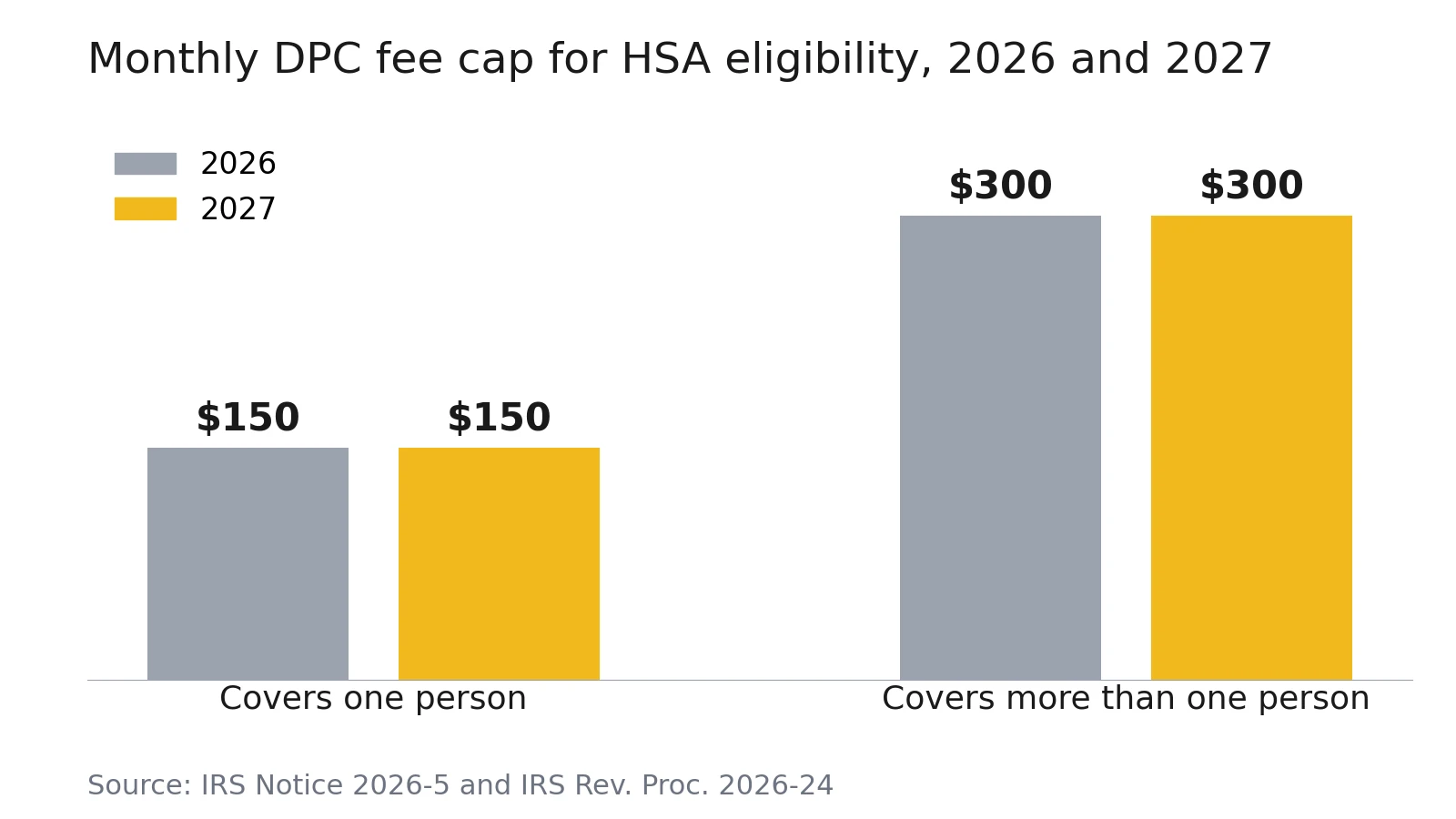
The cap is the same in 2027 as it was in 2026. Rev. Proc. 2026-24 states the 2027 figures directly.
For 2027, aggregate fees for all DPC arrangements covering one person can be no more than 150 dollars per month.
If the person is covered by a DPC arrangement that covers more than one individual, the 2027 limit is 300 dollars per month.
How the cap is indexed
The law set the starting amounts for 2026 and says they are adjusted for inflation for months beginning after December 31, 2026. The IRS publishes the adjusted figures each year alongside the other HSA numbers. For 2027 the published amounts did not move, so you can plan your 2027 pricing around the same limits you used this year and check the next revenue procedure (usually released in the spring) before setting 2028 prices.
The cap is per person and counts every membership together
Two details in the wording matter. First, the limit applies to "aggregate fees for all DPCSAs" for an individual, so someone with two separate DPC memberships has to add them together. Second, the higher limit is tied to whether the arrangement covers more than one person, not to whether the person has family HDHP coverage. A household membership that covers a parent and a child is measured against the higher figure.
Annual and quarterly billing are allowed
Notice 2026-5 (Q-13) says fees can be billed for periods longer than a month, up to a year, as long as they are fixed, periodic and within the monthly limit on an annualized basis. The IRS gives its own 2026 example for a single person.
That example is 1,800 dollars for a year, 900 dollars for six months or 450 dollars for three months.
What Qualifies vs What Doesn't
The law defines a qualifying arrangement narrowly. It has to provide medical care "consisting solely of primary care services provided by primary care practitioners," and "the sole compensation for such care is a fixed periodic fee." Primary care practitioners are physicians with a primary specialty in family medicine, internal medicine, geriatric medicine or pediatric medicine, plus nurse practitioners, clinical nurse specialists and physician assistants.
The law then excludes three things from "primary care services," and Notice 2026-5 adds several clarifications in its questions and answers. Here is how it sorts out.
| Feature of the membership | Qualifies? | Where it comes from |
|---|---|---|
| Single fixed monthly, quarterly or annual fee within the cap | Yes | Law, Notice 2026-5 Q-13 |
| Fee over the monthly cap (all memberships added together) | No for HSA contributions, though the HSA can still pay the fee | Notice 2026-5 Q-20 |
| Care from family, internal, geriatric or pediatric physicians, NPs, CNSs or PAs | Yes | Law, SSA 1833(x)(2)(A) |
| Vaccines included in the membership | Yes | Law, Notice 2026-5 |
| Prescription drugs (other than vaccines) included in the membership | No | Law, Notice 2026-5 Q-17 |
| Procedures that require general anesthesia | No | Law, Notice 2026-5 Q-17 |
| Lab services typically done in an ambulatory primary care setting | Yes | Law |
| Lab services not typically done in an ambulatory primary care setting | No | Law, Notice 2026-5 Q-17 |
| Members billed separately (to insurance or out of pocket) for care that comes with membership | No | Notice 2026-5 Q-11 |
| Separately billed services sold to members and non-members alike, outside the membership | Yes, the membership can still qualify | Notice 2026-5 Q-12 |
| Non-primary services in the membership that a patient simply never uses | No, the terms of the arrangement decide, not usage | Notice 2026-5 Q-14 |
Q-17 also clarifies that "primary care services" is not limited to the Medicare billing code list in section 1833(x)(2)(B). The test is the plain statutory definition minus the three exclusions.
For Patients on an HDHP
If you have a high deductible health plan and a DPC membership that qualifies, you can keep contributing to your HSA and pay the membership from it. For reference, the 2027 HSA contribution limits in Rev. Proc. 2026-24 are below.
For 2027 you can contribute up to 4,500 dollars with self-only HDHP coverage and up to 9,000 dollars with family coverage, compared with 4,400 dollars and 8,750 dollars for 2026 under Rev. Proc. 2025-19.
A few rules from Notice 2026-5 are worth knowing before you plan around them:
- Membership fees don't count toward your deductible. The notice (Q-16) says DPC fees are not out-of-pocket payments for HDHP-covered services, so they do not count toward your plan's deductible or out-of-pocket maximum.
- Your HDHP can't pay for the membership before the deductible. The notice (Q-15) says the new rule protects your eligibility, but it does not let the insurance plan itself cover DPC membership fees before the deductible is met.
- You can reimburse yourself when you pay up front. The notice (Q-19) lets an HSA treat the fee as incurred on the first day of each covered month, the first day of the coverage period, or the date you paid. A January membership paid in December can be reimbursed right away.
- A membership over the cap still has a use for your HSA. You can pay it with HSA money already saved, but you cannot make new contributions for the months you are enrolled (Q-20).
- Keep the paperwork. HSA reimbursements need substantiation, so save the invoice or statement that shows the dates covered, who is covered and the amount paid.
Bronze and catastrophic marketplace plans now count as HDHPs
The same law (section 71307) made a second change that matters for DPC patients who buy their own insurance. Starting with months after December 31, 2025, bronze and catastrophic plans available as individual coverage through an ACA Exchange are treated as HDHPs even if their deductible or out-of-pocket maximum would not otherwise qualify.
Notice 2026-5 adds that an identical bronze or catastrophic plan bought off-Exchange also counts (Q-6), and that using an individual coverage HRA to buy one does not change that (Q-5). Small-employer SHOP bronze plans generally do not count unless they meet the regular HDHP rules (Q-8). For many self-employed people and young adults, a bronze or catastrophic plan, an HSA and a qualifying DPC membership now fit together as one plan.
If your employer pays for the membership
Employer-sponsored DPC works too, as long as the arrangement qualifies and stays under the cap. The catch is in Q-18 of the notice. If your employer pays the fee, including through pre-tax salary reduction in a section 125 cafeteria plan, you cannot also reimburse that fee from your HSA, because it was never your own expense.
For DPC Practice Owners
Most DPC practices already run on a flat membership, so the core model fits the law well. The work is mostly in the fine print of your agreement, your price sheet and the statements you send. If you are still planning a launch, our 2027 guide to starting a DPC practice covers the rest of the setup.
Review your membership agreement wording
Because Q-14 says the terms of the arrangement decide whether it qualifies, the agreement itself carries the weight. It is worth reading yours with a health law attorney or CPA and checking a few points:
- The membership fee is described as the sole compensation for the care it includes.
- Care included in the membership is primary care from qualifying practitioners.
- Prescription drugs (other than vaccines), procedures needing general anesthesia and labs not typically run in an ambulatory primary care setting are outside the membership.
- Anything you sell separately, such as at-cost medications or send-out labs, is offered outside the membership on the same terms to members and non-members, which is the setup Q-12 allows.
Many practices offer wholesale medications and discounted labs as a selling point. Those can still be offered, but they should sit outside the membership terms rather than being bundled into the fee, and it is worth confirming the structure with your advisor.
Price under the cap, or be clear when you aren't
The cap is per person per month across all memberships, so the cleanest tiers are ones where a single adult membership and a household membership each sit at or below the limits. Our guide on how much to charge for a DPC membership walks through tier design, and DPC break-even panel size shows how price and panel size trade off.
If one of your tiers sits above the cap, it is still a valid membership. It just won't keep members HSA eligible, so say that plainly on your pricing page rather than leaving patients to discover it at tax time. Enrollment fees, visit fees for members and per-service charges for included care are worth a careful look too, since the fee has to be fixed and periodic and the membership has to be the sole compensation.
Give patients the statement their HSA administrator will ask for
Patients will be asked to substantiate HSA withdrawals, so make that easy. A good membership statement shows the practice name, the member or members covered, the coverage period, the amount paid and the date paid, and notes that the fee is for a direct primary care service arrangement. Annual and quarterly prepayments are allowed under Q-13, so the statement should show the period the payment covers.
Employer plans
If you sell to employers, remind them that a qualifying arrangement under the cap keeps their HDHP employees HSA eligible, and that the employer-paid fee cannot be double-dipped through the employee's HSA. Employers also cannot have the HDHP itself pay DPC fees before the deductible (Q-15), so the membership has to be paid outside the insurance plan. State rules still apply on top of all this, so check direct primary care laws by state for your market.
Keep the paperwork moving
Most of what this rule asks of a practice is consistent follow-through, the kind that lives between your billing tool, your EHR and your inbox. Sending the right statement when a patient asks, flagging a household that has crossed into a higher tier, or answering the same HSA question in a consistent way are small tasks that slip when the tools don't talk to each other. Tabflows is a dedicated tech team that connects the tools a clinic already uses so those follow-ups, tasks and patient context end up in one place, which helps when HSA questions spike each January.
What Is Still Unsettled
Notice 2026-5 asked for public comments by March 6, 2026, and the IRS said it may issue more guidance. Questions that practices still raise include exactly which in-office labs count as "typically administered in an ambulatory primary care setting" and how mixed arrangements should be documented. If you depend on HSA-eligible members, check the IRS newsroom and your advisor before each plan year, and look for the 2028 figures in next year's HSA revenue procedure.
Related Reading
- How to start a DPC practice in 2027
- How much to charge for a DPC membership
- Direct primary care laws by state
- Converting your practice to direct primary care
- DPC vs concierge medicine
- Find a DPC practice near you
This article summarizes Public Law 119-21, IRS Notice 2026-5 and IRS Rev. Proc. 2026-24 as of October 29, 2026. It is general information, not tax or legal advice. Talk to a CPA or tax advisor about your own HSA, and to a health law attorney about your membership agreement.
FAQs
Can I use my HSA for direct primary care in 2027?
Yes. Under section 71308 of Public Law 119-21 (the One Big Beautiful Bill Act), a qualifying direct primary care service arrangement is not treated as a health plan for HSA eligibility, starting with months after December 31, 2025. If your DPC membership qualifies and its fees stay at or under 150 dollars a month for one person or 300 dollars a month for a membership covering more than one person in 2027, you can keep contributing to your HSA. You can pay a qualifying membership's fee from your HSA tax free even above that cap, though enrollment in a membership over the cap stops new contributions.
What is the DPC fee limit for HSA eligibility in 2027?
IRS Rev. Proc. 2026-24 sets the 2027 limit at 150 dollars a month in aggregate DPC fees for an individual, or 300 dollars a month if the individual is covered by a DPC arrangement that covers more than one person. Those are the same figures as 2026. The limit counts all of a person's DPC arrangements together, not each one separately.
What if my DPC membership costs more than 150 dollars a month?
According to IRS Notice 2026-5, a DPC arrangement over the monthly cap can still be paid or reimbursed from an HSA as a medical expense, but being enrolled in it makes you ineligible to make new HSA contributions for those months. Money already in the account can still be spent on the fee.
Does a DPC practice that bills insurance or charges extra fees still qualify?
Not if members are billed separately for care that comes with the membership. IRS Notice 2026-5 says the fixed periodic fee must be the sole compensation for care under the arrangement. A practice can still sell separately billed services to members and non-members alike outside the membership, as long as those services are not conditioned on membership.
Can an employer pay for DPC and the employee use their HSA too?
An employee can be enrolled in a qualifying DPC arrangement the employer pays for and still be HSA eligible if the cap is met. But IRS Notice 2026-5 says DPC fees paid by the employer, including through a section 125 cafeteria plan salary reduction, cannot also be reimbursed from the employee's HSA, because they were not the employee's own expense.
Can a bronze or catastrophic marketplace plan be paired with DPC and an HSA?
Yes. The same law treats bronze and catastrophic plans available as individual coverage through an ACA Exchange as high deductible health plans for months beginning after December 31, 2025, so people on those plans can open and fund an HSA. Pairing one with a qualifying DPC membership under the cap keeps them HSA eligible.
Do DPC membership fees count toward my HDHP deductible?
No. IRS Notice 2026-5 says DPC membership fees are not out-of-pocket payments for services covered by the HDHP, so they do not count toward the plan's deductible or out-of-pocket maximum.