Can a DPC Practice Bill Insurance and Charge a Membership?
Yes, a direct primary care practice can bill insurance and charge a membership, and practices that do both are known as hybrid practices. The rule Medicare and Medicaid share, and that some payers' own policies repeat, is that the membership cannot be a second payment for services insurance or Medicare already pays for. Medicare, Medicaid, your commercial payer contracts, your state's DPC law and the new HSA rules each draw that line in their own way, and a hybrid practice has to satisfy all of them at once.

Hybrid setups come up when a doctor is converting an existing practice to direct primary care and wants to keep insured patients during the move, or when a new DPC wants to serve patients on Medicare without the doctor opting out. This guide walks through each payer and rule in turn, starting with Medicare, with the regulation or statute linked at every step.
This is general information, not legal or tax advice. A health care attorney should read your membership agreement and your payer contracts before you launch a hybrid model, and a CPA can confirm how it affects your patients' HSAs.
What Counts as a Hybrid DPC Practice?
"Hybrid" is not a legal term, and no federal rule defines it. In practice it describes three different setups, and the rules apply differently to each one.
| Setup | What the membership pays for | Where the risk sits |
|---|---|---|
| Split panel | Some patients are members paying cash, others are seen through insurance and pay no membership | Payer contracts and state law may not allow a clinician to treat the same kind of patient two ways |
| Membership for extras, insurance for visits | The fee buys things insurance does not cover, while office visits are billed to the patient's plan | The fee must not overlap with covered services, and the membership may not keep patients HSA eligible (see the HSA section below) |
| Membership plus billing for the same care | Members pay a fee and the practice also bills their insurance for the care the fee includes | Highest risk, because the patient pays twice for covered care |
The definition the DPC Alliance used for its State of Direct Primary Care report is a primary care practice that, at least in part, charges a fixed periodic fee and does not bill insurance for clinical services rendered. The words "at least in part" leave room for hybrid models, including the physicians the report counts who still bill Medicare.
If you are still deciding between models, our comparison of DPC vs concierge medicine covers the version where a membership sits on top of insurance billing, which is the concierge model.
How Many DPC Doctors Run a Hybrid Model?
The closest figures are in the AAFP's 2026 DPC data brief, from a survey about 2025. Of the 167 respondents practicing in DPC (313 respondents overall, a 9.3% response rate), 71% reported pure DPC as their practice type, down from 90% in 2022 and 84% in 2024, and 9% still incorporated some fee-for-service insurance billing. The brief doesn't say which payers that billing goes to. The DPC Alliance survey reports Medicare status. In that survey (465 responses collected between October 8 and November 7, 2024, published July 2026), 80.7% of physicians had opted out of Medicare, 15.5% reported being "opted in" but not seeing Medicare patients, and 3.9% reported being opted in and billing Medicare for eligible patients.
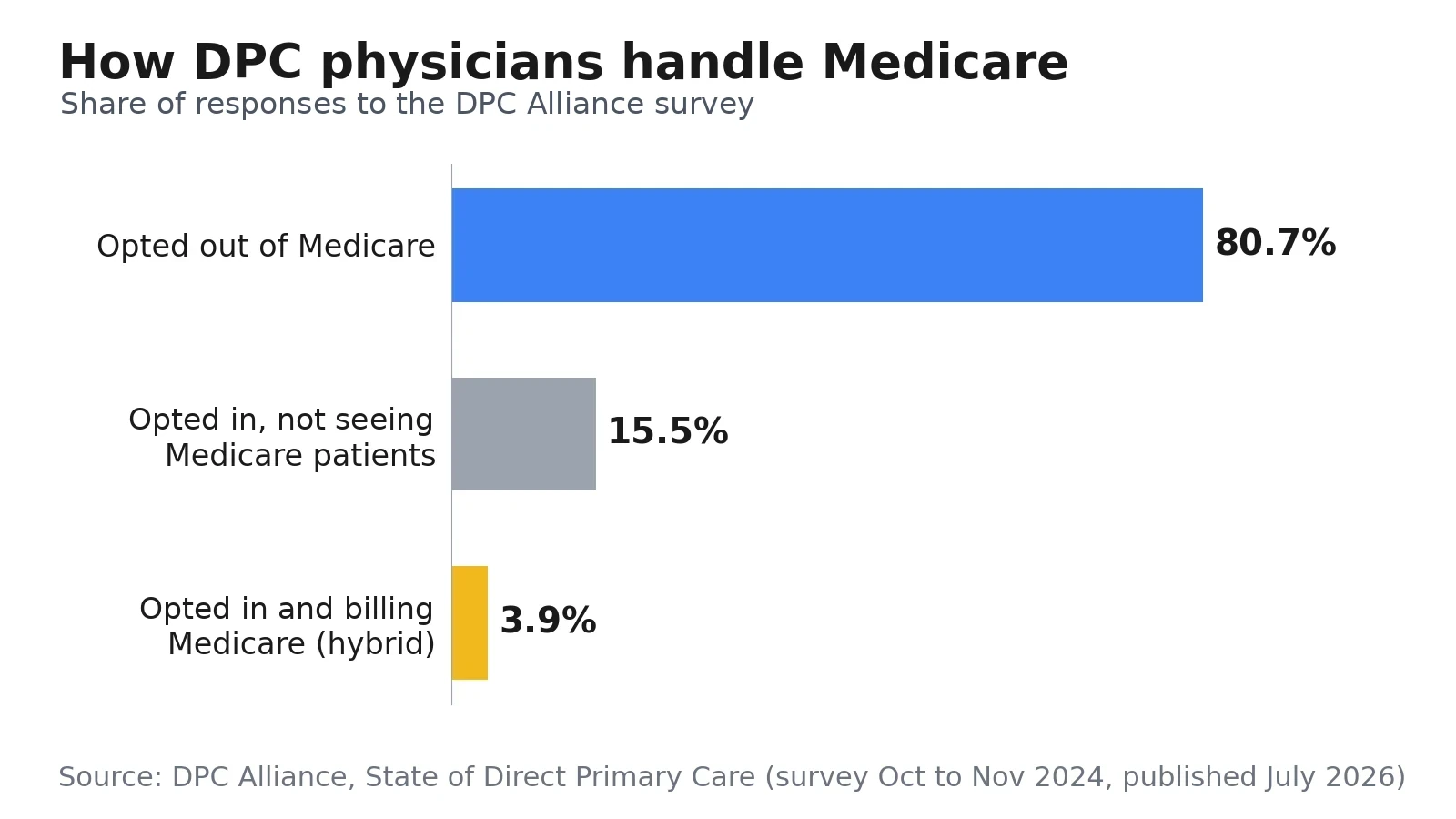
The report calls the 3.9% group hybrid and gives one reason doctors land there, moonlighting while building a panel. CMS says opt-out applies to everything a physician furnishes to Medicare patients, wherever it is furnished, so a physician whose side job bills Medicare for their services can't opt out without ending that billing. They have to choose between leaving Medicare patients out of the DPC or running a hybrid model. If that describes your first year, our guide on how to opt out of Medicare for DPC covers the opt-out timing, and our guide to leaving employed medicine for DPC walks through the move from an employed job.
Medicare Rules for a Hybrid DPC Practice
Medicare has the most detailed rules a hybrid model has to follow, because they are federal, written out in regulation and enforced with penalties. Your options depend on which of three Medicare statuses each clinician holds. A clinician who has never enrolled and hasn't opted out holds none of them, and CMS says physicians and practitioners who see Medicare patients but don't want to enroll must opt out.
If you are a participating Medicare provider
A participating provider accepts Medicare's approved amount as payment in full for covered services. In March 2004 the HHS Office of Inspector General issued an alert on added charges for covered services that still frames this question. It says participating providers can charge Medicare patients extra for items and services Medicare does not cover, and can collect deductibles and coinsurance, but that requesting any other payment for covered services exposes them to substantial penalties and exclusion from federal health programs.
The alert describes a case where a physician sold an annual contract that he described as covering non-covered services. OIG alleged that, on the specific facts of that case, at least some of what the contract offered was already covered by Medicare. The contract's services included care coordination, a comprehensive assessment and extra time with patients, and the physician settled. The lesson for a hybrid membership is that the label on the service does not decide the question. What matters is whether Medicare already pays for it.
If you are enrolled but nonparticipating
A nonparticipating physician can choose claim by claim whether to accept assignment (nurse practitioners, clinical nurse specialists and physician assistants must always accept it), but the protection for patients does not go away. Under 42 CFR 414.48, a nonparticipating supplier who does not accept assignment may charge up to the limiting charge, which is 115 percent of the fee schedule amount for nonparticipating suppliers. The same OIG alert notes that nonparticipating providers may also face penalties and exclusion for overcharging Medicare patients for covered services, whether or not they accept assignment.
If you opt out
Opting out is the route 80.7% of the physicians in the DPC Alliance survey took, and it ends the hybrid question for Medicare entirely. Under 42 CFR 405.425, an opted-out physician or practitioner may not submit claims to Medicare except for emergency or urgent care under section 405.440, and may furnish Medicare-covered services to Medicare patients only through a private contract. No payment may be made by Medicare or by any Medicare Advantage plan to them during the opt-out period, and 42 CFR 422.220 repeats that from the plan's side, with exceptions for emergency or urgently needed services and for supplemental benefits.
That means you cannot opt out for your members and keep billing Medicare for everyone else. Opt-out belongs to the clinician, so a practice with two physicians can have one opted out and one enrolled, but each person is all in or all out. An opted-out physician can still order labs, prescribe and refer for Medicare patients under 405.425(i), as long as they have not been excluded or had their Medicare enrollment revoked, and are not paid, directly or indirectly, for what they order, prescribe or refer, except as 42 CFR 405.440 allows. The step-by-step process, including the affidavit and private contract, is in our guide on how to opt out of Medicare for DPC.
When the switch takes effect
Timing matters if you are moving from hybrid to full DPC. Under 42 CFR 405.410, a nonparticipating physician can opt out at any time, with the opt-out starting on the date the affidavit is signed if it is filed within 10 days after the first private contract. A participating physician can opt out only at the beginning of a calendar quarter, with the affidavit submitted at least 30 days before that quarter starts, and any private contract signed earlier takes effect on the first day of the quarter. Plan your membership launch date around that quarter if you are participating today.
For your Medicare-age patients, our guide to direct primary care for seniors on Medicare explains what the private contract means from their side.
Can You Charge Members for Services Their Insurance Already Covers?
Outside Medicare, the answer comes from two places, which are your Medicaid program if you take Medicaid and the contracts you signed with each commercial payer.
Medicaid
Federal Medicaid rules are short on this point. Under 42 CFR 447.15, a state Medicaid program must limit participation to providers who accept, as payment in full, the amount the Medicaid agency pays plus any deductible, coinsurance or copayment the plan requires. A membership fee charged to a Medicaid patient for services Medicaid covers would be a payment on top of that. States run their own Medicaid programs and managed care contracts, so how a membership for non-covered services fits is a question for your state Medicaid agency and your attorney.

What Your Commercial Payer Contracts Say
Commercial participation agreements are private contracts, and each payer writes its own, so we can't tell you what yours says. Some payers also publish their rules. One national insurer's provider manual, in its June 2026 edition, says participating providers can't charge a member a fee to join or remain in the practice, and must tell the insurer's network manager in advance before charging concierge fees. A regional plan's payment policy says network providers may not apply retainer or access fees toward services covered under the member's contract. Before you charge any patient on a commercial plan a membership, have your attorney read every participation agreement you hold, and each payer's provider manual and payment policies, for these terms:
- Payment in full and hold-harmless language, which limits what you may collect from the plan's members beyond their cost sharing for covered services.
- Charges for non-covered services, including any notice or written consent the contract requires before you bill a member for them.
- Rules on access fees or retainers, if the contract addresses charging members to join your panel or to get access to you.
- Termination and notice periods, which decide how fast you can leave the network if you move a patient group to membership only.
If neither the contract nor the payer's manual and policies address it, ask the payer in writing and keep the answer with the contract.
How State DPC Laws Treat Billing Insurance
State DPC laws declare that a membership agreement meeting the statute's definition is not insurance, and a state's law may also bar a direct practice from billing an insurer for services its membership covers, as Washington's does. The rules differ by state, so treat any one state as an example, not a template.
Washington is a clear example. Its RCW 48.150.040 says a direct practice may not submit a claim to a carrier for health care services provided to direct patients as covered by their agreement, and may not enter a participating provider contract to provide health care services through a direct agreement. The same section lets a direct practice hold a payer contract for other purposes, such as referrals, admitting patients and prescribing. In other words, Washington allows a practice to stay credentialed with a plan for those purposes while keeping the membership services off that plan's claims.
Your state may be stricter, looser or silent. Our guide to direct primary care laws by state links each statute, and the state pages at /start-a-dpc gather the rest of what you need to open in a given state. If your state is silent, the federal and contract rules above still apply in full.
Does a Hybrid Membership Keep Patients HSA Eligible?
Since January 1, 2026, a direct primary care membership that meets the federal definition no longer blocks a patient's HSA contributions. The definition is narrow. IRS Notice 2026-5 repeats the statute, which requires care consisting solely of primary care services from primary care practitioners, with a fixed periodic fee as the sole compensation for that care.
That one phrase, sole compensation, decides most hybrid questions. Notice 2026-5 answers two of them directly:
- Q-11. An arrangement that provides services on the condition that patients are members and have paid the fee, but bills separately for those services through insurance or otherwise, does not qualify.
- Q-12. An arrangement that otherwise qualifies still qualifies when its providers offer other services outside the membership to members and non-members alike and bill both groups separately for them, through insurance or otherwise.
Q-14 adds that whether an arrangement qualifies depends on its terms, not on the services a member uses. The IRS gave that answer for a membership that includes services beyond primary care, so a member cannot keep HSA eligibility by declining the extras. That matters for a hybrid membership built around extras, and a CPA should check your agreement against it.
The fee cap also applies, and IRS Rev. Proc. 2026-24 sets it for calendar year 2027. It counts all of a person's memberships together.
The cap is $150 a month in total membership fees for one person, or $300 a month for someone in a membership that covers more than one person.
Our full guide to DPC and HSA rules for 2027 covers the excluded services, annual billing and employer-paid memberships.
Hybrid DPC Rules at a Glance
| Payer or rule | What a hybrid practice can do | What it cannot do | Primary source |
|---|---|---|---|
| Medicare, participating | Charge for services Medicare does not cover, plus deductibles and coinsurance | Ask for any other payment for covered services | OIG alert, March 31, 2004 |
| Medicare, nonparticipating | Charge up to the limiting charge on unassigned claims | Overcharge for covered services | 42 CFR 414.48, OIG alert |
| Medicare, opted out | Charge Medicare patients under a private contract | Bill Medicare or a Medicare Advantage plan, except emergency or urgent care claims | 42 CFR 405.425, 422.220 |
| Medicaid | Follow your state's rules for non-covered services | Collect more than Medicaid's payment plus cost sharing for covered services | 42 CFR 447.15 |
| Commercial plans | Whatever your participation agreement and the payer's manual allow | Whatever they forbid, which only those documents can tell you | Your contracts and payer manuals |
| State DPC law | Depends on the state | In Washington, bill a carrier for services covered by the direct agreement | RCW 48.150.040 and your state's statute |
| HSA eligibility | Bill separately for services offered to members and non-members alike | Bill separately for services the membership includes | Notice 2026-5 Q-11, Q-12 |
How to Set Up a Hybrid Practice Without Tripping a Rule
A hybrid model works best when every service has one clear payer and your paperwork says so. These steps follow from the rules above:
- Decide each clinician's Medicare status first. Everything else follows from whether each person is participating, nonparticipating or opted out, and the participating route has a quarter-based start date.
- Write the membership around what insurance does not cover. If you stay enrolled, list the included services in the agreement and have your attorney check each one against what Medicare and your payers cover.
- Keep one payer per service. A visit is never both included in the membership and billed to insurance, and your agreement should say which services are which. For a Medicare patient, a clinician enrolled in Medicare has to submit the claim for a covered service, and a participating clinician can't ask for any other payment for it beyond deductibles and coinsurance. Medicaid providers accept Medicaid's payment plus cost sharing as payment in full, and some commercial contracts require claims for all covered services too.
- Read every payer contract and your state statute. Look for the payment-in-full, non-covered-service and access-fee terms listed above, and for any state rule on direct practices and carriers.
- Tell patients plainly about HSAs. If your model bills insurance for anything the membership includes, the membership will not keep members HSA eligible, and your pricing page should say so before they find out at tax time.
- Set a date to finish the move if hybrid is a bridge. If you are using hybrid as a step toward full DPC, a written end date keeps the two billing systems from running longer than you planned. Our DPC break-even panel size guide helps you pick that date from your own numbers.
If you will sell memberships to employers as well, our guide to selling direct primary care to employers covers how those contracts interact with their health plans, and DPC anti-kickback and Stark basics covers the referral rules that apply while you still bill federal programs.
Keeping Two Billing Worlds Straight
Once the rules are clear, the daily work in a hybrid practice is keeping track, patient by patient, of who is a member, which plan they carry, what was included and what was billed, when that information lives in an EHR, a claims system and a membership billing tool that were never built to talk to each other. A visit that gets coded as a claim for a member, or a renewal that goes out to a patient who moved to insurance only, is the kind of mistake that comes from systems that don't share information, not from anyone being careless.
Tabflows is a dedicated tech team that connects the tools a clinic already uses, so the follow-ups, tasks and patient context between your EHR, billing and messaging sit in one place. For a hybrid practice that can include flagging a failed membership payment before a visit. If you are still planning the whole practice, start with our pillar guide on how to start a DPC practice.
This article summarizes federal regulations, IRS guidance and one state statute as of November 6, 2026. It is general information, not legal or tax advice, and rules for Medicaid, commercial plans and state DPC laws vary. Talk to a health care attorney about your membership agreement and payer contracts, and to a CPA about HSA questions.
FAQs
Can a direct primary care practice bill insurance and also charge a membership fee?
Yes, but the membership cannot be a second payment for services Medicare or Medicaid already pays for. A practice that participates in Medicare can charge Medicare patients for items and services Medicare does not cover, and the HHS Office of Inspector General warned in 2004 that asking Medicare patients for any other payment for covered services, beyond deductibles and coinsurance, can bring civil money penalties and exclusion. Commercial payer contracts and state DPC laws add their own limits, so read your participation agreements and your state statute before you launch.
Can I opt out of Medicare for some patients and bill Medicare for others?
No. Opt-out applies to the clinician, not the patient. Under 42 CFR 405.425, an opted-out physician or practitioner cannot submit claims to Medicare (except for emergency or urgent care to a patient without a private contract) and can furnish Medicare-covered services to Medicare patients only through private contracts. A practice can still have one clinician opted out and another enrolled, because each clinician makes their own choice.
Can an opted-out DPC doctor be paid by a Medicare Advantage plan?
No. Under 42 CFR 405.425(a), no payment may be made by Medicare or by any Medicare Advantage plan to an opted-out physician or practitioner, except for the emergency and urgent care claims allowed by 42 CFR 405.440. 42 CFR 422.220 says the same from the plan's side, with exceptions for emergency or urgently needed services and for supplemental benefits.
Can a DPC practice that takes Medicaid charge Medicaid patients a membership?
Not for services Medicaid covers. Under 42 CFR 447.15, a state Medicaid program may only enroll providers who accept the Medicaid payment, plus any cost sharing the plan requires, as payment in full. How that applies to non-covered services and to your membership agreement depends on your state's Medicaid rules, so ask your state Medicaid agency or a health care attorney.
Does a hybrid DPC membership keep patients HSA eligible?
Only if the membership itself is the sole payment for the care it includes. IRS Notice 2026-5 (Q-11) says an arrangement that provides services on the condition of membership but bills separately for them, through insurance or otherwise, is not a direct primary care service arrangement for HSA purposes. Q-12 says a qualifying membership can sit beside services the practice offers to members and non-members alike and bills separately. The monthly fee cap in IRS Rev. Proc. 2026-24 also applies, and it counts all of a person's memberships together.
Do state DPC laws allow billing insurance?
It depends on the state. Washington's RCW 48.150.040, for example, says a direct practice may not submit a claim to a carrier for health care services provided to direct patients as covered by their agreement, and may not sign a participating provider contract to provide services through a direct agreement, though it may hold a payer contract for other purposes such as referrals and prescribing. Check your own state's statute through our guide to direct primary care laws by state.