What Goes in a DPC Business Plan?
A direct primary care business plan explains who you will serve, what the membership includes, what you will charge, how you will enroll members, what it costs to run and how long until the practice pays for itself. The core of it is a 24-month pro forma built from three assumptions (your blended monthly fee, members at opening and net new members per month), plus a funding request if you are borrowing. Below is a section-by-section template with the questions to answer and a short example paragraph for each, all written for a fictional practice so you can see the shape without copying anyone's numbers.

Every example describes one made-up practice, Example Family DPC. Its numbers are illustrations, not benchmarks, while the survey figures around it are real and linked.
If you are earlier than the planning stage, start with how to start a DPC practice, or with converting a practice to direct primary care if you already have one. The SBA's own guide to writing a business plan is a good general reference, and this template adapts that structure to the way a membership practice actually works.
The DPC Business Plan Template at a Glance
| Section | What it proves | Who reads it closely |
|---|---|---|
| Executive summary | The whole plan fits on one page | Every reader, lenders first |
| Model and services | What the fee buys and what costs extra | Lenders, partners, attorneys |
| Market analysis | Enough people in reach want this | Lenders, you |
| Competition | You know who else is nearby | Lenders |
| Pricing | Your fee is grounded in real data | Everyone |
| Marketing and enrollment | How members actually arrive | You, lenders |
| Operations and staffing | Who does what, and when you hire | You |
| Technology stack | The tools that run billing, charting and messaging | You |
| Legal and compliance | State law, Medicare and HSA rules are handled | Lenders, attorneys |
| Financial projections | The math works, month by month | Lenders first |
| Funding | How much you need and what it pays for | Lenders |
| Risks and mitigations | You have thought about what could go wrong | Lenders |
| Milestones | Dated targets you can be held to | You, lenders |
1. Executive Summary
Write this last, even though it sits first. In one page, say what the practice is, where it is, who it serves, what it charges, when it opens, how many members you expect by month 12 and month 24, when you expect to break even and how much funding you are asking for.
Questions to answer:
- What is the practice called, and where will patients see you (office, home visits, virtual)?
- Who is the core patient (families, small employers, uninsured adults, HSA holders)?
- What is your price, your opening member count and your 24-month target?
- How much are you raising or borrowing, and what is it for?
Example. Example Family DPC is a fictional one-physician direct primary care practice opening in a mid-sized town in spring 2027. It offers unlimited primary care visits, same-day or next-day appointments and direct messaging with the physician for a flat monthly membership, sold to individuals, families and local employers. The plan projects 282 members at month 12 and 462 at month 24, with operating break-even in month 7.
2. The Model and Services (and What Sits Outside the Membership)
Describe exactly what the membership includes, what costs extra and how members pay. This section matters more in 2027 than it used to, because the HSA rules now shape what can be inside the fee.
Starting January 1, 2026, Public Law 119-21 lets people with HSAs join a qualifying DPC arrangement without losing HSA eligibility. Under the law and IRS Notice 2026-5, prescription drugs other than vaccines, procedures that need general anesthesia and labs not typically run in an ambulatory primary care setting have to sit outside the membership. The full detail lives in our guide to DPC and HSA rules for 2027, and the dispensing side is covered in DPC dispensing, medications and labs.
Questions to answer:
- What is included without a visit fee (visits, messaging, basic in-office tests, care coordination)?
- What do you sell at cost or at a published price (medications, outside labs, imaging, procedures)?
- Do you sell to employers, and if so, is it the same membership or a separate contract?
- Is this a pure DPC or a hybrid that still bills insurance for some patients? (Our DPC vs concierge medicine guide helps you name the model.)
Example. The example practice's membership covers unlimited office and virtual visits, messaging with the physician, chronic disease management and basic in-office point-of-care tests. Medications are dispensed at a published cost-plus price, and outside lab panels are billed at the practice's negotiated cash rates, both outside the monthly fee so the membership stays HSA-compatible. Employer memberships use the same clinical services with a separate group agreement.
3. Market Analysis
This is where you show that enough people within driving distance would plausibly join. Lenders do not expect a perfect forecast, but they want to see that you looked.
Useful tools and sources for this section:
- Census QuickFacts for your county or city, which gives population, age mix, median household income and the share of people under 65 without health insurance.
- The Tabflows DPC Finder, a directory of DPC practices, to see who already operates near you.
- Our DPC market density by state analysis, which ranks states by DPC practices per resident so you can see whether your state is crowded or wide open.
- Local employer lists from your chamber of commerce, since employers can bring dozens of members at once.
Questions to answer:
- How many adults live within a 20 to 30 minute drive, and how many are uninsured, on high-deductible plans or self-employed?
- How many small and mid-sized employers are nearby?
- How many DPC practices already serve the area, and how full are they?
Example. The example practice's service area is a fictional county of roughly 90,000 residents with a large share of self-employed tradespeople and small employers. The plan's target is to reach about one half of one percent of residents within two years, which is the 462 members shown in the pro forma. The founder lists five local employers she has already spoken with and the two nearest DPC practices, both more than 40 minutes away.
4. Competition
Name your real alternatives, which include more than other DPC clinics. Patients compare you to urgent care, retail clinics, telehealth subscriptions, the hospital-owned primary care group and doing nothing at all.
Questions to answer:
- Who else offers primary care within 30 minutes, and how long is their wait for a new patient?
- Which nearby DPC or concierge practices exist, and what do they charge?
- Why would someone pick you (access, continuity, price transparency, home visits, a language you speak)?
Example. The closest primary care group in the example practice's fictional county has a new-patient wait of about two months, and the local urgent care does not provide ongoing care. The example practice's advantage is next-day access and one physician who knows each member, which the plan supports with a simple comparison table for employers.
5. Pricing
Ground your price in published data, then explain why yours sits where it does.
The DPC Alliance State of DPC report (July 2026) puts the average DPC fee at about $99 a month.
Hint's Trends in DPC 2026 report found that nearly 60% of memberships are employer-paid, and that employer-paid memberships carry a lower median fee than retail ones. If you expect employer contracts, your blended average will sit below your retail price, and your pro forma should use the blended number.
Hint's 2025 medians were $99 for retail memberships and $65 for employer-paid ones.
The HSA fee cap is a ceiling worth noting too. IRS Rev. Proc. 2026-24 keeps the 2027 cap at 150 dollars a month for one person and 300 dollars for a membership covering more than one person.
Questions to answer:
- What are your individual, family and employer prices, and do you band by age?
- What blended average fee will you use in the pro forma, and why?
- Is there an enrollment fee, and how will you handle price increases later?
For a full walkthrough, see how much to charge for a DPC membership.
Example. The example practice plans adult memberships near the national average, lower prices for children on a family plan and an employer rate in line with Hint's employer median. Because the founder expects roughly a third of members through employers, the pro forma uses a blended fee a little below retail.
The example's blended fee is $90 per member per month.
6. Marketing and Enrollment Plan
Your pro forma lives or dies on enrollment, so this section should read like a schedule, not a wish. Explain where your first members come from, how many you expect at opening and what you will do each month after that.
Questions to answer:
- Are patients following you from a previous practice, and can you contact them legally and ethically?
- How many people are on a pre-launch waitlist, and how did they get there?
- Which channels will you use (website, Google Business Profile, DPC directories, community talks, employers)?
- What is your realistic net new members per month after cancellations?
The first 100 members playbook and our guide to how patients find a DPC in 2027 both go deeper here, and selling DPC to employers covers the group side.
Example. The example practice opens with 40 members from a pre-launch waitlist built through a simple website, a listing on DPC directories and three talks at local businesses. The plan assumes 22 net new members a month in year one and 15 a month in year two as word of mouth replaces launch activity, which keeps the practice at month 24 under the average panel of 504 that the AAFP reports across all its survey respondents, 53% of them practicing in DPC.
7. Operations and Staffing
Describe how a normal day runs, who handles each job and when you will hire.
Questions to answer:
- What are your hours, and how do members reach you after hours?
- Who answers the phone, schedules, handles refills and follows up on labs?
- At what member count do you add a medical assistant, a second staff member or a second clinician?
Example. The example practice opens with the physician and one full-time medical assistant who handles scheduling, intake, refills and lab follow-up. The plan adds a part-time front desk role and expanded hours in month 13, when the panel passes about 280 members.
8. Technology Stack
List the tools for membership billing, the EHR, patient messaging and scheduling, with monthly costs. Keep it short, since lenders mainly want to know the cost is budgeted. Our guide to the best DPC software for 2027 compares the common options with prices checked on each vendor's site.
Questions to answer:
- Which tool handles recurring membership billing, and does it support employer groups?
- Which EHR, which messaging and phone system and which scheduling tool?
- How will information move between them so refills, lab results and follow-ups do not get lost?
Example. The example practice uses one DPC platform for membership billing and charting, a separate messaging and phone service and the platform's built-in scheduling. Software and payment processing are folded into the monthly overhead line of the pro forma.
9. Legal and Compliance
Show that the practice is set up correctly for your state and for federal programs. This section is short in the plan but it carries real weight, so name your attorney if you have one.
Questions to answer:
- Does your state have a DPC statute that says membership medicine is not insurance? Check direct primary care laws by state.
- Will you see Medicare patients, and will you opt out? Under 42 CFR 405.445, opt-out runs in two-year periods that renew automatically.
- Is your membership designed to meet the HSA rules, with excluded services priced separately?
- What entity type, malpractice coverage and business insurance will you carry? (See insurance for a new DPC practice.)
- If a nurse practitioner is opening the practice, what are the state's scope and supervision rules? (See can nurse practitioners open a DPC.)
Example. The example practice operates as a professional corporation in a fictional state with a DPC statute. The physician opts out of Medicare and uses private contracts with Medicare-age members, and the membership agreement was reviewed by a health care attorney to keep excluded services outside the monthly fee.
10. Financial Projections and the DPC Pro Forma
This is the section lenders read hardest. It covers three things, your startup costs, a break-even calculation and a 24-month pro forma. For realistic startup ranges, see how much it costs to start a DPC, and for the break-even method in more depth, see DPC break-even panel size.
Example assumptions (fictional practice)
State every assumption in plain words so anyone can rebuild the pro forma. These are the example practice's, and they are examples only:
- A blended membership fee per member per month, set a little below retail.
- 40 members at opening, then 22 net new members a month in months 2 to 12 and 15 a month in months 13 to 24.
- Fixed overhead for rent, one medical assistant, software, malpractice, utilities and supplies, rising from month 13 when a part-time staff member is added.
- A variable cost per member per month for point-of-care tests, supplies and payment processing.
- Owner pay is not included. The net line is what is left to pay the physician and repay debt.
In dollars, the blended fee is $90 per member per month, fixed overhead is $14,000 a month in year one and $18,000 from month 13, and the variable cost is $8 per member per month.
Formulas
- Members in month m (year one) = 40 + 22 × (m − 1). From month 13, members = 282 + 15 × (m − 12).
- Revenue = members × 90.
- Fixed overhead = 14,000 in months 1 to 12, then 18,000 from month 13.
- Expenses = fixed overhead + (members × 8).
- Net = revenue − expenses.
- Break-even members = fixed overhead ÷ (90 − 8), which is 14,000 ÷ 82, or about 171 members, reached in month 7 with 172.
Example 24-month pro forma
| Month | Members | Revenue | Expenses | Net |
|---|---|---|---|---|
| 1 | 40 | $3,600 | $14,320 | −$10,720 |
| 3 | 84 | $7,560 | $14,672 | −$7,112 |
| 6 | 150 | $13,500 | $15,200 | −$1,700 |
| 12 | 282 | $25,380 | $16,256 | $9,124 |
| 18 | 372 | $33,480 | $20,976 | $12,504 |
| 24 | 462 | $41,580 | $21,696 | $19,884 |
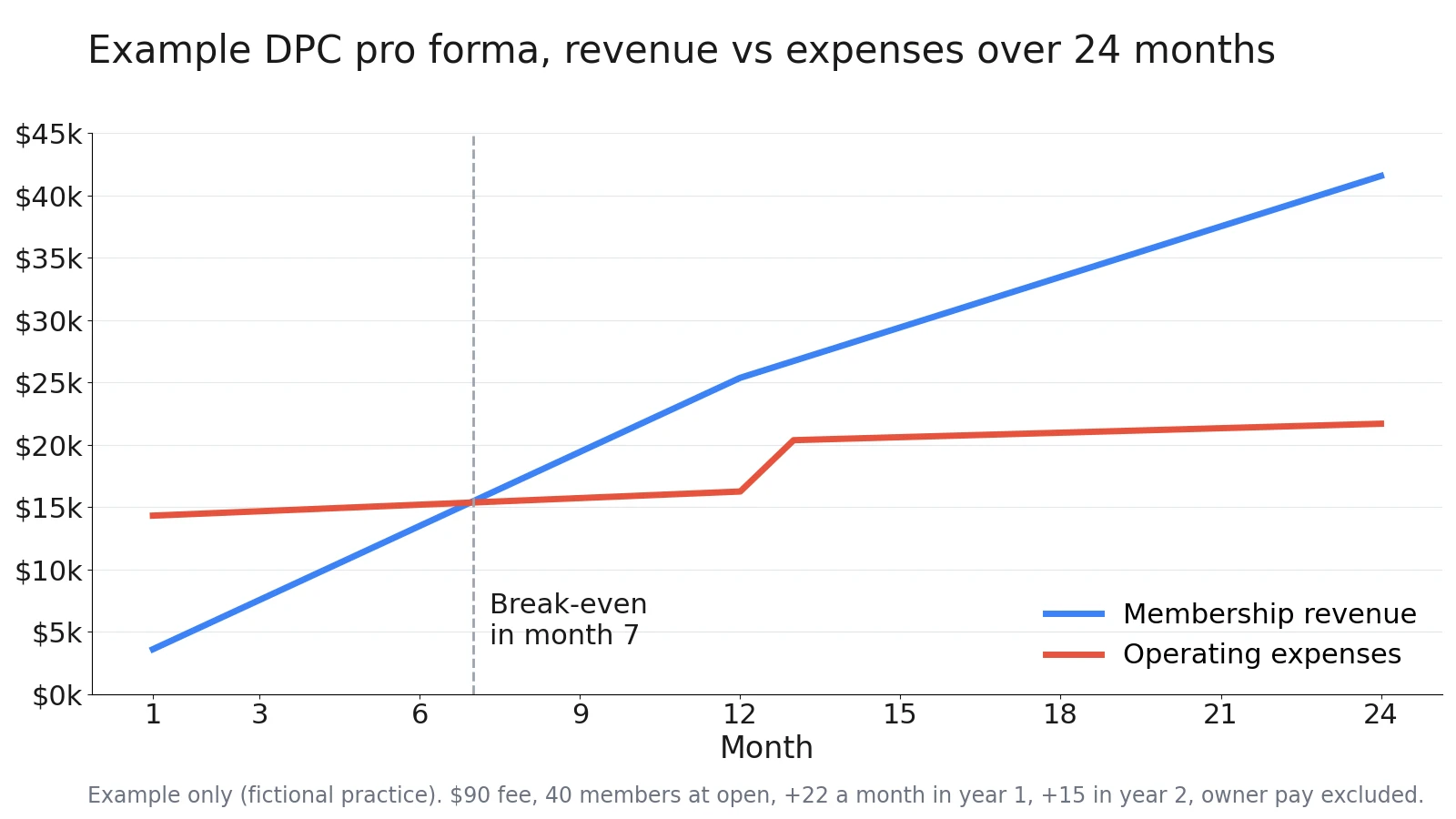
Add up the losses for months 1 through 6 and you have the minimum working capital the plan needs to reach break-even, before any owner pay.
In the example, the combined loss for months 1 to 6 is $37,260.
Your real plan should show all 24 months, and lenders will usually want a spreadsheet version they can check. Add a second scenario with slower enrollment (for example, 15 net new members a month in year one) so the reader can see what happens if growth is slower than hoped.
11. Funding
Say how much you need, where it comes from and exactly what it pays for. A use-of-funds table makes this easy to read.
For borrowed money, many DPC founders look at SBA-backed loans. According to SBA.gov, the 7(a) loan program is the SBA's main program for small businesses and its maximum loan amount is 5 million dollars. SBA loans are made by participating lenders, so the lender sets the rate, collateral and approval terms within SBA rules.
For smaller launches, the SBA microloan program offers loans of up to 50,000 dollars through nonprofit intermediary lenders. SBA.gov says the average microloan is about 13,000 dollars and the maximum repayment term is seven years, with interest rates set by the intermediary.
Questions to answer:
- What is the total you need, including startup costs and working capital?
- How much comes from your own savings, and how much from a loan or investors?
- How many months of personal living expenses do you have, given that owner pay starts later?
Example. The example practice needs one-time startup costs plus a working capital reserve that covers the month 1 to 6 losses with some cushion. The founder covers the startup costs from savings and applies for an SBA microloan for the reserve, and separately holds six months of household expenses because the pro forma pays no owner salary until the practice is cash positive.
In the example, startup costs are $27,000 and the working capital reserve is $40,000, for a total of $67,000. The founder puts in $27,000 and borrows $40,000 through an SBA microloan intermediary.
12. Risks and Mitigations
Every lender knows a new practice carries risk. Naming the risks yourself, with a plan for each, reads as competence rather than weakness.
| Risk | What it would do | Mitigation |
|---|---|---|
| Slower enrollment | Pushes break-even later and uses up working capital | Slow-growth scenario in the pro forma, a larger reserve, employer outreach from month 1 |
| An employer contract ends | Removes many members at once | No single employer above a set share of the panel, 60 to 90 day notice terms |
| Physician illness or burnout | Access promise breaks | Panel cap, coverage agreement with a nearby physician, protected time off |
| Rule changes (state law, HSA, Medicare) | Membership terms need rewriting | Annual attorney review, membership agreement that allows updates with notice |
| Tools that do not talk to each other | Missed refills, lost lab follow-ups, staff time drain | Choose a connected stack early and assign each handoff an owner |
Example. The example practice's biggest named risk is slower enrollment, so the plan keeps a reserve above the six-month loss and caps any one employer at a fifth of the panel.
13. Milestones
End with dated, checkable milestones. They give you a scoreboard and give a lender something concrete to watch.
Questions to answer:
- When do you sign the lease, file the entity, file any Medicare opt-out and open enrollment?
- What member counts do you expect at months 3, 6, 12, 18 and 24?
- When does owner pay start, and when do you add staff or a second clinician?
Example. The example practice's milestones are entity and bank account in January 2027, lease and Medicare opt-out filing in February, waitlist of 40 by opening day in April, break-even in month 7, part-time staff in month 13 and a full owner salary once monthly net covers it in year two. The DPC 90-day launch plan is a useful companion for the months right before opening.
Making the Plan Real After Opening
Check the plan monthly against what actually happens. Comparing members, revenue, expenses and net to the pro forma tells you early whether to adjust marketing, hiring or price.
The harder part is usually the work between your tools, such as a lab result that arrives in the EHR, needs a message to the member and a refill in the pharmacy system, and depends on someone remembering. If that is where your time goes, Tabflows is a dedicated tech team that connects the tools your clinic already uses (EHR, billing, messaging) so follow-ups, tasks and patient context live in one place and those handoffs get finished.
FAQs
What should a direct primary care business plan include?
A DPC business plan should include an executive summary, your model and services (including what sits outside the membership), a market analysis, competition, pricing, a marketing and enrollment plan, operations and staffing, your technology stack, legal and compliance (state DPC law, Medicare opt-out, HSA rules), financial projections with a 24-month pro forma, your funding request, risks with mitigations, and dated milestones. Lenders read the executive summary, the pro forma and the funding section first.
How do I build a DPC pro forma?
Start with three assumptions you can defend, which are your blended monthly fee, members at opening and net new members per month. Revenue each month is members times the blended fee. Expenses are your fixed monthly overhead plus a small variable cost per member for labs, supplies and payment processing. Net is revenue minus expenses. Show the formulas next to the table so a lender can check the math, and keep owner pay on its own line.
Can I get an SBA loan to start a DPC practice?
Many DPC physicians look at SBA-backed financing. According to SBA.gov, the SBA 7(a) program goes up to 5 million dollars and SBA microloans go up to 50,000 dollars through nonprofit intermediaries, with an average microloan of about 13,000 dollars and a maximum term of seven years. SBA loans are made by lenders, not the SBA directly, so eligibility, rates and collateral are set by the lender you work with. A clear business plan with a realistic pro forma is what those lenders ask for.
How many members does a DPC need to break even?
Divide your monthly overhead by your average fee minus your variable cost per member. This guide's fictional example breaks even at about 171 members, reached in month 7. Your number will differ with rent, staffing and price, so rebuild it with your own figures. The fictional example uses overhead of $14,000 a month and a $90 fee with $8 of variable cost per member.
What is the average DPC membership fee to use in a business plan?
Start from the two published sources, the DPC Alliance State of DPC report (July 2026) and Hint's Trends in DPC 2026 report. Hint found that nearly 60% of memberships were employer-paid in 2025 and that employer-paid memberships had a lower median fee than retail ones, so if you expect employer contracts, use a blended fee below your retail price. The DPC Alliance report puts the average fee at about $99 a month. Hint found a median of $99 for retail memberships and $65 for employer-paid memberships in 2025.
How do the 2026 HSA rules affect a DPC business plan?
Starting January 1, 2026, Public Law 119-21 lets people with HSAs join a qualifying DPC arrangement. IRS Rev. Proc. 2026-24 keeps the fee cap at 150 dollars a month for one person and 300 dollars for a membership covering more than one person in 2027. Prescription drugs other than vaccines, procedures that need general anesthesia and labs not typically run in ambulatory primary care must sit outside the membership, so your plan should list those as separately priced services.
Do I need a business plan if I am self-funding my DPC?
It still helps. Writing the plan forces you to set a price, an enrollment target and a cash runway before you sign a lease, and the pro forma tells you how many months of personal savings you need. Self-funded plans can be shorter, but the pricing, pro forma and milestones sections are worth doing in full.