How Do You Finance a DPC Startup in 2027?
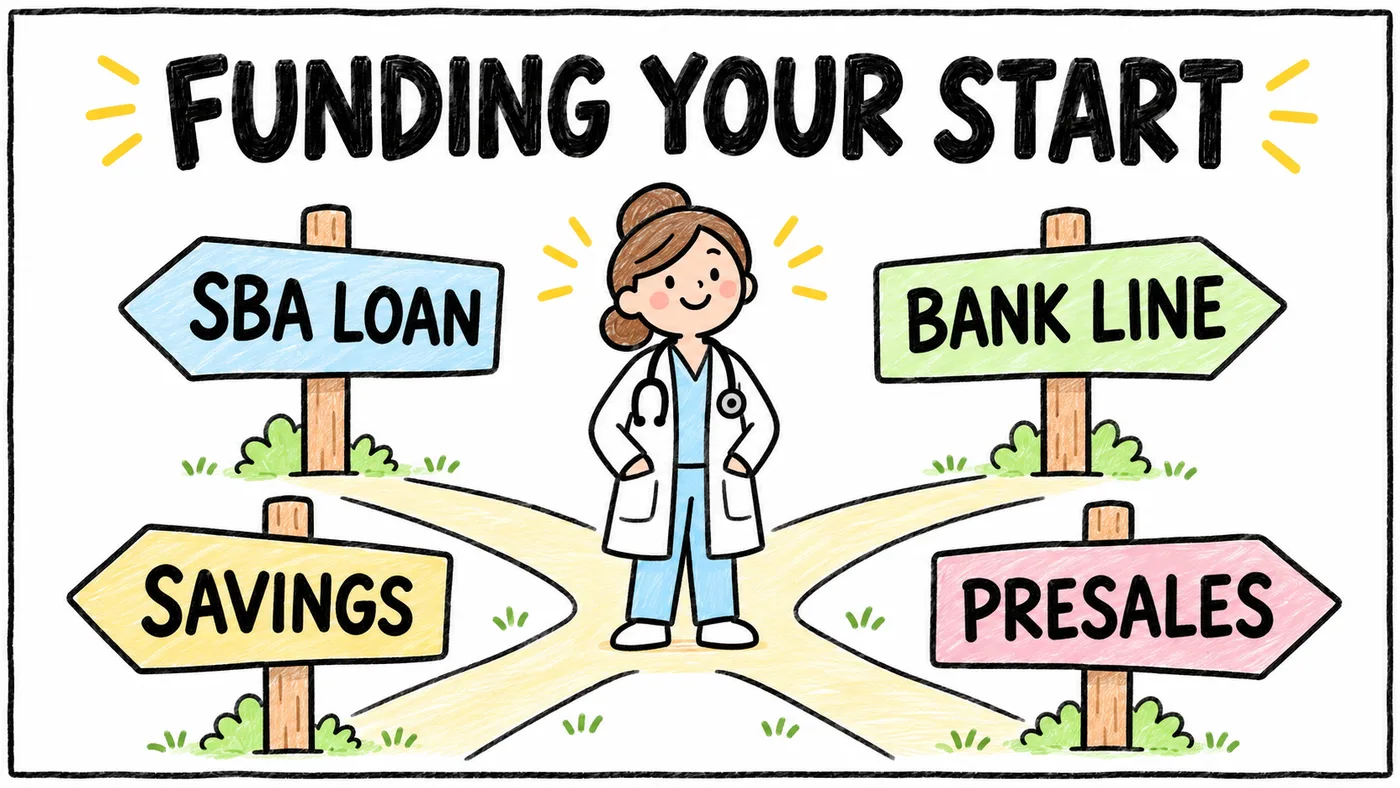
You can finance a 2027 direct primary care launch with a mix of personal savings, an SBA-backed loan or bank line of credit, and founding-member presales. Savings cover the equity a lender wants to see and your own living costs in the first months, the loan covers build-out, equipment and working capital, and presales bring in early revenue while proving that patients want what you are building. A lean, leased-space DPC may need only a small loan or none at all, while buying a building is where SBA 504 financing comes in.
The good news is that you are not building a claims department. The harder part is the gap between opening day and the month your membership revenue covers your costs, and that gap is what most of your financing really pays for.
This guide walks through each source in plain terms, with the current limits, rate caps and fees taken from SBA.gov and the federal rules behind them, all checked on November 2, 2026. It is general information, not legal, tax or lending advice, so bring your numbers to a lender, a CPA and a healthcare attorney before you sign anything. For the full launch sequence, start with how to start a DPC practice.
DPC Financing Options at a Glance
| Source | Size limit | What it costs | Best for | Watch for |
|---|---|---|---|---|
| SBA 7(a) loan | Up to $5 million | Negotiated rate under an SBA cap, plus an upfront guaranty fee | Build-out, equipment, working capital, buying a practice | 10% equity for startups, collateral over $50,000 |
| SBA Express | Up to $500,000 | Negotiated rate under the same caps | Revolving line of credit or a quicker term loan | 50% SBA guaranty, so some banks are pickier |
| SBA 504 loan | Up to $5.5 million | Fixed rate tied to 10-year Treasuries, fees about 3% | Buying or building the property you practice in | No working capital, 15% down for a new business |
| SBA microloan | Up to $50,000 | Generally 8% to 13% | Very lean launches, equipment, supplies | Set by local nonprofit lenders |
| Bank line of credit | Set by the bank | Bank's own variable rate | A cash cushion for slow months | Personal guarantee and annual reviews |
| Personal savings | What you have | Your opportunity cost | Equity injection and personal runway | Don't drain your emergency fund |
| Founding-member presales | Your founding panel | No loan to repay; unearned fees may be refundable | Early revenue and proof of demand | State rules on prepaid fees and refunds |
Limits and terms come from SBA's 7(a), 504 and microloan pages and its lender program comparison. Each row is explained below.
How Much Do You Actually Need to Borrow?
Before you talk to a lender, work out two numbers. The first is your one-time startup cost (lease deposit, build-out, exam room equipment, your software stack, malpractice, entity and licensing). The second is your runway, which is the total of every monthly shortfall between opening and break-even, plus the personal income you need to live on while the panel grows.
Runway can be the bigger number, because membership revenue grows a few patients at a time. Our DPC startup cost calculator and break-even calculator will give you both from your own assumptions, and the guides on what it costs to start a DPC and the panel size you need to break even explain the inputs.
With those two numbers in hand, savings and presales cover what they can, and you borrow the difference plus a margin for slower months.
SBA 7(a) Loans for a DPC Practice
The 7(a) program is SBA's main small business loan. SBA does not lend you the money itself. A bank or other approved lender makes the loan and SBA guarantees part of it, which lets the lender say yes to borrowers it might otherwise turn down, like a brand-new practice with no operating history.
According to SBA.gov, 7(a) money can go toward working capital, equipment, furniture, fixtures and supplies, real estate and buildings, refinancing business debt and buying a business. That covers nearly everything a DPC spends money on before opening.
SBA's 7(a) loan page puts the largest 7(a) loan at $5 million.
SBA guarantees up to 85% of 7(a) loans of $150,000 or less.
Larger loans carry a guaranty of up to 75%, per SBA's lender guide. Terms run 10 years or less unless the loan finances real estate or long-lived equipment, with a 25-year maximum for real estate. Loans with a term of 15 years or more carry a prepayment fee of 5%, 3% or 1% if you pay down 25% or more of the balance in the first three years.
What are the SBA 7(a) interest rate caps in 2027?
You negotiate the rate with your lender, but federal rules set a ceiling. Under 13 CFR 120.214, a variable-rate 7(a) loan can't go above the base rate, which is usually the prime rate, plus a set number of points that shrinks as the loan gets larger. The Federal Reserve's H.15 release showed the bank prime loan rate at 7.00% for every day from October 23 to October 29, 2026.
| Loan size | Most SBA allows above base rate | Cap with prime at 7.00% |
|---|---|---|
| $50,000 or less | 6.5 points | 13.5% |
| $50,001 to $250,000 | 6.0 points | 13.0% |
| $250,001 to $350,000 | 4.5 points | 11.5% |
| More than $350,000 | 3.0 points | 10.0% |
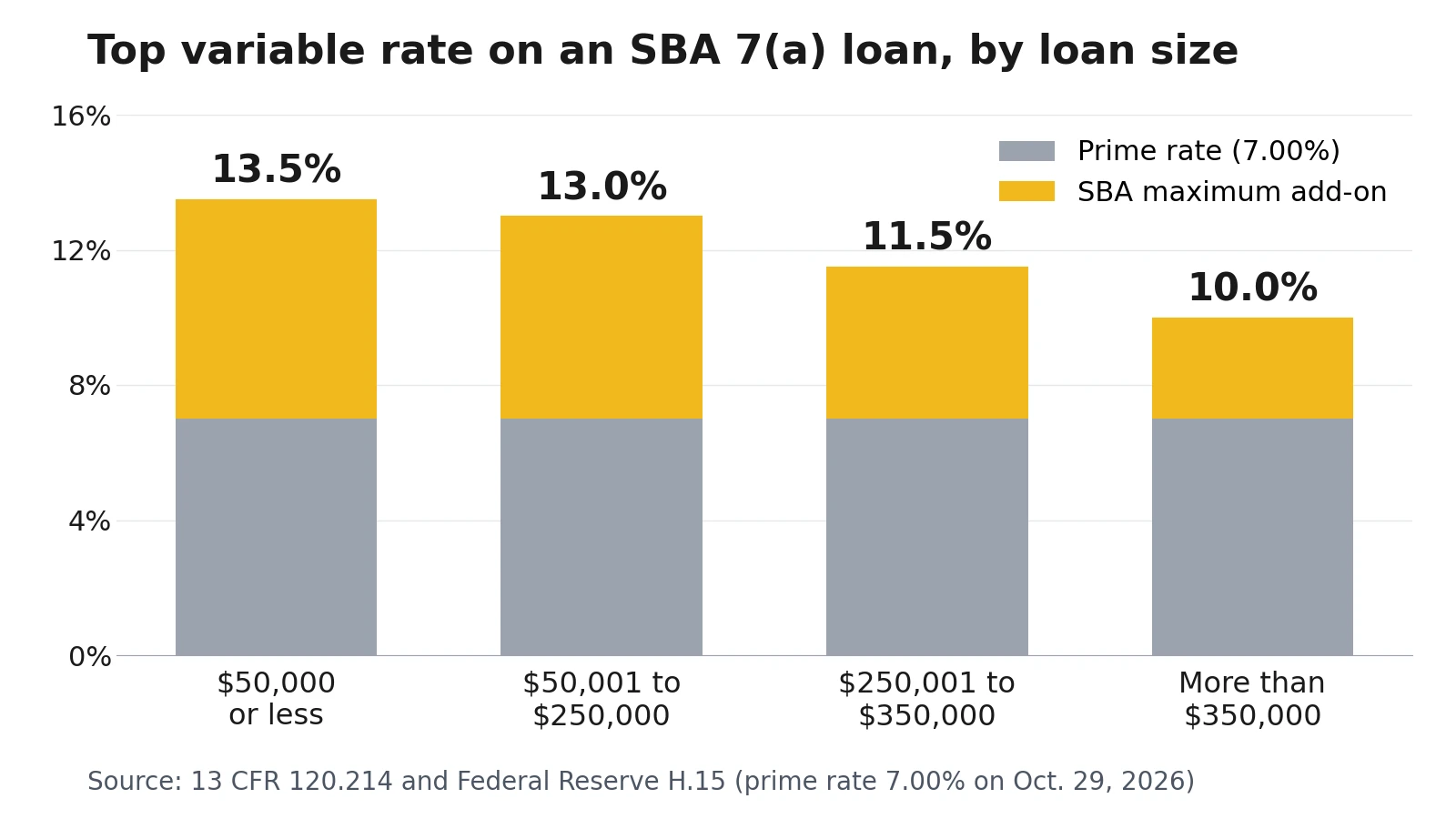
These are ceilings, not quotes, and because they move with prime, check the current rate on the day you apply. Fixed-rate 7(a) loans have their own maximums, which SBA publishes separately, so ask your lender for both options.
What fees does an SBA 7(a) loan charge in fiscal year 2027?
The biggest fee is the upfront guaranty fee, which the lender pays to SBA and can pass on to you. SBA Information Notice 5000-881797 sets it for every 7(a) loan approved from October 1, 2026 through September 30, 2027, when the loan's term is longer than 12 months:
- 2% of the guaranteed portion on loans of $150,000 or less
- 3% of the guaranteed portion on loans of $150,001 to $700,000
- 3.5% of the guaranteed portion up to $1,000,000, plus 3.75% above that, on loans of $700,001 to $5,000,000
- 0.25% of the guaranteed portion on loans with a term of 12 months or less
Here is how that works on two example loans, using the fee rates above and the guaranty percentages from SBA's lender guide.
A $150,000 loan with an 85% guaranty has $127,500 guaranteed, so the 2% fee is $2,550.
A $300,000 loan with a 75% guaranty has $225,000 guaranteed, so the 3% fee is $6,750.
One line in the same notice matters for rural DPCs. Businesses located in a rural area pay no upfront fee on smaller 7(a) loans, so if your clinic will sit in a rural county, ask your lender to confirm whether the address qualifies.
The rural fee waiver covers 7(a) loans of $700,000 or less.
The same notice sets a 0.55% annual service fee on the guaranteed balance, but that one is paid by the lender and can't be passed on to you.
What does SBA require from a startup borrower?
SBA rewrote its lending rulebook, SOP 50 10 8, effective June 1, 2025. The Congressional Research Service's summary of the changes lists the ones that matter most to a new DPC:
- Equity injection. Startups generally put in at least 10% of project costs themselves.
- Collateral. Collateral is now required on almost every loan except the smallest ones.
- Personal resources. Lenders check whether an owner has liquid assets that could stand in for the loan, after allowances for retirement, college and medical savings.
- No credit elsewhere. The lender has to document specific reasons you can't get the same credit on reasonable terms without the SBA guaranty.
Per the CRS summary, the new collateral threshold is $50,000, down from $500,000. SBA's lender guide adds that for 7(a) small loans, which run up to $350,000, lenders follow their written collateral policies above $50,000, but a loan is not to be declined solely on the basis of inadequate collateral.
There is also a citizenship rule worth checking early. Under SBA Procedural Notice 5000-876626, effective March 1, 2026, every direct and indirect owner of a 7(a) or 504 borrower must be a U.S. citizen or U.S. national whose main home is in the United States, its territories or possessions. Lawful permanent residents no longer qualify as owners, so a green-card-holding founder will want to start with conventional bank financing.
To find a lender, SBA's Lender Match tool sends your request to participating lenders in your area.
SBA Microloans for a Lean DPC Launch
If you are opening lean, with a small leased room or a home-visit model, a microloan may be all the debt you need. Microloans come from nonprofit intermediary lenders that SBA funds, and they can pay for working capital, supplies, furniture, fixtures and equipment, but not real estate or existing debt.
According to SBA's microloan page, a microloan can be as large as $50,000.
The same page puts the average microloan at about $13,000.
SBA says microloan rates vary by lender and generally fall between 8% and 13%, and the longest repayment term is seven years. SBA adds that these nonprofit lenders can also offer management and technical help, which can be useful in a first year of running a business.
Should You Use an SBA 504 Loan to Buy a Building?
If you are still choosing a space, our guide to DPC office space in 2027 walks through the tradeoffs. If you do want to own the building, the 504 program is built for that. SBA's 504 page says it provides long-term, fixed-rate financing for buildings, land and long-lived equipment, and that it can't be used for working capital.
The largest 504 loan SBA lists is $5.5 million.
A 504 project usually has three parts, per SBA's lender guide. A private lender covers up to 50% of the project with a first lien, a Certified Development Company covers up to 40% with an SBA-backed second loan, and you put in at least 10%. For a newer practice, 13 CFR 120.910 raises your share to 15% if the business has operated for two years or less, and to 20% if the building is also a special-purpose building.
504 loans come with 10, 20 and 25-year terms, at a rate pegged to 10-year Treasury yields, and SBA says the fees total about 3% of the debt and can be rolled into the loan. Because 504 money can't fund your first months of payroll or rent, a founder who buys a building needs another source, such as a 7(a) loan or line of credit, for working capital.
Bank Lines of Credit and SBA Express
A line of credit is a cushion you draw on only when you need it, and you pay interest only on what you use. For a DPC it is most useful in the first year, when a slow enrollment month or a delayed employer contract can leave a gap you don't want to fill from personal savings.
SBA Express is the SBA's quicker route to a line of credit. Per SBA's lender guide, Express loans can be revolving lines with terms up to 10 years, and the lender makes the credit decision with its own forms. The SBA guaranty is only 50%, which can make some banks more cautious with a startup.
The largest SBA Express loan is $500,000.
Express lenders don't have to take collateral on loans of $50,000 or less.
A conventional bank line with no SBA guaranty is the other option. Terms are whatever the bank offers, and new practices may need a personal guarantee and an annual review of the practice's financials. Either way, set up the line before you need it, because banks are much easier to talk to while your plan still looks like a plan and not an emergency.
How Much of Your Own Savings Should You Put In?
Your savings do two jobs. They fund the equity a lender requires, which is at least 10% for a 7(a) startup and 15% for a new practice's 504 project, and they carry your household through the months before the practice can pay you a full salary.
The second job is the one to protect. Keep a personal emergency fund separate from the money you put into the practice, and plan your own pay as a line in the budget rather than whatever is left over. Our guide to leaving employed medicine for DPC covers how founders bridge that income gap, including part-time or locum shifts in the first year.
Some founders look at their 401(k) instead. A rollover as business startup (ROBS) moves retirement funds into a new C corporation's retirement plan, which then buys the company's stock. The IRS describes ROBS as not abusive but questionable, has run a compliance project on them since 2009, and warns that plans run incorrectly can be disqualified with tax consequences. The same page reports that, although there were some success stories, most ROBS businesses in its project either failed or were on the road to failure. If you still consider one, have a CPA and an ERISA attorney set it up and keep it compliant.
Your entity choice affects all of this, from who signs the loan to whether a ROBS is even possible, so read our comparison of PLLC vs. LLC for a DPC before you open accounts.
Can You Fund a DPC with Founding-Member Presales?
Presales carry no loan to repay, though you can still owe refunds of unearned fees. Founders sell memberships before opening, often with a founding price or perk, and the members who sign up become both early revenue and proof for a lender that the community wants the practice. A strong founding list also shortens your runway, which shrinks the loan you need. Our guide to running a DPC founding-member presale covers how to set one up.
The catch is how you hold prepaid money, which your state's DPC law may control. Washington's RCW 48.150.030, for example, says that if a patient pays more than one monthly fee in advance, the money must sit in a trust account and be paid to the practice as each month is earned, and unearned fees must be refunded promptly, prorated, when the patient cancels. Other states set their own terms, so check our guide to direct primary care laws by state before you take a deposit.
The safest presale structures charge nothing until opening month, or collect a small refundable deposit, and spell out the refund terms in plain words. If your founding members plan to pay from a health savings account, the 2026 HSA rules apply to how the fee is charged, which our DPC HSA rules for 2027 guide explains.
Putting the Pieces Together
A common order of operations looks like this:
- Size the need. Add startup costs and runway, then add a cushion for slower months.
- Count what you can cover yourself. Savings first, after setting aside your personal emergency fund.
- Start the presale early. Founding members reduce the runway you have to finance and strengthen your loan application.
- Borrow the gap. A microloan for a very lean launch, a 7(a) loan for a typical build-out, and a 504 loan only if you are buying a building.
- Add a line of credit. Set it up before opening so it is there when a slow month arrives.
Lenders will ask for a business plan with monthly projections, and the strongest ones show enrollment assumptions tied to real pricing data. Our DPC business plan template walks through the sections a lender reads first.
Keeping the Plan on Track After You Open
The financing plan rests on a few numbers you'll want to watch every week once you open, like new members, cancellations, failed card payments and the employer groups still deciding. Those numbers usually live in different tools, so follow-ups on a declined card or a lapsed founding member can slip between the billing system, the EHR and the inbox, and each one is real revenue your runway was counting on.
Tabflows is a dedicated tech team that connects the tools your clinic already uses, so those follow-ups, tasks and patient context land in one place and get done. It doesn't replace your EHR or billing platform. It makes sure the work between them gets finished.
Still choosing a location? Our DPC Finder shows the DPC practices near any spot you are considering, which helps with the market section of your loan application.
FAQs
How can a doctor finance a DPC startup?
A DPC startup can be financed from three or four sources. Personal savings cover the down payment and the first months of personal income, an SBA-backed loan or a bank line of credit covers build-out, equipment and working capital, and founding-member presales bring in early revenue and prove demand before opening day. The right mix depends on whether you lease a small space or buy a building, and on how many months you need before membership revenue covers your costs.
Can I get an SBA loan to start a DPC practice in 2027?
Yes, a new DPC can qualify if it meets SBA's rules. SBA.gov lists the 7(a) maximum at $5,000,000, SBA Express at $500,000, the 504 loan at $5,500,000 and microloans at $50,000. Since SOP 50 10 8 took effect on June 1, 2025, startups generally put in at least 10% equity, collateral is required on most loans over $50,000, and since March 1, 2026 every direct and indirect owner of a 7(a) or 504 borrower must be a U.S. citizen or U.S. national whose main home is in the United States, its territories or possessions.
What is the maximum interest rate on an SBA 7(a) loan?
Rates are negotiated with the lender, but 13 CFR 120.214 caps variable rates at the base rate (usually the prime rate) plus 6.5 points for loans of $50,000 or less, plus 6 points from $50,001 to $250,000, plus 4.5 points from $250,001 to $350,000 and plus 3 points above $350,000. With the Federal Reserve's bank prime rate at 7.00% on October 29, 2026, that puts the caps at 13.5%, 13%, 11.5% and 10%.
What are the SBA 7(a) fees for loans approved in fiscal year 2027?
SBA Information Notice 5000-881797 sets the upfront guaranty fee for 7(a) loans approved from October 1, 2026 through September 30, 2027. For loans over 12 months it is 2% of the guaranteed portion on loans of $150,000 or less, 3% on loans of $150,001 to $700,000, and 3.5% to 3.75% on larger loans. Loans of $700,000 or less to businesses located in a rural area pay no upfront fee.
Can a DPC take membership fees before it opens?
Founders can sell founding memberships before opening, but how you hold that money depends on your state's DPC law. Washington's RCW 48.150.030, for example, requires fees paid more than one month in advance to be held in a trust account and released as each month is earned, with prompt prorated refunds when a patient cancels. Check your state's statute before you collect prepaid fees.
Can I use my 401(k) to start a DPC?
Some founders use a rollover as business startup (ROBS), which moves retirement funds into a new C corporation's plan to buy company stock. The IRS does not treat ROBS as abusive but calls them questionable and runs a compliance project on them, so plans that are not run correctly can be disqualified with tax consequences. Talk to a CPA and an ERISA attorney before choosing this route.