How Many Patients Does a DPC Need to Break Even?
A direct primary care practice breaks even when monthly membership revenue covers monthly overhead, so the member count you need is simply your overhead divided by your average fee. Using the DPC Alliance's national average fee and the example budgets in this guide, a lean, no-staff launch covers its costs at about 18 members and a brick-and-mortar office with one staff member needs about 94. If you also want to pay yourself a full-time draw, the targets rise to roughly 170 and 246 members, which is still well under the 400 to 700 patients where mature DPC panels tend to settle.
The rest of this guide shows the math line by line so you can swap in your own numbers. Every survey figure links to its source. Every overhead line is a clearly labelled example, because rent, salaries and malpractice vary too much by city and specialty for any single number to be honest.
It helps to think about two break-even points rather than one. The first is when the practice stops losing money, which is the number most people quote. The second, and the one that actually matters for your family's budget, is when the practice also pays you a living wage.
What Is a Typical DPC Panel Size?
The best current data comes from the Direct Primary Care Alliance's State of DPC report, published in July 2026 from 465 survey responses collected in late 2024. Hint's summary of the report notes that among mature practices, panels cluster in the 400 to 700 range, close to the often-cited 600 patient benchmark. It also found that 68.4% of respondents said their panels had not yet filled, which tells you how many practices are still in the ramp this guide is about.
The AAFP's direct primary care resource page, citing its 2026 DPC data brief, reports an average panel of 504 patients in 2025, up from 402 in 2024, across all its survey respondents, 53% of them practicing in DPC. "Full" is personal, though. The DPC Alliance report points out that each physician defines a full panel by their own goals, hours and practice design rather than a standard number.
| Benchmark | Figure | Source |
|---|---|---|
| Mature DPC panel range | 400 to 700 patients | DPC Alliance via Hint |
| Average panel, 2025, all AAFP survey respondents (53% in DPC) | 504 patients (402 in 2024) | AAFP |
| Panels not yet full | 68.4% of respondents | DPC Alliance via Hint |
| Single-location practices with zero support staff | About one-third | DPC Alliance via Hint |
| Single-location practices with one staff member | About one-third | DPC Alliance via Hint |
How Much Does the Average DPC Member Pay?
The fee is the other half of the break-even equation. The DPC Alliance survey found a national average membership price across all categories, and it varies by region, setting and panel size.
The national average was $98.64 per member per month. By region, the West averaged $113.28, the Northeast $110.44, the South $98.38 and the Midwest $80.36. Rural practices averaged $81.56 against $110 for urban practices.
Panel size matters too. Practices with fewer than 200 patients averaged $105.93, while practices with more than 500 patients averaged $77.74 (DPC Alliance via Hint).
That last number is worth sitting with. As panels grow, they usually pick up more children, more family plans and more employer members, so the average revenue per member drifts down even if your adult price never changes. A model that assumes your launch-month average fee holds forever will be a little optimistic. If you are still setting prices, our guide on how much to charge for DPC membership walks through tiering and regional benchmarks.
The Break-Even Model, Line by Line
Below are two example budgets. They are not survey averages, they are illustrations built from typical overhead categories, and you should replace every number with a real quote from your own market. The AAFP describes DPC startup costs as often around a few thousand dollars a month, with rent the biggest expense, and our DPC startup cost breakdown covers the one-time launch costs that sit outside this monthly picture.
The two example budgets compare as follows:
| Monthly overhead line (example numbers) | Lean launch (home-based, telehealth-first, no staff) | Brick-and-mortar (small office, one staff member) |
|---|---|---|
| Rent and utilities | $0 | $2,500 |
| Staff (wages, payroll tax) | $0 | $3,800 |
| Software (EHR, membership billing, phone and messaging) | $400 | $450 |
| Malpractice insurance | $500 | $600 |
| Labs, supplies and dispensed meds not passed through | $250 | $600 |
| Marketing | $300 | $500 |
| Other (card processing, accounting, business insurance) | $300 | $750 |
| Total monthly overhead | $1,750 | $9,200 |
For software, published list prices for solo DPC platforms sit in the low hundreds of dollars a month. Our 2027 DPC software comparison lists current vendor prices if you want to tighten that line.
Break-even member count
The formula is monthly cost divided by average fee, rounded up to a whole member. The table below runs it at the national average fee, at the average for panels over 500 and at the urban average the survey reported.
| Example scenario | At $77.74 average fee | At $98.64 average fee | At $110 average fee |
|---|---|---|---|
| Lean, overhead only ($1,750) | 23 members | 18 members | 16 members |
| Lean, overhead plus $15,000 owner draw ($16,750) | 216 members | 170 members | 153 members |
| Brick-and-mortar, overhead only ($9,200) | 119 members | 94 members | 84 members |
| Brick-and-mortar, overhead plus $15,000 owner draw ($24,200) | 312 members | 246 members | 220 members |
The owner draw is also an example.
A $15,000 monthly draw works out to $180,000 a year before taxes and benefits, below the AAFP's reported average.
The AAFP reports that family physicians in direct primary care settings earned an average full-time income of $288,779 in 2024, citing its Career Benchmark Dashboard.
Swap in whatever number lets you stop moonlighting, because that is the break-even point that actually changes your life.
How Long Does It Take a New DPC Practice to Break Even?
Time to break even is the member target divided by how fast you add members, adjusted for the members who leave. The chart and table below use three example enrollment paces of 10, 20 and 30 new members a month, and they assume 1% of active members leave each month (moves, job changes, cost). That churn rate is an assumption for illustration, not a survey figure.
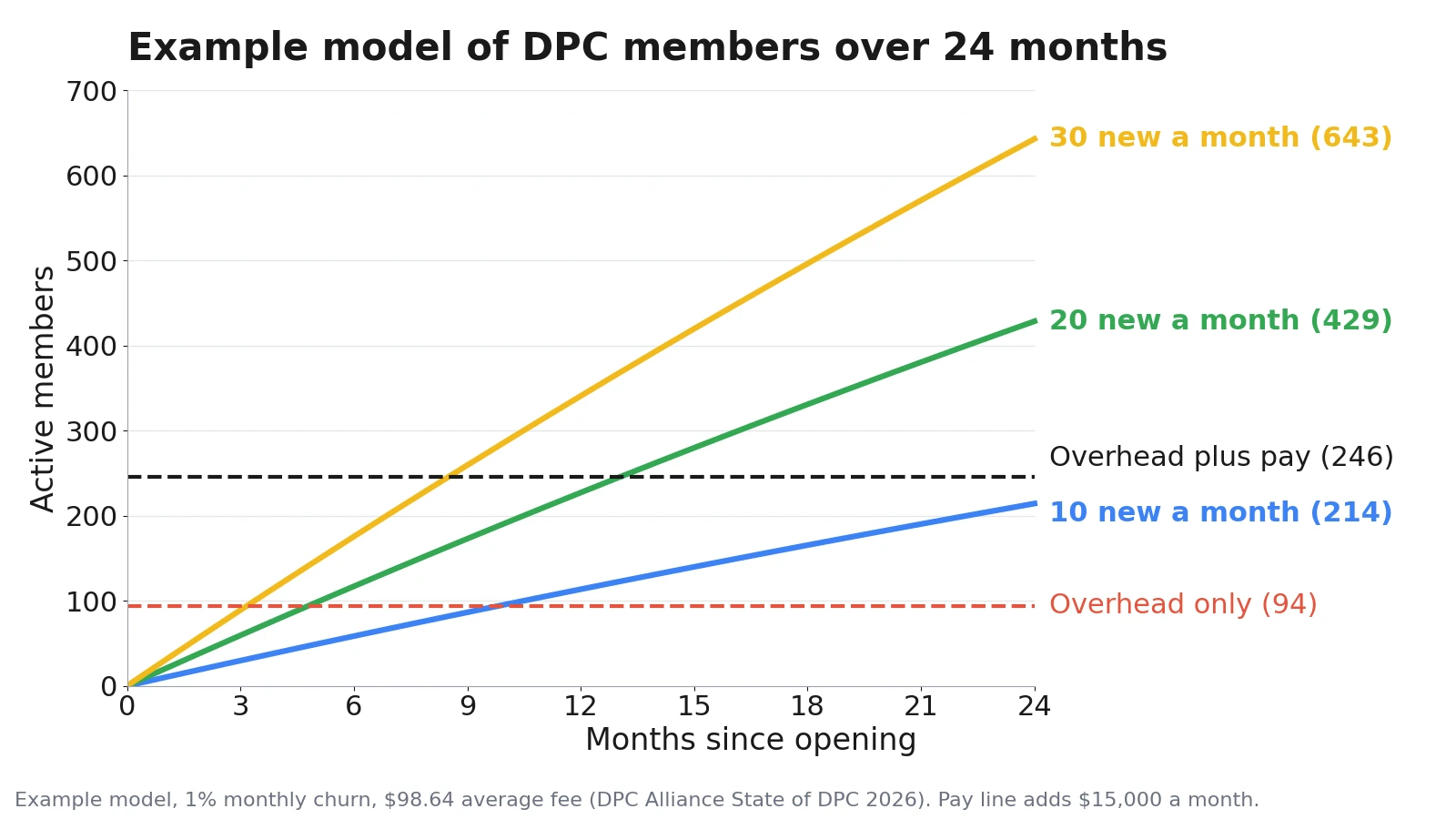
Here is the same arithmetic as a table, showing the month in which each example practice first crosses each line:
| Example enrollment pace | Members after 12 and 24 months | Lean launch (18 members for overhead, 170 with pay) | Brick-and-mortar (94 members for overhead, 246 with pay) |
|---|---|---|---|
| 10 new members a month | 114 at month 12, 214 at month 24 | Covers overhead in month 2, adds your pay in month 19 | Covers overhead in month 10, adds your pay after month 24 |
| 20 new members a month | 227 at month 12, 429 at month 24 | Covers overhead in month 1, adds your pay in month 9 | Covers overhead in month 5, adds your pay in month 14 |
| 30 new members a month | 341 at month 12, 643 at month 24 | Covers overhead in month 1, adds your pay in month 6 | Covers overhead in month 4, adds your pay in month 9 |
Two things stand out. The lean practice covers its bills almost immediately at any pace, which is why so many physicians start that way. And the gap between "not losing money" and "paying yourself" is where most of the ramp lives, often a year or more for a brick-and-mortar office.
Keep in mind that these months count from opening day. Many practices start enrolling before they open through a waitlist or founding member offer, which pulls every line in the table earlier. Our first 100 members playbook covers how practices build that early momentum.
Lean Launch vs Brick-and-Mortar
The single biggest lever on break-even is not your price, it is whether you sign a lease. A lean launch keeps overhead so low that the practice is self-funding within weeks, which buys you time to grow at a pace that suits your life. A brick-and-mortar launch gives patients a familiar place to come, room for in-office procedures and labs, and a stronger local presence, but it puts a much larger fixed cost on the clock from day one.
| Factor | Lean launch | Brick-and-mortar |
|---|---|---|
| Where visits happen | Home visits, telehealth, shared or rented exam space by the hour | Your own leased office |
| Staff | None at first; physician handles scheduling and messages | Usually one person for front desk and clinical support |
| Overhead break-even (example) | About 18 members | About 94 members |
| Main risk | Physician time spent on admin, harder to do procedures | Fixed costs before members arrive |
| Typical next step | Add space or a part-time staff member around 150 to 250 members | Add a second clinician or expand hours as the panel fills |
Plenty of practices move from the first column to the second once revenue can carry it. The survey data supports that path, since about one-third of responding single-location practices run with no support staff and another third with just one person (DPC Alliance via Hint). If you are still working out the full sequence of launch decisions, the 2027 guide to starting a DPC practice puts this choice in context alongside licensing, Medicare opt-out and state law.
What Moves the DPC Break-Even Point?
Five levers move the numbers above, and they are worth checking in this order because the first two are mostly set before you open.
- Overhead. Every fixed cost you avoid lowers the member target permanently. Rent and staff are the two largest lines in the example, and both can be added later once members justify them.
- Price. In the example, moving the average fee from the national average to the urban average drops the brick-and-mortar overhead target from 94 to 84 members. Price also shapes who joins, so it is a judgment call about your market as much as a math problem.
- Enrollment pace. Going from 10 to 20 new members a month cuts the brick-and-mortar overhead break-even from month 10 to month 5 in the example. Referral programs, community talks and a working website all feed this number.
- Employer contracts. Hint's summary of the DPC Alliance report calls employer partnerships one of the fastest-growing paths to panel growth. One employer agreement can add dozens of members in a single month, which jumps you up the curve rather than climbing it one family at a time.
- Churn. Each member who leaves has to be replaced before the panel grows again. At 1% a month, the 20-a-month practice in the example loses about 4 members a month by month 24, and higher churn flattens every line on the chart.
A sixth factor sits in the background in 2027. Since January 1, 2026, qualifying DPC arrangements within the federal fee cap no longer disqualify patients from contributing to a health savings account, which removes a long-standing objection for HSA-holding patients and employers. The details, including the cap and what it excludes, are in our DPC HSA rules for 2027 guide.
Is DPC Profitable?
DPC can be very profitable once the panel matures, because the model removes most insurance billing work and the overhead that comes with it. The AAFP's reported average full-time income for family physicians in DPC settings is a useful reference, though survey averages blend new and mature practices across many markets.
The honest risk is the ramp rather than the destination. Membership revenue grows only as fast as enrollment, so the months between opening and a full panel are when practices feel the squeeze, and that is why so many physicians keep part-time clinical work while they build. Running the model above with your own numbers, and revisiting it every quarter as real enrollment comes in, turns that risk into a plan you can see.
Keeping the Ramp Smooth Once Members Arrive
Break-even math assumes every new member stays and every inquiry turns into a signup. In practice, members slip away when follow-ups are missed, renewals lapse quietly or a message sits in one app while the chart lives in another. Those small leaks show up directly in the churn and enrollment lines of your model.
That is the problem Tabflows works on. We are a dedicated tech team that connects the tools a DPC clinic already uses, such as the EHR, membership billing and patient messaging, so follow-ups, tasks and patient context sit in one place and the work between those tools gets done. We do not replace any of them. The goal is simply to help the panel you worked hard to build stay with you.
Frequently Asked Questions About DPC Break-Even
The questions physicians ask most often about DPC panel size, income and break-even are answered in the FAQ section below, with the same sources used throughout this guide. For a full picture of launch costs, read how much it costs to start a DPC, and to see how other practices in your area price and position themselves, browse the DPC finder.
FAQs
How many patients does a DPC practice need to break even?
It depends almost entirely on overhead. In this guide's worked example at the DPC Alliance's national average fee, a lean home-based or telehealth-first practice covers its costs at roughly 18 members, while a brick-and-mortar office with one staff member needs roughly 94 members. Paying the physician a full-time monthly draw on top of that raises the targets to about 170 and 246 members. The example uses that average fee of $98.64 per member per month, about $1,750 in monthly overhead for the lean practice, about $9,200 for the brick-and-mortar office and a $15,000 monthly draw.
How long does it take a new DPC practice to break even?
In the example model, a brick-and-mortar DPC covers its overhead in about 4 months at 30 new members a month, 5 months at 20 a month, and 10 months at 10 a month, assuming 1% of members leave each month. Covering overhead plus a full-time physician draw takes about 9 months at 30 a month, 14 months at 20 a month, and longer than 24 months at 10 a month. These are illustrations, not predictions, and your own overhead and pace will change the answer. The example draw is $15,000 a month.
What is a typical DPC panel size?
The DPC Alliance's State of DPC report, published in July 2026, found that mature practices cluster in the 400 to 700 patient range, close to the often-cited 600 patient benchmark, and that 68.4% of respondents said their panels were not yet full. The AAFP's 2026 DPC data brief reports an average panel of 504 patients in 2025, up from 402 in 2024, across all its survey respondents, about half of them in DPC.
How much do DPC physicians make?
Income for any one practice depends on panel size, fee, overhead and how long the practice has been open, and most of that income arrives only after the panel matures. For a benchmark, the AAFP reports an average full-time income for family physicians in direct primary care settings, citing its Career Benchmark Dashboard. That average was $288,779 in 2024.
Is DPC profitable?
A DPC practice becomes profitable once recurring membership revenue covers overhead plus the physician's pay, and because there is no insurance billing, overhead can be much lower than in fee-for-service care. The main risk is the ramp, since revenue grows only as fast as enrollment. Lean launches, employer contracts and low churn shorten that ramp the most.
What is the average DPC membership fee?
The DPC Alliance's State of DPC report (survey collected late 2024, published July 2026) is the main national measure. It found fees highest in the West and Northeast and lowest in the Midwest, and lower in practices with more than 500 patients, likely reflecting more children and family discounts in larger panels. It reported a national average of $98.64 per member per month across all categories, with the West at $113.28, the Northeast at $110.44, the South at $98.38 and the Midwest at $80.36. Practices with more than 500 patients averaged $77.74.