Can You Use Direct Primary Care on Medicare?
Yes, you can join a direct primary care (DPC) practice while you are on Medicare, and hundreds of practices publish membership prices just for seniors. Medicare does not pay the membership fee, so you pay it yourself. If your DPC doctor has opted out of Medicare, you will sign a private contract agreeing that Medicare will not pay for that doctor's services, while your Medicare coverage stays in place for hospital care, specialists and the tests and prescriptions your doctor orders from Medicare providers.
This guide is written for people on Medicare or about to turn 65, and for the adult children who often help them sort through choices like this. It explains the two ways DPC doctors handle Medicare, what you sign, what Medicare keeps paying for, how Medicare Advantage and health savings accounts fit, and what seniors typically pay. If you are new to the idea, our plain-language guide to what direct primary care is is a good place to start.
This is general information, not legal, tax or insurance advice. Medicare rules are detailed, and your situation may differ, so check anything important with Medicare, your plan or a licensed advisor before you sign.
How Does Direct Primary Care Work With Medicare?
A DPC practice charges a flat monthly membership for everyday primary care, such as visits, phone calls, messages and often basic labs. How that works for someone on Medicare depends almost entirely on one question, which is whether the doctor has opted out of Medicare or is still enrolled in it.
If your DPC doctor has opted out of Medicare
A DPC doctor who wants to cover a Medicare patient's everyday care inside the membership has to formally opt out of Medicare. To do that, the doctor files an affidavit with Medicare and then signs a private contract with each Medicare patient, as set out in 42 CFR 405.410. An opt-out lasts for two-year periods and, under 42 CFR 405.400, renews for each new two-year period unless the doctor properly cancels it.
Once a doctor has opted out, 42 CFR 405.425 says Medicare and Medicare Advantage plans cannot pay that doctor, and the doctor cannot bill Medicare for your care, apart from the emergency and urgent care cases covered below. You pay the doctor directly, which is how the membership covers services Medicare would normally pay for.
The same rule makes clear that an opted-out doctor who has not been excluded from Medicare (barred from the program, usually over fraud or abuse) can still order tests, prescribe drugs and refer you to specialists for Medicare-covered care. That is the part many people miss. You are stepping outside Medicare for one doctor's services, not for your health care as a whole.
If your DPC doctor is still enrolled in Medicare
Some membership practices stay enrolled in Medicare and keep billing it for covered visits. This is more common in what is usually called concierge medicine, and it is the arrangement people often mean when they search for a "concierge doctor on Medicare."
Medicare.gov explains the rules for these doctors. A doctor who accepts assignment (agrees to take Medicare's approved amount as full payment) cannot charge you extra for Medicare-covered services, so the membership fee cannot include charges for items or services Medicare usually covers, unless Medicare won't pay for them, in which case the doctor must give you a written notice called an Advance Beneficiary Notice. Every Medicare doctor can charge you for things Medicare doesn't cover.
In practice, that means an enrolled doctor's membership can only pay for extras Medicare doesn't cover, such as after-hours access or a more detailed annual exam, while Medicare is still billed for your covered visits. The fee cannot buy time or services Medicare already pays for, so extra time spent on covered care is billed to Medicare, not added to the membership. Our comparison of DPC vs concierge medicine walks through how the two models differ on Medicare, price and what the fee buys.
What Does Medicare Still Cover if You Join a DPC?
Joining a DPC does not cancel your Medicare. You keep paying your Part B premium, and Medicare keeps covering care from doctors, hospitals and other providers who bill it. The table below shows how the costs usually split when your DPC doctor has opted out.
| Type of care | Who usually pays | Notes |
|---|---|---|
| Visits, calls and messages with your DPC doctor | Your DPC membership | Medicare and Medigap will not pay for these under a private contract |
| Extras the practice includes, such as some in-office labs or discounted medications | Your DPC membership, or a small add-on fee | Depends on the practice, so ask for the list in writing |
| Hospital stays | Medicare Part A, or your Medicare Advantage plan | Normal Medicare rules, deductibles and coinsurance apply |
| Specialist visits your DPC doctor refers you to | Medicare Part B, or your Advantage plan | The specialist must bill Medicare and, for Advantage, usually be in network |
| Labs and imaging ordered by your DPC doctor at an outside lab or imaging center | Medicare Part B, or your Advantage plan | Covered when the outside provider bills Medicare under its usual rules |
| Prescriptions your DPC doctor writes | Your Part D plan, or your Advantage drug coverage | Opted-out doctors can still prescribe drugs Medicare covers |
| Emergency room care | Medicare, or your Advantage plan | Your DPC doctor does not replace emergency care |
| Medigap coverage of the DPC doctor's services | Not covered | Medigap does not pay for services Medicare doesn't pay for |
The rule behind most of this table is 42 CFR 405.425(i), which lets an opted-out doctor order, prescribe and refer for Medicare-covered items as long as that doctor isn't paid for those services. If your DPC doctor draws your blood and sends it to an outside lab that bills Medicare, the lab work is generally covered. If the doctor runs the test in the office and bills you, that is part of your private arrangement and Medicare won't pay.
For a fuller picture of how DPC pairs with coverage for the big, rare costs, see our guide to what insurance to pair with DPC, which has a section on Medicare.
What Do You Sign in a Medicare Private Contract With a DPC Doctor?
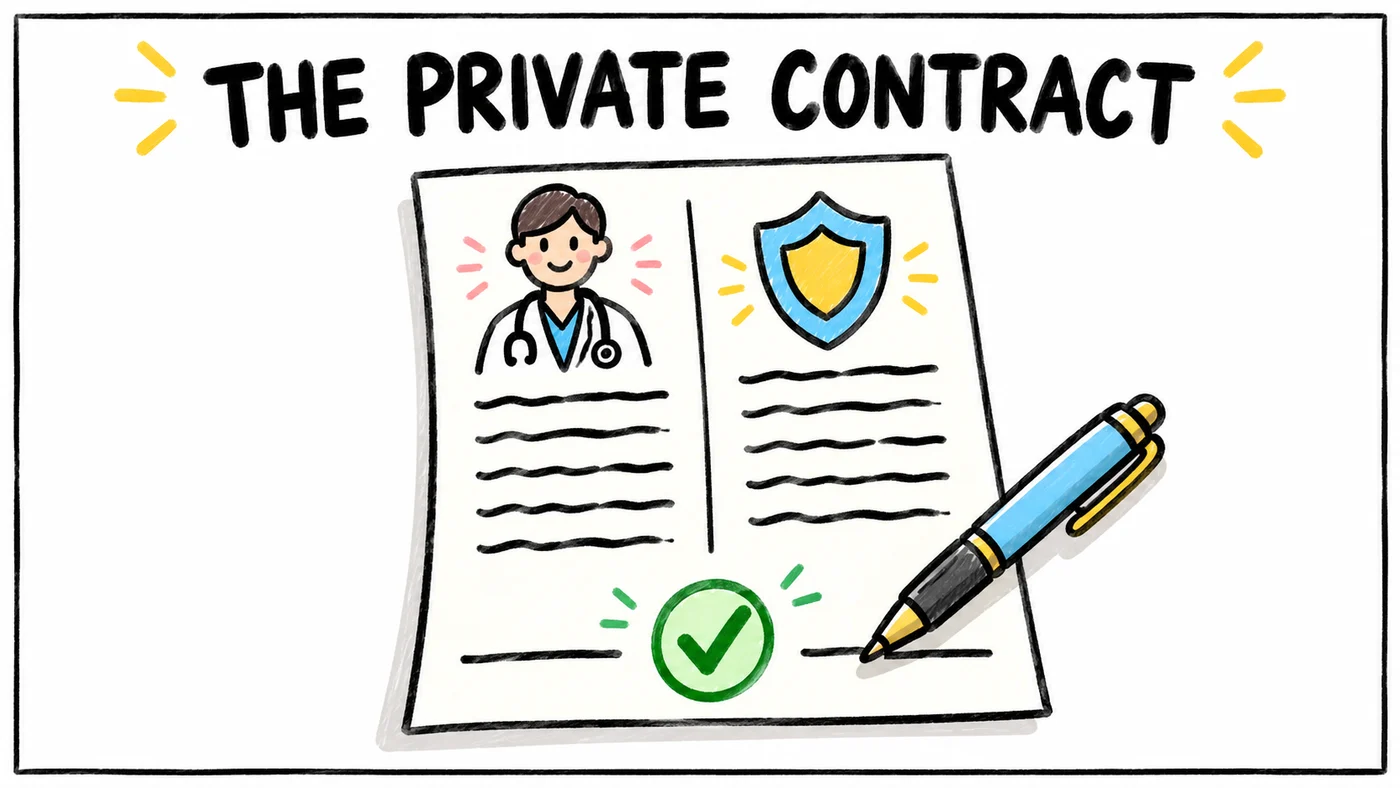
If your DPC doctor has opted out, you will be asked to sign a private contract before you receive care. This is a standard Medicare document, and its required contents are spelled out in 42 CFR 405.415. It is worth reading slowly, because it is the document that tells you exactly what you are agreeing to.
Under that rule, the contract must be in writing, in print large enough for you to read, and it must say that you (or your legal representative):
- Accept full responsibility for paying the doctor's charges for all services the doctor gives you.
- Understand that Medicare limits do not apply to what the doctor may charge.
- Agree not to submit a claim to Medicare, and not to ask the doctor to submit one, for the doctor's services.
- Understand that Medicare will not pay for services from this doctor that it would otherwise have covered.
- Understand that Medigap plans (the supplement policies that help pay Medicare's out-of-pocket costs) will not pay, and other supplemental plans may choose not to pay, for services Medicare doesn't pay for.
- Keep the right to get Medicare-covered care from other doctors who have not opted out, and are not required to sign private contracts with anyone else.
The contract must also state whether the doctor is excluded from Medicare, list the start and end dates of the doctor's current two-year opt-out period, and be signed by both you and the doctor. You must be given a copy before you receive any care under it, the doctor must keep the original for the whole two-year period, and a new contract is signed for each two-year period.
One protection matters a lot for older adults. A private contract cannot be signed while you need emergency or urgent care. If you ever need urgent care from an opted-out doctor you have not signed a contract with, 42 CFR 405.440 sets out how that visit is billed to Medicare under the normal rules.
The rules also hold the doctor to these terms. Under 42 CFR 405.435, a doctor who knowingly bills Medicare while opted out, or uses contracts that don't meet the requirements, can lose the opt-out. That is one reason well-run DPC practices take this paperwork seriously and are happy to walk you through it.
Does Medicare Advantage Work With a Direct Primary Care Doctor?
If you have a Medicare Advantage plan (sometimes called Part C), the answer is mostly the same, with one extra wrinkle. Under 42 CFR 422.220, an Advantage plan may not pay an opted-out doctor for basic Medicare benefits.
There are two exceptions. Your plan must pay for emergency or urgently needed services from an opted-out doctor you have not signed a private contract with, and a plan may choose to pay an opted-out doctor for supplemental benefits that go beyond basic Medicare. Neither exception covers a DPC membership in the usual sense, so plan on paying the membership yourself.
Your Advantage plan still covers the rest of your care, including hospital stays, specialists, labs and prescriptions, under its normal network and referral rules. If your plan requires a primary care doctor to make referrals, ask the plan how that works when your main doctor is outside the plan. Some people keep an in-network primary care doctor on file for referrals and use their DPC doctor for everyday care, which is a question worth raising with both the plan and the practice.
How Much Does Direct Primary Care Cost for Seniors?
Many DPC practices price their memberships by age, and older adults usually pay more than the lowest adult price. These figures come from the Tabflows DPC Finder's records of the prices practices publish on their own websites, most last checked in September 2026 and queried October 29, 2026 (DPC pricing report 2027). For adults 65 and older we took each practice's lowest tier for one person ("65+", "65 and older", "senior" or "Medicare"), leaving out tiers for people under 65, couples' plans and spouse or additional-member rates. The count doesn't include dental, vision or weight-only plans, or prices under 10 dollars a month.
The median 65+ tier at about 330 practices is about $110 a month, with the middle half between about $99 and $129.
That works out to about $1,300 a year at the median, on top of your Medicare premiums and any Medigap or Advantage costs.
When you compare prices, look at what the membership includes rather than the monthly number alone. One practice may include common labs and same-day visits, while another charges extra for them, and those differences can matter more than a small gap in price. Our DPC Finder lists practices near you with their published prices, which makes it easier to compare a few side by side.
Can You Use an HSA to Pay for DPC on Medicare?
You cannot add new money to a health savings account (HSA) once you are on Medicare. IRS Publication 969 says that beginning with the first month you are enrolled in Medicare, your HSA contribution limit is zero. It also says this applies to backdated Medicare coverage, so if you delay applying and your enrollment is later made retroactive, contributions made during those backdated months count as excess contributions.
If you already have money in an HSA, you can still spend it tax free on qualified medical expenses after you join Medicare. Since 2026, federal law has treated payments for a qualifying DPC arrangement, one that leaves out the services the law excludes, as a qualified medical expense. The monthly fee limit in those rules decides who can keep contributing, not what an HSA can pay, and IRS Notice 2026-5 sets no dollar limit on paying a qualifying fee. Whether a particular membership qualifies depends on those rules, which our guide to DPC and HSA rules for 2027 explains in detail.
If you are still working and approaching 65 with an HSA, the timing of your Medicare enrollment matters. It is worth talking with a tax advisor before you sign up, especially if you plan to keep contributing.
Questions to Ask a DPC Before You Join on Medicare
A short conversation with the practice will answer most of what you need to know. These are the questions that matter most for someone on Medicare, and our longer list of questions to ask before joining a DPC covers the rest.
- Has the doctor opted out of Medicare? Ask directly, and ask for the dates of the current opt-out period. CMS also publishes a public list of opted-out doctors and practitioners you can search.
- Can I see the private contract before I decide? A good practice will let you take it home and read it with family. Check that it includes the items listed above.
- What exactly does the membership include? Ask about visit limits, phone and message access, after-hours care, home visits, in-office labs and medications, and which of those cost extra.
- How do outside labs, imaging and referrals work? Ask where the practice sends blood work and imaging, and whether those places bill Medicare.
- How do you work with my specialists? If you see a cardiologist or other specialists, ask how records and test results are shared.
- What happens if I need care after hours or in the hospital? Ask whether the doctor stays in touch during a hospital stay and who to call at night.
- How do I cancel, and is there a notice period or fee? Ask how prices change with age and how much notice you get before a price increase.
If the doctor is enrolled in Medicare instead, the most useful question is which services the membership pays for and which visits are billed to Medicare, since the fee should only cover services and access Medicare doesn't pay for.
Is Direct Primary Care a Good Fit for Seniors on Medicare?
DPC tends to suit older adults who value time with the same doctor, easy access by phone or message, and help coordinating care across several specialists. People managing a few chronic conditions often find that unhurried visits and quick answers make day-to-day care feel less stressful. Our guide on whether direct primary care is worth it goes through the trade-offs in more detail.
It may be a weaker fit if the monthly fee would strain your budget, if your Advantage plan makes referrals hard without an in-network primary care doctor, or if you would rather keep everything inside Medicare. None of those is a reason to rule DPC out, but each is worth thinking through before you sign.
For Adult Children Helping a Parent Decide
If you are helping a parent, sit in on the first call or visit if they would like you to, and read the private contract together. Write down what the membership includes, how to reach the doctor after hours, and where to go for labs and imaging, so the whole family knows how care works.
It also helps to make sure the parent's records follow them. Many DPC practices use connected tools behind the scenes to keep messages, follow-ups and outside records in one place. Tabflows, for example, is a dedicated tech team that connects the EHR, billing and messaging tools a clinic already uses, so follow-ups and patient context don't get lost between them. When you visit a practice, asking how they handle follow-ups and outside records is a fair and useful question.
The Bottom Line
Direct primary care can work well on Medicare, as long as you know which kind of doctor you are joining. With an opted-out doctor, you sign a private contract, pay the doctor yourself, and keep Medicare for hospital care, specialists, outside labs and prescriptions. With an enrolled doctor, the membership can only pay for services Medicare doesn't cover.
Start by asking whether the doctor has opted out, read the private contract before you sign, and get a clear list of what the membership includes. When you are ready to look, the DPC Finder lists practices near you with their published prices.
FAQs
Can Medicare patients join a direct primary care practice?
Yes. Many direct primary care (DPC) practices accept people on Medicare. If the doctor has opted out of Medicare, you sign a private contract and pay the doctor yourself, and Medicare does not pay for that doctor's services. Your Medicare coverage stays in place for hospital care, specialists and other care from providers who bill Medicare. If the doctor is still enrolled in Medicare, the doctor cannot charge you a membership fee for services Medicare already covers.
Does Medicare pay for direct primary care?
No. Medicare.gov says Medicare does not cover membership fees for concierge care, a category it says also includes direct care, so you pay the membership yourself. If your DPC doctor has opted out of Medicare, Medicare also will not pay for any services that doctor gives you under your private contract, and Medigap plans will not pay for them either.
What is a Medicare private contract with a DPC doctor?
It is a written agreement, required by 42 CFR 405.415, between you and a doctor who has opted out of Medicare. In it you agree to pay the doctor's charges yourself, not to submit claims to Medicare for that doctor's services, and you confirm you understand Medicare will not pay and Medigap will not pay. It must also say you keep the right to get Medicare-covered care from other doctors, list the dates of the doctor's two-year opt-out period, be signed by both of you, and be given to you before you receive care.
If my DPC doctor opted out of Medicare, will Medicare still cover my labs, specialists and hospital care?
Generally yes. Under 42 CFR 405.425(i), a doctor who has opted out (and is not excluded from Medicare) can still order tests, prescribe drugs and refer you to specialists, and those services are covered when you get them from providers who bill Medicare, with your usual deductibles and coinsurance. What Medicare will not pay for is the opted-out doctor's own services, including any lab work or tests that doctor bills you for directly.
Will my Medicare Advantage plan pay a DPC doctor who opted out of Medicare?
Usually not. Under 42 CFR 422.220, Medicare Advantage plans cannot pay an opted-out doctor for basic Medicare benefits. The exceptions are emergency or urgently needed care from an opted-out doctor you have not signed a private contract with, and some supplemental benefits a plan chooses to offer. Your Advantage plan still covers the rest of your care from in-network providers.
Can I use an HSA to pay for direct primary care once I am on Medicare?
You cannot put new money into an HSA once you are enrolled in Medicare. IRS Publication 969 says your contribution limit is zero starting with the first month of Medicare enrollment, including any backdated months. Money already in your HSA can still be spent tax free on qualified medical expenses, and whether a DPC membership qualifies depends on the 2027 HSA rules for DPC arrangements.