How much should a DPC charge per month?
Most direct primary care practices charge a monthly membership priced by age, with lower prices for children, higher prices for seniors and a cap for families. Two independent data sets, the DPC Alliance's physician survey (collected late 2024, published July 2026) and Hint Health's billing data, put the national average for an individual member just under one hundred dollars a month. A good 2027 price for your practice sits near your local market, covers your costs at a panel size you can actually care for, and stays under the federal HSA fee limit so patients with health savings accounts can join and keep contributing to them.
In numbers, the national average is about $99 a month for an individual member.
The 2027 HSA limit is 150 dollars a month for one person and 300 dollars a month for a membership covering more than one person.
The rest of this guide shows where those averages come from, how practices structure their prices, what usually sits inside the fee and outside it, and what the numbers look like at different panel sizes. If you are still at the planning stage, our 2027 guide to starting a DPC practice covers the steps around pricing.
What is the average DPC membership fee in 2027?
The two best public sources agree remarkably well. The DPC Alliance's State of DPC report, published in July 2026, surveyed 465 physician-owned practices in late 2024. Hint Health's Trends in DPC 2026 report draws on membership prices in Hint's own billing database.
| Measure | Monthly price | Source |
|---|---|---|
| National average, all practices | About $99 per member | DPC Alliance, State of DPC |
| Median retail individual membership, 2025 | $99 | Hint Health, Trends in DPC 2026 |
| Median employer-sponsored membership, 2025 | $65 | Hint Health, Trends in DPC 2026 |
| Urban practices | $110.00 | DPC Alliance |
| Suburban practices | $99.78 | DPC Alliance |
| Rural practices | $81.56 | DPC Alliance |
| West | $113.28 | DPC Alliance |
| Northeast | $110.44 | DPC Alliance |
| South | $98.38 | DPC Alliance |
| Midwest | $80.36 | DPC Alliance |
| Panels under 200 members | $105.93 | DPC Alliance |
| Panels of 201 to 500 | $99.28 | DPC Alliance |
| Panels over 500 | $77.74 | DPC Alliance |
The DPC Alliance report notes that rural prices were significantly lower than urban ones, and that the Midwest and South were significantly lower than the Northeast. It also found that practices with larger panels tend to charge less, and suggests this may reflect supply and demand, or older practices that have not raised prices over time.
How DPC prices have changed since 2017
Retail DPC prices have climbed steadily while employer prices have risen more slowly, according to Hint's report.
The retail median rose from the mid-$70s in 2020 to $99 a month in 2025, while employer-sponsored rates held between $55 and $66.
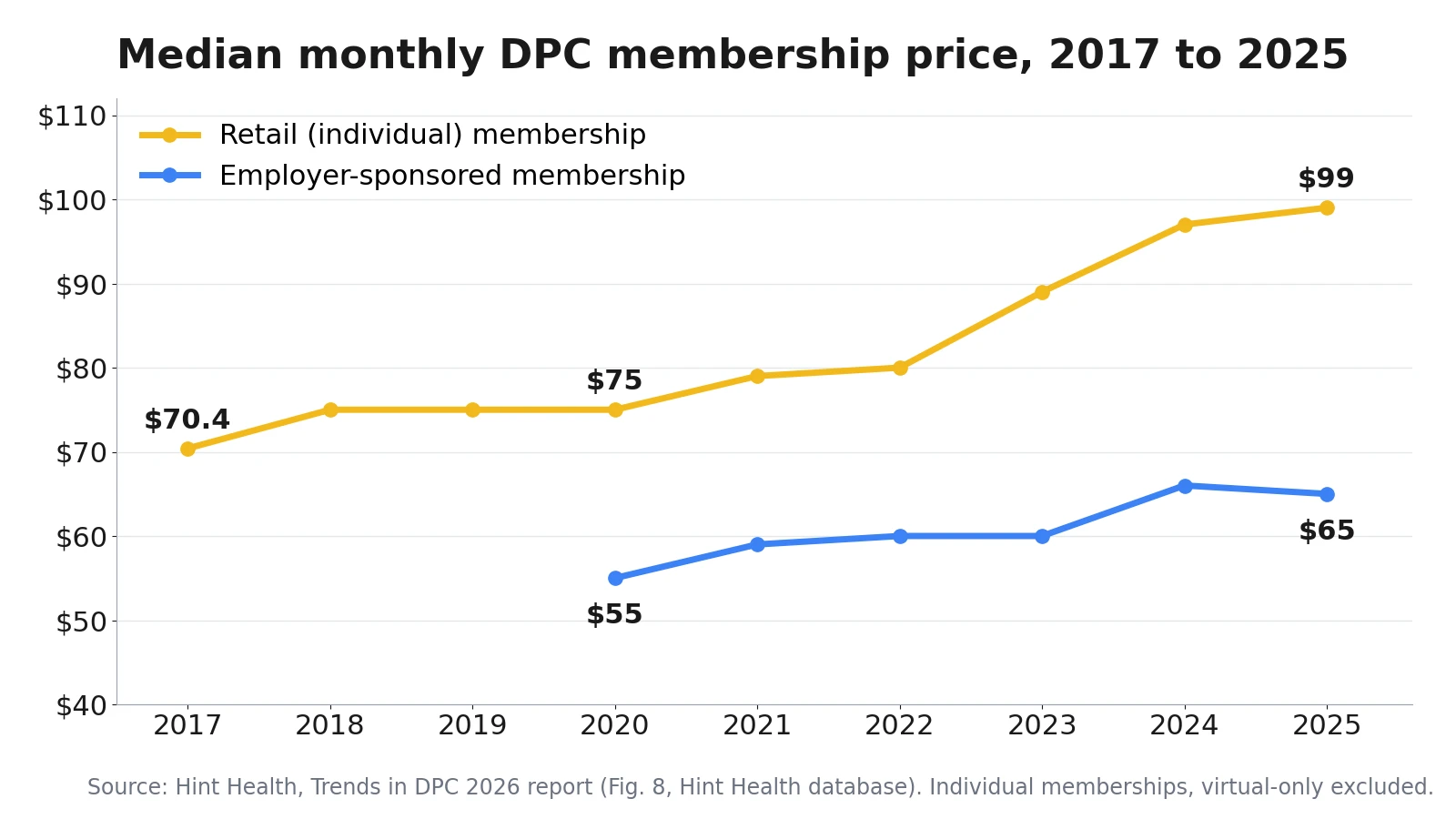
Hint also compared prices to incomes. From 2017 to 2024, it found median household income rose 36% and retail membership prices rose 38%, which suggests prices have moved roughly in line with what households can afford.
How do DPC practices structure their pricing?
There are five common building blocks, and most practices combine two or three of them. The DPC Alliance survey found that 76.4% of practices use age-based tiers, 15.1% charge one flat price, and 8.5% use family tiering, where the price per member changes with how many family members join together.
Age-banded pricing
Age bands are the default because the work of caring for a 70-year-old with three chronic conditions is genuinely different from caring for a healthy 30-year-old. Most practices use three to five bands, with children lowest and adults over 65 highest. The bands also make the price feel fair to younger, healthier members who might otherwise feel they are subsidizing everyone else.
Flat pricing
One price for every adult is simple to explain, simple to bill and easy to put on a billboard. It tends to suit practices with a narrow patient mix, such as a practice that mostly serves working-age adults through employers. The tradeoff is that your youngest members pay more than they would elsewhere, and your oldest members may be underpriced for the time they need.
Family caps and household pricing
A family cap sets a maximum monthly price for a household no matter how many children are enrolled. It is one of the strongest reasons parents choose a DPC, because it removes the mental math of adding a fourth or fifth child. Some practices also price couples together.
Employer pricing
Employer contracts are usually priced lower per member than retail memberships.
Hint's data shows a 2025 employer median of $65 a month, compared with $99 for retail.
That gap reflects volume. An employer group brings many members at once, pays reliably and often enrolls healthier working-age adults. Hint also reports that nearly 60% of active memberships on its platform were paid for by an employer in 2025, so this is a large part of the market and worth a separate price sheet.
Enrollment fees
Many practices charge a one-time enrollment or registration fee to cover the long first visit, records transfer and setup. It also gently discourages people from joining only when sick and leaving once they feel better. Practices often waive it for employer groups, during an opening period or for members who rejoin.
Real DPC price pages, as published examples
Published price pages are the best way to see how these pieces fit together. The three below were checked on October 29, 2026, and are shown only as examples of structure, not as recommendations. Prices change, so check each page directly.
502 Direct Primary Care in Kentucky uses four age bands and a family maximum:
- Ages 0 to 22 at $59 a month, 23 to 44 at $89, 45 to 64 at $109, and 65 and over at $129.
- A family maximum of $259 a month.
- An enrollment fee of $149 per person or $249 per family, with labs done on site at wholesale cost.
Cove DPC prices by age and caps the household:
- Children 2 to 18 at $35 a month, adults 19 to 44 at $65, 45 to 64 at $75, and 65 and over at $85.
- A family maximum of $200 a month for the whole household.
- Screening labs at the new-patient and annual visits are included, with additional labs at wholesale.
Duet Family Health in Chicago combines age bands with couple and family prices:
- Children 0 to 17 at $70 a month, adults 18 to 44 at $90, 45 to 64 at $110, and 65 and over at $150.
- A young couple at $170, a couple over 45 at $190 and a family of four at $290.
- A one-time enrollment fee of $100 per individual or $200 for a family of up to four.
You can browse many more price pages through the DPC Finder, which lists DPC practices across the country.
Why the HSA fee cap matters for your 2027 prices
From January 1, 2026, the One Big Beautiful Bill Act (Public Law 119-21) made qualifying direct primary care arrangements compatible with health savings accounts, and capped the monthly fee for members who want to keep contributing. IRS Revenue Procedure 2026-24 confirms that the cap for calendar year 2027 stays the same as in 2026.
The 2027 limit is 150 dollars per month for one person and 300 dollars per month for an arrangement that covers more than one person.
This matters for pricing because a member with an HSA-qualified plan can keep contributing to their HSA only if your fee is at or under the cap. Paying is a separate rule: if your membership otherwise qualifies, the member can pay your fee from their HSA even above the cap, but enrolling in it stops their new contributions for as long as they stay enrolled.
A senior band above 150 dollars or a family maximum above 300 dollars could quietly push some patients out of HSA eligibility.
Keeping every tier at or under the cap lets you tell HSA holders on your price page that joining won't cost them their HSA contributions. The rules have more detail on what the arrangement may and may not include, and we cover them fully in our guide to DPC and HSA rules for 2027.
What does a DPC membership include, and what costs extra?
The membership fee usually covers the relationship itself, meaning unlimited or generous access to your doctor in person, by phone, by text and by video, along with chronic disease management, care coordination and many simple in-office procedures. The details vary from practice to practice, and members appreciate a clear, written list.
| Usually inside the membership | Often extra, at or near cost | Billed outside the practice |
|---|---|---|
| Office and virtual visits | Labs, often at wholesale cost | Specialist visits |
| Texting, calls and messaging with the doctor | Medications dispensed in the office | Hospital care and emergencies |
| Chronic disease management | Some procedures and supplies | Most imaging |
| Many in-office procedures | Vaccines in some practices | Insurance-covered services |
| Annual wellness visit | Enrollment fee, one time |
The three example pages above follow this pattern. 502 Direct Primary Care says in-office procedures and tests are included and labs are done at wholesale cost, while Cove DPC lists screening labs as included and on-site medications as an additional charge. Being specific on your price page saves you dozens of questions at the front desk and makes your value easier to compare with insurance.
If you are wondering how a DPC fee compares to a higher-priced concierge retainer, our guide to DPC vs concierge medicine explains the difference.
Example age-banded price sheet for 2027
Here is an example price sheet built from the averages above. It is an illustration, not a recommendation, and you should adjust it to your local market and your costs.
| Example tier | Example monthly price | Notes |
|---|---|---|
| Children 0 to 18 (with an enrolled parent) | $40 | Lower price encourages whole-family enrollment |
| Adults 19 to 44 | $85 | Between the Midwest and South averages |
| Adults 45 to 64 | $105 | Near the national average |
| Adults 65 and over | $125 | Under the 150 dollar HSA cap for one person |
| Family maximum | $280 | Under the 300 dollar HSA cap for more than one person |
| Employer groups | Quoted per group | Hint's 2025 employer median was $65 |
| Enrollment fee | $75 per person, one time | Often waived for employer groups |
Every individual tier in this example sits under 150 dollars, and the family maximum sits under 300 dollars, so as long as the membership otherwise qualifies, a member with an HSA-qualified plan stays eligible to contribute under the 2027 limits.
Worked example of DPC revenue at different prices and panel sizes
This is pure arithmetic to show how price and panel size interact. It assumes every member pays the same blended monthly price and ignores enrollment fees, labs, medications, churn and processing fees.
| Panel size | At $75 a month | At $100 a month | At $125 a month |
|---|---|---|---|
| 300 members | $270,000 a year | $360,000 a year | $450,000 a year |
| 450 members | $405,000 a year | $540,000 a year | $675,000 a year |
| 600 members | $540,000 a year | $720,000 a year | $900,000 a year |
Two things stand out. A higher price lets you reach the same revenue with a smaller panel, and a smaller panel is what gives DPC its longer visits and same-day access.
For example, 450 members at $100 a month brings in the same $540,000 a year as 600 members at $75.
In practice your blended price will sit below your adult price, because children and family caps pull the average down. The DPC Alliance survey also found that most respondents run panels well below the often-cited 600-patient benchmark, so plan your numbers around the panel you actually want to care for. To find the panel size where your practice covers its costs, see our guide to DPC break-even panel size and our breakdown of what it costs to start a DPC.
How to choose your own price
A simple, defensible way to set your 2027 price is to work from three directions and meet in the middle.
- Start with your costs. Add up rent, staff, software, malpractice, supplies and the salary you need, then divide by the panel size you want. That gives you the blended price you need, not just the price you hope for.
- Look at your local market. Check the price pages of nearby practices on the DPC Finder and compare them with the regional and rural averages in the table above.
- Check the HSA cap. Make sure every tier you publish stays at or under 150 dollars a month for one person and 300 dollars a month for a membership covering more than one person if you want HSA-eligible patients to be able to join without worry.
Many physicians underprice at launch out of kindness, and then find it hard to raise prices later. Starting at a price that sustains the practice is a kindness to your future members too, because it keeps your doors open and your panel small enough to give them real time.
How to raise DPC prices on existing members kindly
Prices will need to move over time, and the Hint data shows the retail median has risen most years since 2020. Members usually understand an increase when they hear about it early and the reasoning is honest.
- Give generous notice. Tell members in writing well before the new price takes effect, ideally a couple of months ahead and on a clear date such as their renewal.
- Explain what changed. A short, plain note about rising rent, staff wages or supply costs reads very differently from a bare number on a card statement.
- Decide on grandfathering up front. Some practices hold founding members at their original price for a set period, which rewards the patients who took a chance on you early.
- Offer a way to talk. Invite anyone who is worried about cost to reach out, and decide in advance how you will handle hardship cases.
- Keep the HSA cap in mind. An increase that pushes a tier above 150 dollars a month for one person or 300 dollars a month for a household membership affects HSA eligibility, so check before you announce.
The hardest part of a price change is often not the decision but the follow-through, such as making sure every member got the notice, updating every subscription on the right date and answering replies without anyone slipping through. That work sits between the billing platform, the messaging tool and the team's to-do list, which is where tools tend to leave gaps. Tabflows is a dedicated tech team that connects the tools a clinic already uses, like the EHR, billing and messaging, so follow-ups and tasks like these land in one place with the patient context attached. Our guide to membership renewal tracking walks through the same idea for renewals.
The bottom line on DPC pricing for 2027
A typical DPC adult membership in 2027 will sit close to the national average, with lower prices for children and rural markets and higher prices in the West and Northeast. Age bands with a family cap are the most common structure, employer contracts run lower per member, and keeping every tier under the HSA limits keeps the door open for HSA holders. Choose a price that supports the panel size you want, publish what is included in plain words, and when the time comes to raise it, give members the notice and explanation they deserve.
FAQs
How much should a direct primary care practice charge per month in 2027?
Most practices price by age, with children usually lower, seniors higher and families often capped at a household maximum. The two main national benchmarks are the DPC Alliance's State of DPC report and Hint Health's 2026 trends report, and the right price for your own practice also depends on your local market and your costs. Most DPC practices land between about $75 and $125 per adult per month. The DPC Alliance found a national average of about $99 per member per month, and Hint put the 2025 median retail individual membership at $99 per month.
What is the average DPC membership fee?
Two national sources measure it. The DPC Alliance's State of DPC report, published in July 2026 from a survey of 465 physician-owned practices, gives a national average per member, and Hint Health's 2026 report gives medians from its own billing data, where employer-sponsored memberships are priced lower than retail ones. The DPC Alliance reported a national average of roughly $98 to $99 per member per month. Hint put the median retail individual membership at $99 per month in 2025 and the median employer-sponsored membership at $65 per month.
Do most DPC practices price by age?
Yes. In the DPC Alliance survey, 76.4% of practices used age-based tiers, 15.1% charged one flat price, and 8.5% used family tiering where the price per member changes with the number of family members who join together.
What is the HSA limit on DPC membership fees in 2027?
Starting January 1, 2026, enrollment in a qualifying direct primary care service arrangement does not disqualify someone from contributing to an HSA if the aggregate fees are no more than 150 dollars per month for one person or 300 dollars per month for an arrangement covering more than one person. IRS Revenue Procedure 2026-24 confirms the same 150 and 300 dollar limits for calendar year 2027. The limit decides contributions, not payment: a membership that otherwise qualifies can still be paid from HSA money above it, but enrollment in it stops new contributions.
What is usually included in a DPC membership fee and what costs extra?
The membership fee usually covers visits, texting, calls and virtual visits with your doctor, chronic disease management, and many in-office procedures. Labs are commonly offered at or near wholesale cost, medications dispensed in the office are often sold near wholesale, and imaging, specialists, hospital care and some procedures are billed separately. Each practice publishes its own list, so read the price page.
How do you raise DPC membership prices on existing members?
Give members plenty of written notice, explain plainly what has changed in your costs, apply the new price on a clear date such as a renewal, and decide in advance whether long-time members are grandfathered for a period. Most members accept a fair, well-explained increase far better than a surprise on their card statement.