What Insurance Should You Pair With Direct Primary Care?
Pair your direct primary care membership with coverage for the big, rare costs that a primary care doctor cannot handle, such as hospital stays, surgery, cancer treatment and specialists. For most people under 65 in 2027 that means a bronze or catastrophic plan from the ACA Marketplace or a high deductible plan through work, and both can now be combined with a qualifying DPC membership and a health savings account (HSA). If you are 65 or older, Medicare does that job. Health care sharing ministries and short-term plans can cost less up front, but they are not comprehensive insurance and they do not make you HSA eligible on their own.
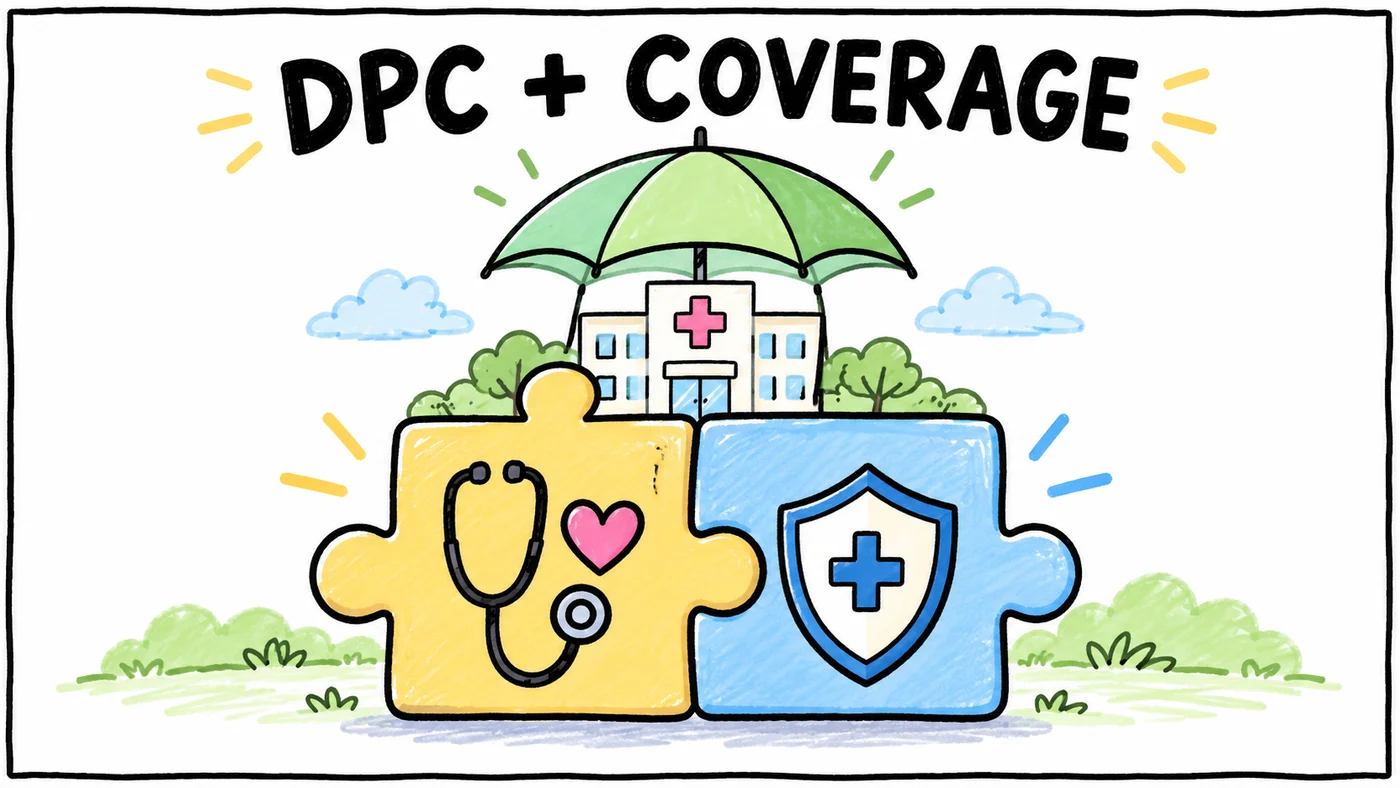
Your DPC membership handles the everyday part of health care, like visits, messages with your doctor and many in-office procedures, while the insurance is the umbrella for the expensive, unpredictable part. This guide walks through each option, what changed for 2027, and how to run the numbers.
This page is general information, checked against federal sources on October 29, 2026. It is not insurance, tax or legal advice, and plan rules vary by state, so confirm details with a licensed broker or tax advisor before you enroll.
Why Do You Still Need Insurance With a DPC Membership?
A DPC membership is not insurance. It is a flat monthly fee paid directly to a primary care practice for primary care, and it does not pay for care you get anywhere else. If you need an emergency room, an MRI, an operation or a week in the hospital, the membership will not cover those bills. If you are new to how DPC differs from other membership models, our guide to DPC vs concierge medicine explains the basics.
That is why DPC doctors usually describe insurance as a "wraparound." You keep a plan for the catastrophic side, and many people find they can choose a lower premium plan with a higher deductible because their routine care is already paid for. The trick is picking a plan whose gaps your DPC membership actually fills, and whose rules do not trip up your HSA.
What Changed for DPC and Insurance in 2027?
Two changes from the One Big Beautiful Bill Act, Public Law 119-21, signed July 4, 2025, shape every option below. Both took effect for months starting after December 31, 2025, so they apply all through 2027.
First, section 71308 says a qualifying DPC membership is no longer treated as a health plan that blocks HSA contributions, as long as fees stay at or under a monthly cap. Second, section 71307 says bronze and catastrophic plans available as individual coverage through an ACA Exchange are treated as high deductible health plans (HDHPs) for HSA purposes, even when their deductible or out-of-pocket limit would not otherwise qualify. The IRS explained both changes in Notice 2026-5, which adds that an identical bronze or catastrophic plan bought off the Exchange also counts. We cover the DPC side in depth in our guide to DPC and HSA rules for 2027.
The 2027 figures come from IRS Rev. Proc. 2026-24. The DPC fee cap stays at 150 dollars a month for one person and 300 dollars a month for a membership covering more than one person.
For 2027, a regular HDHP needs a deductible of at least 1,750 dollars for self-only coverage or 3,500 dollars for family coverage, and out-of-pocket costs of no more than 8,700 dollars self-only or 17,400 dollars family. The HSA contribution limit rises to 4,500 dollars for self-only and 9,000 dollars for family coverage.
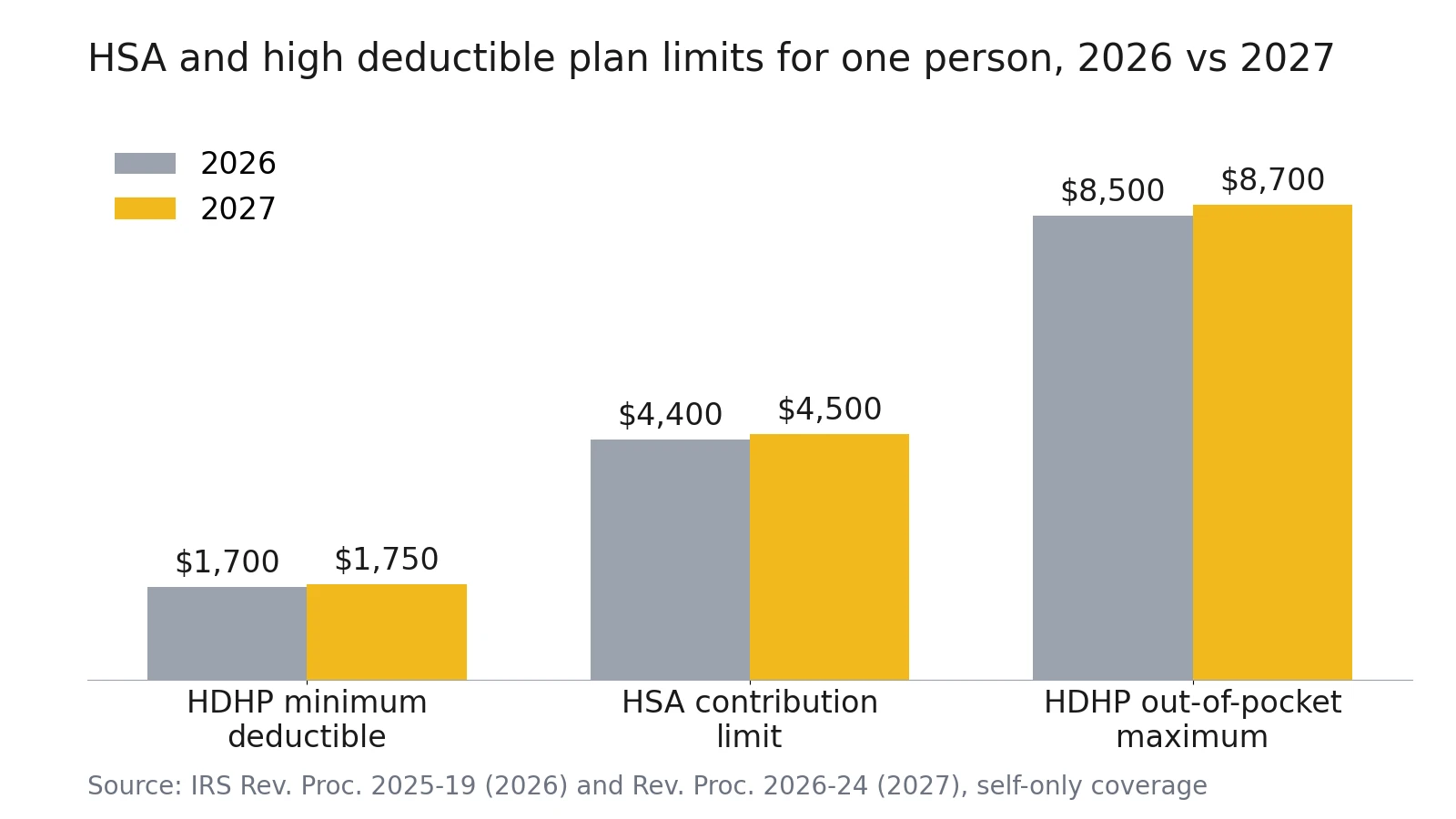
The 2026 comparison figures are from IRS Rev. Proc. 2025-19. One more detail matters for budgeting. Notice 2026-5 says DPC membership fees do not count toward your plan's deductible or out-of-pocket maximum, so treat the membership and the deductible as two separate lines in your budget.
DPC Insurance Options Compared for 2027
Here is how the common pairings stack up. "HSA eligible with DPC" assumes your DPC membership meets the federal definition and stays at or under the 2027 fee cap.
| Coverage | What it covers | HSA eligible with DPC in 2027? | Watch-outs |
|---|---|---|---|
| Bronze Marketplace plan | Full ACA coverage, including hospital, specialists, prescriptions and the 10 essential health benefits | Yes, bronze Exchange plans count as HDHPs from 2026 | High deductible, and premium tax credits depend on income |
| Catastrophic Marketplace plan | ACA essential health benefits after a very high deductible, free preventive care, and at least 3 primary care visits a year before the deductible | Yes, catastrophic Exchange plans count as HDHPs from 2026 | Only for people under 30 or with a hardship or affordability exemption, and premium tax credits cannot be used on it |
| Employer high deductible plan | Group coverage set by your employer | Yes, if the plan meets the 2027 HDHP rules | Check whether your employer already pays for a DPC membership, since the HSA cannot also reimburse that fee |
| Other employer or Marketplace plan (silver, gold, PPO) | Comprehensive coverage with lower deductibles | Usually no, unless the plan itself meets HDHP rules | You may pay twice for primary care, through copays and the membership |
| Health care sharing ministry | Voluntary sharing of members' eligible medical bills under the ministry's own guidelines | No, a ministry is not an HDHP | Not insurance, no guarantee of payment, pre-existing conditions often limited |
| Short-term limited duration plan | Varies by policy, often excludes pre-existing conditions and some essential benefits | Only if that specific policy meets HDHP rules, which many do not | Not ACA coverage, and federal and state rules on length keep shifting |
| Medicare (65 and older) | Hospital (Part A), outpatient and specialists (Part B), drugs (Part D) or a Medicare Advantage plan | No, HSA contributions stop once you enroll in Medicare | Medicare does not pay DPC fees, and your DPC doctor may have opted out |
The sections below explain each row in more detail.
Can You Pair DPC With a Bronze Plan?
Yes, and for many self-employed people and families who buy their own coverage it is now one of the strongest options. A bronze Marketplace plan covers the same essential health benefits as any other metal level, with lower premiums and higher out-of-pocket costs. Pairing it with DPC means your everyday care is handled by the membership while the bronze plan sits in the background for hospital and specialist care.
The 2027 advantage is the HSA. Because section 71307 treats bronze Exchange plans as HDHPs, you can open and fund an HSA, use it to pay your DPC fee tax free, and save the rest toward the bronze deductible. HealthCare.gov now notes on its catastrophic plans page that all bronze and catastrophic plans work with HSAs, and the plan browser has an "Eligible for an HSA" filter.
One thing to compare carefully is silver. HealthCare.gov points out that if you qualify for premium tax credits or cost-sharing reductions, a bronze or silver plan may be a better value than catastrophic coverage, and the same logic applies when you are choosing between bronze and silver. Cost-sharing reductions only apply to silver plans, so if your income qualifies, run both.
Can You Pair DPC With a Catastrophic Plan and an HSA?
Yes. A catastrophic plan is the leanest ACA option, and from 2026 it counts as an HDHP for HSA purposes, so catastrophic plus DPC plus an HSA is a legitimate 2027 setup. Catastrophic plans cover the 10 essential health benefits, free preventive care, and at least three primary care visits a year before the deductible.
The question is who can buy one. HealthCare.gov lists people under 30 and people who qualify for a hardship or affordability exemption. In September 2025 CMS issued guidance on hardship exemptions for plan year 2026 and future years, adding a new hardship for people who are not eligible for advance premium tax credits or cost-sharing reductions because of their income. In plain terms, many adults who earn too much (or too little) for Marketplace subsidies can now apply for the exemption and buy catastrophic coverage. CMS also said it would make the exemption easier to request through HealthCare.gov.
Catastrophic plans are not offered in every county, and you cannot apply premium tax credits to them. If you qualify for subsidies, a subsidized bronze plan will often cost you less per month than an unsubsidized catastrophic plan.
Can You Use an Employer Plan With DPC?
Yes. If your employer offers a high deductible plan that meets the 2027 HDHP numbers, adding a qualifying DPC membership keeps you HSA eligible. This is the setup many employers now offer on purpose, with the employer paying the DPC membership and an HDHP covering everything else. Hint Health's 2026 Trends in DPC report found that nearly 60% of DPC memberships are employer-paid.
There is one rule to know. Notice 2026-5 says DPC fees paid by your employer, including through pre-tax salary reduction in a cafeteria plan, cannot also be reimbursed from your HSA, because they were not your own expense. If you pay the membership yourself, you can use HSA money for it.
If your employer plan is a lower-deductible PPO or HMO, DPC still works, but it will not make you HSA eligible and you may pay for primary care twice. DPC owners who want to bring this setup to local businesses can read our guide on selling direct primary care to employers.
Is a Health Care Sharing Ministry a Good Pair for DPC?
Health care sharing ministries are popular with DPC patients because monthly contributions can be lower than unsubsidized premiums. But a ministry is not insurance, and that difference matters when a large bill arrives.
Michigan's Department of Insurance and Financial Services explains that ministries are not considered health insurance "because they do not assume any risk, and because the ministries are not legally or contractually obligated to pay health care costs." The same notice says ministries do not have to cover pre-existing conditions or essential health benefits. Other regulators, including Massachusetts and Tennessee, publish similar consumer guidance.
For HSA purposes, a ministry is not a high deductible health plan. IRS Publication 969 requires HDHP coverage to contribute to an HSA, so DPC plus a sharing ministry alone does not make you HSA eligible. If a ministry is your choice, read its sharing guidelines closely, especially the parts on pre-existing conditions, annual or per-incident limits, and what happens when a bill is not shared.
What About Short-Term Health Plans With DPC?
Short-term limited duration plans are sold outside the ACA rules, so they can exclude pre-existing conditions and skip some essential benefits. In 2024 the Departments of Labor, HHS and the Treasury issued a final rule limiting short-term plans to an initial term of no more than three months and a total of no more than four months including renewals.
That rule is in flux. On August 7, 2025 the departments announced that they do not intend to prioritize enforcement of the 2024 definition while they write a new rule, and invited states to take a similar approach or apply their own definitions. In practice, how long a short-term plan can last now depends heavily on your state, so check with your state insurance department before relying on one.
A short-term plan only works with an HSA if that specific policy meets the regular HDHP rules. The bronze and catastrophic shortcut in section 71307 does not apply to short-term plans. For most people, short-term coverage is best treated as a bridge between other coverage rather than the long-term partner for a DPC membership.
How Does DPC Work With Medicare?
If you are 65 or older, Medicare is your wraparound coverage. Part A covers hospital care and Part B covers outpatient care and specialists, whether or not your primary care doctor runs a DPC practice. What changes is how your DPC doctor is paid.
Many DPC doctors have opted out of Medicare. Under the opt-out rules in the Medicare Benefit Policy Manual, chapter 15, you sign a private contract with that doctor, you pay for their services yourself, and Medicare does not pay that doctor or reimburse you for those visits. Your hospital stays, imaging and specialist care from Medicare providers are still covered as usual. CMS publishes a public list of opt-out physicians if you want to check.
Some DPC and concierge doctors stay enrolled in Medicare instead. Medicare.gov says Medicare does not cover membership fees, and a doctor who accepts assignment cannot charge you extra in the membership for services Medicare usually covers. Ask your practice which model it uses before you join. Physicians weighing this choice can read our guide to converting a practice to direct primary care, which walks through opt-out in detail.
One HSA note for people turning 65 is worth flagging. IRS Publication 969 says your HSA contribution limit drops to zero starting the first month you are enrolled in Medicare, although you can keep spending money already in the account, including on a DPC fee.
A Worked Example of the Annual Cost Math for One Person
Every household's numbers differ, so here is a template you can fill in. This is an example with stated assumptions, not a quote or a recommendation.
The assumptions are one adult in 2027 buying a bronze Marketplace plan with a monthly premium of P (look up your own on HealthCare.gov), a plan out-of-pocket maximum of M, a DPC membership that qualifies for HSA purposes, and an HSA funded to the 2027 self-only limit. We use the national average DPC fee from the DPC Alliance State of DPC report.
DPC membership at about $99 a month comes to $1,188 for the year.
Fixed yearly cost is then 12 × P + $1,188, before any tax savings.
The HSA limit for 2027 is 4,500 dollars. You could pay the membership from the HSA with pre-tax dollars.
If your federal income tax bracket were 22%, contributing the full amount would lower your federal income tax by about $990.
In a quiet year, your costs are roughly the premiums plus the membership, minus the tax savings, because most of your care happens at the DPC practice. In a bad year, add up to M on top, since DPC fees do not count toward the bronze plan's out-of-pocket maximum. Comparing that worst case across two or three plans is usually more useful than comparing premiums alone.
To compare against a richer plan, run the same math with its premium and out-of-pocket maximum, and remember that a non-HDHP plan takes the HSA tax savings off the table. If you want to see how practices set the fee itself, our guide on how much to charge for a DPC membership shows typical ranges.
How to Choose the Right Pairing
Most people can narrow it down with a few questions:
- Are you 65 or older? Medicare is your wraparound, and HSA contributions stop once you enroll.
- Does your employer offer an HDHP or pay for DPC? Start there, because employer contributions usually beat anything you can buy alone.
- Do you buy your own coverage? Compare a bronze plan (and silver if you qualify for cost-sharing reductions) on HealthCare.gov or your state Exchange, with the HSA filter on.
- Are you under 30, or unable to get subsidies because of your income? Check whether a catastrophic plan is offered in your area.
- Considering a sharing ministry or short-term plan? Read the guidelines for pre-existing conditions and limits, and know that neither makes you HSA eligible on its own.
If you have ongoing conditions, expensive medicines or a planned surgery, put more weight on the out-of-pocket maximum and the drug coverage than on the premium, and ask your DPC practice which local plans and hospitals its patients use.
For DPC Owners Sharing This With Patients
Patients ask this question constantly, and the honest answer depends on their age, income, employer and state. Many practices keep a one-page insurance explainer in the welcome packet and on the website, link to HealthCare.gov and the HSA rules, and suggest a local broker they trust. If you are still setting up your practice, our 2027 guide to starting a DPC practice and the companion post on insurance for a new DPC practice cover the business side, and DPC laws by state covers how your state treats memberships.
The follow-up work is where things slip. A patient asks about HSA receipts, another needs an itemized statement for their sharing ministry, and a third is turning 65 and wants to know what changes. Tabflows is a dedicated tech team that connects the tools your clinic already uses, like your EHR, billing and messaging, so those questions become tracked tasks with the patient's context in one place instead of sticky notes. Patients looking for a practice near them can browse the DPC Finder.
Sources
- Public Law 119-21 (One Big Beautiful Bill Act), sections 71307 and 71308
- IRS Notice 2026-5
- IRS Rev. Proc. 2026-24 (2027 figures) and Rev. Proc. 2025-19 (2026 figures)
- IRS Publication 969
- HealthCare.gov, catastrophic health plans
- CMS guidance on hardship exemptions, September 4, 2025
- 2024 short-term limited duration insurance final rule and the August 7, 2025 departments' statement
- Michigan DIFS on health care sharing ministries
- Medicare.gov, concierge care and CMS Medicare Benefit Policy Manual, chapter 15
- DPC Alliance, State of DPC 2026 and Hint Health, 2026 Trends in DPC
This article summarizes federal law and guidance as of October 29, 2026. It is general information, not insurance, tax or legal advice. Talk to a licensed insurance broker about plans in your state and a tax advisor about your HSA.
FAQs
What insurance should I pair with direct primary care in 2027?
Most people pair a DPC membership with a plan that covers the big, rare costs, such as a bronze or catastrophic plan from the ACA Marketplace, a high deductible plan from an employer, or Medicare if they are 65 or older. Bronze and catastrophic Marketplace plans count as high deductible health plans for HSA purposes starting in 2026 under Public Law 119-21, so in 2027 they can be combined with a qualifying DPC membership and an HSA. Health care sharing ministries and short-term plans cost less in some cases but are not comprehensive insurance and come with real gaps.
Can I have DPC, a high deductible health plan and an HSA at the same time in 2027?
Yes, if the DPC membership qualifies. Since January 1, 2026, a direct primary care arrangement that covers only primary care for a fixed fee no longer blocks HSA contributions, as long as total DPC fees stay at or under 150 dollars a month for one person or 300 dollars a month for a membership covering more than one person in 2027 (IRS Rev. Proc. 2026-24). You also need to be covered by a high deductible health plan, which for 2027 means a deductible of at least 1,750 dollars for self-only coverage and out-of-pocket costs of no more than 8,700 dollars, unless it is a bronze or catastrophic Exchange plan, which counts automatically.
Is a health care sharing ministry insurance?
No. Health care sharing ministries are not health insurance. State regulators such as Michigan's Department of Insurance and Financial Services point out that ministries are not legally or contractually obligated to pay members' medical bills and do not have to cover pre-existing conditions or essential health benefits. Because a sharing ministry is not a high deductible health plan, having only a ministry plus DPC does not make you eligible to contribute to an HSA.
Who can buy a catastrophic plan with DPC in 2027?
HealthCare.gov says catastrophic plans are open to people under 30 and to people who qualify for a hardship or affordability exemption. In September 2025 CMS expanded the hardship exemption for plan year 2026 and later years to people who cannot get premium tax credits or cost-sharing reductions because of their income, which opened catastrophic plans to many more adults. Catastrophic plans are not sold in every area, so check what is offered where you live.
Does DPC work with Medicare?
Yes, but how it works depends on whether your DPC doctor has opted out of Medicare. If the doctor opted out, you sign a private contract and pay for their services yourself, and Medicare does not pay that doctor. Medicare still covers your hospital stays, specialists, imaging and other care from Medicare providers. Medicare does not cover membership fees. Once you enroll in Medicare you can no longer contribute to an HSA.
Do DPC membership fees count toward my insurance deductible?
No. IRS Notice 2026-5 says DPC membership fees are not out-of-pocket payments for services covered by the high deductible health plan, so they do not count toward the plan's deductible or out-of-pocket maximum. Your DPC fee and your insurance deductible are two separate buckets.