Can You Open a DPC Right Out of Residency?
Yes, you can open a direct primary care practice right out of residency, and some family physicians do. In the 2026 DPC data brief from the AAFP and the DPC Alliance, 8% of physicians practicing in DPC said they opened their practice immediately after residency. What changes for a new grad is the starting line, since you have no patients who will follow you, no practice history for a lender to read, and student loans that may stop counting toward PSLF once you own the practice. Plan for those three things and the path is real.
The same survey shows the more common route, too. Sixty-three percent of DPC respondents opened an independent practice after leaving a health system or group, which is why most DPC advice assumes you are bringing a following with you. If you are a PGY-2 or PGY-3 reading this, that advice is only partly about you, and this guide covers the parts that are different.
It is general information, not legal, tax or financial advice. For the full launch sequence, start with how to start a DPC practice, then come back here for the new grad questions.
What Is Different When You Open a DPC as a New Grad?
The model is the same whether you are 31 or 51. The differences are in your starting position, and most of them are about money and time rather than skill. Your residency taught you to care for a broad panel; what it usually did not give you is a list of people who already think of you as their doctor.
| Question | Opening right out of residency | Opening after a few years employed |
|---|---|---|
| Who joins in month one | Founding members you recruit from scratch, plus friends, family and local employers | Often some patients who follow you from your old practice, if your contract allows it |
| Student loans | PSLF clock usually pauses while you own the practice | Some PSLF payments may already be banked, or loans may be smaller |
| Board certification | Exam in spring of PGY-3, so results and certification may arrive around opening | Usually already certified |
| Lender view | Personal credit, your savings and a business plan, with no practice history | A track record of income, and sometimes a known local reputation |
| Noncompete | Usually none, since you have not signed one yet | Can limit where you open or who you can tell |
| Personal costs | Often lower, since you are used to resident pay | Often higher, with a lifestyle built on an employed salary |
That last row is the advantage new grads tend to undersell. If you can keep living close to a resident budget for another year or two, your break-even point arrives far sooner, and a slow first year hurts less. The break-even panel size guide walks through that math.
Does a DPC Count for PSLF?
For most new grads this is the biggest single decision, so it is worth reading the rules yourself on StudentAid.gov. Public Service Loan Forgiveness forgives the remaining balance on Direct Loans after 120 qualifying monthly payments while you work full time for an eligible employer. The payments do not need to be consecutive, so qualifying payments you made while working full time in residency at a qualifying hospital still count later.
The catch is who counts as an eligible employer. The federal rule at 34 CFR 685.219 lists government organizations, 501(c)(3) nonprofits and certain other nonprofits, and it excludes a business organized for profit. A physician-owned DPC set up as a for-profit LLC or corporation is a business organized for profit, so it is not a qualifying employer, even if it pays you on a W-2. A DPC organized as a nonprofit is a different structure with its own rules, and that is a conversation for a healthcare attorney.
Ways new grads handle student loans and DPC
There is no single right answer, and plenty of physicians have made each of these work:
- Work for a qualifying employer for a few years, finish or bank PSLF payments, and open the DPC afterward.
- Keep a qualifying job while you build the DPC on the side. The rule defines full time as an average of at least 30 hours a week, which can come from more than one qualifying job, so this is possible but leaves little time for a new practice.
- Take a W-2 DPC role inside a nonprofit or government system, which can be a qualifying employer. The employed DPC job offer guide and our post on health system direct primary care cover what those jobs look like.
- Skip PSLF and repay on a standard or income-driven plan, treating the loan payment as a fixed personal cost in your business plan.
The One Big Beautiful Bill Act also changed federal repayment plans, and StudentAid.gov's updates page is the place to check which plans are open to you now. Run your own numbers with a student loan adviser who works with physicians before you sign a lease.
When Do You Get Board Certified?
You do not need board certification to open a DPC. The American Board of Family Medicine's resident guide calls it a voluntary credential beyond your state medical license, and since a DPC does not credential with insurers, no payer is checking it.
It still matters to patients and employers, who can look you up on ABFM's Find a Physician tool. The guide says the certification exam usually takes place in the spring of PGY-3, and certification is granted only after you finish residency, pass the exam, earn 50 certification points and hold a full, unrestricted medical license. If you need more time, the seven-year board eligibility period starts the day after you complete residency. ABFM also posts its exam dates and deadlines if you plan to sit for a later window.
The practical point for a new grad is timing. If you plan to open in the summer or fall after graduation, your exam, your license and your build-out are all happening in the same months, so put them on one calendar early.
How Do You Get Licensed and Credentialed as a New Grad?
If you trained on a resident or training license, you will need a full license in the state where you open before you see your first DPC patient. After that, the list looks like any new practice, with an NPI, an EIN and business registration, DEA registration at your practice address, any state controlled substance or dispensing registration, a CLIA certificate if you run in-office tests, and malpractice coverage that starts before your first patient. Our DPC credentialing and licenses checklist walks through each step in order.
Two items are easy to miss for new grads. First, ask your program what kind of malpractice coverage you had in residency, so you know whether anything carries over or ends at graduation. Second, check your state's DPC statute in DPC laws by state, because some states have rules on how membership agreements are written and how prepaid fees are held.
Can You Get a Loan to Start a DPC With No Practice History?
You can apply, and SBA-backed lenders do lend to startups, but the file looks different. With no practice history, the lender leans on your personal credit, the cash you put in and the strength of your plan. According to the Congressional Research Service's summary of SBA's SOP 50 10 8, rules that still hold in the 8.1 update effective October 1, 2026, startups generally contribute an equity injection of 10% of project costs, and collateral is required on almost all 7(a) loans.
That makes your plan the main exhibit. A DPC business plan with a realistic month by month member curve, a conservative fee and a clear picture of your own income in year one gives a lender something concrete to underwrite. The DPC startup financing guide covers SBA loan types, rate caps and fees, and how much it costs to start a DPC helps you size the request.
Many new grads keep the loan small by leasing a modest space, buying only the equipment they need on day one and selling founding memberships before opening. A lean launch is also the one that lets you survive a slow first year without new debt.
Where Do New Grads Find DPC Mentors?
Mentors matter more when you have never run a practice, and the DPC community is unusually open about sharing what worked. Three good places to start:
- The DPC Summit. The 2027 DPC Summit is July 15 to 18 in Kansas City, Missouri. It is hosted by the AAFP, the American College of Osteopathic Family Physicians, the DPC Alliance and the Family Medicine Education Consortium, and it has a starting-a-practice track covering finances, legal topics and advertising.
- DPC Summit Connection. The Summit's mentoring program places emerging DPC physicians in small groups with experienced DPC physicians, who meet before the event and daily during it. Space depends on volunteer mentors, so sign up early when you register.
- Practices near you. Our DPC Finder lists 5,093 DPC and concierge listings across all 50 states and DC. Pick a few within driving distance, read their sites and ask whether you can shadow for a day or buy the owner a coffee.
Residents and medical students can apply for the DPC Summit scholarship, a fund the AAFP Foundation set up with the Summit's hosts and paid for by DPC physicians' donations, with applications for 2027 opening in mid-March. Applicants need membership in one of the Summit's host organizations.
Each scholarship comes with free registration and $700 toward travel, lodging and meals, per the scholarship page.
If your program allows an elective rotation in a community practice, asking for one in a local DPC is one of the most useful months you can spend as a senior resident. You see the membership agreement, the messaging load and the business side up close before you commit.
Should You Work Part Time While the Panel Grows?
Many new founders do, and for a new grad with loans it is often the difference between a calm first year and a stressful one. Urgent care, hospitalist or nocturnist shifts, telehealth and locums are the common choices, because the hours are predictable and they do not compete with your members for primary care. Our guide to starting a DPC part time covers how founders split the week and how to set expectations with members.
Two cautions are worth planning around. Your membership promises, such as same-day or next-day visits and quick replies to messages, have to fit around your shifts, so write a patient messaging policy that matches your real availability. And Medicare opt-out is a decision about you as a clinician, not only about the DPC, so it affects which moonlighting jobs you can take. Read Medicare opt-out and moonlighting before you file anything.
How Fast Does a New Grad's DPC Panel Grow?
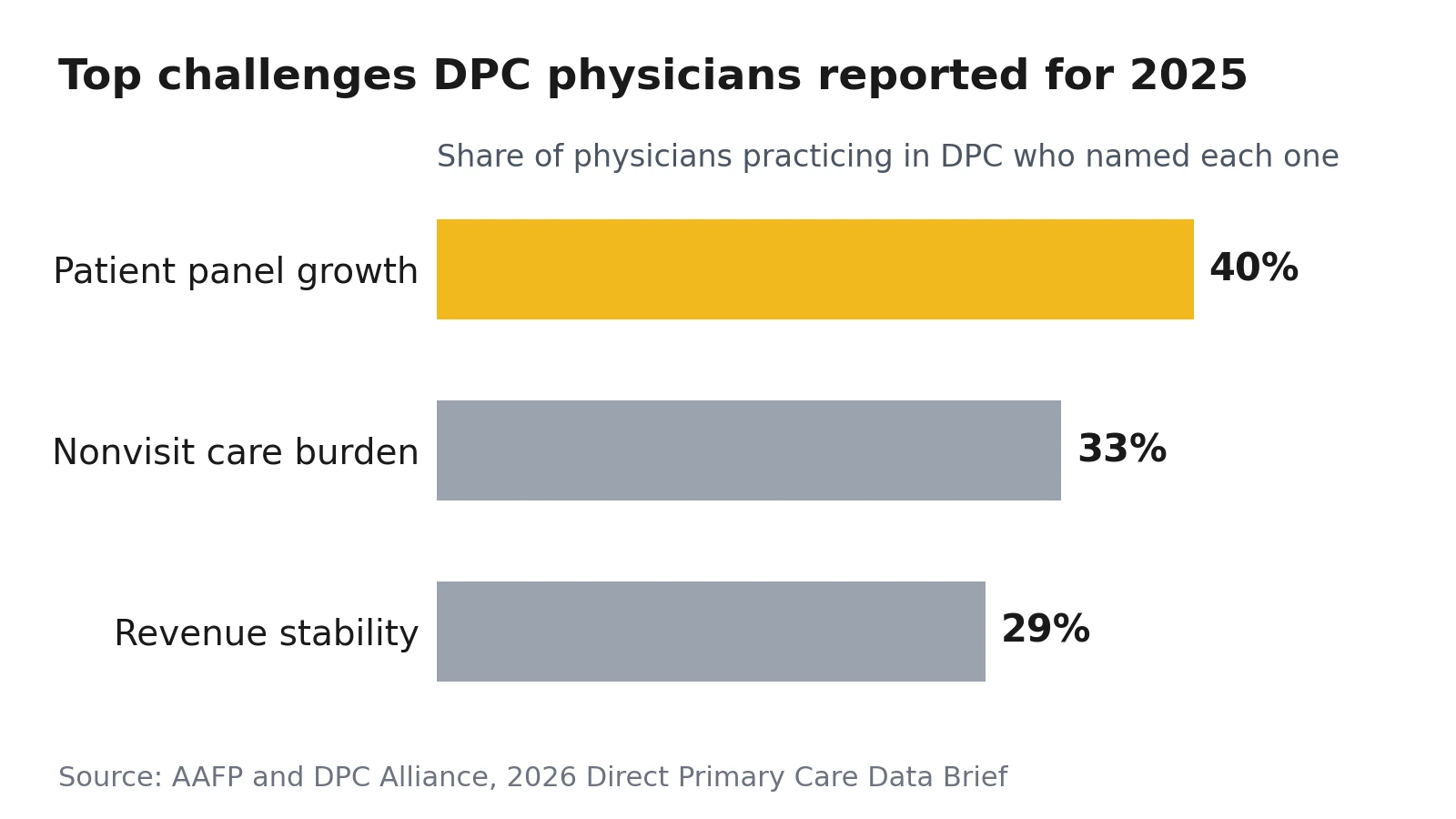
Slower than most founders hope, and that is true for experienced physicians as well as new grads. In the AAFP and DPC Alliance brief, 40% of physicians practicing in DPC named patient panel growth as a major challenge, ahead of nonvisit care burden at 33% and revenue stability at 29%. The average panel across all respondents was 504 patients in 2025.
For a new grad, the first few months usually come from founding members you signed before opening, people in your own community, and small local employers that can decide quickly. Referrals and reviews start to compound after that, and employer groups tend to arrive around their benefit renewal dates. Our post on why new DPC practices grow slowly lays out what a typical first year looks like quarter by quarter, and how patients find a DPC covers the channels that bring people in.
Be honest with yourself about income, too. The same survey found that 47% of DPC respondents reported lower earnings in DPC and 30% reported higher earnings, while large majorities reported better care quality, patient relationships and work-life balance. Our DPC physician salary guide goes deeper on what owners actually take home.
Is Opening Straight Out of Residency Right for You?
It can be a great fit if you already know the community you want to serve, you can keep personal costs low for a while, you have a plan for your loans that does not depend on PSLF, and you are willing to do the selling that an established doctor's reputation would otherwise do for you. It is harder if PSLF is a large part of your financial plan, if you need a full salary from day one, or if you are moving to a town where you know no one.
Neither answer is permanent. Some physicians work for a qualifying employer first and open later, and some open right away with a part-time job underneath them. If you are weighing the two directly, DPC or an insurance-based practice compares the models, and is there room for another DPC near me helps you size up the market where you want to open.
Getting Ready in Your Final Year of Residency
A simple order of operations for PGY-3, built from the sections above:
- Decide on your student loan strategy first, since it shapes everything else.
- Put your ABFM exam, full license application and DEA registration on one calendar.
- Pick your town, check nearby practices on the DPC Finder and reach out to a few owners.
- Write the business plan and talk to two or three lenders before you sign a lease.
- Line up part-time clinical work if you need it, and decide on Medicare with that job in mind.
- Start a founding member waitlist months before opening day.
Once you open, the work between your tools grows faster than the panel does. Membership billing, the EHR, patient messaging and scheduling each hold part of the picture, and a solo new grad ends up being the glue. Tabflows is a dedicated tech team that connects the tools a clinic already uses, so follow-ups, tasks and patient context land in one place while you focus on the first few hundred patients who trusted a new doctor with their care.
FAQs
Can you open a DPC right out of residency?
Yes. Nothing in the DPC model requires years of employed practice first, and in the AAFP and DPC Alliance 2026 DPC data brief, 8% of physicians practicing in DPC said they opened their practice immediately after residency. What is different for a new grad is that you start with no existing patients who follow you, a lender sees no practice history, and PSLF payments usually stop counting once you own your practice. Many new grads handle that by keeping part-time clinical work while the panel grows.
Does owning a DPC practice count for Public Service Loan Forgiveness?
Generally no. PSLF counts payments only while you work full time for a qualifying employer, which federal rules define as a government organization, a 501(c)(3) nonprofit or certain other nonprofits that are not organized for profit. A physician-owned DPC set up as a for-profit LLC or corporation is not a qualifying employer, even if it pays you a W-2. Payments you already made while working for a qualifying employer still count, and the 120 payments do not need to be consecutive.
Do I need to be board certified to open a DPC?
No law requires board certification to open a DPC, and the American Board of Family Medicine describes certification as a voluntary credential beyond your state medical license. Most family medicine residents take the ABFM exam in the spring of PGY-3, and the seven-year board eligibility period starts the day after you finish residency. Patients and employers can look up certification on ABFM's Find a Physician tool, so it is worth finishing.
Can a new residency graduate get an SBA loan to start a DPC?
A new grad can apply, but the lender will lean on your personal credit, your own cash and your business plan, because there is no practice history to review. Under SBA's lending rules (SOP 50 10 8, carried into version 8.1 in October 2026), a startup's 7(a) loan needs an equity injection of at least 10% of project costs, and collateral is required on almost all 7(a) loans. A lean, leased-space DPC often needs a smaller loan than founders expect.
Should I moonlight while my new DPC grows?
Many new DPC founders keep part-time clinical work, such as urgent care, hospitalist shifts or telehealth, so their personal income does not depend on the panel in year one. Check the job's schedule against your membership promises, and think through Medicare before you opt out, because opting out applies to you as a clinician, not only to the DPC.
Where can a resident find a DPC mentor?
The DPC Summit, hosted by the AAFP, ACOFP, the DPC Alliance and the Family Medicine Education Consortium, runs an in-person mentoring program called DPC Summit Connection that places emerging DPC physicians in small groups with experienced ones. The 2027 Summit is July 15 to 18 in Kansas City, Missouri, and a scholarship fund for medical students and residents opens applications in mid-March 2027. Local DPC owners are also worth a direct email or a shadowing request.