How Should a DPC Practice Set Its Messaging Policy?
A DPC messaging policy is a short written promise that tells members how to reach the practice, how fast they will hear back, what messaging the membership includes, and what to do when something is urgent. There is no national standard response time, so each practice picks times it can keep on its busiest week, separates urgent requests (call, with a fast callback) from routine ones (message, answered in business hours), and states plainly that a medical emergency means calling 911. The same wording goes into the patient agreement, the welcome message and the auto-reply, so members hear one consistent answer everywhere.
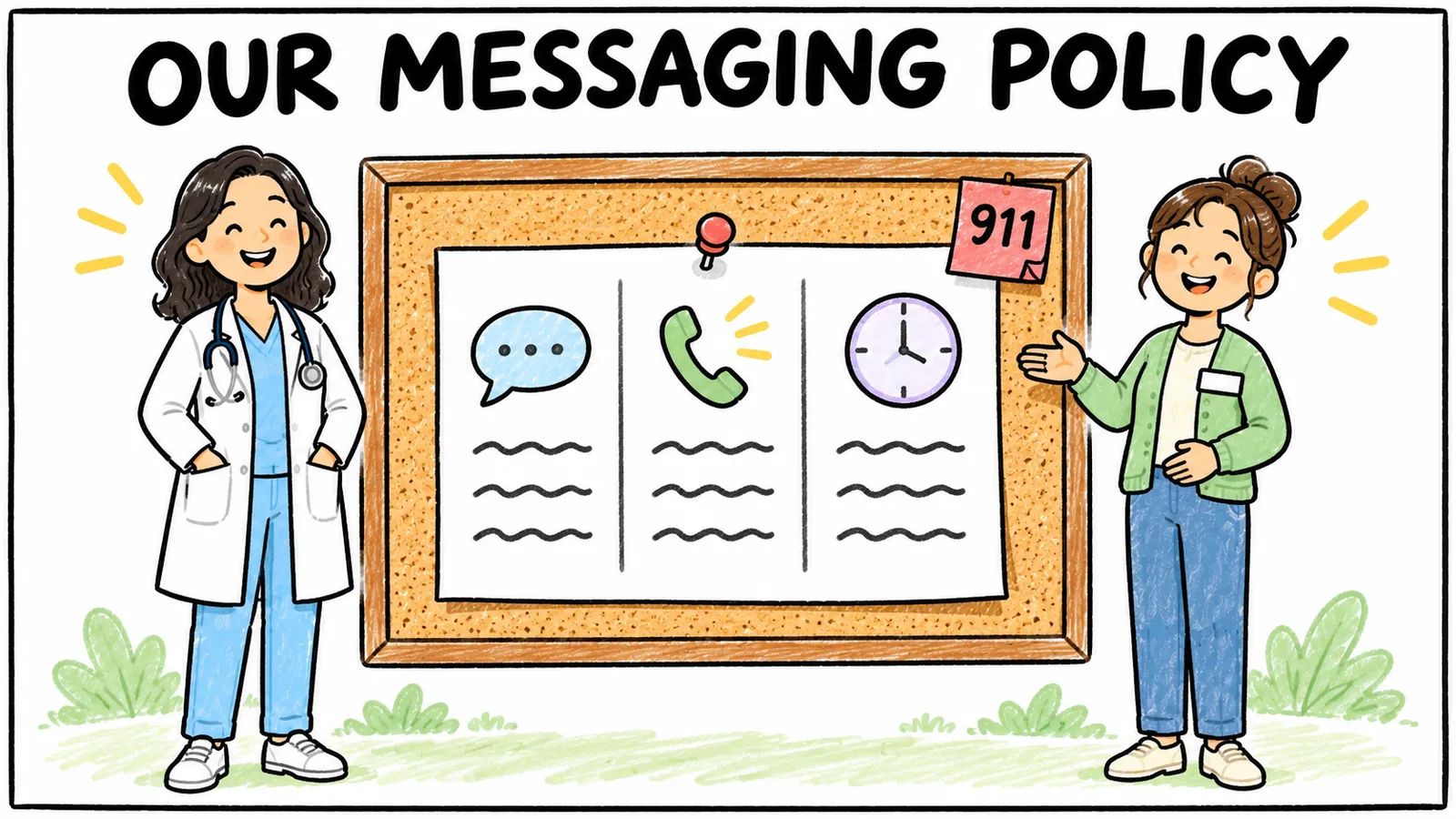
Direct access to your own doctor is one of the main reasons people join a direct primary care practice, so the policy is not about limiting that access. It is about making it dependable. Members who know a refill request waits until morning, and that a worrying symptom gets a call back within the hour, tend to trust the practice more and send fewer repeat messages.
What Should a DPC Messaging Policy Cover?
A complete policy usually fits on one page and answers seven questions a member will eventually ask:
- Which channels can I use? Phone, secure messaging, the portal, email, and whether texting is offered.
- When is someone reading messages? Business hours, after-hours coverage, weekends and holidays.
- How fast will I hear back? One time for routine messages and a faster one for urgent concerns.
- What counts as urgent? Plain examples, written for patients rather than clinicians.
- What is included in the membership? Which questions are handled by message and when a message becomes a visit.
- Who answers? Whether nurses, medical assistants or front desk staff reply first under the physician's protocols.
- What do I do in an emergency? Call 911, and for a mental health crisis, call or text 988.
How Fast Should a DPC Doctor Answer Patient Messages?
No law or professional body sets a required response time for patient messages, so the answer is whatever your practice can promise and keep. The guidance that does exist focuses on being clear rather than being fast. The AMA's STEPS Forward patient portal toolkit suggests giving new patients a handout that communicates the expected response time for messages, and Matthew Sakumoto, MD, quoted in that piece, says setting clear timelines and acknowledging receipt cut down on repeat messages.
For comparison, an academic family medicine practice described in the AAFP's journal FPM tells patients to allow up to three business days for a clinician to respond to a message, with a triage nurse handling symptom concerns by phone. A DPC practice can often promise a shorter window than that, because quick access is part of what members pay for and panels are smaller.
A useful test before you publish a time is to picture your hardest week, with a sick day, a full schedule and a run of lab results. If you would still meet the promise that week, it is the right number. If you would only meet it on a quiet week, choose a longer window and beat it most days.
Should you promise a reply time or an acknowledgment time?
Many practices promise two things. The first is an acknowledgment, often an automatic reply that confirms the message arrived and restates the policy. The second is a real answer within the stated window. The automatic acknowledgment can also repeat the urgent and emergency instructions every time a member writes in.
Sample DPC Messaging Policy Table
The table below is a starting point. The response times are examples a practice might choose, not standards, so change them to match your hours, staffing and panel size.
| Message type | Channel members use | Example response time a practice might choose |
|---|---|---|
| Medical emergency (chest pain, trouble breathing, stroke signs, severe injury) | Call 911 | Not handled by the practice |
| Mental health crisis | Call or text 988, or 911 | Not handled by the practice |
| Urgent new or worsening symptom, business hours | Phone call to the practice | Callback within 1 hour |
| Urgent concern after hours | After-hours phone line | Callback from the on-call clinician within 1 hour |
| Routine clinical question | Secure message or portal | Same business day if sent before 3 p.m. |
| Lab or imaging result questions | Secure message | Within 1 business day |
| Prescription refill | Secure message or pharmacy request | Within 1 business day |
| Scheduling, billing and forms | Secure message or phone | Within 1 to 2 business days |
| Anything sent after hours that is not urgent | Secure message | Next business day |
The 988 Suicide and Crisis Lifeline is available by call, text or chat around the clock, which makes it a good line to include alongside 911 in any policy members will read.
Urgent vs Routine, and Where 911 Fits
The single most important sentence in the policy is the one that tells members messages are not for emergencies. Christine Sinsky, MD, of the AMA, puts it directly in the same AMA piece, saying the inbox is not the place for patients to access care for urgent needs and that this should appear in the standard information patients see when they sign in.
In a DPC practice this matters even more, because members are used to reaching their doctor directly. A message about chest pain sent at 9 p.m. might sit unread for an hour even in an attentive practice, while a phone call to the after-hours line rings through. So the policy works best when it routes by urgency, not by convenience:
- Emergencies go to 911 every time, and the policy lists a few plain examples.
- Urgent concerns go by phone, so a person hears them in real time.
- Routine requests go by secure message, answered within the stated window.
Clinic staff need the same clarity in reverse. The AAFP advises that for emergencies staff should immediately interrupt the physician or triage nurse, and should never rely on leaving a message in the EHR for an urgent or emergent issue. Our guide to triaging after-hours patient messages walks through how to sort messages so urgent ones reach the on-call provider and routine ones wait for morning, and what a DPC membership covers when something urgent happens covers the emergency language members see when they join.
What Messaging Does the Membership Include?
Most DPC memberships include messaging with the care team, and that is one of the reasons members join. The policy question is not whether messaging is included but where a message ends and a visit begins. The AMA STEPS Forward program suggests reminding patients that portal messages should not replace a telehealth or in-person visit for complex concerns.
A simple way to write this down is to list what the practice handles by message and what it turns into a visit:
- Handled by message. Quick questions, refills under protocol, lab results, follow-ups after a visit, forms, and scheduling.
- Turned into a visit. New symptoms that need an exam, several problems in one thread, mental health concerns that deserve real time, and anything where the back and forth has gone past a few exchanges.
Because visits are usually part of a DPC membership, converting a message into a visit costs the member nothing extra in most practices, and it moves the work into the schedule instead of the evening. Saying so in the policy helps members see a visit offer as better care, not a brush-off. If you are still settling what the membership itself covers, how to price a DPC membership goes through the services practices usually include.
Who answers first?
Members joined to see their doctor, but that does not mean the doctor has to read every message first. In the FPM practice above, a registered nurse reads every patient message first and routes it to the right team member and tells the patient the expected response time. The AAFP also suggests refill protocols so staff can handle routine refills that the physician co-signs. In a small DPC, that might be one medical assistant who handles scheduling and forms and prepares routine refills under the physician's protocol for the physician to sign, where state rules allow, so the physician's message time goes to the questions only a physician can answer.
Why Boundaries Protect Access
Clear boundaries can feel at odds with the DPC promise of access, but the research on inbox volume points the other way. Most of it comes from large health systems rather than DPC practices, so it describes the conditions many physicians leave behind when they open a DPC, and it shows why message volume deserves a plan from the first member.
- In 366 US health systems, messages from patients rose to 157% of the prepandemic average during 2020, and each additional patient message was associated with 2.32 more minutes of EHR time per day (Holmgren and colleagues, JAMIA, 2022).
- US clinicians received 33.8 messages per day compared with 12.8 for clinicians outside the US, and spent 12.5 minutes a day on in-basket messages compared with 4.8 (JAMA Internal Medicine, 2021).
- In one multispecialty group, physicians received an average of 243 in-basket messages a week, 30 of them from patients, and receiving more than the average number of system-generated messages was associated with a 40% higher probability of burnout (Health Affairs, 2019).
A DPC panel is smaller and members are not billed per message, so the numbers will look different in your practice. The pattern still holds, though. Message volume grows with the panel, every message takes real time, and the time tends to land after hours unless the policy gives it a home in the day. Our guide to designing a sustainable DPC physician schedule shows how practices block message time into the week.
What to Put in the DPC Patient Agreement
The patient agreement is where the policy becomes part of the membership. The messaging section usually covers:
- the channels members can use, and which one to use for urgent concerns
- business hours, and the response times the practice aims for during and after them
- which requests wait for the next business day, such as refills, forms, billing and scheduling
- a clear statement that messages are not monitored continuously and are not for emergencies, and that emergencies go to 911
- that the practice may ask a member to book a visit when a concern needs an exam or more time
- who covers when the physician is away, and how members reach that person
- any limits on messaging channels, such as no clinical questions through social media or personal phone numbers
Here is sample wording a practice could adapt, written for members rather than lawyers.
Secure messages are answered during business hours, usually the same business day. Messages sent after hours, on weekends or on holidays are read the next business day. For an urgent concern after hours, call our after-hours line and the on-call clinician will call you back. Messages are not for emergencies. If you think you are having a medical emergency, call 911. If you are in a mental health crisis, call or text 988.
Many states have direct primary care laws that set what an agreement must include, so check the DPC laws in your state and have a health care attorney licensed there review the final wording. The sample above is a starting point, not legal advice.
HIPAA and the Channel You Choose
The policy names channels, so it should only name channels the practice can use safely. HHS says the HIPAA Privacy Rule allows covered providers to communicate electronically with patients, such as through email, provided they apply reasonable safeguards, for example checking the address before sending and limiting what goes into an unencrypted message. The same HHS answer notes that patients can ask to be contacted by alternative means if reasonable, that a provider can assume email is acceptable when a patient starts the conversation by email, and that electronic protected health information must also meet the HIPAA Security Rule.
That is why many practices put clinical messaging in a secure messaging tool that signs a business associate agreement, rather than on a personal cell phone. Our guide to HIPAA-compliant texting for DPC practices explains what HHS says about texting, why the business associate agreement matters, and how practices choose a tool. The policy should point members to that one channel.
After Hours, Vacations and Coverage
After-hours access is where messaging policies are tested. The written version should say who covers nights and weekends, how members reach them, and what happens to non-urgent messages that arrive overnight. Some practices take after-hours calls themselves on a rotation, some share call with a nearby DPC, and some use an answering service that pages the on-call clinician for urgent calls.
If you use an answering service, the hard part is the handoff into the morning, so nothing a member said overnight gets lost. Our after-hours answering service workflow covers how clinics land overnight calls and messages in one place and review them first thing. For vacations, the policy should name the covering clinician and say whether routine message times change while the physician is away, so members are not left wondering why a reply took longer.
Telling Members About the Policy
A policy only works if members have seen it before they need it. Practices usually share it at several points, so it never depends on one document:
- at the meet and greet, when prospective members ask how to reach the doctor
- in the welcome email or packet, alongside portal sign-up instructions
- in the automatic reply to every message, in two or three short sentences
- on the website, in the same words as the agreement
Prospective members increasingly ask about this before they join. Our checklist of questions to ask before joining a DPC includes how to reach the doctor, how fast the practice replies and what happens after hours, so a clear written answer helps at the meet and greet too. Browsing practices on the Tabflows DPC Finder is a quick way to see how other DPC clinics describe access on their own websites.
Making the Policy Easy to Keep
Writing the policy is the easy half. Keeping it means every message lands in one place, gets sorted by urgency, reaches the right person, and turns into a task, a refill, a visit or a reply before the stated time runs out. In most clinics that work crosses several systems, with messages in one tool, the chart in another and the schedule in a third, which is where promises quietly slip.
Tabflows is a dedicated tech team that connects the tools a clinic already uses, such as the EHR, membership billing and messaging, so the follow-ups, tasks and patient context from patient messages end up in one place for the team. It does not replace your messaging tool or your EHR. It helps the team keep the response times the policy promises.
The Bottom Line
A good DPC messaging policy is short, specific and the same everywhere members see it. Pick response times you can keep on a hard week, route urgent concerns by phone and emergencies to 911, say what the membership handles by message and when a message becomes a visit, name who covers after hours, and put it all in the patient agreement. Members get access they can count on, and the physician gets evenings that stay their own.
FAQs
How fast should a DPC doctor respond to patient messages?
There is no national standard, so each direct primary care practice picks its own response times and writes them down. For example, a practice might promise a reply the same business day for routine messages and a much faster phone callback for urgent ones during the hours it covers. The best number is one the practice can keep on its busiest week, stated plainly in the patient agreement and the welcome message, because a clear and kept promise matters more to members than a fast one that slips.
Is unlimited messaging included in a DPC membership?
Most DPC memberships include messaging with the care team, and the practice decides what that covers. A common approach is that quick questions, refills, results and follow-ups are handled by message, while anything that needs an exam, a long discussion or a new diagnosis becomes a visit, which in most DPC models is also part of the membership. Writing that line into the policy keeps messaging fast without turning the inbox into a substitute for visits.
Should DPC patients text the doctor after hours?
Only if the practice has decided to offer that and has written down which kinds of messages belong after hours. A common pattern is to route after-hours contact through one channel, ask members to call rather than message for anything urgent, hold refills and scheduling for the next business day, and tell members that a medical emergency means calling 911. The policy should also say who covers when the doctor is away.
What should a DPC patient agreement say about messaging?
The agreement should name the channels members can use, the response times the practice aims for during business hours and after hours, which requests wait for the next business day, that messages are not for emergencies and emergencies go to 911, how the practice may turn a message into a visit, and who covers when the physician is unavailable. Many states have direct primary care laws that also set what an agreement must say, so have a health care attorney in your state review the final wording.
Can a DPC practice text or email patients under HIPAA?
Yes. HHS says the HIPAA Privacy Rule lets providers communicate with patients electronically, including by email, as long as they apply reasonable safeguards, and that patients can ask to be contacted by alternative means. Electronic protected health information must also meet the HIPAA Security Rule. Many practices use a messaging tool that signs a business associate agreement rather than personal texting.
How do DPC doctors avoid burnout from patient messages?
By setting the policy before the panel grows, giving messages set times in the day, letting trained staff sort and answer what they can under protocol, routing true urgencies to one on-call path, and turning long message threads into visits. Research from large health systems links more patient messages to more time in the EHR, and one study tied above-average volumes of system-generated inbox messages to a higher chance of burnout, which is why clear boundaries tend to protect access rather than reduce it.