Why Does a New DPC Practice Grow So Slowly?
A new direct primary care practice usually grows slowly because the things that bring members in are slow by nature, not because the doctor is doing something wrong. Word of mouth needs months of happy members talking, employers buy around their benefits calendar, most patients already pay for insurance and need time to see DPC as worth an extra monthly fee, and a brand new clinic starts with almost no reviews or search history. Each of those mechanics takes months to build, so a quiet first few months is common, not a sign of failure.

If your panel is building more slowly than the plan you wrote last year, you are in good company. In the AAFP's 2026 Direct Primary Care data brief, patient panel growth was the challenge physicians in DPC named most often, cited by 40% of them, ahead of nonvisit care burden at 33% and revenue stability at 29%.
This guide explains where the slowness comes from, what the first year tends to look like, the signals worth watching each month, and the things that tend to bend the curve upward. For the launch tactics themselves, the first 100 DPC members playbook is the companion piece, and for the money side, see when a DPC practice breaks even.
What the Data Says About DPC Growth
To give the honest answer first, we could not find a reliable national, month by month growth curve for new DPC practices. The surveys that exist measure panel size across practices of every age at one point in time, so they tell you where practices are, not how fast a typical one got there. So a precise "members at month six" benchmark is not something anyone can honestly give you yet.
What the surveys do show is useful anyway:
- Average panels run a few hundred patients. The AAFP brief reports an average panel of 504 patients in 2025 across all 313 respondents, about half of them practicing in DPC, up from 402 in 2024 (AAFP data brief).
- Most practices are not full yet. A national survey of 465 DPC practices in the Journal of the American Board of Family Medicine found only 31.2% reported a full panel, with an average panel of 473 patients.
- Growth is the shared challenge. The 40% figure above makes panel growth the most common challenge in the AAFP survey, and the AAFP's DPC page says plainly that practice growth remains a challenge.
- Members tend to stay once they join. Over half (53%) of DPC respondents reported annual member termination rates of 1% to 5%, and only 4% reported more than 10% (AAFP data brief).
That last point is the reassuring one. DPC growth is slow to start, but it holds, because members who join usually stay. Every month of patient work adds to a base that does not drain away quickly.
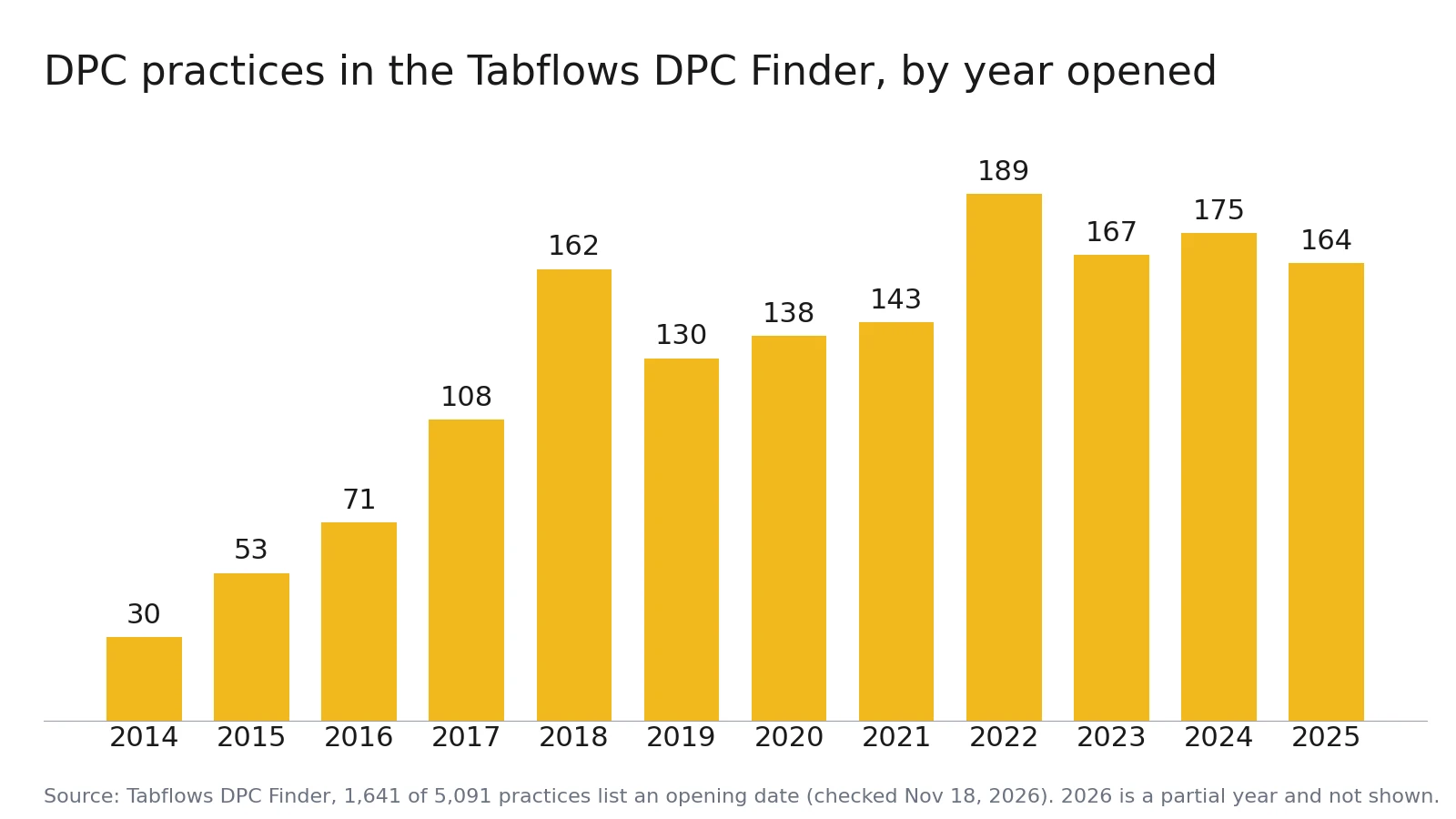
A lot of practices are early in the ramp right now, too. In our DPC Finder, 1,641 of the 5,091 listed practices have an opening date on file, and 738 of those (45%) opened in 2022 or later, with 382 (23%) opening in 2024 or later. If your practice is new, many of your peers are living the same first years.
The Four Slow Mechanics Behind DPC Growth
Most of the slowness comes from four mechanics that every new practice runs into. None of them reflect on your care, and each has a few things you can do about it.
Word of mouth takes time to compound
Direct primary care is a trust purchase. People are choosing a doctor, paying a monthly fee for a model many of them have never heard of, and often explaining it to a spouse before they sign. Many of them need to hear about it from someone they know, then hear it again, before they act.
That is why referrals start slowly. A member who joined in month two may not mention you to a friend until they have had a quick same-day visit or a text answered at night, and that friend may take a few more months to need a doctor. The first members are planting seeds that sprout later.
Employers buy on a benefits calendar
Employer contracts can add many members at once, and they are common in DPC. In the AAFP data brief, 55% of DPC respondents had employer-based contracts, and among them, 69% contracted with employers that had fewer than 10 employees and 59% with employers of 10 to 25 employees.
The catch is timing. Employers usually change benefits at their plan renewal, after talking with a broker, an owner or a benefits committee. A great first meeting in March may not turn into members until the next renewal. Small local businesses, where the owner can say yes in one conversation, tend to move fastest, which matches the employer sizes in the AAFP data. Our guide on selling direct primary care to employers covers the pitch, pricing structures and contract terms.
Patients already have insurance and habits
Most people you talk to already pay for health insurance. Respondents in the AAFP survey reported that, on average, 80% of their patients had private health insurance (AAFP data brief). For them, DPC is an extra monthly cost on top of a premium they already pay, so the question in their head is "is this worth it on top of what I have?"
People also think about health spending in seasons. Marketplace open enrollment on HealthCare.gov runs from November 1 to January 15 for the 2027 plan year, with December 15 the deadline for coverage that starts January 1. Plenty of people who like the idea of DPC in the summer wait until they are reviewing coverage, a new year or a change in their own health before they move. Recent federal law also made qualifying DPC memberships compatible with HSAs, within a monthly fee cap, which gives some patients a new way to pay. The details are in our 2027 DPC HSA rules guide.
Search visibility starts near zero
A new clinic starts with no reviews, few links and a fresh website. Google's own help page says local results are based mainly on relevance, distance and how well known a business is, and that more reviews and positive ratings can help a business's local ranking (Google Business Profile Help). It also says there is no way to request or pay for a better local ranking.
So search visibility grows with the practice. Every review, every complete profile field and every local page that mentions you adds a little, and the effect shows up over months, not weeks. Our guide on how patients find a DPC in 2027 walks through Google, Maps and the newer answer engines, and the Google Business Profile guide covers the profile itself.

What the First Year of a DPC Usually Looks Like
Because there is no national month by month number, the stages below sketch a common shape built from the mechanics above, not from data. Treat them as a map, not a forecast. Your start date, your town and how many people you signed before opening will move every line.
| Stage | What usually happens | What to watch |
|---|---|---|
| Before opening | Founding members, waitlist sign-ups and early conversations with former patients and local employers | Founding members signed, waitlist size, employer meetings booked |
| Months 1 to 3 | Founding members start care, first visits, first reviews; new sign-ups come mostly from people you already know | Net new members each week, inquiries answered within a day, first reviews posted |
| Months 4 to 6 | First referrals from early members, first employer proposals out, the profile and website start to show up in local searches | Share of new members from referrals, inquiry to member conversion, employer proposals and their renewal dates |
| Months 7 to 9 | Referrals compound, community events and local partners start sending people, employer renewals come into view | Net new members each month, referral share, cancellations and why they happen |
| Months 10 to 12 | Open enrollment and new year interest, first employer groups may start at renewal, the panel feels steadier | Members gained in open enrollment season, employer groups signed, months of cash runway |
If the first quarter is quieter than you hoped, that is common. The members who join early do the work of the later quarters, through referrals and reviews, so their experience is the best growth investment you have.
The numbers worth tracking each month
A short list beats a dashboard in the first year. These are the numbers that tell you the most.
- Net new members. New sign-ups minus cancellations, counted the same way every month.
- Where each member came from. Referral, employer, search, event, former patient. Ask on the intake form and write it down.
- Inquiry to member conversion. How many calls, texts and web forms turned into members, and how fast each one got a reply.
- Reviews. The count and the date of the latest one.
- Employer pipeline. Each conversation with its next step and the employer's plan renewal month.
- Cash runway. Months of expenses you can cover at today's revenue.
Our guide to DPC metrics to track in 2027 goes deeper on definitions, and the break-even guide shows how to turn net new members into a month by month money picture.
What Tends to Move the Curve
None of these turn a slow start into an overnight one, but each one speeds up one of the four slow mechanics.
Sign members before you open
Every member signed before opening day pulls the whole curve earlier. Many physicians start with former patients who would like to follow them, where their old contract allows it, and the AAFP brief found that 63% of DPC respondents opened an independent practice after leaving a health system or group (AAFP data brief). Our guide on signing founding members before you open covers waitlists, deposits, refunds and the state rules to check, and the DPC startup guide puts that step in order with everything else.
Ask for referrals and reviews at the good moments
The best time to ask is right after something went well, such as a same-day visit, a quick refill or a lab result explained by text. A simple, rule-friendly referral ask and a direct link to your review page make it easy. The member referral program guide covers what you can and cannot offer as a thank-you.
Start with employers that can decide quickly
Small local businesses, where one owner decides, tend to move faster than larger groups with brokers and committees. Ask each employer when their plan renews and put that month on your calendar, so a good conversation in spring still turns into members in the fall.
Explain DPC next to the insurance people already have
Most of your prospects will keep their insurance, so the clearest pitch shows how DPC works alongside it, what it costs per month, what it saves in time and hassle and which kinds of plans pair well with it. Our guide on what insurance to pair with DPC helps with that conversation, and community talks help too, as covered in DPC community marketing events.
Answer every inquiry fast
Early interest is fragile. Someone who calls on Tuesday and hears back on Friday has often moved on. A shared inbox, a clear owner for new inquiries and a follow-up reminder for anyone who did not sign on the first contact protect the leads the slow mechanics worked hard to produce.
When Slow Growth Needs a Closer Look
Slow is normal. Still, a few patterns are worth a second look, because they usually point to a fixable gap between tools or steps rather than a problem with the practice:
- Inquiries are steady but few become members. Look at reply time, the enrollment steps and whether the price and what is included are easy to find.
- New members arrive but leave within a few months. Ask why, kindly, and check whether early expectations matched the experience.
- Nearly every member came from one source. One channel can stall, so start a second one early.
- Cash runway is shrinking faster than the panel grows. Revisit the break-even math, consider part-time clinical work for a while, and lean on the lowest-cost channels like referrals and employers.
Keeping Early Members Close While the Panel Builds
In the first year, the members you already have are your best source of the members you want next. That makes the follow-ups matter a great deal, such as the lab result someone is waiting on, the refill request that came in by text, the employer who asked for a proposal and the family that said "call us after the holidays."
That work usually lives across several tools, such as the EHR, membership billing and patient messaging. Tabflows is a dedicated tech team that connects the tools a clinic already uses, so follow-ups, tasks and patient context sit in one place. It does not replace any of them. For a small team building a panel one family at a time, it helps keep each early member's experience as good as the one that made them want to join.
For more help, the most common follow-up questions are answered in the FAQ below. To see how other practices in your area describe and price their memberships, browse the DPC Finder.
FAQs
Why is my new DPC practice growing so slowly?
Slow early growth is the normal shape of a new direct primary care practice, not a sign that the model or the doctor is failing. DPC is a trust purchase that many people make only after hearing about it several times, employers decide on benefits around their plan renewal, most patients keep their insurance and see DPC as an extra monthly cost they need to justify, and new practices have few reviews and little search history. Each of those mechanics takes months to build up, so a quiet start is common.
How many members does a new DPC practice have after the first year?
There is no reliable national number for members at month 12. The surveys that exist report panel size across practices of all ages, not by month since opening. The AAFP's 2026 DPC data brief reports an average panel of 504 patients in 2025 across its respondents, and a national survey in the Journal of the American Board of Family Medicine found only 31.2% of practices described their panel as full. Your own month by month enrollment is the best number to plan with.
Is slow growth common for DPC practices?
Yes. In the AAFP's 2026 DPC data brief, patient panel growth was the most often reported challenge among physicians practicing in DPC, named by 40% of them, ahead of nonvisit care burden and revenue stability. A national survey in the Journal of the American Board of Family Medicine found that only 31.2% of responding practices reported a full panel.
When do new DPC members usually sign up during the year?
Interest tends to bunch around moments when people review their health coverage. Marketplace open enrollment on HealthCare.gov runs from November 1 to January 15, and many employers change benefits at their plan renewal. The new year, a job change, a move to a new town and a bad experience with the old clinic are other common triggers. Planning outreach around those moments helps more than spreading it evenly.
What helps a new DPC practice grow faster?
The things that move the curve are usually signing founding members before you open, asking every happy member for a referral and a review, selling to small local employers that can decide quickly, explaining DPC clearly next to the insurance a patient already has, and keeping the Google Business Profile complete and active. Fast, reliable follow-up on every inquiry matters as much as any of them, because early interest is easy to lose.
Should I worry if my DPC is not at break-even after six months?
Not necessarily. Break-even depends on your overhead, your fee and how many members you signed before opening, and many practices keep part-time clinical work while the panel builds. Track your monthly net new members, your inquiry to member conversion and your cash runway, and revisit your break-even math each quarter so you can adjust before money gets tight.