Is My Area Saturated With DPCs?
Probably not, even if it feels crowded. Among the 15 cities with the most practices listed on the Tabflows DPC Finder, most have between about 2 and 7 DPC and concierge practices for every 100,000 residents, and between about 1 and 5 pure DPC practices, and a typical DPC needs only a few hundred members to fill its panel. A high count usually means patients and employers in that area already know what direct primary care is, which can make it easier to open, not harder. The better question is whether the practices near you are full and whether you would serve patients they don't.
If you are thinking about opening a practice, or adding a second location, this guide gives you real counts for the busiest DPC cities, explains what those numbers can and can't tell you, and walks through the other public data worth checking before you sign a lease. For the full launch sequence, see how to start a DPC practice.
How Many DPC Practices Are in the Busiest Cities?
We counted every practice listed on the Tabflows DPC Finder as of November 18, 2026, by the city and state on each listing, and divided by that city's population from the US Census Bureau's Vintage 2025 city estimates. The Finder lists 5,091 direct primary care and concierge practices across all 50 states and DC today: pure DPC, hybrid and onsite employer clinics, plus listings with no model stated, most of them concierge network doctors.
The table below shows the 15 cities with the most listings that have a clean Census population figure for the city itself. Louisville has enough listings to make the list, but Census reports it as a consolidated metro government, so we left it out rather than mix a county-sized population with a city count. Population is for the city limits only, and nearby suburbs count as their own cities (Scottsdale is separate from Phoenix, for example). Listings filed under a neighborhood name, such as Tarzana in Los Angeles, La Jolla in San Diego or Brooklyn in New York, aren't counted in the city, so the biggest cities' figures run a little low.
| City | Practices on the Finder | Pure DPC listings | Population (Census 2025) | Practices per 100,000 |
|---|---|---|---|---|
| Boca Raton, FL | 27 | 8 | 101,582 | 26.6 |
| Scottsdale, AZ | 36 | 12 | 243,006 | 14.8 |
| Cincinnati, OH | 28 | 12 | 314,367 | 8.9 |
| Tampa, FL | 28 | 17 | 413,554 | 6.8 |
| Tucson, AZ | 36 | 11 | 548,371 | 6.6 |
| Colorado Springs, CO | 24 | 14 | 494,743 | 4.9 |
| Atlanta, GA | 25 | 7 | 529,110 | 4.7 |
| Austin, TX | 44 | 20 | 1,002,632 | 4.4 |
| Las Vegas, NV | 27 | 12 | 679,817 | 4.0 |
| Seattle, WA | 22 | 16 | 784,777 | 2.8 |
| Dallas, TX | 36 | 11 | 1,329,491 | 2.7 |
| San Antonio, TX | 39 | 18 | 1,548,422 | 2.5 |
| Charlotte, NC | 24 | 14 | 964,784 | 2.5 |
| Houston, TX | 47 | 15 | 2,397,315 | 2.0 |
| New York, NY | 50 | 15 | 8,584,629 | 0.6 |
Practice counts are from the DPC Finder on November 18, 2026. Populations are from the Census Bureau's Vintage 2025 estimates. The "Pure DPC" column counts listings our research classifies as membership-only. The rest are hybrid, onsite or listings with no model stated, most of them concierge network doctors such as MDVIP, so the per-100,000 column counts DPC and concierge practices together.
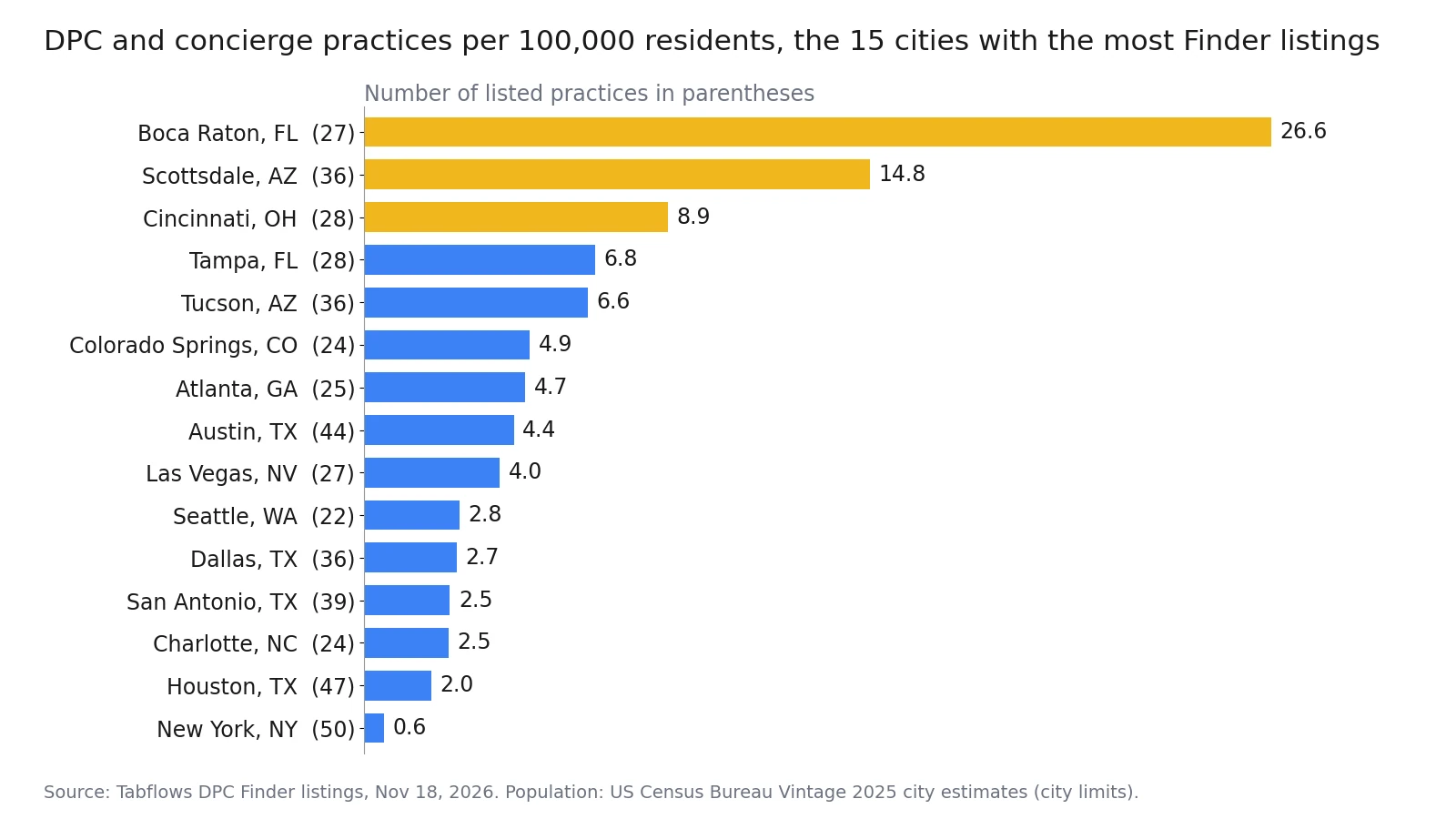
Some of the biggest cities in the country sit far lower. On the same Finder data and Census estimates, Los Angeles has 10 listed practices for 3,869,089 residents (about 0.3 per 100,000), San Diego has 8 for 1,406,106 (about 0.6), Chicago has 17 for 2,731,585 (about 0.6) and Philadelphia has 14 for 1,574,281 (about 0.9).
A quick way to read your own number
To get your own figure, open the DPC Finder, count the practices within the drive your patients will realistically make, and divide by the population of that same area. That drive for a regular visit is usually shorter in a dense city than in a suburb. Compare your number with the table above to see where your area falls.
What Does a High DPC Density Mean?
A high count of practices per person is easy to read as "too late," but it usually tells you something more useful. It means patients there have heard of direct primary care, local employers may already offer it, and the doctors who opened first proved that people will pay a monthly membership. Those are hard things for a new practice to build on its own in a market where nobody has heard the term.
Boca Raton and Scottsdale show why the raw number needs context. Both are smaller cities with many listings, and both sit inside larger metros, so their practices draw patients from well beyond city limits. Both also have more hybrid or concierge-network listings than pure DPC ones on the Finder (in Boca Raton, 11 of the 27 are MDVIP doctors), so many of those practices serve a different patient and price point than a new membership-only practice would.
So before you treat a high number as a warning, look at who the existing practices serve. A town with ten practices that all target retirees with higher-priced memberships may still have plenty of room for a family-focused DPC, an employer-focused DPC or one built around a specialty interest such as women's health or sports medicine.
How Many Patients Does One DPC Actually Need?
The reason most areas have room is simple panel math. The AAFP reports an average patient panel of 504 in 2025 across all its survey respondents, up from 402 in 2024. A practice that fills a panel that size serves a few hundred households, not a whole city.
Run that against the table and the Census population figures and the numbers stay small. If all 27 practices listed in Boca Raton each carried a panel of 504 patients, they would serve about 13,600 people, around 13% of the city's 101,582 residents, before counting anyone who drives in from neighboring towns. In Houston, 47 practices at 504 patients each would serve about 23,700 people, about 1% of the city's 2,397,315 residents. These are rough ceilings, since hybrid practices carry fewer DPC members and many patients cross city lines, but they show how much of each city still has no DPC or concierge doctor at all.
That is why the useful question is not "how many DPCs are here?" but "are the ones here full, and would my patients choose me?" If you can find a few hundred people who want what you offer within a reasonable drive, the market has room for you. Our guide to DPC break-even panel size shows how to work out the number you personally need.
What Does a Low DPC Density Mean?
A low count can mean an open market, but it is a question, not an answer. It might mean nobody has tried DPC there yet. It might also mean the local population leans heavily on Medicaid or Medicare, that the main employers are large self-insured systems with their own clinics, or that household incomes make a monthly membership a hard sell.
Los Angeles, San Diego and Chicago are good examples of how a low number can hide a large opportunity and a real challenge at the same time. Each has more than a million residents and very few listed practices per person, so the room is there. Each also has high rents, deep health system networks and a population that may need more explaining before DPC makes sense to them. A low density tells you that you will be teaching the market as well as serving it, so plan your marketing budget and your ramp-up time accordingly.
Other Signals to Check Before You Open
Practice density is one input. These public sources fill in the rest of the picture, and all of them are free.
| Signal | What it tells you | Where to find it |
|---|---|---|
| Nearby DPC practices and their prices | Who you would compete with and what they charge | DPC Finder |
| Population | How many people live within your drive radius | Census population estimates |
| Insured and uninsured share | How many people may pair DPC with insurance or pay cash | Census Small Area Health Insurance Estimates |
| Employer base | How many local businesses could buy DPC for staff | Census County Business Patterns |
| Primary care shortage | Whether federal data says the area lacks primary care doctors | HRSA HPSA Find |
| State rules | What your state's DPC law says | Start a DPC state guides |
Look at the employer base
Employers are often the fastest way to fill a panel, because one agreement can bring in dozens of members at once. The Census Bureau's 2025 health insurance coverage report found that employment-based insurance was the most common type of coverage, held by 53.5% of people for some or all of 2025. County Business Patterns shows how many establishments of each size operate in your county, which tells you whether there are enough small and midsize employers to call on. Our guide on selling direct primary care to employers covers how to approach them.
Check the insured and uninsured share
DPC works for insured and uninsured patients alike, but the mix changes how you position the practice. The same Census report found 7.9% of people were uninsured for all of 2025 nationally, and your county can be well above or below that. The Census Small Area Health Insurance Estimates give the insured rate by county and by income, so you can see whether you will mostly be pairing DPC with existing insurance or offering an affordable option for people who have none. Our post on what insurance to pair with DPC helps with the conversation either way.
See whether HRSA lists a primary care shortage
HRSA designates Health Professional Shortage Areas, and its HPSA Find tool lets you search by state and county and filter for primary care. Under the federal criteria in 42 CFR Part 5, Appendix A, a geographic area qualifies as a primary care shortage area when it is a rational area for primary care, has at least 3,500 people per full-time-equivalent primary care physician (or more than 3,000 with unusually high needs or too little existing capacity), and doctors in neighboring areas are overused, too far away or out of reach. A shortage designation is a strong sign that patients are struggling to find a doctor, even if the DPC count is low.
Compare local fees
Prices tell you how the existing practices see the market. Look up the practices near you on the DPC Finder, note what an adult, a child and a senior pay, and compare that with the state and national spread in our DPC Pricing Report. If every nearby practice is priced well above the middle, there may be room for a more affordable family option, and if they are all clustered low, you may compete better on access or added services. Our guide on how much to charge for DPC membership walks through setting your own price, and direct primary care cost by state shows how fees vary across the country.
Ask the practices near you
The best signal is free and takes an afternoon. Call the nearby practices or look at their websites to see whether they are accepting new patients, whether they have a waitlist, and who they focus on. DPC doctors are often generous with colleagues, and a practice with a full panel may be glad to refer the patients it can't take. A waitlist in your area is about as clear a sign of room as you will find.
A Simple Checklist for Sizing Up Your Area
Put the signals together and you have a short, honest read on your market:
- Count the DPC practices within your patients' drive on the DPC Finder and divide by the population of that area.
- Note who each nearby practice serves and what it charges.
- Ask whether those practices are full or have a waitlist.
- Check the county's employer base, insured share and HPSA status.
- Decide which patients you would serve that the others don't.
- Work out how many members you need to break even and whether that number is reachable within your radius.
If steps 3, 5 and 6 come out in your favor, there is room for you, whatever the raw count says. The state guides cover the legal setup for your state, and our guide on how patients find a DPC shows how to get in front of the people who are already searching.
Opening in a Busy Market Without Burning Out
In an area where patients already know DPC, the practices that grow fastest tend to be the ones that answer quickly, follow up reliably and make joining easy. That is mostly a question of how well your tools work together. Membership sign-ups, messages, lab results and employer billing often live in separate systems, and the work between them is where response times slip.
That is the gap Tabflows fills. It is a dedicated tech team that connects the tools a clinic already uses, such as the EHR, membership billing and patient messaging, so follow-ups, tasks and patient context stay in one place and the small team you start with can keep the promise of access that brought members in.
The Bottom Line
Most areas are not saturated with DPCs. Even in the busiest DPC cities on the DPC Finder, the listed practices could serve only a small share of residents, and a high count often means the hard work of explaining DPC has already been done. Look past the raw number to whether nearby practices are full, who they serve, the local employers and insured share, and HRSA's shortage data, and you will know whether there is room for you.
FAQs
How do I know if my area is saturated with DPC practices?
Count the DPC practices within the distance your patients will drive, divide by the population of that area and compare the result with other cities. Then check what each nearby practice offers and whether their panels are full. A market is only saturated when the existing practices are competing for the same patients and none of them is full. In most of the busiest cities on the Tabflows DPC Finder, listed DPC and concierge practices come to only a few per 100,000 residents.
How many DPC practices per 100,000 people is a lot?
Among the 15 cities with the most listings on the Tabflows DPC Finder (Louisville left out, see the table), checked on November 18, 2026, most fall between about 2 and 7 DPC and concierge practices per 100,000 residents, and between about 1 and 5 pure DPC practices. Boca Raton, Florida and Scottsdale, Arizona stand out at about 27 and 15, largely because of concierge network doctors; on pure DPC listings alone they are about 8 and 5. A high number often means patients and employers there already understand membership medicine, so it can signal demand as much as competition.
Is a city with no DPC practices a good place to open one?
It can be, but an empty map is a question, not an answer. No local practice can mean an open market, or it can mean few employers, a population that is mostly on Medicaid or Medicare, or simply that nobody has tried yet. Check the employer base, the insured share and whether HRSA lists the area as a primary care shortage area before deciding.
What data should I check before opening a DPC in a new area?
Start with the Tabflows DPC Finder for nearby practices and their prices, the Census Bureau's population estimates for the area, the Census Small Area Health Insurance Estimates for the insured share, County Business Patterns for the local employer base, and HRSA's HPSA Find tool for primary care shortage designations. Then call or visit the nearby practices to learn whether their panels are open.
Can two DPC practices succeed in the same town?
Yes. A DPC practice needs a few hundred members, not a whole town. The AAFP reports an average panel of 504 patients in 2025 across its survey respondents, so even a city of 100,000 people can support many practices before most residents have one. Practices also differ in who they serve, such as families, employers, seniors or a specialty focus, which spreads them across different patients.
Does a high number of DPC practices mean prices will be lower?
Not necessarily. The number of nearby practices doesn't set prices by itself. Compare the posted prices of practices near you on the Tabflows DPC Finder and read the DPC Pricing Report for how fees change by age and state.