Can You Join a Direct Primary Care Practice Without Insurance?
Yes. A direct primary care (DPC) membership is a monthly agreement between a patient and a practice for primary care, so no insurance is needed to join. A membership is not health insurance, though, so it will not pay for a hospital stay, surgery, an emergency room visit or most specialist care. A sturdier setup pairs a membership for everyday care with some coverage for the big, rare events, such as a bronze or catastrophic Marketplace plan, and if cost is the barrier, community health centers and hospital charity care are there too.

This guide is written so a DPC practice can share it with patients who ask, "I don't have insurance, can I still join?" It covers how many people are uninsured, what a membership does and does not cover, how a membership fits with a bronze or catastrophic plan and a health savings account (HSA), the 2027 enrollment dates, where federal premium help stands as of November 10, 2026, and the safety-net options worth knowing. It is general information, not legal, tax or insurance advice, so a licensed broker, a tax professional or your state's marketplace has the final word on your situation.
How Many People in the U.S. Are Uninsured?
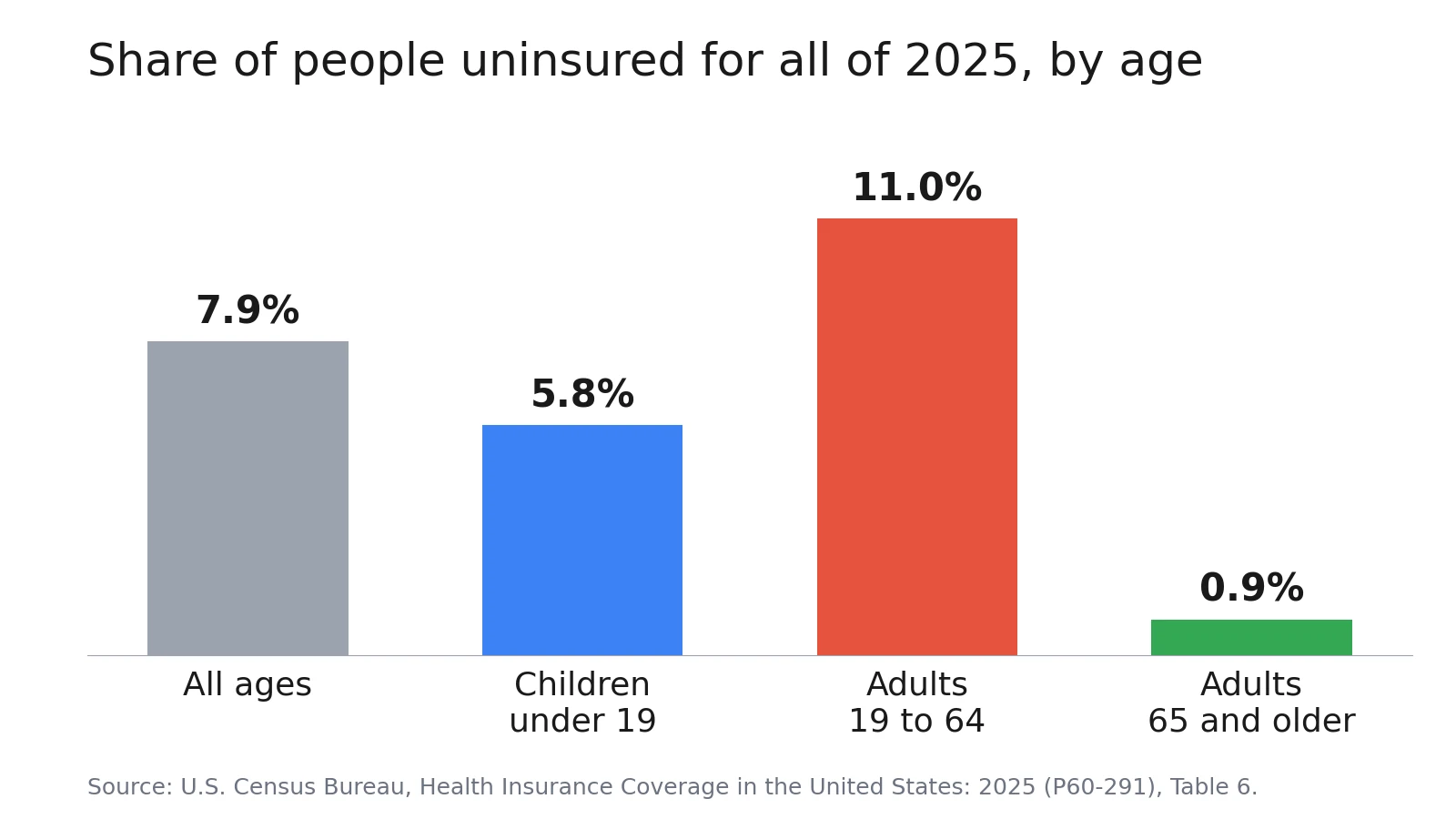
The U.S. Census Bureau's latest report, Health Insurance Coverage in the United States: 2025, found that 26.7 million people (7.9%) were uninsured for the entire year in 2025, which the Census Bureau says was not statistically different from 2024. The CDC's National Health Interview Survey measures something slightly different, whether a person was uninsured on the day they were interviewed, and its 2025 early release counted 28.0 million people (8.3%).
Working-age adults have the highest uninsured rate. In the Census Bureau's Table 6, 11.0% of adults ages 19 to 64 were uninsured all year in 2025, compared with 5.8% of children under 19 and 0.9% of adults 65 and older. The NHIS put adults 18 to 64 at 11.6% uninsured at the time of interview.
Those are the people who call a DPC practice and ask whether a membership could be their health care. The honest answer is that it can be their primary care, and it works best alongside something that covers the rest.
What a DPC Membership Covers (and What It Doesn't)
Each practice writes its own membership agreement, so the list below shows what a membership can include, not a promise for any one practice. Ask the practice for its list in writing before you join, and our guide to questions to ask before joining a DPC has a checklist.
| Type of care | Inside a DPC membership? | What to know |
|---|---|---|
| Office visits and annual physicals | Yes, as the practice lists them | See our guide to physicals and preventive care in DPC |
| Messaging, calls and telehealth with your doctor | Yes, as the practice lists them | Ask about response times and after-hours access |
| Chronic condition care (blood pressure, diabetes) | Yes, as the practice lists it | See chronic disease management in DPC |
| Labs and medications | Sometimes, at the practice's negotiated cash prices | See how DPC practices handle medications and labs |
| Imaging such as X-rays and MRIs | Not included, but the practice may help you find cash prices | See cash-price imaging for DPC members |
| Specialist visits | Not included, though your doctor can coordinate referrals | See how DPC handles specialist access |
| Emergency room, ambulance and hospital stays | No | This is the gap a bronze or catastrophic plan is for |
| Surgery, cancer care, maternity delivery | No | Needs insurance, a financial assistance program or a cash agreement with the facility |
The big costs in the bottom rows are why a membership by itself leaves a person exposed. Our guide to what DPC covers in urgent care and emergencies walks through those situations in more detail.
Membership prices vary by practice and by age. Our DPC pricing report summarizes published starting prices across practices, and direct primary care cost by state breaks them down by location. Because DPC is regulated differently from state to state, our direct primary care laws by state guide links each state's rules.
Pairing DPC With a Bronze or Catastrophic Plan
A Marketplace plan with a low premium and a high deductible covers the expensive, unexpected events a membership leaves out, while the membership covers the day-to-day care that would otherwise fall under the deductible. Our guide to what insurance to pair with DPC compares the options in more depth, and here are the two low-premium plan types to know.
Catastrophic plans. HealthCare.gov says catastrophic plans have low monthly premiums and very high deductibles, cover the same essential health benefits as other Marketplace plans, cover preventive services at no cost, and cover at least three primary care visits a year before the deductible. They are open to people under 30 and to people who qualify for a hardship or affordability exemption. A broader eligibility expansion that CMS announced in September 2025 was paused by a federal court order on July 16, 2026 while the case is pending, so for 2027 Open Enrollment only that narrower group can enroll.
Bronze plans. Bronze plans are open to anyone who can buy on the Marketplace. HealthCare.gov notes that if you qualify for the premium tax credit or cost-sharing reductions, a bronze or silver plan may be a better value than a catastrophic plan, so compare the prices you are actually offered after any credit.

Can You Use an HSA With DPC and a Bronze Plan in 2027?
Yes, under the rules that took effect in 2026. The One Big Beautiful Bill Act, Public Law 119-21, made two changes that matter for people building their own coverage. The IRS explains that as of January 1, 2026, bronze and catastrophic plans available through an Exchange are treated as HSA-compatible even if they do not meet the usual high deductible plan definition, and Notice 2026-5 clarifies that the plan does not have to be bought through an Exchange to qualify. The same law lets an otherwise eligible person enrolled in a qualifying DPC arrangement keep contributing to an HSA and pay the periodic DPC fees from it tax free.
The DPC rule has a monthly fee limit. For 2027, IRS Rev. Proc. 2026-24 keeps it at $150 a month in total DPC fees for one person, or $300 if the person is covered by an arrangement that covers more than one individual.
The same revenue procedure sets the 2027 HSA contribution limits at $4,500 for self-only coverage and $9,000 for family coverage.
There are more conditions than fit here, including which services an arrangement may include and what happens above the fee limit. Our 2027 DPC HSA rules guide covers them in plain language, and a tax professional can confirm how they apply to you.
When Can You Enroll in an ACA Plan for 2027?
On HealthCare.gov, Open Enrollment for 2027 coverage runs from November 1, 2026 to January 15, 2027. These are the key dates:
- November 1, 2026. Open Enrollment starts, and you can enroll in, renew or change a plan for 2027.
- December 15, 2026. Last day to enroll for coverage that starts January 1, 2027.
- January 15, 2027. Open Enrollment ends. Plans chosen between December 16 and January 15 start February 1.
After January 15, you can enroll only with a Special Enrollment Period, which HealthCare.gov ties to life changes like getting married, having a baby, moving or losing other coverage. States that run their own marketplace can set their own deadlines, so check your state's site if it is not HealthCare.gov. KFF notes that a federal rule that would have shortened Open Enrollment to nine weeks was vacated.
HealthCare.gov says you can apply for Medicaid and CHIP any time of year. The Census Bureau found that Medicaid coverage fell in 2025, so some people who are now uninsured may still qualify, and our guide to DPC and Medicaid explains how practices and Medicaid members can work together.
What Happened to the Enhanced Premium Tax Credits?
The enhanced premium tax credits that lowered Marketplace premiums for several years are not in effect for 2027 as of November 10, 2026. KFF reports that the enhanced credits expired, that the average finalized benchmark silver premium rose 13% for 2027, and that benchmark silver premiums are up 42% on average from 2025 to 2027. KFF also reports that individual market enrollment fell 18% by June 2026, from 25.2 million to 20.5 million people.
Congress has not finished acting on an extension. The House passed H.R. 1834 on January 8, 2026, by a vote of 230 to 196, and AHA News reports that the bill carried a three-year extension of the enhanced credits. As of November 10, 2026, per Congress.gov, its latest action is from February 10, 2026, when it was placed on the Senate Legislative Calendar, and it has not passed the Senate.
The regular premium tax credit still exists, so the price you see after applying on your marketplace may be lower than the sticker price. If a quote comes back higher than last year, it is worth comparing bronze, catastrophic (if you qualify) and silver plans side by side, with a licensed broker or navigator if you want help, before deciding to go without coverage.
Other Options if Cost Is the Barrier
A membership is one path to affordable primary care, and it is not the only one. For people who cannot fit a membership or a premium into their budget, two parts of the safety net are worth knowing.
Community health centers. According to HRSA, health centers are local clinics that treat medical, dental, mental health and substance use needs, and all of them adjust their fees based on income and family size. HRSA says about 90% of health center patients have incomes below 200% of the federal poverty level. KFF reports that 1,356 health center organizations ran over 16,600 sites in 2025 and served about 32.7 million patients, 17% of them uninsured. HRSA's page includes a search to find a health center near you.
Hospital financial assistance (charity care). Nonprofit hospitals must follow section 501(r) of the tax code. The IRS says each must have a written financial assistance policy covering emergency and other medically necessary care, post it online free along with an application and a plain language summary, and charge a person who qualifies no more than the amounts it generally bills insured patients. Hospitals must also have a policy to provide emergency care without discrimination, whether or not a patient qualifies for assistance. If you are facing a hospital bill, ask the billing office for its financial assistance application.
Good faith estimates. CMS says that, in most cases, if you aren't using health insurance to pay for your care, your provider must give you a good faith estimate when you ask for one or schedule a service at least three business days ahead. Our guide to good faith estimates for DPC explains how that works for memberships and the services around them.
| Path to care | Best for | What it won't do |
|---|---|---|
| DPC membership alone | Regular primary care with direct access to your doctor | Pay for the ER, hospital, surgery or most specialist care |
| DPC plus bronze or catastrophic plan | Everyday care plus protection from large bills | Remove the plan's deductible for hospital care |
| Community health center | Primary care priced by income and family size | Give the same direct, unhurried access a membership promises |
| Hospital financial assistance | Lowering a hospital bill you already face | Cover primary care or prevent the bill in the first place |
| Medicaid or CHIP (if eligible) | Free or low-cost full coverage | Let an enrolled practice charge a membership for Medicaid-covered care |
How a DPC Practice Can Use This Guide With Patients
A patient who asks about joining without insurance is making a careful, budget-conscious decision, and the most helpful thing a practice can do is give them the full picture in one place. Sharing this page, pointing to the enrollment dates in the fall, and saying plainly what the membership leaves out builds trust, whether or not they decide to join. Our guides on whether DPC is worth it and what direct primary care is are good companions for a first conversation.
On the practice side, those conversations create follow-up work that is easy to lose between the EHR, the billing system and the patient inbox, such as a reminder before Open Enrollment closes, a note that a member found a bronze plan, a check-in after a hospital visit the membership didn't cover. Tabflows is a dedicated tech team that connects the tools a clinic already uses, so follow-ups, tasks and patient context live in one place and the work between those tools gets done.
Rules for HSAs, Marketplace eligibility and premium help change from year to year, and this guide reflects them as of November 10, 2026. A licensed broker or navigator can help you compare plans, and a tax professional can confirm how the HSA rules apply to you.
FAQs
Can I join a direct primary care practice if I don't have health insurance?
Yes. A direct primary care membership is a monthly agreement between you and a practice for primary care, so you do not need insurance to join. The membership is not health insurance, though. It does not pay for hospital stays, surgery, emergency room visits or most specialist care, so a serious illness or accident can still leave you with large bills unless you also have coverage for those.
Is a DPC membership enough coverage on its own?
A membership covers the primary care the practice lists in its agreement, which can include visits, messaging with your doctor and some in-office procedures. It does not cover the large, unpredictable costs of an emergency, a hospital admission or cancer care. Pairing a membership with a bronze or catastrophic plan from the Health Insurance Marketplace is one way to cover both, and charity care programs and community health centers are other options if cost is the barrier.
Can I use an HSA with a direct primary care membership and a bronze plan in 2027?
Under Public Law 119-21, bronze and catastrophic plans are treated as HSA-compatible starting January 1, 2026, and a qualifying direct primary care arrangement no longer blocks HSA contributions. For 2027, IRS Rev. Proc. 2026-24 keeps the DPC fee limit at $150 a month for one person and $300 for a membership covering more than one person, and sets HSA contribution limits of $4,500 for self-only coverage and $9,000 for family coverage. Ask a tax professional how this applies to you.
When can I sign up for an ACA Marketplace plan for 2027?
On HealthCare.gov, Open Enrollment for 2027 coverage runs from November 1, 2026 to January 15, 2027. Enroll by December 15 for coverage that starts January 1, or between December 16 and January 15 for coverage that starts February 1. States that run their own marketplace can set their own deadlines. Outside Open Enrollment you need a qualifying life event, such as losing other coverage, moving or having a baby, to get a Special Enrollment Period.
Are the enhanced ACA premium tax credits available in 2027?
Not as of November 10, 2026. KFF reports that the enhanced premium tax credits expired, and benchmark silver premiums are up 42% on average from 2025 to 2027. The House passed H.R. 1834 on January 8, 2026, a bill that the American Hospital Association reports carried a three-year extension, but per Congress.gov it has sat on the Senate calendar since February 10, 2026. The regular premium tax credit still exists, so check what you qualify for on your marketplace.
Who can buy a catastrophic health plan?
HealthCare.gov lists two groups, people under 30 and people who qualify for a hardship or affordability exemption. A broader eligibility expansion announced in 2025 was paused by a federal court order on July 16, 2026, according to CMS. Catastrophic plans cover the same essential health benefits as other Marketplace plans, cover preventive services at no cost and cover at least three primary care visits a year before the deductible.
What if I can't afford a membership or insurance?
Community health centers adjust their fees based on income and family size, and they served about 32.7 million patients in 2025, 17% of them uninsured, according to KFF. Nonprofit hospitals must have a written financial assistance policy under section 501(r) of the tax code, and people who qualify cannot be charged more than the amounts the hospital generally bills insured patients for emergency or other medically necessary care. You may also qualify for Medicaid, which you can check through your state or HealthCare.gov.