Can You Use an FSA to Pay for Direct Primary Care in 2027?
Yes, if your employer's plan treats the membership fee as medical care, so the answer depends on the plan, not on a single IRS rule. A health FSA pays for medical expenses that would qualify for the medical expense deduction and that the plan covers, and a 2020 IRS proposed rule said a direct primary care fee is a medical expense either as payment for care or as payment for something like insurance, depending on how the arrangement works. Because an FSA can never reimburse insurance premiums, the plan administrator decides which side your membership lands on. And even when the fee is eligible, an FSA reimburses it as each month of care is provided, not in one lump when you prepay.

This guide is for DPC physicians and owners who get the "can I use my FSA?" question at enrollment season, and for the patients and employers asking it. It walks through the 2027 limits, what makes a membership fee eligible or not, the timing rule for prepaid memberships, how a limited-purpose FSA fits next to an HSA, and which family members count. It is general information, not tax or legal advice, and a patient's own plan document and plan administrator have the final word.
The 2027 Health FSA Limits at a Glance
The IRS published the 2027 figures on November 5, 2026 in Rev. Proc. 2026-35 (announced in IR-2026-133). Here is how they compare with 2026 and with the HSA cap that applies to DPC fees:
| Limit | 2026 | 2027 | Source |
|---|---|---|---|
| Health FSA salary reduction limit | $3,400 | $3,500 | Rev. Proc. 2025-32, Rev. Proc. 2026-35 |
| Maximum carryover, if the plan allows one | $680 | $700 | Rev. Proc. 2025-32, Rev. Proc. 2026-35 |
| DPC fee cap for keeping HSA eligibility, one person | $150 a month | $150 a month | Rev. Proc. 2026-24 |
| DPC fee cap, membership covering more than one person | $300 a month | $300 a month | Rev. Proc. 2026-24 |
The FSA limit is a ceiling on what an employee can put in through salary reduction, and an employer's plan can set a lower one. A plan can offer a carryover or a grace period of up to two and a half months after the plan year, according to IRS Publication 969, and it decides which of the two, if either, it offers. The DPC fee cap belongs to HSAs and has nothing to do with whether an FSA can pay a fee; it sits in the table only so the two are easy to tell apart.
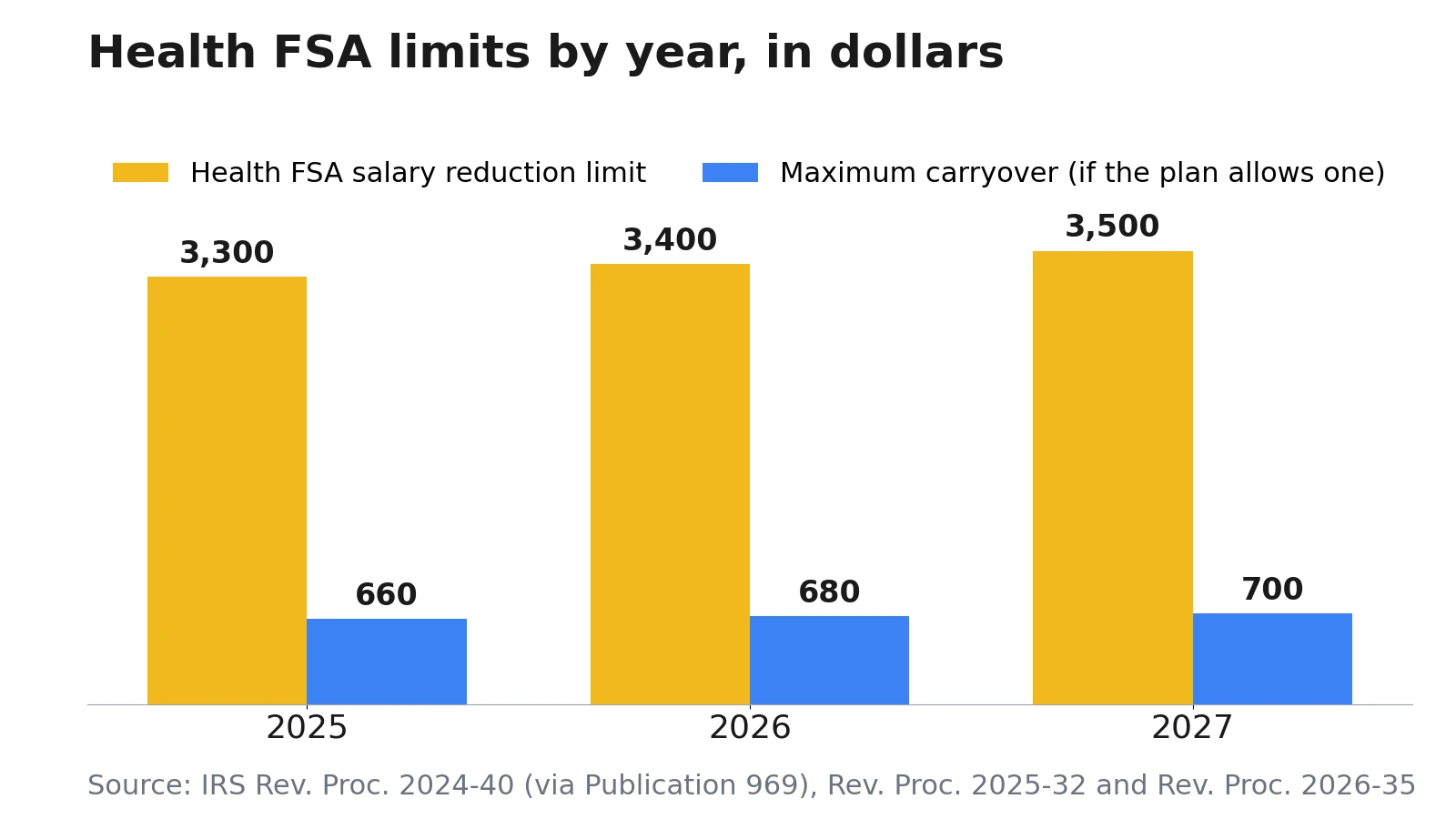
The 2025 figures in the chart come from Rev. Proc. 2024-40, as quoted in Publication 969 (2025). The limit rose in each of these years under the inflation adjustment, and the carryover rose with it.
Is a DPC Membership Fee an Eligible FSA Expense?
Start with what a health FSA pays for. Publication 969 says qualified medical expenses for an FSA "are those specified in the plan that would generally qualify for the medical and dental expenses deduction." So there are two tests, the tax code's definition of medical care and the employer's own plan document.
On the first test, the IRS has not added direct primary care to Publication 502, the list of deductible medical expenses, as of its 2025 edition. The clearest IRS statement is the 2020 proposed rule on certain medical care arrangements (REG-109755-19). It says that "depending on the specific facts regarding an arrangement, a payment for a direct primary care arrangement may be a payment for medical care under section 213(d)(1)(A) or may be a payment for medical insurance under section 213(d)(1)(D)," and that either way the amount "will qualify as a medical expense under section 213." That rule was proposed, and we found no final version of it.
Why "medical care or insurance" matters for an FSA
Here is where FSAs part ways with HSAs and HRAs. Publication 969 lists what an FSA cannot pay for, and the first item is "Amounts paid for health insurance premiums." The 2007 proposed cafeteria plan rules say the same thing, that "a health FSA may not reimburse premiums for accident and health insurance or long-term care insurance."
So if a plan administrator reads a membership as payment for primary care visits and services, the fee fits an FSA. If it reads the membership as a form of coverage, closer to a premium, the FSA cannot pay it, even though the same fee could still count as a medical expense on Schedule A, where only the total above 7.5% of AGI is deductible for someone who itemizes. Nothing in the IRS guidance we found tells administrators where to draw that line for DPC, which is why the answer varies from one employer's plan to the next.
What the 2025 law changed, and what it didn't
Section 71308 of Public Law 119-21, the One Big Beautiful Bill Act, made qualifying DPC memberships compatible with HSAs from January 1, 2026 and let HSAs pay the fees. IRS Notice 2026-5 explains those rules in detail. Both are about HSAs. We found nothing in the law or the notice that changes the health FSA rules, so an FSA still runs on the plan document and the general cafeteria plan rules described here. Our DPC and HSA guide covers the HSA side in full.
Prepaid vs. Incurred, the Timing Rule That Catches Annual Memberships
Even when a plan treats the fee as eligible, timing decides when the money comes back. The 2007 proposed cafeteria plan rules, which taxpayers may rely on until final rules are issued, say in proposed section 1.125-6(a)(2) that "medical expenses are incurred when the employee (or the employee's spouse or dependents) is provided with the medical care that gives rise to the medical expenses, and not when the employee is formally billed, charged for, or pays for the medical care." The same rules say expenses incurred before or after the period of coverage may not be reimbursed.
Publication 969 puts it more bluntly, saying "The FSA can't make advance reimbursements of future or projected expenses." The proposed rules make one exception for prepaid care, and it is narrow. Under proposed section 1.125-5(k)(3), a plan may reimburse advance payments for orthodontia when they are made.
How that plays out for common billing patterns
The rule points to these outcomes, though the plan administrator applies it:
| How the member pays | What the incurred rule points to |
|---|---|
| Monthly fee, billed each month | Each month's fee is reimbursable once that month of membership has been provided |
| Annual fee, prepaid in January | Reimbursed in pieces as each month passes, not all in January |
| Annual fee straddling two plan years | Each plan year's FSA pays only for the months that fall inside its own coverage period |
| One-time enrollment or registration fee | Depends on whether the administrator ties it to care provided; ask before counting on it |
This is a real difference from HSAs. Notice 2026-5, Q-19, lets an HSA treat a DPC fee as incurred on the first day of each month, the first day of the coverage period or the date the fee is paid, so an HSA can reimburse a January prepayment right away. That answer is written for HSAs, and we found no matching IRS guidance for FSAs.
There is an upside on the FSA side too. Under the uniform coverage rule in Publication 969, the full amount a member elected for the year is available at any time during the coverage period, regardless of how much has been taken from their paychecks so far. So once a month of membership has passed, that month's fee can come back early in the plan year, even before much has come out of the member's paychecks.
If your practice offers both options, our piece on annual vs. monthly membership billing walks through the trade-offs, and FSA timing is one more thing to weigh for members who plan to pay with an FSA.

Can You Have a Limited-Purpose FSA With an HSA and DPC?
A regular health FSA that pays general medical expenses blocks HSA contributions, according to Publication 969. The exception is a limited-purpose health FSA, which "can pay or reimburse the items listed earlier under Other health coverage except long-term care" (accidents, disability, dental care, vision care, and telehealth and other remote care) plus preventive care. Employers offer it so people with a high deductible plan and an HSA can still set aside pre-tax money for dental and vision bills.
A DPC membership covers more than those items. It pays for sick visits, chronic care and the rest of primary care, so a fee for the whole membership does not fit neatly inside a limited-purpose FSA's list. We found no IRS guidance that addresses DPC fees in a limited-purpose FSA, and we would not guess at one.
For someone with an HSA, the clearer route is to pay the membership from the HSA itself. Since 2026, a qualifying DPC membership no longer stops HSA contributions as long as the monthly fees stay at or under the cap in the table above, per Rev. Proc. 2026-24, and HSA money can pay the fee. The HSA guide has the details, including what happens when a membership runs above the cap.
Which account pays for what
| Account | Can it pay a DPC membership fee? | Main catch |
|---|---|---|
| Health FSA (general purpose) | If the plan treats the fee as medical care, not a premium | Reimburses as care is provided, and it blocks HSA contributions |
| Limited-purpose FSA | We found no IRS guidance covering DPC fees | Built for dental, vision and preventive care |
| HSA | Yes, for a qualifying DPC arrangement | Fees above the monthly cap stop new contributions |
| HRA | Generally yes, per the 2020 proposed rule, which was never finalized | Employer-funded; an HRA that pays more than premiums generally blocks HSA contributions (Notice 2026-5, Q-5) |
The HRA line comes from the 2020 proposed rule, which says "an HRA may provide reimbursements for direct primary care arrangement fees." Employers weighing that route can read our guide to DPC and ICHRA.
Can You Use Your FSA for Your Spouse's or Kids' DPC Membership?
Yes, as long as the plan covers the fee in the first place. Publication 969 says a health FSA covers qualified medical expenses incurred by:
- you and your spouse;
- all dependents you claim on your tax return;
- anyone you could have claimed as a dependent except that they filed a joint return, had gross income at or above the exemption amount, or you could be claimed as a dependent yourself;
- your child under age 27 at the end of your tax year.
That last line matters for family memberships. A 25-year-old on a parent's family DPC plan can be covered by the parent's FSA even if the parent no longer claims them as a dependent. For how practices structure those plans, see DPC family and child pricing tiers and direct primary care for families.
The same timing rule applies to every person on the membership. Each family member's months of care are incurred as they are provided, so a prepaid family plan is reimbursed month by month just like a single one.
What If Your Employer Already Pays for the DPC Membership?
Then the FSA is out for that fee. A health FSA only reimburses expenses the participant incurred, and Publication 969 requires a written statement that the expense "hasn't been paid or reimbursed under any other health plan coverage." An employer that pays a member's fee directly to the practice has already covered it.
IRS Notice 2026-5 makes the same point for HSAs in Q-18, saying DPC fees an employer pays, including by salary reduction through a section 125 cafeteria plan, "are not expenses of the HSA beneficiary." The reasoning, that the employer's payment is the employer's expense, is why a fee can't be paid twice with pre-tax money.
Employer arrangements raise their own plan design questions. Our guides on selling DPC to employers and DPC with self-funded employer plans go further, and DPC for small businesses covers the smaller-employer side.
Read the Plan Document Before You Count on It
Every rule above is an outer limit, and the employer's written plan can be narrower than it. Publication 969 says qualified expenses are "those specified in the plan," and the 2007 proposed rules confirm that a health FSA may be limited to a subset of medical expenses. Two employers can look at the same membership and reach different answers.
Here are the questions worth asking the plan administrator before enrolling in a membership or setting an FSA election around it:
- Does the plan treat a direct primary care membership fee as a reimbursable medical expense, or as a premium it cannot pay?
- If the fee is covered, will a prepaid annual fee be reimbursed monthly as care is provided, or some other way?
- What documentation does the administrator want, and will it accept a monthly receipt from the practice?
- Does the plan offer a carryover or a grace period, and how much?
- Is the FSA general purpose or limited purpose, and does the member also have an HSA?
A patient's CPA can help with how this interacts with their own taxes, and an employer's benefits attorney or broker should weigh in before a plan document is changed. Neither this guide nor a DPC practice can make that call for them.
How DPC Practices Can Make FSA Claims Easier
Practices don't decide FSA claims, but the paperwork they hand members makes approval easier or harder. The 2007 proposed rules, in section 1.125-6(b)(3), say every claim must be backed by information from an independent third party "describing the service or product, the date of the service or sale, and the amount." The practice is that third party.
A few habits help members get reimbursed without back-and-forth:
- Monthly statements for every member, including annual payers, showing the patient's name, the month of membership covered, the practice's name and the amount for that month.
- Plain, accurate descriptions of what the membership is, a fee for primary care services from your practice, so an administrator isn't left guessing what was bought.
- Separate lines for anything billed outside the membership, such as labs or medications at cash prices, each with its own date of service.
- A short FAQ for enrollment season that tells members to check their own plan and links them to the IRS publications above, rather than promising FSA eligibility the practice can't guarantee.
None of this is complicated, but it tends to fall between tools when the billing system holds the payments, the EHR holds the visit dates and the inbox holds the member's request. Tabflows is a dedicated tech team that works between the tools a clinic already uses, so a member's request for an FSA statement can become a task on one shared list, linked to the patient and visible to the whole team. If you're still setting prices and plan structures, our guides on how much to charge for DPC membership and what insurance to pair with DPC are good next reads, and is a concierge or DPC membership tax deductible? covers the deduction side.
Sources
- IRS, Rev. Proc. 2026-35, section 3.16 (2027 health FSA limit and carryover), and IR-2026-133, November 5, 2026.
- IRS, Rev. Proc. 2024-40 (2025 limit and carryover), as quoted in Publication 969 (2025).
- IRS, Rev. Proc. 2025-32, section 3.15 (2026 health FSA limit and carryover).
- IRS, Rev. Proc. 2026-24, section 3.01(2) (2027 DPC fee cap for HSA eligibility).
- IRS, Publication 969 (2025), Flexible Spending Arrangements and Other employee health plans.
- IRS, Publication 502 (2025), Medical and Dental Expenses.
- IRS, Notice 2026-5, Q-18 and Q-19.
- Public Law 119-21, section 71308.
- Treasury and IRS, proposed regulations on certain medical care arrangements, 85 FR 35398, June 10, 2020.
- Treasury and IRS, proposed cafeteria plan regulations, 72 FR 43938, August 6, 2007.
All sources were checked on November 10, 2026.
FAQs
Can I use my FSA to pay for a direct primary care membership in 2027?
Yes, if your employer's plan treats the fee as medical care, so it depends on the plan. A health FSA reimburses medical expenses that would qualify for the medical expense deduction and that your plan document covers, and the IRS's 2020 proposed rule said a DPC fee counts as a medical expense either as payment for medical care or as payment for medical insurance, depending on the arrangement. Because a health FSA cannot reimburse health insurance premiums, the plan administrator decides which way your membership falls, so ask before you enroll.
What is the health FSA contribution limit for 2027?
IRS Rev. Proc. 2026-35 sets the 2027 limit on employee salary reductions into a health FSA at $3,500, up from $3,400 in 2026. If the plan allows a carryover, the most that can carry over is $700. Your employer's plan can set a lower limit.
Can my FSA reimburse a DPC membership I prepay for the whole year?
Not in one lump. The IRS's proposed cafeteria plan rules say a medical expense is incurred when the care is provided, not when you are billed or pay, and IRS Publication 969 says an FSA cannot make advance reimbursements of future expenses. The one advance payment the proposed rules carve out is for orthodontia. Expect an annual prepayment to be reimbursed month by month as each month of membership passes, unless your plan administrator tells you otherwise.
Can I have a limited-purpose FSA, an HSA and a DPC membership at the same time?
You can hold all three, and since 2026 a qualifying DPC membership under the IRS monthly fee cap no longer blocks HSA contributions. A limited-purpose FSA, per IRS Publication 969, pays for dental, vision, accident and disability items, telehealth and other remote care, and preventive care, which is narrower than what a DPC membership covers. We found no IRS guidance that addresses DPC fees in a limited-purpose FSA, so paying the membership from the HSA is the clearer route, and you should confirm with your plan administrator.
Can I use my FSA for my spouse's or children's DPC membership?
Yes, if the plan covers the fee. IRS Publication 969 says a health FSA covers qualified medical expenses for you, your spouse, the dependents you claim and certain others you could have claimed, and your child who is under age 27 at the end of your tax year, even if you do not claim them.
What if my employer already pays for my DPC membership?
Then you cannot also get reimbursed for it from your FSA. A health FSA only pays for expenses you incurred and that were not paid under any other health plan coverage, and Publication 969 requires a written statement that the expense has not been reimbursed elsewhere. IRS Notice 2026-5 makes the same point for HSAs, saying employer-paid DPC fees are not the employee's own expense.