Can You Pair Direct Primary Care With a Health Care Sharing Ministry?
Yes. A direct primary care (DPC) membership pays your own doctor a flat periodic fee for everyday care, and a health care sharing ministry is a faith-based nonprofit whose members share each other's large medical bills, so a patient can hold both, one for everyday care and one for large bills. The catch is that a sharing ministry is not insurance. State regulators say ministries carry no legal obligation to pay any bill, and federal tax rules do not treat a ministry as a high deductible health plan, so DPC plus a ministry alone does not make you eligible for a health savings account (HSA).
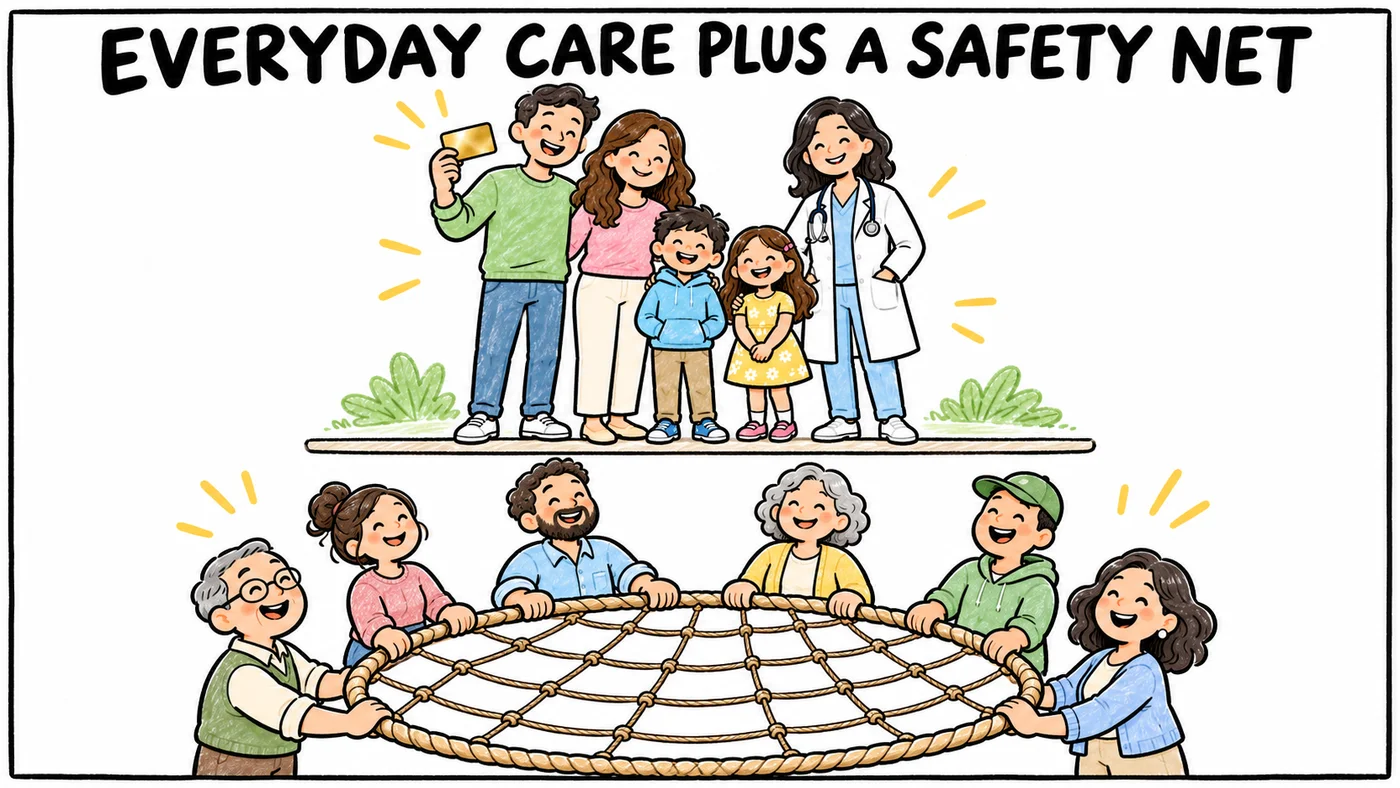
This guide is for DPC physicians and owners who get asked about health sharing at the front desk, and for the patients and employers they talk to. It covers what federal law says a sharing ministry is, how its history ties to the Affordable Care Act, what state disclaimers and regulator warnings say, how members combine sharing with a DPC membership, and where HSAs fit. It is general information, not legal, tax or insurance advice, so a patient weighing a ministry should also talk with a licensed broker or a CPA.
For the full menu of coverage that pairs with DPC (bronze, catastrophic, employer plans, Medicare and more), see our guide to what insurance to pair with DPC. This post goes deeper on sharing ministries alone.
What Is a Health Care Sharing Ministry Under Federal Law?
Federal law defines a health care sharing ministry in 26 U.S.C. 5000A(d)(2)(B), the section of the tax code that created the Affordable Care Act's individual coverage requirement. To count, an organization has to meet five tests:
- It is described in section 501(c)(3) and exempt from tax under section 501(a).
- Its members "share a common set of ethical or religious beliefs and share medical expenses among members in accordance with those beliefs and without regard to the State in which a member resides or is employed."
- Its members "retain membership even after they develop a medical condition."
- It, or a predecessor, has existed at all times since December 31, 1999, and its members' medical expenses have been shared continuously and without interruption since then.
- It has an annual audit by an independent certified public accounting firm under generally accepted accounting principles, made available to the public on request.
That 1999 date matters. It means a brand new organization cannot become a sharing ministry under this definition by starting up today, unless it descends from one that was already sharing bills before 2000. State regulators also look beyond this definition. Colorado, for example, tracks a broader category it calls health care sharing plans and arrangements, and Michigan, Massachusetts and North Carolina publish their own warnings (more on those below).
Why the ACA created the definition
The Affordable Care Act added section 5000A, which required most people to carry minimum essential coverage or pay a shared responsibility payment on their federal tax return. Members of a qualifying sharing ministry were exempted from that payment, so the definition above worked as a gate to the exemption rather than as a license to sell anything.
That exemption still sits in the statute, but its practical weight changed. Public Law 115-97, section 11081 cut the payment's percentage to zero and its flat dollar amount to zero for months beginning after December 31, 2018. HealthCare.gov now says plainly that the fee for not having health insurance no longer applies. In 2027, then, the federal definition mostly matters for how a ministry describes itself and for bills in Congress that build on it, not for a federal penalty.
Is a Health Sharing Ministry Insurance?
No, and regulators repeat this in plain language. Michigan's Department of Insurance and Financial Services explained in January 2024 that "HCSMs are not considered health insurance because they do not assume any risk, and because the ministries are not legally or contractually obligated to pay health care costs." The same release says ministries do not have to cover pre-existing conditions or essential health benefits, and that because they are not regulated as insurance, complaints go to Michigan's Attorney General rather than to the insurance department.
The Massachusetts Division of Insurance put out similar guidance on January 8, 2024, saying sharing ministries, discount plans and risk-sharing plans "are not insurance products" and urging consumers to weigh any alternative to comprehensive coverage carefully. North Carolina's Department of Insurance, on its alternate plans page, says "there is never a guarantee of payment on any eligible need" and that the department will be unable to help with a consumer complaint about one.
What state disclaimers say
Some states write the "not insurance" point into statute and require ministries to hand members a written notice. Florida is a clear example. Florida Statutes section 624.1265 exempts a qualifying nonprofit religious organization from the state insurance code only if, among other things, it shares needs with no assumption of risk and no promise to pay, gives participants a monthly accounting of needs shared, has an independent annual audit and does not sell through licensed insurance agents. It also requires a written notice that includes this sentence:
"Regardless of whether you receive any payments for medical expenses or whether this organization continues to operate, you are always personally responsible for the payment of your own medical bills."
State laws on sharing ministries differ, and we did not find a primary source that counts them across all 50 states today. If you practice in another state, check your own insurance department's site, and for the separate question of how your state treats DPC agreements, see our DPC laws by state guide.
DPC Membership, Sharing Ministry and ACA Plan Compared
A DPC membership, a sharing ministry and a regulated health plan do very different jobs. Here is how they differ on the points that matter when a big bill shows up.
| Question | DPC membership | Health care sharing ministry | ACA Marketplace plan |
|---|---|---|---|
| What it is | A flat periodic fee to a doctor for defined primary care | Members voluntarily share each other's eligible bills under the ministry's guidelines | Regulated health insurance |
| Is it insurance? | Depends on your state's DPC law | No, per state regulators | Yes |
| Guaranteed payment of big bills? | Not designed for them | No guarantee, per state regulators | Yes, after deductible and cost sharing, under the plan's terms |
| Pre-existing conditions | Set by the practice's membership agreement | Not required to share them, per Michigan DIFS | Covered under federal rules |
| Who you complain to | Your state's rules for DPC | Not the insurance department in Michigan or North Carolina | Your state insurance department or the Marketplace |
| Counts as an HDHP for an HSA? | No, but a qualifying DPC arrangement no longer blocks HSA eligibility | No | Exchange bronze and catastrophic plans can, from 2026 |
The HSA row is covered in more detail below and in our 2027 DPC HSA rules guide.
How Do Members Pair DPC With Health Sharing for Big Bills?
The idea is simple. The DPC membership handles the everyday work, such as sick visits, chronic disease follow-ups, labs drawn in the office and direct messages with the doctor. The sharing ministry is where they send the large, rare bills, such as an emergency room visit, an inpatient stay or surgery, hoping the ministry's members will share them.
Because a ministry is not an insurer, a hospital or specialist often treats a ministry member as a self-pay patient. Massachusetts' Division of Insurance notes that ministries usually have no provider networks, so members may be charged full price, while North Carolina's notes that some do use networks and issue member cards. Depending on the ministry's guidelines, the member or the provider submits the bill for sharing. Colorado's Division of Insurance, in its first report on sharing arrangements (May 2023, covering 2021 data), noted that some arrangements require members to first ask providers and hospitals to reduce or write off their bills, and some require members to seek charity care or local government help before sharing.
That self-pay reality is where a DPC practice can help most, without promising anything about what a ministry will share:
- Itemized receipts. Give members clear, itemized statements for the membership and for any extra service, so they have what their ministry's guidelines ask for.
- Cash prices outside the membership. Point patients to transparent cash prices for imaging, labs and procedures. Our guides on cash-price imaging and specialist access cover how DPC practices arrange these.
- Good faith estimates. Self-pay patients have rights to a good faith estimate under federal law. See good faith estimates for DPC.
- Coordinated referrals. When a big bill is coming, a referral with the records and a clear plan gives the patient a better footing when they talk with the hospital and the ministry.
Whether a ministry shares any part of the DPC membership fee itself depends entirely on that ministry's guidelines. We do not name or compare ministries here, so a patient should read the current guidelines or ask the ministry directly before counting on it.
Where Colorado draws the line between DPC and sharing
Colorado is one place that spells out that DPC is a different thing. The Division of Insurance's 2024 report on sharing arrangements (published October 2025) quotes Regulation 4-10-01, whose definition of a health care sharing plan or arrangement "does not include direct primary care agreements" as Colorado statute defines them. Colorado law, under House Bill 22-1269, requires sharing arrangements operating there to report enrollment and financial data to the state every year.
What Risks Do Regulators Warn About?
The regulator warnings cluster around a few concrete risks, and they are worth knowing before you recommend anything to a patient.
No promise to pay. Michigan, North Carolina and Florida's required notice all say the same thing in different words. A large bill can go unshared, and the member is still responsible for it.
Excluded conditions and services. Colorado's 2023 release said many of the reporting arrangements excluded benefits such as contraception, mental health services, prescription drugs for chronic conditions and some pre-existing conditions, and many limited maternity care unless the member had belonged to the arrangement's highest membership tier for some time. Michigan notes ministries do not have to cover pre-existing conditions or essential health benefits.
Fewer complaint routes. Michigan sends complaints to its Attorney General, and North Carolina says its insurance department cannot help with a sharing ministry complaint. A patient used to calling the insurance department when a claim is denied may not have that option.
Confusion with insurance. North Carolina warns that "there is a risk that a consumer may buy a HCSM plan believing it to be insurance or that it works like insurance." Colorado's insurance commissioner said in the same 2023 release that complaints typically center on an arrangement not paying for a service and leaving the person with a bill for thousands of dollars.
None of this says a ministry is the wrong choice for a given family. It says the choice carries risk that regulated insurance does not, and patients deserve to hear that from someone they trust before they sign.
Health Sharing and HSA Eligibility in 2027
Patients who have read about the 2026 HSA changes may ask about this. The short version is that DPC itself is no longer the problem, and the sharing ministry is.
Starting January 1, 2026, the One Big Beautiful Bill Act (Public Law 119-21) made a qualifying DPC service arrangement compatible with an HSA, within a monthly fee cap the law sets and the IRS adjusts for inflation. Our 2027 DPC HSA rules guide walks through the statute, IRS Notice 2026-5 and the 2027 figures, so we will not repeat them here.
To contribute to an HSA, though, you still need a high deductible health plan. IRS Publication 969 lists the conditions, starting with "You are covered under a high deductible health plan (HDHP), described later, on the first day of the month," and "You have no other health coverage except what is permitted." A sharing ministry is not insurance, so it is not an HDHP, and Publication 969 does not mention sharing ministries at all. DPC plus a ministry, with no HDHP, leaves the patient unable to contribute.
What Congress has proposed
The Personalized Care Act of 2025 (H.R. 810, with a Senate companion, S. 276) would drop the HDHP requirement for HSAs and make a health care sharing ministry participant an eligible individual. Congress.gov's summary says it would also treat direct care fees and sharing ministry membership fees as medical care for the itemized medical expense deduction. As of November 10, 2026, per Congress.gov, both bills were introduced on January 28, 2025, and referred to committee, with no further action. Our guide to DPC legislation in 2027 follows the other DPC bills in Congress, such as the Primary Care Enhancement Act.
Treasury and the IRS also proposed a rule in June 2020, Certain Medical Care Arrangements, that would treat amounts paid for DPC arrangements and sharing ministries as medical care under section 213. We found no final version of that rule in the Federal Register today, so treat it as a proposal only. For what is deductible right now, see is a concierge or DPC membership tax deductible, and send patients with a specific question to a CPA.
What Should a DPC Practice Tell Patients About Health Sharing?
Your patients will make this choice with or without you, so the most useful thing a practice can offer is a clear, neutral explanation and good paperwork. A few habits help:
- Say what the membership covers and what it does not. A one-page sheet that lists what is included and what is not (hospital care, surgery, specialists) keeps expectations honest. Our guide to what a DPC membership covers in urgent situations can help you draft it.
- Point to the regulator, not to a product. Linking a patient to their state insurance department's page on sharing ministries is safer than recommending a particular ministry.
- Mention the HSA rule. Patients who want an HSA need an HDHP, such as a bronze or catastrophic Marketplace plan or an employer's HDHP, and our guide on what insurance to pair with DPC lays out those options.
- Keep receipts easy. Itemized statements and cash-price lists save the member time when they submit to their ministry, and save your front desk repeat requests.
- Stay out of selling. Florida's exemption applies only to an organization that does not market or sell through licensed insurance agents, and selling any coverage product can bring its own licensing questions. Talk with a health care attorney before your practice does more than explain.
Employers comparing options for a team can read our guide to DPC and ICHRA in 2027, which covers a regulated route for reimbursing employees' individual coverage. Physicians still planning a practice can start with how to start a DPC practice.
Keeping the Follow-Up From Slipping
The questions that come with health sharing land on the same small team that runs the rest of the practice. One member needs an itemized statement for their ministry by Friday, another wants cash prices for an MRI before a referral, and a third asks whether they can open an HSA next year. Each request touches the EHR, the billing system and the patient's messages, and those tools don't always talk to each other.
Tabflows is a dedicated tech team that connects the tools your clinic already uses, like your EHR, billing and messaging, so requests like these become tracked tasks with the patient's context in one place and get finished instead of waiting on a sticky note. Patients looking for a practice near them can browse the DPC Finder.
Sources
- 26 U.S.C. 5000A, including (d)(2)(B) and the Public Law 115-97 amendment notes
- Florida Statutes section 624.1265
- Michigan DIFS, health care sharing ministries are not health insurance (Jan 23, 2024)
- Massachusetts Division of Insurance advisory (Jan 8, 2024)
- North Carolina Department of Insurance, alternate plans
- Colorado Division of Insurance, first annual report release (May 2023)
- Colorado Division of Insurance, 2024 report (October 2025)
- IRS Publication 969
- HealthCare.gov glossary, Fee
- H.R. 810, Personalized Care Act of 2025 and S. 276
- Federal Register, Certain Medical Care Arrangements, proposed rule (June 10, 2020)
All sources checked November 10, 2026.
FAQs
Is a health care sharing ministry the same as health insurance?
No. A health care sharing ministry is a faith-based nonprofit whose members share each other's medical bills under the ministry's own guidelines. Michigan's Department of Insurance and Financial Services says ministries are not considered health insurance because they do not assume any risk and are not legally or contractually obligated to pay health care costs. North Carolina's Department of Insurance says there is never a guarantee of payment, and Florida's statute requires a written notice that members are always personally responsible for their own medical bills.
Can I pair a direct primary care membership with a health sharing ministry?
Yes, nothing in federal law stops a patient from holding both. The DPC membership covers everyday primary care for a flat periodic fee, and the ministry is where large bills such as a hospital stay or surgery go for possible sharing. Whether a ministry shares any part of the DPC fee itself is set by that ministry's own guidelines, so read them or ask the ministry before you count on it.
Does a health care sharing ministry make me eligible for an HSA?
Not on its own. IRS Publication 969 says you must be covered by a high deductible health plan to contribute to a health savings account, and a sharing ministry is not insurance, so it is not a high deductible health plan. The Personalized Care Act of 2025 (H.R. 810 and S. 276) would let sharing ministry members contribute to HSAs, but as of November 10, 2026, Congress.gov shows both bills only introduced and referred to committee. A CPA can tell you how your own coverage combination works.
What is the legal definition of a health care sharing ministry?
Federal law defines one in 26 U.S.C. 5000A(d)(2)(B). It must be a 501(c)(3) tax-exempt organization whose members share a common set of ethical or religious beliefs and share medical expenses in line with those beliefs regardless of the state they live in, whose members keep their membership after they develop a medical condition, that (or whose predecessor) has existed and shared medical expenses continuously since December 31, 1999, and that has an annual audit by an independent CPA firm, available to the public on request.
Do I still get an ACA penalty exemption for joining a sharing ministry?
The federal exemption is still written into 26 U.S.C. 5000A, but it no longer saves anyone money. Public Law 115-97 reduced the federal shared responsibility payment to zero for months beginning after December 31, 2018, and HealthCare.gov says the fee for not having health insurance no longer applies. If your state runs its own coverage requirement, check its tax agency's rules separately.
Can a DPC practice bill a health care sharing ministry?
A ministry is not an insurer, so there is no insurance claim to file in the usual sense. Depending on the ministry's guidelines, the member or the provider submits the bill for sharing, so the most helpful thing a DPC practice can do is give the patient clear, itemized receipts and cash prices for anything outside the membership. State DPC laws and the ministry's guidelines both shape the details, so check them before promising anything.