How can a small business offer direct primary care?
A small business can offer direct primary care (DPC) by paying a DPC practice a flat monthly membership fee for each employee who joins, by letting employees pay their own fee pre-tax through payroll, or by funding a health reimbursement arrangement (a QSEHRA or an ICHRA) whose plan document decides whether it covers DPC fees. The membership pays for primary care at that practice, but it is not health insurance, so employees still need coverage for hospital stays, specialists and emergencies. Under IRS guidance, employer-paid DPC fees are generally tax-free to employees, and from 2026 a qualifying membership no longer blocks HSA contributions if each person's fees stay at or under a monthly cap. The way the employer pays changes the tax, HSA and ERISA picture, so the employer's CPA, benefits attorney or broker should confirm the setup first.

This guide is for DPC physicians and owners who get asked by local businesses how to set this up, and for those business owners. It covers federal rules as of November 10, 2026, and it is general information, not legal, tax or benefits advice.
Why small employers are looking at DPC in 2027
The smaller the firm, the less likely it is to offer health benefits. KFF's 2026 Employer Health Benefits Survey, fielded from January to July 2026 and published October 22, 2026, found that 59% of firms with 10 to 24 workers and 66% of firms with 25 to 49 workers offer health benefits, compared with 87% of firms with 50 to 199 workers and 98% of firms with 200 or more. Firms with fewer than 200 workers that don't offer benefits told KFF the most important reason is that the "cost of insurance is too high."
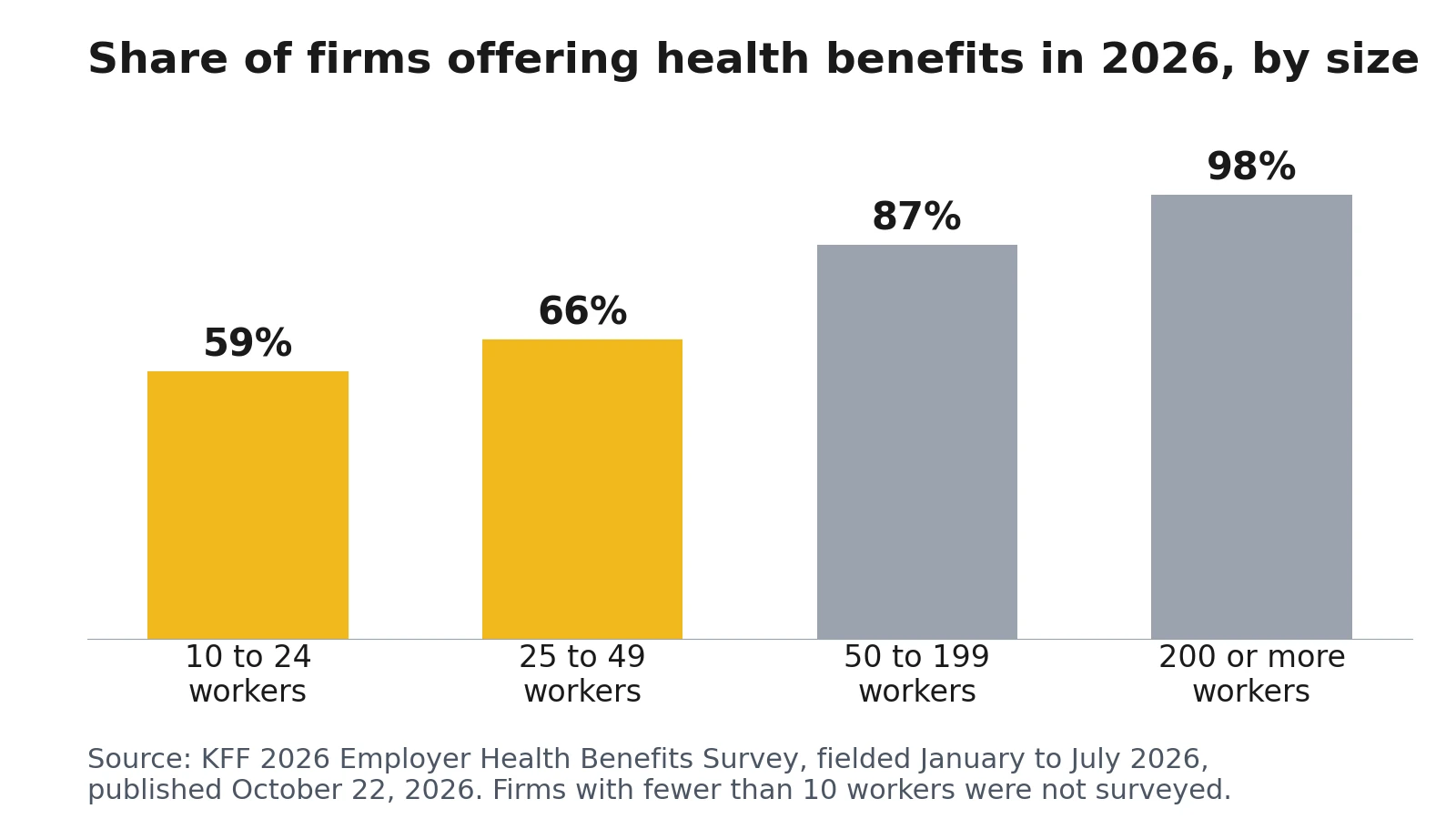
KFF stopped surveying firms with 3 to 9 workers in 2025, citing low response rates and high variability, and it notes that leaving them out raises the overall offer rate. So the very smallest businesses, the ones a neighborhood DPC practice may meet first, aren't in the 2026 numbers.
Workers at small firms who do get coverage carry more of the cost. KFF found that 55% of covered workers at firms with 10 to 199 workers have a general annual deductible of two thousand dollars or more for single coverage, compared with 33% at larger firms.
The same survey puts the average single deductible at those smaller firms, among covered workers in plans with a general annual deductible, at $2,624, and their average worker contribution for family coverage at $9,687, higher than at larger firms.
KFF also found that among firms with 10 to 199 workers that don't offer health benefits, 11% give one or more employees money to buy non-group coverage, a share KFF calls similar to last year's 9%. That is the space where QSEHRAs and ICHRAs (KFF's survey now calls ICHRAs CHOICE arrangements) live, and where a DPC membership can come up in the same conversation.
What are the ways a small business can pay for DPC?
There are five main setups, and the one an employer picks decides which rules apply. The first four get their own sections after the table.
| Setup | Who pays the practice | Taxed to employees? | HSA effect in 2027 | What to confirm |
|---|---|---|---|---|
| Employer pays the membership directly | The business | Generally no (Notice 2026-5, Q-18) | Likely keeps HSA eligibility if the fee is within the cap and paid outside the HDHP | ERISA status, written terms |
| Employees pay through a section 125 cafeteria plan | The business, from pre-tax salary reduction | Generally no (Q-18) | Same as above; the HSA can't also reimburse it | The cafeteria plan document |
| A QSEHRA reimburses the fee | The employee, reimbursed by the business | Generally no, if the employee has minimum essential coverage | Generally lost unless the HRA reimburses only premiums | Whether the plan document covers DPC fees |
| An ICHRA reimburses the fee | The employee, reimbursed by the business | Generally no | Generally lost unless the HRA reimburses only premiums | Plan document; our DPC and ICHRA guide |
| Employees pay on their own | The employee | Not an employer benefit | The HSA can reimburse a qualifying fee | Only the member agreement |
Paying the membership directly
The simplest route is a contract between the business and the practice, with the business paying a monthly fee for each enrolled employee. IRS Notice 2026-5, Q-18, says DPC fees an employer pays are "compensation excluded from employees' gross income under section 106," and 26 U.S.C. 106(a) excludes "employer-provided coverage under an accident or health plan" from an employee's gross income.
It is also the route current IRS guidance contemplates for HSA users, as long as the high deductible plan isn't the payer, though no guidance says outright that it keeps them eligible. It does raise the ERISA questions covered below.
Paying through payroll with a cafeteria plan
Some employers want to offer DPC without paying for it, and let employees pay their own membership with pre-tax dollars. Notice 2026-5, Q-18, treats fees paid "by salary reduction through a section 125 cafeteria plan" the same way as fees the employer pays. The cafeteria plan itself is governed by 26 U.S.C. 125, and whether an existing plan document needs an amendment to add DPC is a question for the employer's benefits counsel.
Reimbursing through a QSEHRA
A qualified small employer health reimbursement arrangement is built for the smallest employers. Under 26 U.S.C. 9831(d), only an employer that is not an applicable large employer and offers no group health plan to any employee can sponsor one. It must be funded solely by the employer, offered on the same terms to all eligible employees, and announced in a written notice at least 90 days before the year begins. IRS Publication 15-B adds that QSEHRA payments are generally tax-free only if the employee has minimum essential coverage, and that the employer reports the permitted benefit on Form W-2, box 12, with code FF.
For 2027, Rev. Proc. 2026-35 caps QSEHRA payments at $6,700 for self-only coverage and $13,550 for family coverage.
Whether a QSEHRA may reimburse DPC fees is not settled by a final rule. A QSEHRA reimburses medical care as defined in section 213(d), and a 2020 IRS proposed rule said that an HRA, "including a QSEHRA," generally may reimburse medical care, so "an HRA may provide reimbursements for direct primary care arrangement fees." That proposal was never finalized. Our guide on whether a DPC membership is tax deductible covers the 213(d) question from the patient's side.
Reimbursing through an ICHRA
An individual coverage HRA requires every covered person to be enrolled in individual health insurance or Medicare, and a DPC membership can never be that coverage. The same 213(d) question applies, and our DPC and ICHRA guide walks through the federal rule, the CHOICE arrangement name and what is still under review.

Can employees keep their HSA if the company pays for DPC?
From January 1, 2026, likely yes, as long as the setup meets a few conditions. Section 71308 of Public Law 119-21, signed July 4, 2025, says a direct primary care service arrangement is not treated as a health plan that blocks HSA contributions, as long as the monthly fees for all of a person's DPC memberships stay at or under a cap.
For 2027, IRS Rev. Proc. 2026-24 keeps that cap at $150 a month for one person and $300 a month for an arrangement covering more than one person.
Notice 2026-5 adds the details that matter for a small employer:
- The HDHP can't be the payer. Q-15 says section 223 does not let an HDHP pay DPC fees "without a deductible or before the deductible has been satisfied." So the business pays the membership on its own, outside the insurance plan.
- The HSA can't pay twice. Q-18 says employer-paid fees, including salary reductions, are not the employee's expenses, so the employee cannot reimburse them from the HSA.
- The fee must be the only charge. Q-11 says the fixed periodic fee must be the "sole compensation" for care under the arrangement, so a membership that also bills insurance or the member for included care doesn't qualify.
- The services have limits. Q-20 limits the arrangement to primary care from primary care practitioners, without general anesthesia procedures, prescription drugs other than vaccines, or lab services not typically administered in an ambulatory primary care setting.
- HRAs are the risky route. Q-5 says that "generally, an HRA (including an ICHRA) is permitted to reimburse only premiums" if it is not to disqualify the employee from HSA contributions. An HRA that also reimburses DPC fees can cost employees their HSA eligibility, and we found no IRS guidance carving DPC fees out of that rule.
- Small-group bronze plans aren't automatic HDHPs. Q-8 says bronze plans offered through the Small Business Health Options Program (SHOP) are generally not treated as HDHPs under the new rule for individual-market bronze plans, though they can still qualify by meeting the usual deductible and out-of-pocket limits.
Notice 2026-5 doesn't say in so many words that an employer's payment outside the HDHP protects HSA eligibility, though Q-18 assumes employers pay these fees. Our 2027 DPC HSA rules guide goes deeper, and an employer with an HSA plan should have counsel confirm its design.
How is employer-paid DPC taxed?
For employees, the answer under Notice 2026-5 is that an employer-paid membership is generally excluded from income under section 106, as covered above. Publication 15-B says an employer can "generally exclude the value of accident or health benefits you provide to an employee from the employee's wages."
Owners are a different story. Publication 15-B says not to treat a 2% shareholder of an S corporation as an employee for this exclusion, and to treat that shareholder as a partner for fringe benefit purposes instead. An owner who is also a member of the practice should ask a CPA how their own fee is reported, and our guide to DPC for the self-employed covers sole proprietors and partners.
For the business, the Schedule C instructions tell sole proprietors to deduct "contributions to employee benefit programs" such as accident and health plans on line 14, leaving out contributions on their own behalf. Other entities should ask their CPA where the payments go.
One credit doesn't apply. The IRS says the small business health care tax credit goes to employers with fewer than 25 full-time equivalent employees that, among other conditions, offer "a qualified health plan to its employees through a Small Business Health Options Program Marketplace." A DPC membership on its own is not a SHOP qualified health plan.
Is a company-paid DPC membership an ERISA plan?
It may be, so ask before employees enroll. ERISA's definition of an employee welfare benefit plan, at 29 U.S.C. 1002(1), covers a plan an employer maintains to provide employees medical care "through the purchase of insurance or otherwise."
We found no Department of Labor guidance written specifically about employer-paid DPC. The closest federal statement sits in the preamble to the 2020 IRS proposed rule, which says the Department of Labor advised that "an employer's funding of a benefit arrangement, in most circumstances, is sufficient to treat an arrangement that provides health benefits to employees as an ERISA-covered plan." The same preamble says that when an employer pays a DPC fee, "that payment arrangement would be a group health plan and it (rather than the direct primary care arrangement), would disqualify the individual from contributing to a HSA." That proposal predates Public Law 119-21 and was never finalized, but counsel will want to see the design.
If the membership is an ERISA plan, a few rules follow.
- A written plan. Under 29 U.S.C. 1102(a)(1), "every employee benefit plan shall be established and maintained pursuant to a written instrument."
- A summary for employees. Under 29 U.S.C. 1022(a), the summary plan description "shall be written in a manner calculated to be understood by the average plan participant."
- A small-plan filing break. Under 29 CFR 2520.104-20, a welfare plan with fewer than 100 participants at the start of the plan year whose benefits are paid solely from the employer's general assets, or provided exclusively through insurance, doesn't file an annual report.
A business with a group health plan also decides whether DPC becomes part of that plan or sits beside it, and Q-15 keeps it outside an HSA-qualified HDHP. For a self-funded employer, see DPC and self-funded employer plans, and if an employer is weighing its own clinic, see onsite employer clinics vs DPC.
Does DPC replace health insurance for a small business?
No. A DPC membership covers primary care at one practice for a flat fee, and it does nothing for a hospital stay, a specialist's bill or an emergency. Public Law 119-21 itself says a qualifying arrangement is not treated as a health plan for HSA purposes, and a membership a practice sells directly is not the minimum essential coverage a QSEHRA requires or the individual coverage an ICHRA requires.
A small employer can pair the two in three ways:
- DPC beside a group plan. The business keeps its insured or level-funded group plan and adds DPC on top, paid outside an HDHP if the plan is HSA-qualified.
- DPC plus an HRA. A business with no group plan funds a QSEHRA or an ICHRA for individual coverage and pays the DPC membership separately, keeping the HRA to premiums if employees want HSAs.
- DPC as a starting benefit. A business too small to offer insurance pays for DPC on its own while employees buy their own coverage. The federal employer mandate reaches only employers averaging at least 50 full-time employees, counting equivalents, under 26 U.S.C. 4980H(c)(2).
Our guide on what insurance to pair with DPC covers the options employees will ask about. State law also shapes DPC agreements, so check direct primary care laws by state before writing an employer contract.
What should a DPC practice offer a small business?
The owner of a small business may have no HR department and no broker on call, so the easier a practice makes the decision, the better. A few habits help.
- Keep the agreement short. A one-page agreement can name the business, the enrolled employees, the monthly fee per member, the start date, how to add and remove people and how either side can end it. Our guide to selling DPC to employers covers contract terms in more depth.
- Know your fee against the cap. If employees have HSAs, each person's total DPC fees must stay at or under the 2027 monthly cap for them to keep contributing. Our guides on membership pricing and family and child tiers help with tier design.
- Keep the fee the sole compensation. A hybrid model that bills insurance for included care fails Notice 2026-5, Q-11, for HSA purposes.
- Send clean invoices. One invoice per month, listing each member and the period, gives the owner's bookkeeper and CPA what they need. Our guide to annual vs monthly billing covers the timing choice.
- Don't promise tax results. Share what the IRS has said, point the owner to their CPA and benefits attorney, and never call the membership insurance. Have your own attorney check any employer discount against our anti-kickback and Stark basics.
Small employer accounts bring a steady stream of small tasks once they sign, from new hires and departures to invoices, renewals and the follow-ups that sit between your billing system, your EHR and your inbox. Tabflows helps there as a dedicated tech team that connects the tools a clinic already uses, so those tasks, patient context and follow-ups land in one place. Our guide to employer group enrollment tracking covers that workflow.
Where the rules are still unsettled
Based on the documents we checked on November 10, 2026, these questions have no final federal answer:
- Whether an HRA may reimburse DPC fees. The 2020 proposed rule said yes, including for QSEHRAs, and it was never finalized.
- Whether an employer's direct payment protects HSA eligibility. Notice 2026-5 assumes employers pay DPC fees but doesn't say so outright, and the 2020 proposed rule, written before Public Law 119-21, said an employer-paid DPC fee would be a group health plan that "would disqualify the individual from contributing to a HSA." The notice asked for public comments by March 6, 2026.
- How a stand-alone employer DPC arrangement fits the group health plan rules. The 2020 preamble called an employer-paid DPC fee a group health plan, and we found no final rule or Department of Labor guidance on DPC specifically.
Sources checked November 10, 2026: KFF 2026 Employer Health Benefits Survey, IRS Notice 2026-5, Rev. Proc. 2026-24, Rev. Proc. 2026-35, Public Law 119-21, 85 FR 35398, IRS Publication 15-B (2026), Instructions for Schedule C, IRS small business health care tax credit page, 26 U.S.C. 106, 26 U.S.C. 125, 26 U.S.C. 4980H, 26 U.S.C. 9831, 29 U.S.C. 1002, 29 U.S.C. 1022, 29 U.S.C. 1102 and 29 CFR 2520.104-20.
This article summarizes federal rules and IRS guidance as of November 10, 2026. It is general information, not legal, tax or benefits advice. Employers should work with their own CPA, benefits attorney or broker on plan design, and practices should have a health law attorney review employer contracts and member agreements.
FAQs
How can a small business offer direct primary care to employees?
A small business can pay a DPC practice a monthly membership fee for each employee who signs up, let employees pay their own fee pre-tax through a section 125 cafeteria plan, or fund an HRA such as a QSEHRA or an ICHRA whose plan document decides whether it reimburses DPC fees. The membership covers primary care at the practice. It is not health insurance, so employees still need coverage for hospital stays, specialists and emergencies. The employer's CPA, benefits attorney or broker should confirm the setup before it starts.
Is employer-paid DPC taxable to employees?
Generally no. IRS Notice 2026-5, Q-18, says DPC fees an employer pays, including by salary reduction through a section 125 cafeteria plan, are compensation excluded from employees' gross income under section 106. IRS Publication 15-B adds that a 2% shareholder of an S corporation is not treated as an employee for this exclusion, so owners of small S corporations need their CPA's help with their own memberships.
Can employees keep contributing to an HSA if their employer pays for DPC?
Likely yes in 2027, if the membership is a qualifying direct primary care service arrangement and each person's DPC fees stay at or under the monthly cap, which IRS Rev. Proc. 2026-24 sets at $150 for one person and $300 for a membership covering more than one person. No IRS guidance says so outright, and a 2020 proposed rule written before the 2025 law said an employer-paid DPC fee would be a group health plan that disqualifies HSA contributions, so the employer's counsel should confirm the design. The employer should pay the fee outside the high deductible plan, because Notice 2026-5, Q-15, says the HDHP itself cannot pay DPC fees before the deductible. Employees also cannot reimburse an employer-paid fee from their HSA (Q-18). Paying the fee through an HRA can cost HSA eligibility, because Notice 2026-5 says an HRA generally has to reimburse only premiums to keep employees eligible.
Can a QSEHRA pay for a DPC membership?
No final federal rule answers this directly. A QSEHRA reimburses medical care as defined in section 213(d), and a 2020 IRS proposed rule said an HRA, including a QSEHRA, generally may reimburse DPC fees, but that proposal was never finalized. A QSEHRA also only reimburses employees who show proof of minimum essential coverage, and for 2027 its limit is $6,700 for self-only coverage and $13,550 for family coverage under Rev. Proc. 2026-35. The plan document and the employer's advisor decide whether DPC fees are covered.
Does a DPC membership count as health insurance for a small business?
No. A DPC membership is a fixed fee for primary care from one practice, and Public Law 119-21 says a qualifying arrangement is not treated as a health plan for HSA purposes. It does not count as the coverage a QSEHRA or an ICHRA requires, and it does not qualify for the small business health care tax credit, which requires a qualified health plan offered through the SHOP Marketplace. A small employer can pair DPC with insurance, or offer it as a benefit beside whatever coverage employees already have.
Is a company-paid DPC membership an ERISA plan?
It may be. ERISA's definition of a welfare plan covers any plan an employer maintains to provide medical care to employees, through the purchase of insurance or otherwise, and a 2020 IRS proposed rule's preamble says the Department of Labor advised that an employer's funding of a health benefit arrangement is, in most circumstances, enough to make it an ERISA-covered plan. We found no Department of Labor guidance written specifically about DPC. A small employer should ask its benefits attorney whether it needs a plan document and a summary plan description, though welfare plans with fewer than 100 participants that meet the conditions in 29 CFR 2520.104-20 skip the annual Form 5500.
Do small businesses have to offer health insurance?
Federal law's employer shared responsibility rule applies to applicable large employers, which section 4980H defines as employers with an average of at least 50 full-time employees, counting full-time equivalents, in the prior calendar year. Smaller employers face no federal penalty for not offering coverage, so a small employer can offer DPC on its own, before or instead of a group plan. State rules can differ, so check with a broker in your state.