How do DPC practices arrange cash-price imaging?
A direct primary care (DPC) practice can arrange cash-price imaging by asking local imaging centers and hospitals for their self-pay rates, recording what each quote includes, and giving members those options when a scan is ordered. Hospitals must publish a discounted cash price where they offer one, while a freestanding center that is not licensed as a hospital or run under a hospital's license is outside that federal rule and has to be asked. A cash price is not automatically lower than what a member's insurance would allow, so the useful habit is comparing a written quote with the plan's estimate. We did not find a survey we could cite on how many DPC practices do this or what prices they get, so nothing below is a benchmark for what your practice should pay.
This guide is for physicians and owners deciding how to handle imaging for members. It covers what the federal rules require, what the research on cash prices shows and how sure it is, how to build a list your team can actually use, and what to tell a member before they book. It is not legal, tax or clinical advice, and every rule below is current as of our check on November 5, 2026.
What does the CMS price transparency rule actually require?
The federal rule is 45 CFR Part 180, and it applies to hospitals. CMS defines the discounted cash price as "the charge that applies to an individual who pays cash (or cash equivalent) for a hospital item or service." Hospitals must publish that price with their other standard charges in a machine-readable file, and they must also show as many of CMS's 70 shoppable services as they provide, within a combined total of at least 300 (or all they provide, if fewer), in a consumer-friendly list or through an online price estimator.
CMS's 70 services include common imaging. The Jiang study's table of those services lists brain and lower spine MRI, head and abdominal CT, a low back X-ray and abdominal and pelvic ultrasound, among others, which gives you a ready starting point when you look a hospital up.
What the rule leaves out
Three limits matter when you plan around this rule. Each one comes from the CMS Hospital Price Transparency FAQs, current as of June 26, 2026.
- It covers hospitals, not every imaging site. The rule reaches institutions licensed as hospitals, or approved as meeting those licensing standards, and their locations under the same license, including an off-campus outpatient department. A center that is not operating under a hospital license falls outside that definition, so its prices come from asking.
- A cash price may not exist. A hospital that has not established a discounted cash price includes the field in its file but does not have to fill it in. For the consumer-friendly shoppable list, 45 CFR 180.60 has it list the undiscounted gross charge instead.
- A radiologist may bill separately. CMS says services from physicians the hospital does not employ are not services "provided by the hospital," so the rule does not require a hospital's file to show those charges. A posted hospital price may therefore be only part of what a member pays.
What changed for 2026, and what is coming
CMS's 2026 price transparency changes took effect January 1, 2026, with enforcement delayed until April 1, 2026. Among other things, they require the median and 10th and 90th percentile allowed amounts in the file where a negotiated charge is based on a percentage or algorithm, and they modify the file's attestation that it is true, accurate and complete. Where those amounts appear, they could make that hospital's insured prices easier to compare with its cash price, although reading the raw files is still real work.
The 2027 proposed rule included a request for information on strengthening the requirements. The final rule fact sheet, published November 4, 2026, does not mention price transparency. We read the fact sheet and not the full final rule, so check the regulation itself before relying on any detail here for 2027.
Hospital penalties for missing the rule are capped by bed count, and CMS gives the amounts in its FAQs. The rule sets the base cap at $300 a day at 30 or fewer beds, $10 per bed a day from 31 to 550 beds, and $5,500 a day above that. HHS adjusts those amounts for inflation, and its current table lists $342, $11 per bed and $6,277.
Is a cash price cheaper than insurance for imaging?
Sometimes, and the research is more mixed than the phrase "cash price" suggests. We found three useful studies, and they do not measure the same thing, so it helps to read them side by side.
| Study | What it looked at | What it found | How far to trust it for your market |
|---|---|---|---|
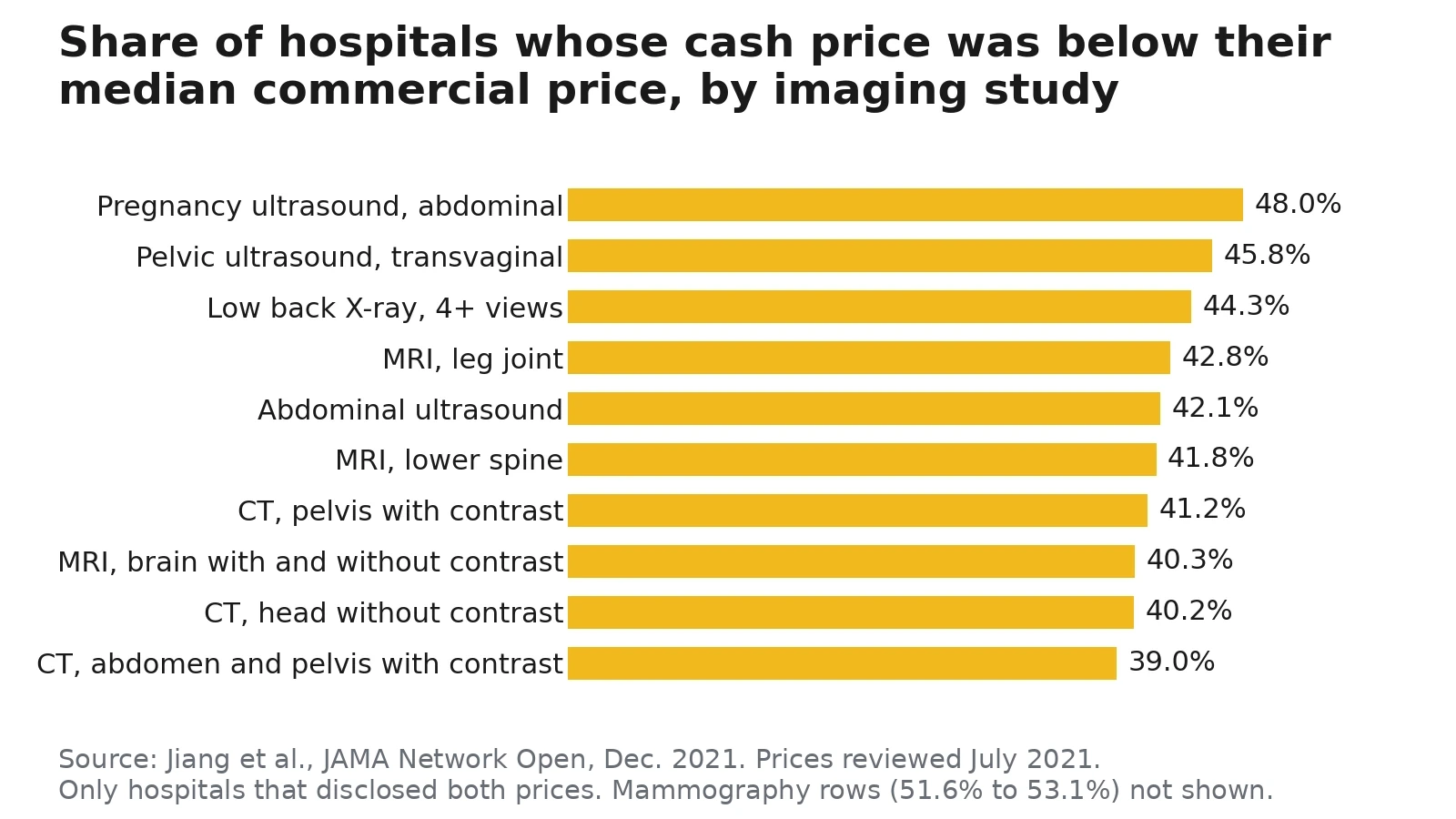
| Jiang et al., JAMA Network Open, published December 2021 | Hospital prices reviewed as of July 2021, hospitals disclosing both cash and commercial prices | Cash was below the hospital's median commercial price at 39.0% to 48.0% of hospitals across CT, MRI, X-ray and ultrasound studies (the study's three mammography rows, not included here, ran 51.6% to 53.1%) | National but only hospitals that disclosed both prices, and the authors could not explain the variation |
| Linde and Egede, Medical Care, published 2022 | 2021 prices for 14 services at 1,599 hospitals | Adjusted across all 14 services, cash prices averaged 60% above negotiated prices | Hospitals that complied with the rule, self-reported, and most representative of larger hospitals |
| Epstein et al., Inquiry, published December 2020 | 142 imaging facilities in the San Francisco Bay Area, 2014 to 2016 data, 194 radiology codes | About 60% of cash prices were below the matching in-network price, and the authors describe cash prices as "rarely posted directly" | One region, older data, Kaiser excluded, and two of the five authors were affiliated with the company that built the dataset |
These results can all be true at once. The Linde and Egede figure comes from a pooled price regression across hospitals and services, and the authors report qualitatively very similar results with outliers removed. The Jiang share compares each hospital's cash price with that hospital's own median commercial price, and the Bay Area study covers imaging facilities in one region rather than hospitals nationwide. None of them tells you the cash price at the center down the road, so treat them as a reason to ask, not as a forecast.
The hospital averages in the Linde and Egede study show why a list price alone tells you little. Their summary table gives these unadjusted means, and the authors flag self-reported data and possible outliers.
| Study | Mean list price | Mean cash price | Mean negotiated price |
|---|---|---|---|
| MRI, brain before and after contrast | $5,021 | $3,484 | $2,127 |
| CT, pelvis with contrast | $2,971 | $2,140 | $1,232 |
| Ultrasound, abdomen complete | $1,352 | $953 | $600 |
Source: Linde and Egede, Medical Care, Table 1.
Where the scan happens seems to matter as well. Philips and Whaley, writing in Health Affairs Scholar in April 2025 on commercial rates for the 2023 contract year, found facility fees varied far more than professional fees, with facility coefficients of variation often 3 to 6 times higher. They could not compare sites of service directly, and they cite a Blue Cross Blue Shield brief for the point that hospital outpatient imaging ran 2 to 3 times physician office prices. That is insured pricing, not cash pricing, so we read it only as a reason to get quotes from both kinds of site.
How to build a cash-price imaging list for your practice
The work here is mostly phone calls and record keeping, and the list only helps if your team can find it during a busy afternoon. A short version that covers the studies you order most is more useful than a long one nobody updates.
- Pull your own order history. Start from the studies your clinicians actually order, because that is the list members will ask about.
- Get quotes from more than one kind of site. Look up nearby hospitals' cash prices in their shoppable services list or estimator, and call freestanding centers, since the authors of the Bay Area study describe cash prices as rarely posted and available to patients who ask.
- Ask the same questions every time. Use the checklist below, so that two quotes are comparable.
- Date every entry and name who quoted it. A self-pay rate can change without notice, so an undated number invites a billing surprise, and your front desk needs to know how old a price is before repeating it.
- Decide who updates it. Give the list one owner and a recheck date on the calendar, and treat a member's report of a different price as a prompt to call again.
What to ask when you request a cash price
| Ask this | Why it matters |
|---|---|
| Does the price include the radiologist's read? | Facility and professional fees are separate components, and an independent radiologist may bill on their own |
| Does it include contrast, and is the with-contrast price different? | CT and MRI studies are priced by exact study, so a quote for one may not match the order |
| Which CPT code is the quote for? | It lets you compare two sites and match the quote to the order |
| Who bills the member, and when is payment due? | It tells the member who to pay and what to expect at check-in |
| Is the rate open to anyone paying cash, or tied to our practice? | A rate tied to your practice raises the billing and legal questions below |
| How do you send the report, and who calls with an urgent finding? | The result has to come back to the clinician who ordered it |
| Will you give a good faith estimate in writing? | A self-pay patient has a federal right to one, as covered below |
Should the practice bill for imaging or let the facility bill?
The simplest arrangement to explain is one where the member pays the facility directly and your practice is not in the money flow. A practice could instead set up a negotiated client account, the way our guide describes for labs at wholesale, but imaging brings three questions worth settling first.
The first is referrals. The Anti-Kickback Statute, the Stark law and state fee-splitting laws can reach payments and financial relationships with an imaging center, and Stark lists radiology and certain other imaging services as designated health services. The second is estimates, because the provider or facility that takes the request and is responsible for scheduling the service it will furnish owes the good faith estimate, so a practice that schedules and bills a scan should settle where that duty falls, as our good faith estimate guide explains. The third is HSA treatment, covered next. If money will move between your practice and an imaging facility, have a health care attorney read the arrangement before it starts.
How do HSA rules affect imaging for DPC members?
IRS Notice 2026-5 does not mention imaging, X-rays or ultrasound. Its named exclusions from primary care services are procedures requiring general anesthesia, prescription drugs other than vaccines, and laboratory services not typically administered in an ambulatory primary care setting. So the notice does not name imaging either way, and we would not assume an answer. It does limit a qualifying arrangement to care "consisting solely of primary care services provided by primary care practitioners," and Q-14 says the test depends on the arrangement's terms, so ask whether scans read by a radiologist fit that test before they go into a membership.
Two answers in the notice still shape the design. Q-11 says the fixed periodic fee must be the sole compensation for care under the arrangement, so a practice cannot provide items on condition of membership and bill separately for them. Q-12 says services offered outside the arrangement, to members and non-members regardless of membership, and billed separately, are compatible. Our reading is that a scan a member pays an outside facility for is the cleaner case, and that a members-only imaging rate your practice bills deserves a question to your tax advisor. That reading is ours, not IRS guidance on imaging. For the rest of the rule, including the monthly fee cap, see our DPC and HSA guide.
On the member's side, IRS Publication 502 defines medical expenses as the costs of diagnosis, cure, mitigation, treatment or prevention of disease, and it lists X-rays for medical reasons as includible. It does not name MRI, CT or ultrasound, so a member unsure about those can ask a tax advisor. Members with a high-deductible plan should also ask the plan whether a self-pay scan counts toward the deductible before they pay. We did not find a federal rule that settles it, and in Texas and Tennessee, 2023 laws require credit for some direct payments below the plan's average rate (in Tennessee, out-of-network ones) under certain insured plans.
What should DPC members expect when they pay cash for a scan?
A cash price can sound like a guarantee, so a few plain expectations set early can save a hard conversation later. Here is what your team can tell members, in your own words.
Start by telling the facility up front. CMS's guidance for people not using insurance says to let the provider know in advance, and that this covers people who have insurance and choose not to use it. Under 45 CFR 149.610, the estimate is due within 1 business day when the service is scheduled at least 3 business days out, within 3 business days when it is scheduled at least 10 business days out, and within 3 business days of a request.
Next, keep the estimate. A self-pay patient can use the federal dispute process when one provider or facility bills well above its own estimate, as long as the initial bill is dated within the last 120 calendar days. The threshold is $400 above that provider's estimate, and the process carries a $25 administrative fee.
Then compare before assuming. A member who has met their deductible, or who has a large share of the year's care ahead of them, may do better through the plan, and the research above gives no reason to assume cash wins. Prior authorization and network rules belong to the plan, so that part of the comparison is a question for the plan.
Finally, know who sends the result. The ACR practice parameter on communicating imaging findings has the report name the referring clinician, and in emergent or nonroutine situations it asks the interpreting physician to expedite delivery, usually to that clinician or their designee. Be sure the facility has your after-hours number on the order, because a member paying cash is not a reason for that loop to run any differently.
Members on Medicare
Opting out of Medicare does not stop you from ordering. Under 42 CFR 405.425(i), an opted-out physician or practitioner who has not been excluded, and whose Medicare enrollment has not been revoked, may order or refer for Medicare-covered services as long as they are not paid, directly or indirectly, for what they order, prescribe or refer, except as 42 CFR 405.440 allows. Before you point a Medicare member to a cash price, ask the facility how it handles Medicare patients. Physicians and suppliers who provide covered services to Medicare beneficiaries must submit claims for them, with listed exceptions, so a plain cash deal may not be available for a covered study, and we did not verify how that plays out for each type of facility. CMS also says people enrolled in federal health care programs such as Medicare, Medicaid or TRICARE are not eligible for a good faith estimate, even if they do not plan to use that coverage, so the estimate and dispute steps above do not apply to them. Our guides to opting out and DPC for seniors on Medicare cover the wider picture.
A low cash price does not change the clinical question
An easier price can make it feel simpler to order a scan, so it helps to keep your usual appropriateness references close to the list. The ACR Appropriateness Criteria are the radiology community's reference by clinical scenario, and ACR says expert panels review them annually, so use the current version rather than a saved copy.
Low back pain is a good example. The American Family Physician summary of the VA/DoD guideline, published April 2023, says that unless there are focal neurologic deficits or red flags, "imaging does not improve outcomes," and it associates early imaging with higher cost of care and more surgery. That is one guideline for one condition, and your clinical judgment for the patient in front of you still decides. Check the issuing body for the current version before you rely on it.
Keeping the follow-up from slipping
A cash-price scan adds steps that no single system is built to track. The quote may be on a sheet, the order in the EHR, the member's question in a message thread and the report on a fax line, and because those tools were never built to talk to each other, the loop can stay open without anyone noticing. Our guide to specialist referral tracking walks through a similar loop, and the same habit applies here, so that an order stays open until a result is back, reviewed and shared with the member.
This is where Tabflows can help. We are a dedicated tech team that connects the tools a clinic already uses, so an imaging order can become a follow-up task with the patient's context beside it, and your team can see what is still waiting. We are not an EHR, a billing system or a messaging app, and we do not set or negotiate imaging prices.
If you are planning services more broadly, our guide to starting a DPC practice and our post on specialist access for DPC members cover the neighboring decisions.
FAQs
How do DPC practices get cash prices for imaging?
A DPC practice can ask local imaging centers and hospitals for their self-pay rate, write the quotes down with what each includes, and share the list with members when an order comes up. Hospitals must publish a discounted cash price where they offer one, under 45 CFR Part 180. Imaging centers that are not licensed as hospitals or operating under a hospital's license fall outside that rule, so the practice or the member has to ask them. We did not find a survey we could cite on how many DPC practices do this or what prices they get.
Do hospitals have to publish cash prices for MRI and CT?
Hospitals must publish their standard charges, including the discounted cash price, under 45 CFR 180.50, and must show shoppable services in a consumer-friendly form under 45 CFR 180.60. CMS's list of 70 shoppable services includes common CT, MRI, X-ray and ultrasound studies. CMS says a hospital that has not established a discounted cash price does not have to fill in that field in its machine-readable file, so a posted cash price is not guaranteed.
Is a cash price always lower than using insurance for imaging?
No. In a JAMA Network Open study of hospital prices reviewed in July 2021, the share of hospitals with a cash price below their median commercial price ran from 39.0% to 48.0% across the CT, MRI, X-ray and ultrasound studies listed (the study's three mammography rows, not included here, ran 51.6% to 53.1%). A Bay Area study of imaging facilities, using 2014 to 2016 data, found about 60% of cash prices below the matching in-network price. Each member's answer depends on the facility, the study and the plan, so compare a real quote with the plan's estimate.
Does a cash-price scan count toward a member's insurance deductible?
It depends on the plan and, in some states, on state law: Texas and Tennessee passed 2023 laws requiring credit for some direct payments below the plan's average rate (in Tennessee, out-of-network ones) under certain insured plans. We did not find a federal rule that settles it for a self-pay scan. The member should ask the plan before paying, and should tell the facility in advance if they do not intend to use insurance, because a member with private or employer coverage gets a self-pay good faith estimate by saying so. Members on Medicare, Medicaid or TRICARE are not eligible for one.
Can imaging be included in a DPC membership and keep members HSA eligible?
IRS Notice 2026-5 does not mention imaging. It says the fixed periodic fee must be the sole compensation for care under the arrangement, that members cannot be billed separately for care that comes with membership (Q-11), and that separately billed services offered to members and non-members alike can sit outside the arrangement (Q-12). It also limits a qualifying arrangement to care 'consisting solely of primary care services provided by primary care practitioners,' and Q-14 says the test depends on the arrangement's terms, so ask whether scans read by a radiologist fit that test before they go into a membership. Run any imaging arrangement your practice bills by a tax advisor, because that reading is ours and not IRS guidance on imaging.
What should a member do if the imaging bill is higher than the estimate?
A self-pay patient can use the federal patient-provider dispute process when a provider or facility bills well above its own good faith estimate. The initial bill must be dated within the last 120 calendar days, and the process has an administrative fee. CMS sets the threshold at $400 above the estimate, and the administrative fee at $25.
Can a DPC practice mark up imaging or take a fee from an imaging center?
A payment from an imaging center tied to referrals is the kind of arrangement the Anti-Kickback Statute, the Stark law and state fee-splitting laws can reach, depending on who pays for the scan and the practice's financial relationship with the facility. Have a health care attorney review any arrangement that involves money moving between your practice and an imaging facility.