Is Direct Primary Care Worth It?
Direct primary care is worth it if you use primary care often enough, or value fast and personal access enough, that a flat monthly fee costs less than what you pay now or buys you care you cannot get any other way. It tends to suit families with young kids, people managing a chronic condition and anyone tired of waiting weeks for a short visit. It is usually harder to justify if you rarely see a doctor and are happy with the one you have. Either way, DPC covers primary care only, so you still need insurance for the big things.
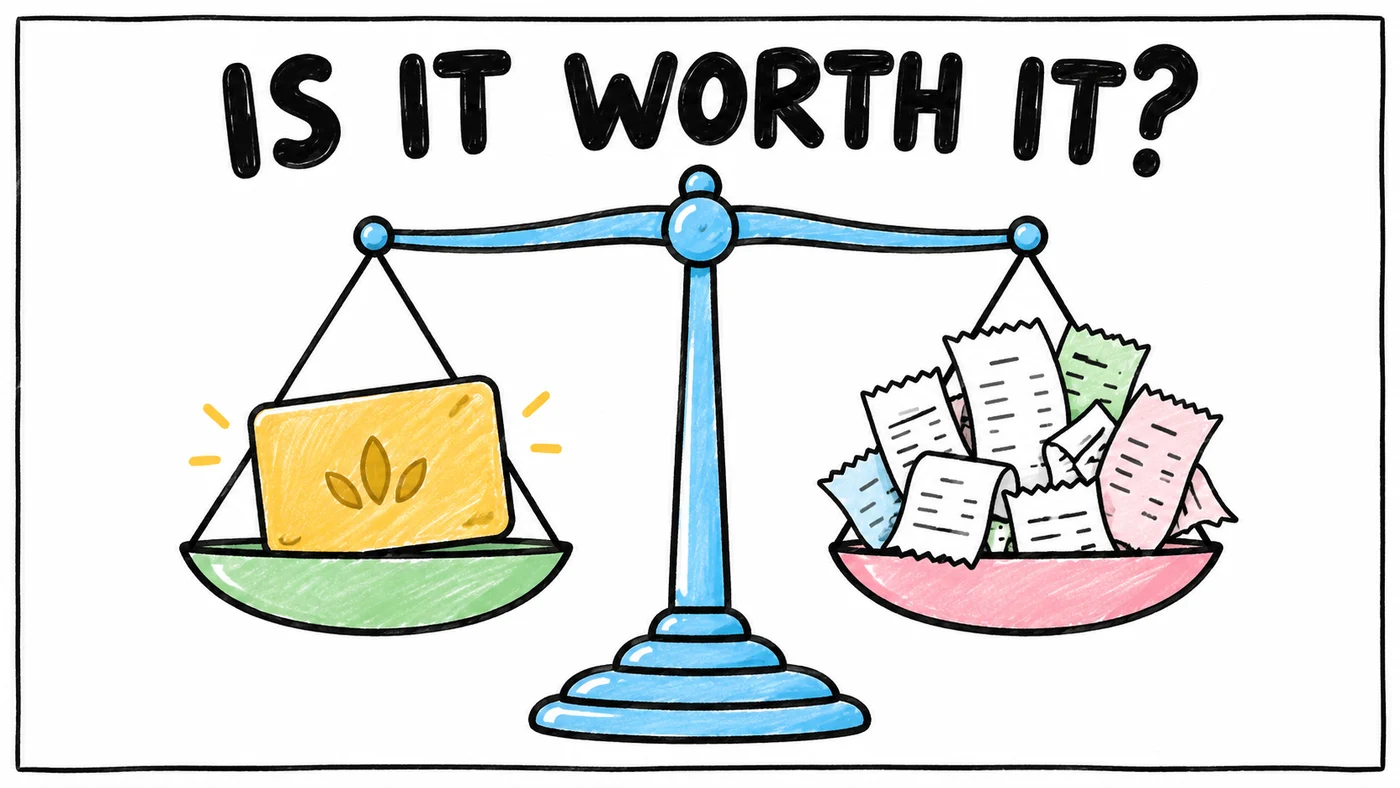
If you are new to the model, our plain-language guide to what direct primary care is covers the basics. This post is about the decision itself. We walk through the honest pros and cons, a simple way to compare the yearly cost against what you pay now, what the research does and does not show, and the signs that a particular practice is a good fit for you.
How Direct Primary Care Works, in Brief
In a DPC practice you pay your doctor a monthly membership instead of paying per visit. That fee usually covers office visits, phone and video visits, text or portal messages with your doctor, and many simple in-office procedures. Many practices also pass along wholesale prices on labs and common medications.
Because the practice does not bill insurance for your primary care, doctors typically care for far fewer patients than a traditional clinic, which is a big part of why same-day appointments and longer visits are realistic. What the membership does not cover is anything outside primary care, such as hospital stays, surgery, specialist visits, advanced imaging and the emergency room. That is what your insurance is for.
What Are the Pros and Cons of Direct Primary Care?
Every honest list of DPC pros and cons comes down to a trade. You pay a predictable fee, often on top of insurance, in exchange for easier access and a closer relationship with one doctor. Here is how that trade usually looks from the patient's side.
| Pros | Cons | |
|---|---|---|
| Access | Same-day or next-day visits are common, and you can often text or message your doctor directly. | Each doctor takes on fewer patients, so popular practices may have a waitlist. |
| Time with the doctor | Visits are usually longer and less rushed, so there is room for more than one concern. | If you only need a quick prescription refill once a year, the extra time may not matter to you. |
| Cost | One predictable monthly fee, no copays for covered visits, and often cheaper labs and medications. | It is an added cost if you also pay a full insurance premium and rarely use care. |
| Insurance | Pairs well with a lower-premium plan, and from 2026 a qualifying membership within the fee limits lets you keep contributing to an HSA. | You still need insurance for hospitals, specialists and emergencies. DPC is not a replacement. |
| Relationship | You see the same doctor, who knows your history and can coordinate with specialists. | If you do not click with that doctor, small practices have fewer alternatives under one roof. |
| Referrals and networks | Your DPC doctor can refer you to specialists and order outside tests. | Some insurance plans only pay for specialists after an in-network primary care doctor sends a referral or gets advance approval, and a DPC doctor may not be in that network. |
| Availability | Practices exist in every state, and you can browse them in the DPC Finder. | In some rural areas the nearest practice may be a long drive away, although many offer virtual visits. |
None of these cons are deal-breakers on their own. They are the questions to answer for your own situation, which is what the rest of this guide helps you do.

Who Is Direct Primary Care Best For?
DPC tends to be worth the money for people who would use it. In practice that often means one of a few groups.
- Busy parents. Kids get ear infections and rashes at inconvenient times, and being able to message your doctor at 7 pm or get a same-day visit saves missed work and urgent care trips. Our guide to direct primary care for families goes deeper on family pricing.
- People managing a chronic condition. Diabetes, high blood pressure, asthma, depression and similar conditions benefit from frequent check-ins, and the membership covers those without a copay each time.
- People on high-deductible or bronze plans. If you pay the full cost of every visit until you meet your deductible, a flat fee can be cheaper and much more predictable.
- Self-employed people and small business owners. They often buy their own coverage and value a doctor they can reach without a long phone tree.
- Older adults who want more time with a doctor. Medicare has its own rules for DPC, which we cover in direct primary care for seniors on Medicare.
DPC tends to be a weaker fit for someone who sees a doctor once a year at most, already has low-cost primary care they like through work, or needs most of their care from specialists rather than a primary care doctor.
Is DPC Worth the Money? A Simple Yearly Cost Comparison
The fairest way to decide is to compare one year of membership with one year of what you spend on primary care today. You do not need exact figures. A rough estimate from last year's statements or receipts is enough.
Step 1. Work out the yearly membership
Start with the membership price of a practice near you.
As an example, we will use a membership of $89 a month.
That works out to $89 times 12 months, or $1,068 a year for one adult.
Your own number may be lower or higher, and some practices add a one-time enrollment fee.
For a sense of the market, here is the DPC Finder's current figure, as our 2027 DPC pricing report gives it.
Across the 1,351 practices on the DPC Finder that post a monthly membership price, the typical starting price is $99 a month, from $15 to $500, and the middle half start between $75 and $125.
Step 2. Add up what you pay now for primary care
Next, total what you spent last year on the things a DPC membership would usually cover. These are the main items to count:
- Copays or full-price charges for primary care and urgent care visits
- Charges for routine labs, if you paid them yourself or toward your deductible
- What you paid for common generic medications that a DPC practice might dispense at cost
- Time off work spent waiting for appointments, if you want to count it
If you are on a high-deductible plan, you may be paying the full negotiated price for each visit until you meet your deductible, which is why the comparison often tips toward DPC for people on those plans.
For context, KFF's 2025 Employer Health Benefits Survey found the average deductible for single coverage was $1,886 among workers in plans with a general deductible.
Step 3. Compare, with clearly labelled example numbers
Here is how the comparison looks for three example people. These are illustrations with made-up visit counts and prices, not averages, so swap in your own numbers. On the DPC side we assume labs and medications cost half of what you pay now, because many practices pass along wholesale prices rather than including them for free. Ask a practice for its real prices.
| Example person | What they pay now for primary care (example) | With DPC at $89 a month (example) | How it compares |
|---|---|---|---|
| Rarely sees a doctor | 1 visit at $40 copay = $40 a year | $1,068 a year | DPC costs about $1,028 more. Hard to justify on cost alone. |
| High-deductible plan, a few visits | 4 visits at $150 each plus $200 in labs = $800 a year | $1,068 membership plus $100 in labs = $1,168 a year | DPC costs about $368 more, in exchange for unlimited visits, messaging and faster access. |
| Chronic condition, frequent visits | 8 visits at $150 each plus $400 in labs and $300 in medications = $1,900 a year | $1,068 membership plus $200 in labs and $150 in medications = $1,418 a year | DPC costs about $482 less, before counting time saved. |
The pattern is simple. The more primary care you use, and the more of it you pay out of pocket, the more likely the membership pays for itself. If your care costs today are close to the membership price, the deciding factor is usually how much you value access and time with your doctor.
Step 4. Look at your insurance too
Many members lower their overall cost by pairing DPC with a lower-premium plan, such as a high-deductible or bronze plan, that protects them from big bills while the membership handles everyday care. Our guide on what insurance to pair with DPC walks through the common options.
Since January 1, 2026, the One Big Beautiful Bill Act (Public Law 119-21) has made qualifying DPC memberships compatible with health savings accounts, and you may be able to pay your fee with pre-tax HSA money. A monthly fee limit decides whether you can keep contributing, and the details are in our DPC and HSA rules for 2027.
For 2027, IRS Rev. Proc. 2026-24 keeps that limit at 150 dollars a month for one person and 300 dollars a month for a membership covering more than one person. Above it you can't make new HSA contributions for those months, though IRS Notice 2026-5 says money already in your HSA can still pay the fee.
What Does the Research Say About Direct Primary Care?
The honest summary is that the evidence is encouraging but still limited. DPC is a young model, practices vary a lot, and there are not many large, carefully controlled studies. Here is what the best-known work shows, without stretching it.
The Milliman and Society of Actuaries study (2020)
The most cited study is Direct Primary Care: Evaluating a New Model of Delivery and Financing, written by Milliman for the Society of Actuaries and published in May 2020. Researchers compared about 900 people who chose a DPC option in one employer's health plan with about 1,100 who stayed in a traditional PPO plan over two years, and adjusted the results for differences in health.
According to Milliman's own summary, the DPC group used fewer healthcare services overall after that adjustment, driven mainly by lower use of facility services such as emergency department visits. That fits what DPC doctors describe, since easier access to your own doctor can mean fewer trips to the ER for problems that could be handled in the office.
The same study did not find clear savings for the employer. Its midpoint estimate was that the employer's net costs were 1.3% higher for DPC members, with a range from a 5.2% reduction to a 7.8% increase. That employer also paid the membership fee and waived the deductible for DPC members, which added cost. The authors also stressed that healthier people tend to choose DPC, so studies that do not adjust for that can overstate its benefits.
The 2025 review of concierge medicine
A 2025 systematic review in The American Journal of Medicine, Maximizing the Value of Concierge Medicine, looked at cost, access and outcomes in concierge-style care. Its abstract reports significantly higher patient and physician satisfaction, while noting that only limited evidence exists on clinical outcomes. The abstract is about concierge medicine and does not name direct primary care specifically, so treat it as related evidence rather than proof about DPC. If you are unsure how the two models differ, see DPC vs. concierge medicine.
What to take from the evidence
Taken together, the research suggests DPC can change how people use care, with fewer emergency visits and more contact with their own doctor, and that patients in membership models tend to be very satisfied. It does not yet prove that DPC improves long-term health outcomes or lowers total costs for everyone. For a patient, that means the strongest case for DPC is personal. It is about whether the access and relationship are worth the fee to you, not about a guaranteed saving.
What About Direct Primary Care Reviews?
When people search for direct primary care reviews, they usually want to know what members of a particular practice think. Reviews on Google and other sites are useful for spotting patterns, such as whether messages get answered quickly or whether the doctor is often booked up. Keep in mind that review counts are often small for DPC practices, because each doctor looks after far fewer patients than a doctor at a traditional clinic.
The best review is often your own short trial. Many practices offer a free meet-and-greet visit, and most memberships are month to month, so you can try a few months and leave if it is not working.
Signs a DPC Practice Is a Good Fit for You
Even if DPC suits you in general, the specific practice matters more than the model. A good fit usually shows these signs:
- The price page is clear about what the membership covers and what costs extra, including labs, medications and any enrollment fee.
- The doctor is taking new patients and can tell you how quickly they typically answer messages and offer visits.
- The practice explains how it handles after-hours questions, referrals to specialists and getting records from your previous doctors.
- The membership is month to month or has a short, clearly stated commitment.
- You feel listened to in the meet-and-greet visit.
We put together a full list of questions to ask before joining a DPC that you can bring to that first conversation. You can also compare practices near you in the DPC Finder.
Responsiveness often depends on how well the practice's tools work together behind the scenes, since messages, records and billing usually live in separate systems. Some practices work with a dedicated tech team such as Tabflows, which connects the tools a clinic already uses so follow-ups and patient context stay in one place, but the simplest test is to ask how long a typical message takes to get answered.
When Is Direct Primary Care Not Worth It?
DPC is not the right call for everyone, and a good DPC doctor will tell you so. It is often not worth it in these situations:
- You rarely see a doctor and are happy with your current care. If you have one checkup a year and like your doctor, the membership mostly buys access you will not use.
- Your plan already gives you cheap, good primary care. Some employer plans and Medicare Advantage plans have low or no copays for primary care visits, which narrows the gap.
- You need an in-network primary care doctor for a specific reason. Some HMO-style plans require a referral or advance approval (called prior authorization) from an in-network primary care doctor before they pay for specialists, and a DPC doctor usually is not in that network. Check your plan's rules before you switch.
- Most of your care comes from specialists. If a specialist manages your main condition, a primary care membership adds less value.
- No nearby practice fits. If the closest DPC is far away, full, or does not offer what you need, such as pediatric care, the model will not help much.
- The fee would strain your budget. If paying the membership would mean dropping insurance, it is usually safer to keep the insurance. DPC works best alongside coverage, not instead of it.
If one of these applies, it does not mean DPC will never make sense. Your needs change, and many people join later, often when they start a family, get a new diagnosis or move to a high-deductible plan.
The Bottom Line
Direct primary care is worth it when you would actually use what the membership offers, which is easy access, unhurried visits and a doctor who knows you. Run the yearly comparison with your own numbers, keep good insurance for the big things, and pick a practice that is clear about its price and responsive from the first conversation. If the numbers are close, a few months of membership will tell you more than any study can.
FAQs
Is direct primary care worth it?
Direct primary care is worth it for many people, but not for everyone. It tends to pay off if you see a doctor several times a year, manage a chronic condition, want same-day or next-day visits and direct messaging with your own doctor, or currently pay a lot in copays and deductible-level visit costs. It is usually harder to justify if you rarely need care and are happy with the doctor you already have. DPC covers primary care only, so you still need insurance for hospital stays, specialists and emergencies.
How much does direct primary care cost per month?
It depends on the practice and on who the membership is for. Children are often cheaper and adults over 65 are often a little more, and some practices add a one-time enrollment fee. Many practices also offer family caps and employer-paid memberships, so check each practice's own price page. The Tabflows DPC Pricing Report gives the DPC Finder's current typical starting price for one adult.
Do I still need health insurance if I join a DPC?
Yes. A DPC membership covers your primary care, such as visits, messaging, many in-office procedures and often discounted labs and medications. It does not pay for hospital stays, surgery, specialists or emergency room care. Most members pair DPC with a health plan, often a high-deductible or bronze plan, so they are protected against large bills.
Can I use my HSA to pay for direct primary care?
Yes, starting in 2026, if the arrangement qualifies. The One Big Beautiful Bill Act (Public Law 119-21) made qualifying DPC arrangements compatible with HSAs, and a membership that includes certain excluded services does not qualify. For 2027, IRS Rev. Proc. 2026-24 keeps the monthly fee limit for staying eligible to contribute at 150 dollars for one person and 300 dollars for a membership covering more than one person. A membership above those amounts makes you ineligible for new HSA contributions for those months, though IRS Notice 2026-5 says money already in your HSA can still pay the fee.
What does research say about direct primary care?
The research is promising but still thin. A 2020 Milliman study for the Society of Actuaries found that, after adjusting for health status, DPC members in one employer plan used fewer downstream services, especially emergency department visits, but the employer's net costs were roughly the same, with a midpoint estimate 1.3% higher. Patient satisfaction with DPC and concierge models is generally reported as high, while evidence on long-term clinical outcomes is limited.
When is direct primary care not worth it?
DPC is often not worth it if you rarely see a doctor and are satisfied with your current care, if your insurance already gives you low-cost primary care you like, if you need a doctor who is in your plan's network for referrals or prior authorizations, or if no DPC practice near you has room on its panel or offers the services you need.