What Is Direct Primary Care?
Direct primary care (DPC) is a way to get your everyday doctor through a flat monthly membership instead of copays, deductibles and insurance bills. You pay the practice directly, and in return you get visits when you need them, a way to text or call your doctor, longer appointments and, at many practices, labs and common medications at low prices. The American Academy of Family Physicians describes it as a monthly, quarterly or annual fee that "covers all or most primary care services." You still keep insurance for the big things, like hospital stays, specialists and emergencies.
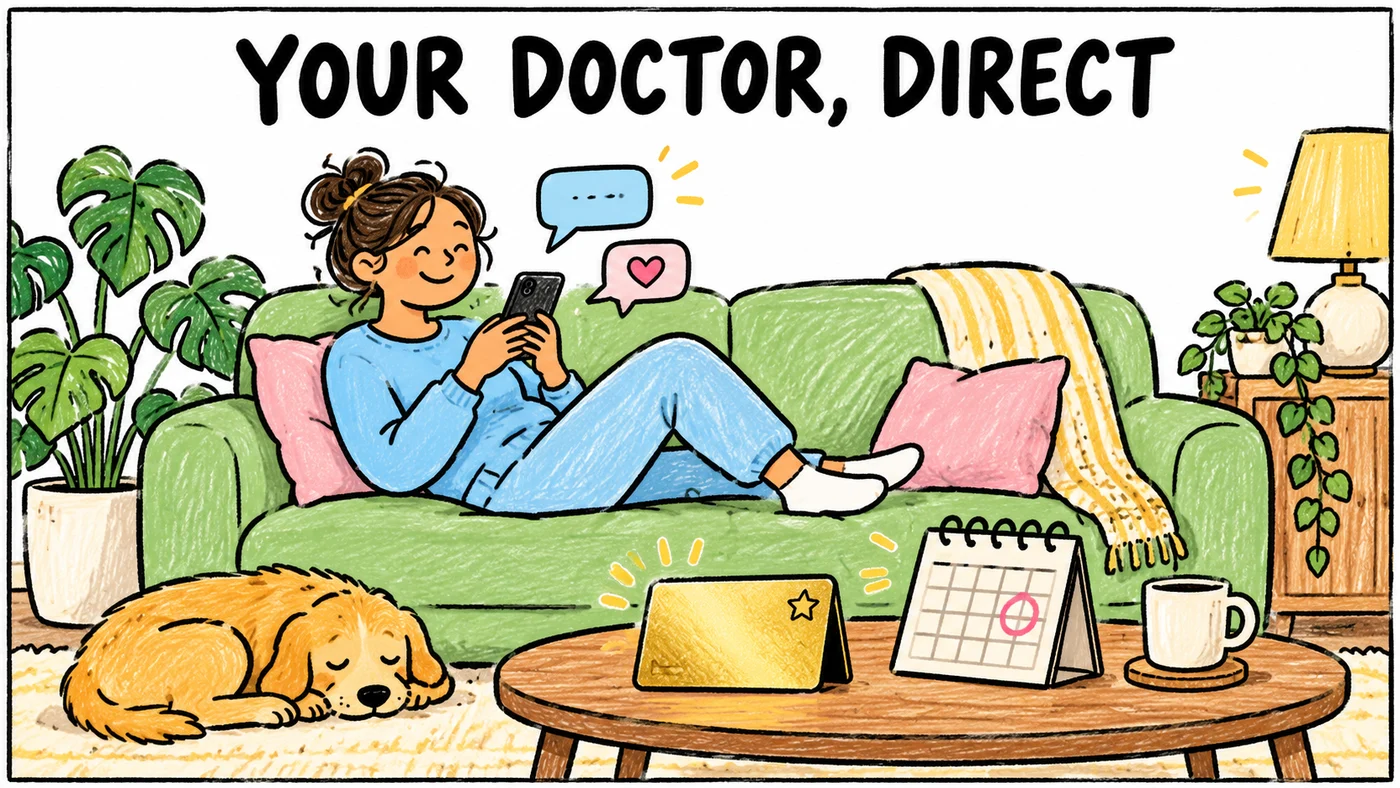
If you have ever waited three weeks for a ten-minute appointment, or opened a surprise bill for a routine visit, the appeal is easy to see. This guide explains how DPC works, what it usually includes and leaves out, how it fits with insurance and your HSA, what it typically costs in 2027 and how to find a practice near you.
How Does Direct Primary Care Work?
You sign up with a practice, agree to a monthly fee and that practice becomes your primary care home. There is usually no copay at the door and no bill after the visit for the care the membership covers. Because the practice is not spending hours on insurance paperwork for every appointment, most DPC doctors look after fewer patients than a typical insurance-based office, which is where the extra time and easier access come from.
A typical month as a member might look like this:
- You wake up with a sore throat, send your doctor a message and hear back the same day.
- You need a check-up or a follow-up on your blood pressure, and you get an appointment that week instead of next month.
- Your appointment runs long enough to actually talk through what is going on.
- You need blood work, and the practice draws it in the office and charges you its own low price for the test.
- You need a common generic medication, and the practice may be able to hand it to you on the spot at close to its cost.
Most memberships are month to month, so you can usually leave if it isn't working for you. Many practices also charge a one-time enrollment fee when you join. In the Tabflows DPC Finder, 55.4% of practices with published prices list one (DPC pricing report).
Some employers also offer DPC as a benefit, paying the membership for their employees. If your job offers it, the experience is the same. The only difference is who pays the monthly fee.
What Does Direct Primary Care Usually Include?
Every practice sets its own menu, so always read the specific practice's website or ask. That said, most DPC memberships are built around the same core:
- Unlimited or generous office visits for everyday care, from colds and rashes to diabetes and blood pressure check-ins.
- Direct access to your doctor by text, phone, secure message or video.
- Longer appointments and quicker scheduling, often same-day or next-day for urgent problems.
- Preventive care such as annual physicals, screenings and help managing ongoing conditions.
- Simple in-office procedures at many practices, such as stitches, skin biopsies, joint injections or removing a mole.
- Care coordination, meaning your doctor helps you find the right specialist and keeps track of what they found.
Two extras make a big difference to many members' wallets. Many practices negotiate low cash prices for lab tests, and many list in-office dispensing of medications, which often means generic prescriptions at a small fraction of the pharmacy price. You can read more about how that works in DPC dispensing of medications and labs.
What Direct Primary Care Does Not Cover
A DPC membership is for primary care, the doctor you see for most things most of the time. It is not health insurance, and it does not pay for care that happens outside the practice. That usually includes hospital stays and surgery, emergency room visits and ambulances, specialist visits, and imaging like MRIs and CT scans (though many practices can get you discounted cash prices for imaging).
Here is how the two usually split:
| Usually included in your DPC membership | Usually still needs insurance |
|---|---|
| Office visits with your own doctor | Hospital stays and surgery |
| Texting, calling or video with your doctor | Emergency room visits and ambulance rides |
| Longer appointments, same-week scheduling | Specialist visits (cardiology, orthopedics and so on) |
| Annual physicals and preventive care | MRIs, CT scans and most advanced imaging |
| Managing ongoing conditions like diabetes | Cancer treatment and other major care |
| Basic in-office procedures | Brand-name or specialty medications |
| Labs and generic medications at low cash prices (many practices) | Pregnancy and delivery care at the hospital |
| Help coordinating referrals | Mental health care beyond what your doctor provides |
Because of that gap, the AAFP notes that DPC practices often suggest patients carry a high-deductible or "wraparound" policy to cover emergencies. That brings us to insurance.
Does Direct Primary Care Work With Insurance?
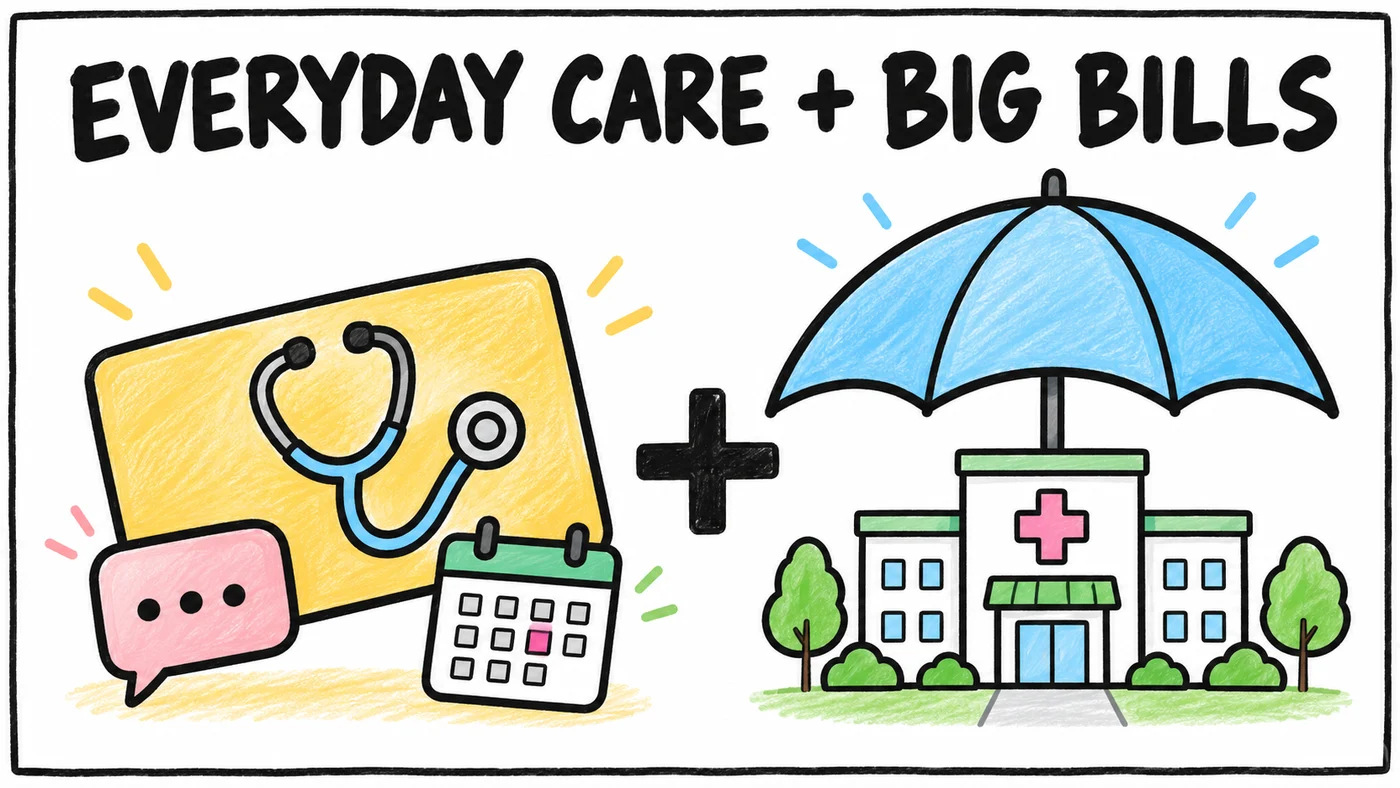
Yes, but not in the way you might expect. Most DPC practices do not bill your insurance for the care your membership covers. Instead, you keep your insurance on the side for the big, expensive things, and the membership handles the everyday care. It helps to think of your DPC membership as the card you use all year, and your insurance as an umbrella you hope you rarely open.
That combination is why many members choose a lower-premium plan with a higher deductible. Your day-to-day doctor visits, messages and many labs are already covered by the membership, so the insurance is mostly there for a hospital stay or a serious diagnosis. Common pairings include a high-deductible health plan, a bronze plan from the marketplace, or the plan you already have through work.
There is no single right answer, because it depends on your health, your budget and your family. Our guide to what insurance to pair with DPC walks through the options side by side, including marketplace plans, employer plans and health sharing ministries.
A few practices are "hybrid" and still bill insurance for some patients, so ask each practice how it handles insurance before you join.
What about Medicare?
People on Medicare can join many DPC practices, but the rules are a little different, because some DPC doctors have formally left Medicare and others have not. That affects what you pay and what Medicare will cover. If you are 65 or older, read direct primary care for seniors on Medicare before you sign up.
Can You Use an HSA for Direct Primary Care?
Starting January 1, 2026, yes, if the membership qualifies. A federal law signed in July 2025 (Public Law 119-21) made qualifying DPC memberships compatible with health savings accounts. You can pay the membership from your HSA, and you can keep contributing to your HSA while you are a member as long as the fees stay within a monthly limit.
For 2027, the IRS keeps that limit at 150 dollars a month for a membership covering one person and 300 dollars a month for a membership covering more than one person (IRS Rev. Proc. 2026-24).
Above those limits you can't make new HSA contributions for those months, though IRS Notice 2026-5 says money already in your HSA can still pay the fee. The law also sets aside some services that don't count as DPC for HSA purposes. Our DPC and HSA rules for 2027 guide explains the details in plain language.
How Much Does Direct Primary Care Cost?
Most DPC memberships cost about as much as a phone bill or a gym membership. The Tabflows DPC Finder checks the prices practices publish on their own websites.
Across the 1,351 practices on the DPC Finder that post a monthly membership price, the typical starting price is $99 a month, from $15 to $500, and the middle half start between $75 and $125.
Practices often price by age. Our pricing report takes each practice's lowest monthly price for a first child and its lowest tier for one adult 65 and older, leaving out family packages, sibling rates, tiers for people under 65, couples' plans and prices under 10 dollars a month. In the Tabflows DPC Finder's records (most last checked in September 2026, queried October 29, 2026), the medians were these.
| Who the membership is for | Median monthly price |
|---|---|
| Children, first child's price (about 570 practices) | About $49 |
| Adults 65 and older (about 330 practices) | About $110 |
Counting sibling rates too, such as a second or additional child, the median child price is about $40.
Source: Tabflows DPC Finder pricing report 2027.
Prices vary a lot by where you live and by your age, because many practices charge older adults more. To see the typical price in your state, check direct primary care cost by state. Families often get a bundled price, which our guide to direct primary care for families covers.
When you compare the cost, it helps to add up what you spend today on copays, urgent care visits, lab bills and generic prescriptions. For some people the membership costs more than they spend now, and for others it saves money while also making the doctor much easier to reach. Our guide to whether direct primary care is worth it walks through that math.
How Many Direct Primary Care Practices Are There?
More than you might think, and they are in every state. The Tabflows DPC Finder lists 5,093 direct primary care and concierge listings across all 50 states and Washington, DC. Of those, 2,518 are pure DPC practices that do not bill insurance at all (how many DPC practices there are).
The number changes as practices open, close and get added, so treat it as a snapshot. Some areas have many practices to choose from, while in rural areas the nearest one may be a drive away. Many practices offer phone and video visits, which can make a longer drive easier to live with.
Direct Primary Care vs Concierge Medicine
These two get mixed up a lot, because both charge a membership fee. The main differences are price and insurance. DPC practices usually charge a lower monthly fee and do not bill insurance for the care the membership covers. Concierge practices usually charge higher fees, often paid once a year, and many still bill your insurance for visits on top of the membership.
The AAFP sums up DPC as lower monthly fees that cover a broader range of services, with no participation in insurance programs. If you are weighing both, our side-by-side guide to DPC vs concierge medicine covers price, Medicare, HSAs and who each one suits.
Is Direct Primary Care Right for You?
DPC tends to work well for people who want an easy, ongoing relationship with one doctor. That includes people managing a chronic condition like diabetes or high blood pressure, parents who want fast answers when a child gets sick, people with high-deductible plans who pay full price for every visit today, and self-employed people and small business owners who buy their own coverage.
It may be a weaker fit if your employer plan already gives you low copays and a doctor you can reach easily, or if most of your care comes from specialists rather than a primary care doctor. It is also worth a second look if you would need to drop insurance entirely to afford the membership, because DPC does not protect you from a large hospital bill.
Where to Start
If you are curious, the easiest next step is to see who practices near you and what they charge. Here is a simple path:
- Find practices near you. Search the DPC Finder by city or state to see real practices, their model (Pure DPC, Hybrid, which also bills insurance, or Onsite, run at an employer's workplace) and contact details.
- Check prices in your area. Compare what you see with DPC cost by state and the 2027 pricing report.
- Do the math for your situation. Is direct primary care worth it helps you compare it with what you spend now.
- Read the guide for your stage of life. See DPC for families or DPC for seniors on Medicare.
- Talk to two or three practices. Bring our list of questions to ask before joining a DPC, such as how fast they reply to messages, what labs cost and what happens if your doctor is on vacation.
- Sort out your insurance. Use what insurance to pair with DPC and the HSA rules for 2027 to pick coverage for the big things.
When you visit or call, pay attention to how easy it is to reach a real person and get an answer. That is the heart of what you are paying for. Many DPC practices are small teams, and the good ones put real effort into making sure your messages, refills and follow-ups don't slip through the cracks. Some work with a dedicated tech team like Tabflows that connects their records, billing and messaging tools so your doctor has your history in front of them and nothing you asked for gets lost between systems.
Direct primary care isn't magic, and it isn't for everyone. But for a lot of people it brings back something that has been hard to find, a doctor who knows you, has time for you and answers when you reach out.
FAQs
What is direct primary care in simple terms?
Direct primary care (DPC) is a way of paying for your everyday doctor with a flat monthly membership instead of insurance copays and bills. The fee usually covers office visits, texting or calling your doctor, longer appointments and help coordinating your care, and many practices also offer labs and common medications at low prices. The American Academy of Family Physicians describes it as a monthly, quarterly or annual fee that covers all or most primary care services.
How much does direct primary care cost per month?
Most DPC memberships cost about as much as a phone bill or a gym membership. Prices vary a lot by where you live and by your age, because many practices charge older adults more. Many practices also charge a one-time enrollment fee. The Tabflows DPC Pricing Report gives the DPC Finder's current typical starting price for one adult. In the Tabflows DPC Finder's records (most last checked in September 2026, queried October 29, 2026), the median first child's price was about $49 a month and the median tier for one adult 65 and older was about $110, leaving out family packages, sibling rates, tiers for people under 65, couples' plans and prices under 10 dollars a month. Counting sibling rates too, such as a second or additional child, the median child price is about $40.
Do I still need health insurance if I join a DPC practice?
Yes, most people should keep insurance. A DPC membership covers everyday primary care, but not hospital stays, surgery, emergency room visits, specialists or most imaging. The American Academy of Family Physicians notes that DPC practices often suggest a high-deductible or wraparound policy to cover emergencies. Many members pair DPC with a high-deductible plan, a bronze plan or employer coverage.
Can I use my HSA to pay for direct primary care?
Starting January 1, 2026, yes, if the membership qualifies. Public Law 119-21 made qualifying direct primary care memberships compatible with health savings accounts, and IRS Rev. Proc. 2026-24 keeps the monthly fee limit for staying eligible to contribute at 150 dollars a month for one person and 300 dollars a month for a membership covering more than one person in 2027. Above those limits you cannot make new HSA contributions for those months, though IRS Notice 2026-5 says money already in your HSA can still pay the fee.
Does direct primary care take insurance?
Most DPC practices do not bill insurance for the care your membership covers. You pay the practice directly, and you keep a separate insurance plan for hospital care, specialists, imaging and emergencies. Some hybrid practices do bill insurance for some patients, so ask each practice how it works.
What is the difference between direct primary care and concierge medicine?
Both use a membership fee, but DPC practices usually charge a lower monthly fee and do not bill insurance for the care the membership covers. Concierge practices usually charge higher fees, often paid yearly, and many still bill your insurance on top of the membership. The American Academy of Family Physicians summarizes DPC as lower monthly fees that cover a broader range of services.
How do I find a direct primary care doctor near me?
Search the Tabflows DPC Finder at tabflows.com/dpc-finder by city, state or practice name. It lists 5,093 direct primary care and concierge listings across all 50 states and Washington, DC, with each practice's model and contact details where available. Then call or visit two or three practices and ask about price, what's included and how fast you can reach the doctor.