How Do DPC Practices Price Families and Children?
Most direct primary care practices price children on a lower age tier than adults, and many add a family cap, a monthly maximum a household pays no matter how many children join. The DPC Alliance found that about three in four practices use age-based tiers, and a smaller group prices families as a bundle. Babies are the main exception, since pediatric practices often charge more in the first year or two, when the checkup schedule is busiest.
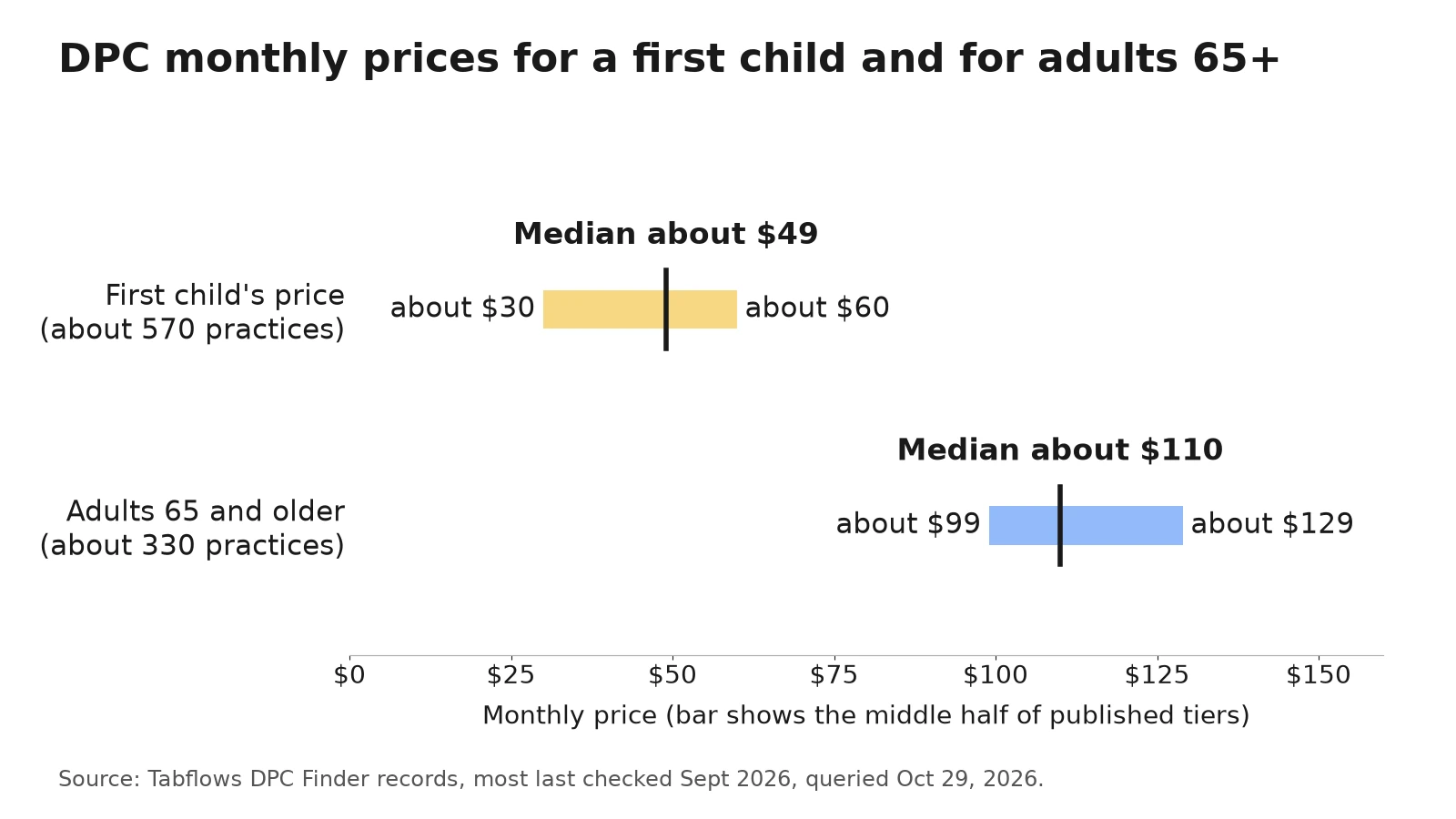
In the Tabflows DPC Finder's records (most last checked in September 2026, queried October 29, 2026), the figure is the first child's price, from a tier labelled for a child, leaving out family and adult-plus-child packages, totals for two or more children, sibling rates and prices under 10 dollars a month. Of about 570 practices with a tier labelled this way, the median is about $49 a month, with the middle half between about $30 and $60.
This guide is for owners setting or revisiting family prices for 2027. It walks through the common structures, what practices actually publish for kids and infants, how a family cap works out in real numbers, and how the HSA fee limits treat a membership that covers more than one person. For the wider question of setting your adult price, start with how much to charge for a DPC membership, and if you are still in the planning stage, the 2027 guide to starting a DPC practice covers the steps around it.
The Common Ways DPC Practices Price Kids and Families
The DPC Alliance State of DPC report (published July 2026 from a survey collected in October 2024) asked practices how they tier their prices. It found that 76.4% use age-based tiers, 15.1% use no tiering at all, and 8.5% use family tiering, which the report defines as the price per member changing with how many family members join together. It calls family tiering one of the newer strategies to emerge.
In practice, family price sheets are built from a handful of pieces, and a practice can combine two or three of them.
| Structure | How it works | Best for | Watch out for |
|---|---|---|---|
| Child age tier | Kids pay a lower fixed monthly price, often up to 17, 18 or 22 | Family medicine practices with a mixed panel | Deciding when a child moves to the adult tier |
| Infant tier | Babies pay more in the first months or years | Pediatric practices with frequent well-baby visits | Staying under the HSA limit for one child |
| Family cap | A household maximum, after which extra children add nothing | Practices that want larger families | Setting it so small families still pay their normal fees |
| Household bundles | Fixed prices for a couple or a family of a set size | Practices that want simple, quotable numbers | Families that don't fit the bundle sizes |
| Child with a parent only | Kids join at the child rate only when an adult joins | Adult-focused practices that still want families | Explaining it clearly on the price page |
None of these is the right answer for every practice. A family medicine practice that sees mostly working-age adults through employers might only need a child tier and a cap, while a pediatric DPC needs an infant tier first and foremost.
What Do DPC Practices Charge for a Child?
These figures come from the Tabflows DPC Finder's records of the prices practices publish on their own websites, most last checked in September 2026 and queried October 29, 2026. For each practice we took its lowest monthly price for a first child (a tier labelled "child", "kid", "pediatric", or ages 0 to 17 or 0 to 18), leaving out family and adult-plus-child packages, totals for two or more children, prices for children and adults alike, prices for dependents 18 and older, and sibling rates such as "each additional child". For adults 65 and older we took its lowest tier for one person ("65+", "65 and older", "senior" or "Medicare"), leaving out tiers for people under 65, couples' plans and spouse or additional-member rates. Neither count includes dental, vision or weight-only plans, or prices under 10 dollars a month. Of about 570 practices with a tier labelled this way, the median sat at under half the 65+ median, which shows how far apart a practice's age tiers can sit.
The median first child's price is about $49. Small changes in the records move this median between about $45 and $50.
The median 65+ tier at about 330 practices is about $110 a month, with the middle half between about $99 and $129.
Counting sibling rates too, such as a second or additional child, the median child price is about $40.
Some practices only add children at the reduced rate when a parent joins. That rule makes sense for an adult-focused practice, since the child tier is priced on the assumption that the family relationship, the shared messages and the visit time are partly carried by the parent's membership.
Published examples of child pricing
These price pages were checked on November 3, 2026. They are examples of structure, not recommendations, and prices change, so read each page directly.
502 Direct Primary Care in Kentucky runs a long child tier:
- Ages 0 to 22 at $59 a month, then $89, $109 and $129 for older bands.
- A family maximum of $259 a month, with an enrollment fee of $149 per person or $249 per family.
Cove DPC keeps the child tier low and starts membership at age 2:
- Children 2 to 18 at $35 a month.
- A family maximum of $200 a month for the whole household, and parents of infants are asked to call or book a meet and greet.
Duet Family Health in Chicago uses household bundles alongside its age tiers:
- Children 0 to 17 at $70 a month.
- A young couple at $170, a couple 45 and over at $190, and a family of four at $290, with a one-time enrollment fee of $100 per person or $200 for a family of up to four.
Notice how differently each practice draws the line between a child and an adult, at 17, 18 or 22. There is no standard, so pick an age that matches your panel and say it plainly, and decide ahead of time what happens on the birthday that moves a member up a tier.
How Should a DPC Price Infants and Newborn Visits?
Babies are where family pricing gets genuinely different. The Bright Futures/AAP periodicity schedule (the version updated February 2025, still the one AAP posted when we checked) lists a newborn visit, then visits at 3 to 5 days, by 1 month, and at 2, 4, 6 and 9 months. That is seven well-baby checkups before the first birthday, followed by visits at 12, 15, 18, 24 and 30 months and then once a year from age 3.
Add the sick visits, feeding questions and late-night messages that come with a first baby, and the first year can take far more of a doctor's time than a healthy school-age child does. Practices handle that in three main ways.
- A minimum age. Some family practices start membership at a set age (Cove's is 2) and ask parents of infants to talk with them first, which protects the panel from more newborn care than the doctor can deliver.
- One child tier for every age. Some family medicine practices price babies the same as older kids and accept that the first year runs heavier, trusting that it evens out over the years a family stays.
- A higher infant tier. Pediatric DPC practices often charge more for the youngest children and step the price down as they grow.
Two pediatric practices show what that third approach can look like. Direct Pediatric Care of Pittsburgh and Alma Direct Pediatric Care in Tucson both publish step-down tiers, checked November 3, 2026.
Pittsburgh charges $184 a month from birth through 2, $158 for ages 3 to 5, $131 for 6 to 17 and $79 for 18 to 21, with a family maximum of $315 a month, and its newborn package is a one-time $750.
Pittsburgh also sells a three-month Newborn 4th Trimester Package to non-members.
Alma charges $190 a month for newborns up to 3 months, $130 from 3 months to 2 years and $100 from 2 to 18, with a family cap of $300 a month and a family enrollment fee of $50.
A newborn package like Pittsburgh's is worth considering if parents often ask about care before they are ready to commit to a full membership. It gives them a defined start, and you can offer them the regular tier when it ends.

How Does a DPC Family Cap Work in Real Numbers?
A family cap only changes the bill once the household's per-person fees add up past it. Below the cap, everyone pays their normal tier. Above it, the household pays the cap and every extra child costs nothing more each month.
Here is how that plays out at 502 Direct Primary Care, using the tiers it published on November 3, 2026, for two parents between 23 and 44 and their children.
| Household | Per-person fees added up | What the family pays |
|---|---|---|
| Two adults | $178 | $178 |
| Two adults, one child | $237 | $237 |
| Two adults, two children | $296 | $259 (the cap) |
| Two adults, three children | $355 | $259 (the cap) |
At this practice, the cap starts to matter with the second child, and a family of five pays the same as a family of four. That is the trade every practice makes with a family cap. It gives up some revenue on larger families in return for a price page that parents can read in seconds.
Where to set your family cap
There is no published market figure for a typical family cap, so set yours from your own numbers. A few questions help.
- How many children does a typical family on your panel have? If most have one or two, a cap that only kicks in at three children costs you very little.
- How much time does a large family really take? Siblings often come in together and share questions, so a fifth child rarely adds a fifth of the work.
- Does the cap stay at or under the HSA limit for multi-person memberships? That one matters enough to get its own section below.
- Does the cap leave room for the panel size you can serve well? Check the math against your break-even panel size, since a household of six counts as six patients for the doctor even when it pays like four.
How the 2027 HSA Limits Apply to Family Memberships
Since January 1, 2026, a qualifying direct primary care arrangement no longer blocks HSA contributions as long as the member's DPC fees stay at or under a monthly limit. IRS Rev. Proc. 2026-24 keeps that limit the same for 2027 and gives a higher figure when the person is covered by an arrangement that covers more than one individual.
For 2027 the limit is $150 a month for one person and $300 a month for an arrangement covering more than one person.
IRS Notice 2026-5 adds details that matter for families. The limit counts the aggregate fees for all of a person's DPC arrangements, pediatric medicine is one of the listed primary care specialties, and vaccines are permitted primary care services, so a child tier that includes vaccines is not ruled out for that reason. A membership above the limit can still be paid from an HSA, but enrolling in it stops new contributions for those months. The full rules, including what a qualifying arrangement can and cannot include, are in our 2027 DPC and HSA guide.
Here is how the published examples above compare with the limits. This is a reading of list prices only, not a judgment on any practice, and each practice may already address it with its members.
| Price | Compared with | Result |
|---|---|---|
| Cove DPC family maximum | Multi-person limit | Under |
| 502 DPC family maximum | Multi-person limit | Under |
| Duet family of four | Multi-person limit | Under |
| Alma family cap | Multi-person limit | At the limit, which fits |
| Pittsburgh family maximum | Multi-person limit | Above |
| Alma newborn tier, one child alone | One-person limit | Above |
| Pittsburgh birth through 2, one child alone | One-person limit | Above |
Two patterns stand out. Family caps set right at or below the multi-person limit stay within it, and infant tiers are where a single child's price is most likely to pass the one-person limit, because the first years are when pediatric practices charge the most.
One open question is worth flagging honestly. Neither the revenue procedure nor the notice gives a worked example of a family plan or of a child's own membership, so we could not find IRS guidance on exactly how a household billed as separate per-person memberships, rather than one family arrangement, should be measured, or on what a child-only tier above the one-person limit means for a parent's HSA. That is a question for a CPA. If HSA holders are a big part of your market, write your family option as one household membership with one fixed monthly fee, and have a CPA review your price sheet before you publish it. Annual billing is allowed too, and the notice tests annual and quarterly fees on a monthly basis (more in annual vs monthly membership billing).
Vaccines, Medicaid and Other Questions About Kids
A few questions come up on almost every family price page, and settling them in advance saves awkward conversations later.
Vaccines. Decide whether childhood vaccines are in the child tier, sold at cost, or handled by a pharmacy or health department. Stocking them ties up cash and fridge space, while referring out means parents make an extra trip. Whatever you choose, say it on the price page, because it is one of the first things parents ask. Our guide for families covers the parent's side, including the Vaccines for Children program.
Children covered by Medicaid or CHIP. Under 42 CFR 447.15, states must limit Medicaid participation to providers who accept the Medicaid payment, plus any allowed cost sharing, as payment in full. If your practice is enrolled as a Medicaid provider, charging a membership fee for covered care can run into that rule and into your state's own rules. Get advice from a health care attorney before enrolling these children, and read our anti-kickback and Stark basics for the related federal program questions.
Enrollment fees for families. Many practices charge a per-family enrollment fee rather than one per person, as several of the examples above do. Our guide to DPC enrollment fees covers how practices set and waive them.
Price increases. When you raise prices, a family on the cap feels it as one number, which can be easier to explain than several. The steps for doing it kindly are in how to raise DPC membership prices.
How to Write the Family Section of Your Price Page
Parents compare practices quickly, often on a phone, so the family section should answer their questions without a call. A clear one usually covers:
- The child tier price and the exact age range, including when a child moves to the adult tier.
- Whether children can join on their own or only with a parent.
- The youngest age you enroll and how newborns are handled, including any infant tier or newborn package.
- The family maximum, written as one number, with a line on how many people it covers.
- The enrollment fee per person and per family.
- What is included for kids (well-child checks, sick visits, messaging, vaccines or not).
- A line on HSA eligibility that matches your actual tiers, so families don't have to work it out.
If you are opening soon, a founding family rate can also bring in households early (see running a founding-member presale), and families who feel well looked after are often your best source of new members through a member referral program. Before you settle on numbers, compare your adult tiers with others in your state using direct primary care cost by state and the practices listed on the DPC Finder.
Keeping Family Memberships Easy to Run
Family pricing is simple on the page and fiddly behind it. Birthdays move children into new tiers, babies join mid-month, a parent's card declines and the whole household's billing pauses, and one parent messages about a sibling who is on another account. Each of those is small, but together they can lead to billing errors and to families quietly drifting away, which is the kind of slow loss we look at in DPC patient retention and churn.
Most of that work lives between the tools a practice already uses, like the EHR, the membership billing system and the messaging app. Tabflows is a dedicated tech team that connects those tools so tier changes, follow-ups on declined cards and messages about each family member get done, with the household's context in one place.
The pricing decisions themselves stay with you. Start from what your own panel looks like, keep the family section short and honest, and check every tier against the 2027 HSA limits so the families who rely on those accounts can join without a surprise.
Spot a wrong fact? Email a correction.
FAQs
How much do DPC practices charge for a child?
Most practices charge a child well under an adult's price. In the Tabflows DPC Finder's records (most last checked in September 2026, queried October 29, 2026), the figure is the first child's price, from a tier labelled for a child, leaving out family and adult-plus-child packages, totals for two or more children, sibling rates and prices under 10 dollars a month. Of about 570 practices with a tier labelled this way, the median sat at under half of the 65+ median, and some practices only add children at that rate when a parent joins. The median first child's price is about $49 a month, with the middle half between about $30 and $60. Counting sibling rates too, such as a second or additional child, the median child price is about $40.
What is a DPC family cap?
A family cap, or family maximum, is the most a household pays each month no matter how many members join. Each person is priced on the practice's normal tiers until the total reaches the cap, and every extra child after that costs nothing more each month. It keeps larger families from doing math on every child, and the practice sets it high enough that most households with one or two children still pay their normal per-person fees.
How do DPC practices price newborns and infants?
Practices handle babies in three main ways. Some family practices start membership at a set age and ask parents of infants to call first. Some price babies on the same child tier as older kids. Many pediatric DPC practices charge more in the first year or two, because the American Academy of Pediatrics schedule calls for seven well-baby checkups before the first birthday, and some sell a separate newborn package for the first few months.
Does a family DPC membership fit under the 2027 HSA limit?
It can. IRS Rev. Proc. 2026-24 sets the 2027 limit higher when a person is covered by a DPC arrangement that covers more than one individual, which is the figure a household membership is measured against, and those amounts are unchanged from 2026. A membership over the limit can still be paid from an HSA, but enrolling in it stops new contributions for those months. The 2027 limit is $150 a month for one person and $300 a month for an arrangement covering more than one person.
What share of DPC practices use age-based or family pricing?
The DPC Alliance State of DPC report (published July 2026 from a survey collected in October 2024) found that 76.4% of practices use age-based tiers, 15.1% use no tiering and 8.5% use family tiering, which the report defines as the price per member changing with how many family members join together.
Can a DPC practice charge Medicaid children a membership fee?
It depends on whether the practice is enrolled as a Medicaid provider and on state rules. Under 42 CFR 447.15, states must limit Medicaid participation to providers who accept the Medicaid payment, plus any allowed cost sharing, as payment in full. If your practice is enrolled, or if you are unsure, talk to a health care attorney before you enroll a child covered by Medicaid or CHIP.