How does direct primary care work in a self-funded employer plan?
In a self-funded plan, the employer pays its employees' medical claims from its own money, typically with a third-party administrator (TPA) running the plan and in some cases with stop-loss insurance capping big losses, so it is free to pay a direct primary care (DPC) practice a flat monthly fee per enrolled member. That fee can be paid by the medical plan as one of its benefits, by the employer outside the medical plan, or through employees' pre-tax payroll deductions. If the plan is an HSA-qualified high deductible plan, the IRS says the plan itself cannot pay the membership before the deductible, so the employer pays it separately and keeps each person's fees at or under the 2027 cap. Whichever route the employer picks, the plan document, the summary plan description, the TPA agreement and the stop-loss policy all need to say the same thing.

This guide is for DPC owners signing their first self-funded employer. It explains how the pieces fit, but it is not legal, tax or insurance advice, so the employer's ERISA attorney, CPA and broker should review any design. For the sales side, see how to sell direct primary care to employers, and if the employer is weighing a clinic of its own, see onsite employer clinics vs DPC.
What is a self-funded plan, and how common is it?
A self-funded plan is one where the employer takes on the cost of its employees' claims directly instead of buying a health insurance policy that carries the risk. KFF's 2026 Employer Health Benefits Survey, fielded from January to July 2026 and published on October 22, 2026, notes that these employers "typically contract with a third-party administrator or insurer to provide administrative services."
It is the most common way covered workers get their benefits. KFF found that 71% of covered workers are in a self-funded plan in 2026, including 85% of covered workers at firms with 200 or more workers and 25% at firms with 10 to 199 workers. The 71% figure compares with 67% in 2025 and 63% ten years earlier, by KFF's count.
Smaller employers can also get there through level funding. KFF describes level-funded arrangements as "nominally self-funded options that package together a self-funded plan with extensive stoploss coverage that significantly reduces the risk retained by the employer," where the employer pays a set monthly amount that funds claims, stop-loss premiums and administration. It found that 38% of covered workers at firms with 10 to 199 workers are in a level-funded plan in 2026. Counting either kind, KFF puts the share at 50%, so the two groups overlap. The chart below shows all three small-firm figures.
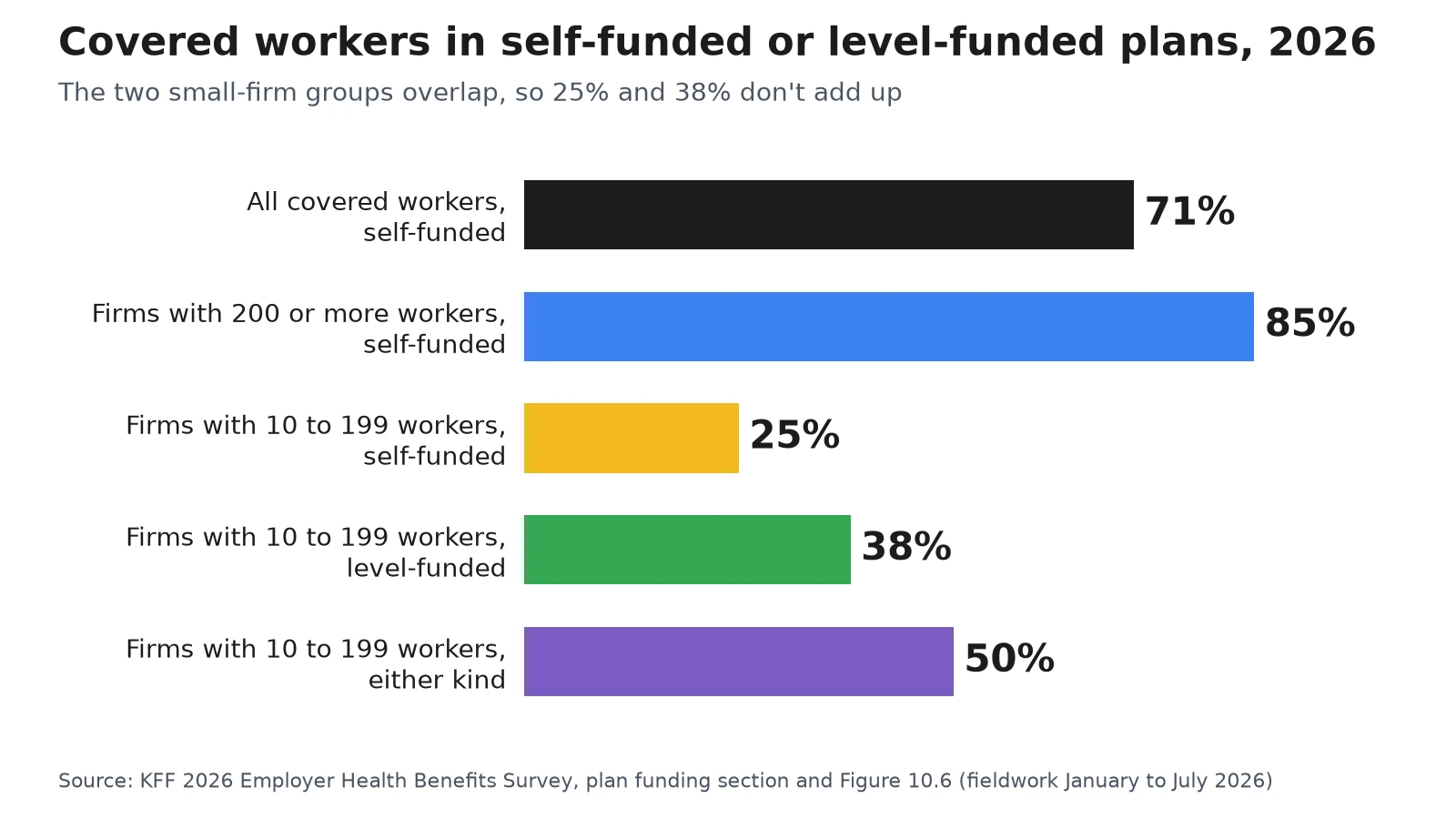
This matters to a DPC practice because a self-funded employer spends its own money on claims and controls its own plan design, so it can add a DPC benefit without waiting for an insurer. A level-funded plan is different. KFF describes a relatively small self-funded component paired with stop-loss insurance that transfers a substantial share of risk to insurers, and says these plans' administrators are generally insurers, so ask the administrator what the package lets the employer add.
Who is involved in a self-funded DPC deal?
A DPC practice used to selling memberships to individuals will meet more parties in a self-funded deal, and each one has a different piece of the paperwork.
- The employer, as plan sponsor. It decides to offer DPC, pays for it and signs the contract with the practice.
- The plan administrator. ERISA makes the administrator the person the plan document designates, or, if it designates no one, the plan sponsor, which for a single employer's plan is the employer. The document must also name one or more fiduciaries to manage the plan. Both roles can be the employer itself, acting through someone in HR or finance.
- The third-party administrator. The TPA processes claims, keeps enrollment and runs the plan's daily work under a services agreement with the employer.
- The benefits broker or consultant. The broker helps design the plan, can place the stop-loss policy and may be the person who brings DPC into the conversation.
- The stop-loss carrier. It sells the employer a policy that reimburses claims above set amounts.
Meet the TPA and the broker early, because their file formats, renewal dates and stop-loss terms set the pace of the launch.
How is the DPC fee paid in a self-funded plan?
There are four routes, and the one an employer picks decides which rules apply.
| Route | Who pays the practice | Works for HSA plan members? | Paperwork that changes |
|---|---|---|---|
| The medical plan pays it as a benefit | The plan, or the TPA on its behalf | No, if the plan is the HDHP, because Notice 2026-5 Q-15 bars paying DPC fees before the deductible | Plan document, SPD, SBC, TPA agreement, stop-loss policy |
| The employer pays it outside the medical plan | The employer, from its own accounts | Likely, though the IRS hasn't said so outright, if the arrangement qualifies and fees stay at or under the cap | DPC contract, plan or wrap document, SPD or separate notice |
| Employees pay through pre-tax payroll | The employer, funded by section 125 salary reduction | Likely, under the same conditions, but the HSA cannot also reimburse it (Q-18) | Possibly the cafeteria plan document, DPC contract |
| Employees pay on their own | The employee | Yes, and the HSA can reimburse a qualifying fee | Only the practice's member agreement |
When the medical plan pays
For a self-funded plan that is not a high deductible plan, such as a traditional PPO-style plan, the plan can add DPC as a covered benefit and pay the practice's monthly fee for each enrolled member. The fee becomes a plan expense, so it shows up in the TPA's reporting and raises the stop-loss questions covered below.
When the employer pays outside the plan
For employers with an HSA-qualified high deductible plan, this is the employer-paid route that can keep employees HSA eligible. IRS Notice 2026-5, Q-15, says the new law lets a qualifying DPC membership sit beside an HDHP, but "section 223 does not provide that an HDHP may offer a benefit that consists of paying fees for, or providing membership in" a DPC arrangement "without a deductible or before the deductible has been satisfied." So the employer pays the membership from its own accounts, under its own contract with the practice, and the HDHP stays a separate plan. Notice 2026-5 does not say outright that an employer's payment outside the HDHP protects HSA eligibility. Q-18 assumes employers pay these fees, but in March 2026 the AAFP, the ERISA Industry Committee and others asked the IRS to make that clear, and we found no IRS response as of November 6, 2026. Have counsel confirm.
When employees pay through payroll
Q-18 of the notice treats fees paid "by salary reduction through a section 125 cafeteria plan" the same way as fees the employer pays directly. Whether the cafeteria plan document needs an amendment is a question for the employer's benefits counsel.
Is an employer-paid DPC membership part of an ERISA plan?
It may well be. ERISA's definition of an employee welfare benefit plan, at 29 U.S.C. 1002(1), covers any plan an employer maintains to provide employees medical care "through the purchase of insurance or otherwise." When the medical plan pays the DPC fee, the membership is simply one more benefit of that ERISA plan.
When the employer pays outside the medical plan, the answer is less settled. The IRS, in Notice 2026-5, Q-18, calls employer-paid DPC fees "compensation excluded from employees' gross income under section 106," and 26 U.S.C. 106(a) says an employee's gross income "does not include employer-provided coverage under an accident or health plan." We found no Department of Labor guidance written specifically about employer-paid DPC. The closest federal statement is in a 2020 IRS proposed rule, never finalized, whose preamble says the Department of Labor advised that an employer's funding of an arrangement providing health benefits to employees is, "in most circumstances," enough to make it an ERISA-covered plan. Whether a separate membership program is its own ERISA plan or part of a wrap plan that bundles several benefits is for the employer's ERISA attorney to decide. Have your contract, member agreement and a plain description of the membership ready to share.
Also raise this with counsel. Offering DPC to employees who are not enrolled in the major medical plan can raise separate questions under the Affordable Care Act's group health plan rules, and we found no final federal rule on it. The closest text is the same 2020 proposed rule, whose preamble says that when an employer pays a DPC fee, "that payment arrangement would be a group health plan." It predates Public Law 119-21 and does not address the ACA's market rules, so show it to counsel.

What plan documents need to change when an employer adds DPC?
ERISA runs on documents, and each one has its own rule. Here is what a self-funded employer should review, and why each matters to the practice.
- The plan document. Under 29 U.S.C. 1102(a)(1), "every employee benefit plan shall be established and maintained pursuant to a written instrument." If the medical plan pays DPC fees, the plan document has to say so, including who is eligible, which practice or practices qualify and how the fee is paid.
- The summary plan description (SPD). Under 29 U.S.C. 1022(a), the SPD must be "written in a manner calculated to be understood by the average plan participant." It is the document employees read, so it is where they learn how to enroll with the practice and what the membership covers.
- The summary of material modifications. Under 29 U.S.C. 1024(b)(1), a change to the plan generally has to be summarized for participants within 210 days after the end of the plan year in which it is adopted, and a material reduction in a group health plan's covered services within 60 days of adoption.
- The summary of benefits and coverage (SBC). Under 29 CFR 2590.715-2715(b), a material change that would affect the SBC and that happens other than at renewal must be noticed to enrollees "not later than 60 days prior to the date on which the modification will become effective." That is one good reason to add DPC at the start of a plan year.
- The Form 5500. 29 CFR 2520.104-20 exempts certain welfare plans with fewer than 100 participants at the start of the plan year from the annual report, so the advisor should confirm whether the DPC design changes the filing.
- The TPA services agreement and the stop-loss policy. Both should match the plan document, which is the subject of the next two sections.
On the practice's side, the employer contract and member agreement should describe covered services the same way the plan documents do, so employees never get two different answers.
How do HSAs and DPC work together in a self-funded plan in 2027?
Public Law 119-21 made qualifying DPC memberships compatible with HSAs from January 1, 2026. A direct primary care service arrangement no longer counts as a disqualifying health plan if it provides only primary care from primary care practitioners for a fixed periodic fee, and if the monthly fees for all of a person's DPC memberships stay at or under a cap.
For 2027, IRS Rev. Proc. 2026-24 keeps that cap at $150 a month for one person and $300 a month for an arrangement covering more than one person.
The same revenue procedure sets the 2027 HDHP minimum deductible at $1,750 for self-only coverage and $3,500 for family coverage, the out-of-pocket maximum at $8,700 and $17,400, and the HSA contribution limit at $4,500 and $9,000.
For a self-funded employer, six answers in Notice 2026-5 do most of the work:
- Q-15. The HDHP cannot pay DPC fees before the deductible, so the employer pays outside the HDHP.
- Q-18. Fees the employer pays, including through section 125 salary reduction, are excluded from the employee's income and cannot also be reimbursed from the employee's HSA.
- Q-16. Fees an employee pays do not count toward the HDHP's deductible or out-of-pocket maximum.
- Q-11 and Q-14. The fixed fee must be the only payment for care under the arrangement, judged by its terms rather than what members use, so a practice that also bills the plan for visits the membership includes loses the HSA treatment.
- Q-20. A membership over the cap can still be paid from an HSA, but the person cannot make new HSA contributions while enrolled.
Our DPC HSA rules for 2027 post covers the excluded services, annual billing and the receipts HSA administrators ask for. If the employer is moving people to individual plans instead, see DPC and ICHRA.
How does stop-loss insurance treat DPC fees?
Stop-loss is the policy that keeps one bad year from sinking a self-funded employer. KFF explains that a policy may cover what the employer pays "over a specified amount for each worker or enrollee (referred to as specific stoploss coverage)" or may "limit the total amount the plan sponsor must pay for all claims in the plan over the plan year (referred to as aggregate stoploss coverage)." Among covered workers in self-funded plans at firms with 200 or more workers, KFF found that 75% are in plans with stop-loss insurance in 2026.
DPC raises three stop-loss questions, and the employer's broker and carrier are the ones to answer them.
- Does the fee count as a plan expense? If the employer pays DPC outside the medical plan, the fees generally are not claims under the medical plan, so they would not be expected to count toward a stop-loss attachment; confirm it in the policy. If the plan pays them, whether they count toward the aggregate amount depends on how the policy defines eligible expenses.
- Does the policy match the plan document? If the plan adds a DPC benefit that the policy's definitions leave out, the employer carries that cost alone, so line the two up before the change takes effect.
- Does the carrier need notice? Read the policy's terms on mid-year plan changes, because adding a benefit between renewals may need the carrier's review.
We looked for a current, independent study of how DPC affects stop-loss claims or renewals and found none.
Working with the TPA
The TPA is the practice's day-to-day partner in a self-funded deal, even when the employer signs the contract. A few things make the relationship work.
Eligibility files. The practice needs to know who is enrolled, when people join and when they leave. HIPAA's standard for electronic enrollment between plans and sponsors is the X12 834 transaction named in 45 CFR 162.1502, and an employer or TPA may also send a simpler spreadsheet. Agree on the format, how often it comes and who to call when a name looks wrong.
Payment. Decide whether the TPA pays the practice from the plan's account or the employer pays an invoice directly, and whether payment follows enrollment on the first of the month or the file date. Matching the invoice to the file every month is where small errors show up.
Privacy. Under 45 CFR 160.103, an employer plan with 50 or more participants, or one administered by someone other than the employer, is a group health plan, one of the health plans HIPAA applies to. Member data shared among the plan, the TPA and the practice should run through agreements counsel sets up, and reports to the employer should leave out anything that identifies a patient.
Claims for everything else. Specialists, imaging and hospital care still run through the plan, and our post on DPC specialist access covers how practices help members there.
State law and ERISA preemption
A self-funded plan sponsored by a private employer sits mostly outside state insurance law. ERISA, at 29 U.S.C. 1144(b)(2)(B), says such a plan shall not "be deemed to be an insurance company or other insurer" for purposes of state laws regulating insurance, and KFF notes that ERISA exempts self-funded plans established by private employers, "but not public employers," from most state insurance laws, including mandated benefits.
The DPC practice is a different story. Any DPC statute its state has still governs the practice and its member agreements, and it may also limit what the practice can promise an employer. Check your state in our DPC laws by state guide, and have your own health law attorney read the employer contract. Public employers such as cities and school districts fall outside that exemption, so ask how state law treats their plan. ERISA's plan rules also don't apply to government plans, or to church plans that haven't elected to be covered, so the document list above may not fit them.
A short checklist before the first self-funded contract
Before you sign, it helps to have answers to these questions in writing:
- Is the employer self-funded, level-funded or fully insured, and who is the TPA?
- Which route pays the fee, the medical plan, the employer outside the plan or payroll deduction?
- Does the employer offer an HSA-qualified HDHP, and do your membership terms qualify under Notice 2026-5?
- Is your rate for each person at or under the 2027 cap, counting any other DPC membership they hold?
- Who updates the plan document, the SPD and the SBC, and by what date?
- Has the broker confirmed how the stop-loss policy treats the DPC fee?
- What format and schedule come with the eligibility file, and what reporting does the employer want?
- Can departing employees convert to an individual membership?
- If the membership is a group health plan, who handles COBRA continuation coverage for people who leave? It doesn't apply if every employer maintaining the plan normally had fewer than 20 employees the year before.
To set an employer rate you can sustain, see how much to charge for a DPC membership and DPC break-even panel size.
Keeping self-funded accounts running smoothly
Once a self-funded employer is live, the work is mostly small and recurring. Eligibility files arrive and need to match billing, new enrollees need a welcome and a first visit, people who leave need a conversion offer, and invoices need checking against the TPA's numbers. Tabflows is a dedicated tech team that connects the tools a practice already uses, such as the EHR, billing and messaging, so those tasks and the patient context behind them sit in one place and get done on time.
The short version
A self-funded employer pays its own claims, so it can pay a DPC practice a flat monthly fee through the medical plan, outside it or through payroll. For HSA plans in 2027, the employer pays outside the HDHP, which the IRS hasn't yet said outright protects HSA eligibility, and keeps each person's DPC fees at or under the cap. The plan document, SPD, SBC, TPA agreement and stop-loss policy need to tell the same story, and the employer's ERISA attorney, CPA and broker should sign off first. If you are still building the practice, start with the 2027 guide to starting a DPC practice.
FAQs
Can a self-funded employer plan pay for direct primary care memberships?
Yes. A self-funded employer pays its employees' claims from its own funds, so it can choose to pay a DPC practice a fixed monthly fee per enrolled member, either as a benefit of the medical plan or as a separate arrangement outside it. The one big limit is for HSA-qualified high deductible plans, because IRS Notice 2026-5, Q-15, says the high deductible plan itself cannot pay DPC fees before the deductible. In that case the employer pays the membership outside the HDHP. The plan document, the summary plan description and the stop-loss policy should all reflect whichever route the employer picks.
Is an employer-paid DPC membership an ERISA plan?
It may be. ERISA's definition of a welfare plan, at 29 U.S.C. 1002(1), covers any plan an employer maintains to provide medical care to employees, through insurance or otherwise, and IRS Notice 2026-5, Q-18, treats employer-paid DPC fees as compensation excluded from income under section 106, the section for employer-provided health coverage. We found no Department of Labor guidance written specifically about employer-paid DPC, so the employer's ERISA attorney should decide whether the membership is part of the existing plan or its own plan, and which documents it needs.
Can employees with an HSA join a DPC practice their self-funded employer pays for?
Likely yes, from 2026, if the membership is a qualifying direct primary care service arrangement and the monthly fees for all of a person's DPC memberships stay at or under the cap, which IRS Rev. Proc. 2026-24 sets at $150 a month for one person and $300 for a membership covering more than one person in 2027. The employer has to pay the fee outside the HDHP (Notice 2026-5, Q-15), and the employee cannot also reimburse an employer-paid fee from the HSA (Q-18). Notice 2026-5 does not say outright that an employer's payment outside the HDHP protects HSA eligibility. Q-18 assumes employers pay these fees, but in March 2026 the AAFP, the ERISA Industry Committee and others asked the IRS to make that clear, and we found no IRS response as of November 6, 2026, so have counsel confirm.
What is the TPA's role in a DPC arrangement?
The third-party administrator runs the self-funded plan's day-to-day work for the employer, including enrollment data and claims for care outside the DPC practice. For a DPC arrangement, the TPA matters most as the source of the eligibility file that tells the practice who is enrolled, and sometimes as the party that pays the monthly fee from the plan's account. The details belong in the employer's agreement with the TPA and in the practice's contract with the employer.
Do DPC fees count toward an employer's stop-loss deductible?
It depends on the stop-loss policy and on how the fee is paid. Stop-loss coverage reimburses the employer for plan claims above a set amount, either per person (specific) or for the whole plan for the year (aggregate). If the DPC fee is paid outside the medical plan, it generally is not a claim under the medical plan, but confirm that in the policy. If the plan pays it, whether it counts toward the aggregate amount depends on how the stop-loss policy defines eligible expenses, so the employer's broker should confirm it with the carrier before the plan changes.
Does a self-funded plan have to follow my state's DPC law?
The DPC practice still follows any DPC statute its state has, because that law regulates the practice and its member agreements. The employer's self-funded plan is a different matter, because ERISA, at 29 U.S.C. 1144(b)(2)(B), keeps a private employer's benefit plan from being treated as an insurer under state insurance law. Your state's DPC statute may also limit what a practice's employer contracts can cover, so check your state in our DPC laws by state guide.