Does direct primary care make sense if you're self-employed?
Direct primary care (DPC) can be a good fit for self-employed people, freelancers and gig workers, as long as it sits next to real health insurance rather than in place of it. A DPC membership pays your own primary care doctor a fixed periodic fee, while a health plan covers hospital stays, surgery and specialist care. Since January 1, 2026, Public Law 119-21 lets a qualifying DPC membership sit alongside a health savings account (HSA) and treats bronze and catastrophic plans available through the Marketplace as HSA-eligible, so a self-employed person can pair a lower-premium plan, an HSA and a membership. The self-employed health insurance deduction on Form 7206 covers insurance premiums, and we found no IRS guidance that puts a DPC fee there.

This guide is for DPC physicians and owners whose members work for themselves, and for the freelancers, contractors and gig workers who ask them how a membership fits their taxes and coverage. It covers how many independent workers have insurance, the self-employed health insurance deduction, whether a DPC fee counts for it, the 2027 HSA rules for bronze and catastrophic plans, and the Marketplace. It relies on IRS, federal and KFF sources and is not tax advice, so readers should confirm their own situation with a CPA or tax advisor, and talk to a licensed broker about plan choices.
How many self-employed and gig workers have health insurance?
The best federal count comes from the Bureau of Labor Statistics. Its Contingent and Alternative Employment Arrangements release, based on a survey taken in July 2023 and published on November 8, 2024, found that 11.9 million people were independent contractors on their sole or main job, which was 7.4% of total employment.
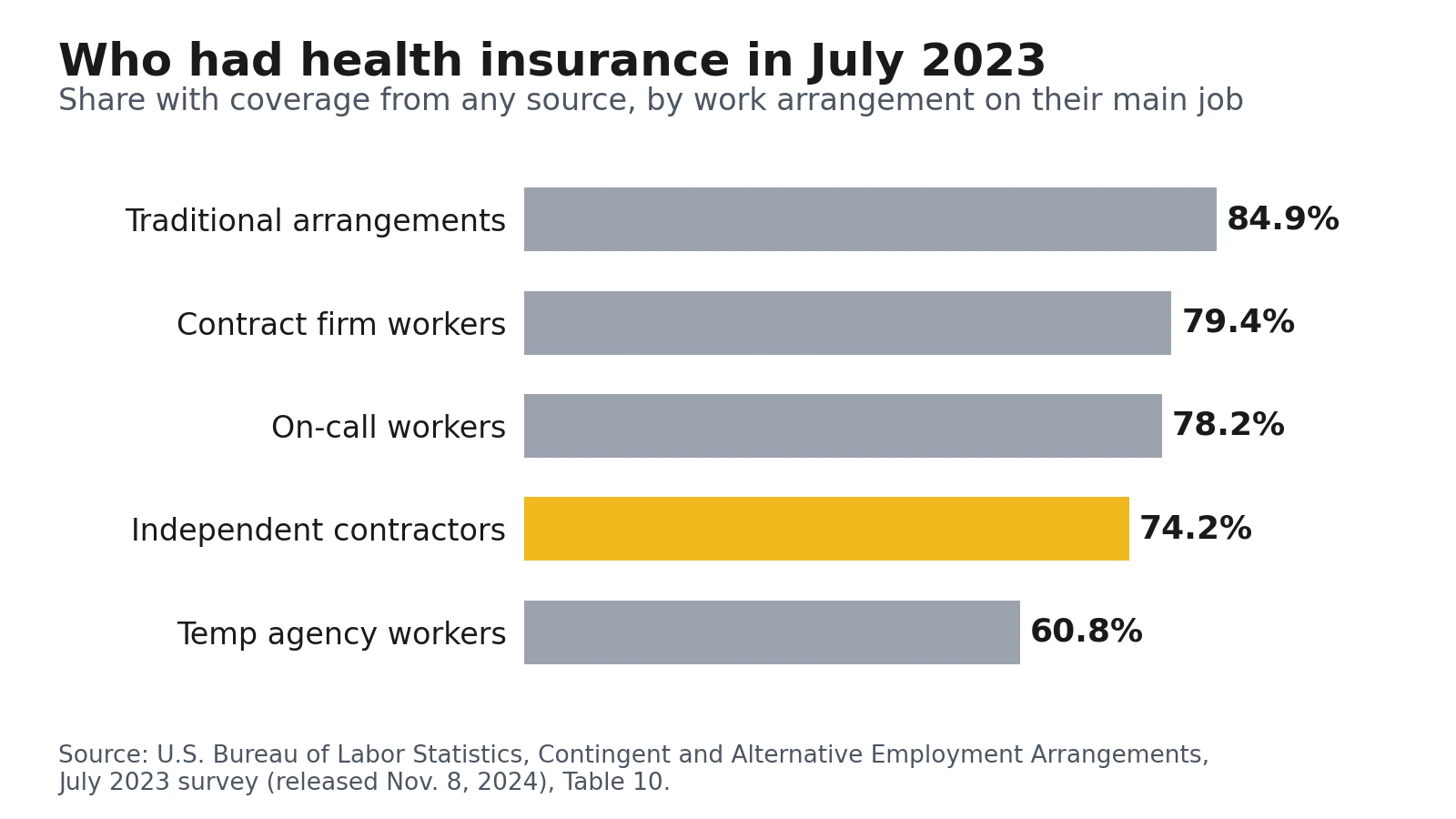
The same release (Table 10) found that 74.2% of independent contractors had health insurance from any source, compared with 84.9% of workers in traditional arrangements. That leaves roughly one independent contractor in four without coverage. BLS doesn't publish employer-provided coverage for independent contractors, because most of them are self-employed, so any coverage they have comes from another source, such as a spouse's plan, a government program or a policy they buy themselves.
App-based gig work is harder to pin down. The July 2023 survey asked about digital platform work, but BLS left those answers out of the November 2024 release, and we found no published BLS figure on how many app-based workers have insurance. So for drivers and delivery workers in particular, the honest answer is that the federal data isn't out yet.
For a DPC practice, these numbers mean a real share of self-employed patients who ask about membership may have no other coverage at all. That is worth knowing before the conversation, because a membership alone leaves them exposed to a hospital bill, and the most useful thing a practice can do is help them see the two pieces together.
What is the self-employed health insurance deduction?
The self-employed health insurance deduction lets a self-employed person deduct premiums for medical, dental and vision insurance and qualified long-term care insurance for themselves, their spouse and their dependents. It is claimed on Schedule 1 (Form 1040), line 17, so it reduces income whether or not the person itemizes, and it isn't subject to the 7.5% of AGI floor that applies to itemized medical expenses.
The IRS now explains it in the Instructions for Form 7206. Form 7206 and its instructions replaced the worksheet that used to sit in Publication 535, and the IRS says it has discontinued Publication 535, whose last revision was for 2022. Anyone following an older guide that still cites Publication 535 for this deduction should look at Form 7206 instead.
The 2025 instructions set out a few conditions that matter most to independent workers:
- You need self-employment income. The deduction is for people who had a net profit from self-employment reported on Schedule C or Schedule F, along with partners and more-than-2% S corporation shareholders, who follow their own rules.
- The plan must be tied to the business. The insurance plan "must be established, or considered to be established," under your business, and for a sole proprietor the policy can be in the business's name or in your own name.
- Employer coverage you could get blocks it. You can't take the deduction for any month you were eligible to participate in any employer's subsidized health plan, including your spouse's, even if you didn't enroll.
- Leftover premiums can still count elsewhere. Medical insurance payments you can't deduct on Schedule 1 can be included as medical expenses on Schedule A if you itemize.
The instructions also point people with Marketplace coverage who received advance premium tax credit payments, or who claim the credit, to Publication 974, because the deduction and the credit affect each other. This is one of the places a CPA earns their fee.
Does a DPC membership count for the self-employed health insurance deduction?
We found no IRS guidance that says it does. The Form 7206 instructions don't mention direct primary care, memberships, retainers or HSAs, and IRS Publication 502 describes the deduction as covering health insurance, "which includes medical, dental, and vision insurance and qualified long-term care insurance." A DPC membership isn't sold as an insurance policy. The 2020 proposed rule said a DPC payment could be medical care or, depending on the facts, medical insurance under section 213(d)(1)(D), but it didn't address this deduction and was never finalized, and Public Law 119-21, section 71308, says a qualifying DPC arrangement is not treated as a health plan for HSA eligibility.
That leaves two paths for a self-employed member who pays the fee personally:
- Itemized medical expense. A fee for medical care can be added to other unreimbursed medical expenses on Schedule A, and only the total above 7.5% of AGI counts, per Publication 502, though the IRS has never finalized a rule naming DPC fees. Our guide to whether a DPC or concierge membership is tax deductible works through the floor and the standard deduction.
- HSA payment. If the member has HSA-eligible coverage and the membership is a qualifying arrangement, the fee can be paid from the HSA, and HSA contributions are themselves deductible whether or not the person itemizes, per Publication 969.
The two don't stack. Publication 502 says an amount paid with a tax-free HSA distribution can't also be counted as a medical expense, so each dollar of a membership gets one tax break at most. A self-employed member who also wants to run the fee through their business should ask a CPA first, because we found no IRS source that addresses it.
Can you pair DPC with a bronze or catastrophic plan and an HSA in 2027?
Yes. Section 71307 of Public Law 119-21 says bronze and catastrophic plans available as individual coverage through an Exchange count as high deductible health plans (HDHPs) for HSA purposes, starting with months after December 31, 2025. Before the law, as IRS Notice 2026-5 explains, many bronze plans failed the HDHP rules on their out-of-pocket maximum or their pre-deductible benefits, and catastrophic plans couldn't qualify at all.
Notice 2026-5 answers the questions a self-employed shopper is likely to have:
- The usual HDHP limits don't apply to these plans. A bronze or catastrophic plan available through an Exchange is treated as an HDHP even if it doesn't meet the normal minimum deductible or out-of-pocket maximum (Q&A-4).
- Buying off-Exchange is fine. A bronze or catastrophic plan bought off-Exchange counts if the same plan is available through an Exchange (Q&A-6), and the IRS will treat you as eligible if you had no reason to think it wasn't (Q&A-7).
- Small-group bronze plans are different. SHOP coverage a small employer offers is not individual coverage, so it generally doesn't get this treatment and has to meet the regular HDHP rules (Q&A-8).
- Catastrophic plans have their own eligibility. Under the ACA, enrollment is limited to people under 30 or those exempt because they lack affordable coverage or face a hardship.
IRS Rev. Proc. 2026-24 sets the 2027 HSA contribution limits.
For calendar year 2027, the limit is $4,500 for self-only HDHP coverage and $9,000 for family coverage. Publication 969 adds a catch-up contribution for eligible people who are 55 or older at the end of the tax year.
Adding a DPC membership on top works the same way it does for anyone else. A qualifying direct primary care service arrangement no longer blocks HSA contributions, as long as the monthly fees stay within the cap.
For 2027, Rev. Proc. 2026-24 keeps the cap at $150 a month for one person, or $300 a month for an arrangement covering more than one person, counted across all such arrangements.
Our 2027 DPC and HSA rules guide covers what qualifies, what is excluded and how the cap works for families, and the DPC and FSA guide covers the employee side.

How does each piece get taxed for a self-employed person?
Each part of the bronze, HSA and DPC setup is treated differently on a self-employed person's federal return. This table pulls the federal rules above into one place.
| Piece | What it pays for | Federal tax treatment for a self-employed person | Where the IRS says it |
|---|---|---|---|
| Bronze or catastrophic plan premium | Hospital, specialist and other insured care | Self-employed health insurance deduction on Schedule 1, if the conditions are met; any remainder can go on Schedule A | Form 7206 instructions |
| DPC membership fee | Primary care from your own doctor for a fixed periodic fee | Itemized medical expense above 7.5% of AGI, or paid from an HSA; we found no guidance putting it on Form 7206 | Publication 502; Notice 2026-5 |
| HSA contributions | Savings for qualified medical expenses, including a qualifying DPC fee | Deductible whether or not you itemize, within the annual limit | Publication 969; Rev. Proc. 2026-24 |
| HSA withdrawals for premiums | Insurance premiums | Generally not allowed, except long-term care, COBRA, coverage during unemployment and Medicare at 65 or older | Publication 969 |
| Health FSA | Plan-approved medical expenses | Not available on their own, because self-employed persons aren't eligible for FSAs; a spouse's employer FSA may cover them | Publication 969 |
The practical upshot is that the premium and the membership take different routes. The premium generally belongs on Form 7206, while the membership belongs in the HSA or on Schedule A, and a CPA can confirm the split for a given return.
What Marketplace options do self-employed people have for 2027?
A self-employed person with no employees can buy coverage on the individual Health Insurance Marketplace, and one with at least one employee may be able to use the SHOP Marketplace for small businesses, per HealthCare.gov. When applying, you estimate your net self-employment income for the year you'll be covered, not last year's income, and savings are based on that estimate.
HealthCare.gov lists Open Enrollment as starting November 1, with December 15 the last day to pick a plan that starts January 1 and January 15 the end of Open Enrollment. People in a state that runs its own Marketplace should check that state's site.
Premium help is smaller for 2027 than it was a few years ago. KFF reports that the enhanced premium tax credits have expired, so people with incomes above 400% of the federal poverty level no longer qualify for premium tax credits and pay the full cost of coverage. KFF also notes that repayment of excess advance credits is now uncapped, which matters for anyone whose income swings during the year, since a higher-than-expected income can mean a larger tax bill. For freelancers and gig workers with uneven earnings, updating the income estimate during the year is worth the few minutes it takes.
KFF also reports that a recent expansion of catastrophic plan eligibility is temporarily paused, and CMS dates the federal court order that paused it to July 16, 2026. Anyone counting on a catastrophic plan should confirm their eligibility on HealthCare.gov or their state's Marketplace before Open Enrollment closes.
For a fuller look at plan types that pair well with a membership, including bronze plans and other options, see what insurance to pair with DPC. If a self-employed patient also has workers of their own, the DPC for small businesses guide and the DPC and ICHRA guide cover the employer side.
What can a DPC practice do for self-employed members?
Self-employed members may bring tax and coverage questions at sign-up and at tax time, and a practice can make those conversations easier without giving tax advice. A few habits help:
- Explain DPC and insurance as two separate pieces. A membership covers primary care, and a health plan covers the rest. Pointing members to HealthCare.gov or a licensed broker for the insurance side keeps the advice where it belongs.
- Keep the membership terms clear for HSA users. Notice 2026-5 says whether an arrangement qualifies depends on its terms, not the services a member uses, and fees count against the monthly cap, so a plain written description of what the fee includes and how often it is billed helps a member and their CPA decide. Our annual vs monthly billing guide and family and child pricing tiers guide cover how billing choices interact with those rules.
- Send itemized statements on request. A year-end statement showing the dates of membership and the fees paid gives a member's CPA what they need for Schedule A or HSA records.
- Point to a professional for the tax call. Whether a fee qualifies for a given return, and how the premium tax credit and Form 7206 interact, is a question for the member's CPA, and saying so plainly builds trust.
State rules on what a DPC agreement must include differ, so practices should check their own state's law in our DPC laws by state guide. For pricing a membership that self-employed patients can afford alongside a bronze plan, see how much to charge for a DPC membership and the 2027 DPC pricing report.
The work behind those habits, from answering a member's question about receipts to following up when a card fails, can land between the EHR, the billing system and the inbox. Tabflows is a dedicated tech team that works between the tools a clinic already uses, so a follow-up like a requested year-end statement can become a task on one shared list, linked to the patient and visible to the whole team.
Where self-employed patients should go for help
Self-employed people sit at the meeting point of three sets of rules, and no single advisor covers all of them. A CPA or other tax professional can say how a premium, an HSA and a membership fee fit a specific return. A licensed insurance broker or HealthCare.gov can help compare bronze, catastrophic and other plans. And the DPC practice can explain what the membership covers and provide clear statements of what was paid.
For physicians thinking about how independent workers fit their own practice, our guides on whether direct primary care is worth it and how to start a DPC practice are good next reads, and the DPC Finder lists practices by location for patients looking for one near them.
FAQs
Is direct primary care a good fit for self-employed people and gig workers?
It can be, as long as it sits next to real insurance. A DPC membership pays for primary care from your own doctor for a fixed periodic fee, but it is not health insurance and does not cover hospital stays, surgery or specialist care. Since January 1, 2026, Public Law 119-21 lets a qualifying DPC membership sit alongside an HSA, and it treats bronze and catastrophic plans available through the Marketplace as HSA-eligible, so a self-employed person can pair a lower-premium plan, an HSA and a DPC membership. This is general information, not tax advice.
Can I deduct my DPC membership as self-employed health insurance on Form 7206?
We found no IRS guidance that says so. The 2025 Instructions for Form 7206 describe the deduction as covering medical, dental and vision insurance and qualified long-term care insurance, and they don't mention direct primary care, memberships or retainers. A DPC fee may still count as an itemized medical expense on Schedule A above the 7.5% of AGI floor, though no final IRS rule names DPC fees, or it can be paid from an HSA. Ask a CPA how it fits your own return.
Where did Publication 535 go?
The IRS discontinued Publication 535, Business Expenses, after its 2022 revision. Its self-employed health insurance worksheet became Form 7206, which has its own separate instructions, and the IRS points to other publications, such as Publication 334 and Publication 583, for general business expense topics.
Can a self-employed person open an HSA with a bronze Marketplace plan in 2027?
Yes, if the bronze or catastrophic plan is available as individual coverage through an Exchange. IRS Notice 2026-5 says such plans are treated as high deductible health plans for months beginning after December 31, 2025, even if they don't meet the usual HSA deductible and out-of-pocket rules, and an identical plan bought off-Exchange counts too. For 2027, IRS Rev. Proc. 2026-24 sets the HSA contribution limit at $4,500 for self-only coverage and $9,000 for family coverage.
Can I pay my DPC membership from my HSA if I'm self-employed?
Yes, if it is a qualifying direct primary care service arrangement. To keep contributing to the HSA in 2027, your fees for all such arrangements must stay at or under $150 a month, or $300 a month for a membership covering more than one person, per IRS Rev. Proc. 2026-24. Your Marketplace premium generally can't come from the HSA, because IRS Publication 969 says HSA funds generally can't pay insurance premiums outside a short list of exceptions.
Can self-employed people use an FSA for a DPC membership?
Not through an FSA of their own. IRS Publication 969 says self-employed persons aren't eligible for FSAs, though if their spouse has a health FSA through an employer, that FSA can reimburse their DPC fee when the plan treats the fee as eligible. Otherwise, a self-employed person's tax-favored options for a DPC fee are an HSA, where the membership qualifies and the person has HSA-eligible coverage, or the itemized medical expense deduction.
What share of independent contractors have health insurance?
In the Bureau of Labor Statistics' July 2023 Contingent Worker Supplement, released November 8, 2024, 74.2% of independent contractors had health insurance from any source, compared with 84.9% of workers in traditional arrangements. The same release counted 11.9 million independent contractors on their sole or main job, 7.4% of total employment.