How Do You Sign Founding Members Before Your DPC Opens?
You sign founding members before opening by moving people from a free waitlist that collects interest, to a signed membership agreement at a founding rate, to a first payment that starts on opening day rather than months ahead. Taking deposits or a paid presale is possible, but it turns patient money into a promise you must be able to refund if your date slips. Before you collect anything, read your state's direct primary care statute, because some states regulate prepaid fees and when you may sign agreements at all.
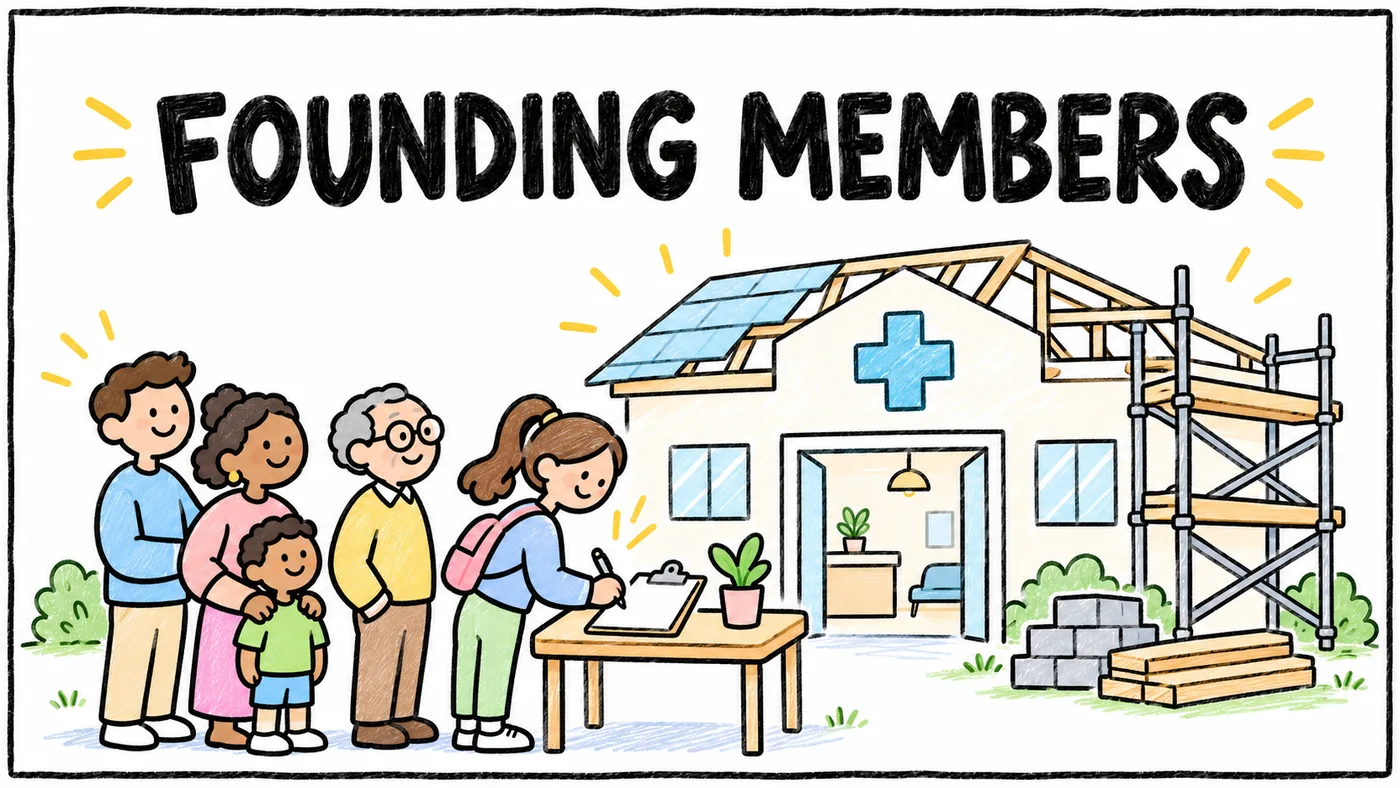
Founding members matter because a new practice pays rent, software and malpractice premiums from the first day, while its panel grows one family at a time. In the DPC Alliance's State of DPC survey (collected late 2024, published July 2026), 68.4% of respondents said their panels had yet to fill, which Hint's summary calls consistent with the relative youth of many practices in the sample. Even a small group of people who have already said yes before you open gives you revenue, word of mouth and real confidence in the hardest weeks.
This guide walks through the options, the money mechanics, the promises worth making, the refund terms to write down, and the state and federal rules to check. It is general information and not legal advice, so have a healthcare attorney in your state review your agreement before the first founding member signs.
Should You Use a Waitlist, a Deposit or a Paid Presale?
There are four common ways to sign people before opening, and they trade commitment for obligation. The more money you take early, the more certain the member is, and the more you owe them if plans change.
| Approach | What the patient does | What you owe them | Best for |
|---|---|---|---|
| Free waitlist | Leaves a name, email and household size | Updates and first access to enrollment | Measuring interest while your opening date is still uncertain |
| Signed agreement, billing starts on opening day | Signs the membership agreement and saves a payment method | Care from opening day at the agreed rate | Founders whose lease and opening date are firm |
| Refundable deposit | Pays a small amount that is credited to the first month | A full refund on request or if you do not open | Turning a long waitlist into real commitments |
| Paid presale | Pays the first month or a longer term before you open | Care for every prepaid month, or a refund of what was not earned | Founders with a fixed date, a trust or escrow setup and legal review |
A free waitlist comes first
A waitlist is the lowest-risk way to start. You ask for a name, contact details, household size and whether the person is coming as an individual, a family or through an employer. That last detail matters later, because employer-paid members follow a different sales path. You owe waitlist members nothing except honest updates, and they owe you nothing either.
Keep the list somewhere you can actually work it. Our first 100 members playbook covers where pre-launch interest tends to come from and how to follow up without becoming a nuisance.
A signed agreement with billing on opening day
This keeps the commitment without holding money. The patient reads and signs your real membership agreement, picks a plan at the founding rate and saves a card or bank account, and the first charge runs on opening day. Nobody's money sits with you before you can deliver care, and the member still feels committed because they have signed and chosen a plan.
The agreement should state the opening date as a target and say what happens if it moves, which we cover in the refund section below.
Refundable deposits and paid presales
A deposit, credited to the first month, is a middle path that filters casual interest from real intent. A paid presale goes further and charges the first month, a quarter or a year before you open. Both can work, but both mean you are holding money for services that do not exist yet. That brings state rules into play, raises the stakes on any delay and makes clean records essential. If you choose either one, decide before launch where the money sits, when it becomes yours and how quickly you will return it.
Why a Card Hold Will Not Bridge a Months-Long Gap
Some founders plan to "hold" a card at sign-up and capture the money on opening day. Card networks do not allow that for long. Stripe's documentation on placing a hold on a payment method says an authorization for an online card payment is typically valid for 7 days, and the funds are released if they are not captured in time. A presale that runs for three months cannot rely on a hold.
The practical alternative is to save the payment method with the patient's permission and charge it on opening day. Stripe documents this pattern as saving a payment method without charging it. Tell members in plain words when the first charge will run and what it will say on their statement.
There is also a dispute angle to keep in mind if you do charge early. Stripe's guide to how disputes work says card networks typically allow cardholders to dispute within 120 days of a payment, and that when a customer pays for a future service, the dispute window generally starts on the service date rather than the payment date. In other words, a member who prepaid and then saw your opening slip can still dispute well after you thought the payment was settled. Clear refund terms and fast refunds are the best protection.
What Should a Founding Member Rate Look Like?
A founding rate works best when it is specific. Members should know exactly what they pay, for how long that price holds, and what happens afterward. Vague promises like "best price ever" create friction later when you need to raise fees to match your costs.
For context on where your regular price might land, the DPC Alliance's State of DPC report (survey collected late 2024, published July 2026) gave the national average membership fee across all categories, per member per month, according to Hint's summary of the report.
That national average was $98.64 a month in the report's text, though its summary graphic prints $98.46.
Our own DPC pricing report and guide to how much to charge for a DPC membership go deeper on adult, child and family pricing. Set your regular price first, then decide how far below it a founding rate can sit without making your break-even math fragile. The DPC break-even calculator helps you test that quickly.
Lock the rate for a term, not forever
A founding rate that holds through a stated date, or for the first year or two of membership, is easy to honor and easy to explain. A rate "for life" sounds generous, but it ties your hands for as long as that member stays, through every rent increase and every new staff hire. If you do offer a lifetime rate, decide in writing what ends it, such as a lapse in membership.
Also check how your state handles fee changes. Washington's RCW 48.150.030 limits fee increases for existing patients to once a year and requires at least 60 days' advance notice of any change. Your founding promise should fit inside rules like these from the start.
Make the founding window real
A founding offer feels honest when it actually ends. Cap it by date, by number of members or both, and say so on the sign-up page. If the window closes, close it. People notice when "limited" offers never end, and the goodwill of your earliest members is worth more than a few extra sign-ups.
What to Promise Founding Members, and What Not To
Founding members are trusting you before they have seen the office, met your staff or sent you a single message. The promises you make now become the reputation you open with.
Good promises are ones you fully control:
- A founding rate with a clear amount and a clear end date or term.
- A target opening date, described as a target, with a promise to update members if it moves.
- First access to new patient visits once you open, in the order members signed.
- A written refund policy that says how fast you will return any money you took early.
- A plain description of what the membership includes, in the same words your agreement uses.
Promises to avoid are the ones that depend on things outside your control:
- An exact opening date before your lease, build-out and licensing are settled.
- Same-day or next-day access before you know your schedule and panel size.
- Specific outside prices, such as labs or imaging, that a vendor can change.
- Coverage of anything outside primary care you deliver yourself, which can push a membership toward looking like insurance.
- Any suggestion that a membership replaces health insurance.
That last point is more than good manners. Washington and Florida both require the agreement itself to carry an insurance disclaimer. Our guide to direct primary care laws by state explains why that line matters and which states have a DPC statute.
How Should Refunds Work If Your Opening Date Slips?
Opening dates move. Build-outs run late, licenses and credentialing take longer than expected, and equipment arrives when it arrives. A founding member program that plans for a delay keeps trust intact when one happens.
Write down three things before you take any money. First, what happens if you open later than the target date, for example that members may cancel for a full refund at any time before their first visit. Second, what happens if you do not open at all, which should be a full refund of every dollar taken. Third, how fast refunds go out once a member asks. Then keep enough cash set aside to honor every refund at once, because a delay is exactly when several members are likely to ask together.
Some states already write parts of this into law. Florida's direct health care agreement statute, section 624.27, requires every agreement to offer a refund of monthly fees paid in advance if the provider ceases to offer health care services for any reason. It also requires that either party can end the agreement with at least 30 days' advance written notice.
Washington goes further on prepaid money. Under RCW 48.150.030, a direct practice charges a monthly fee, and if a patient prepays for more than one month, the funds must be held in a trust account and paid to the practice only as they are earned, with unearned fees refunded after termination. If you practice in Washington, a quarterly or annual founding presale needs a trust account set up before the first payment.
What Do State DPC Laws Say About Signing Members Early?
State DPC laws were written for open practices, but several of their rules apply the moment you sign a founding member. The three to check first are when you may sign agreements, what the agreement must contain, and how prepaid fees must be handled.
Washington is the clearest example of a timing rule. RCW 48.150.100 says a provider may not act as or hold itself out as a direct practice in the state, and may not enter into a direct agreement with a patient, until it files its annual statement with the Insurance Commissioner. A Washington founder who wants signed agreements before opening should file that statement first. Washington also requires every agreement to carry the disclaimer "This agreement does not provide comprehensive health insurance coverage. It provides only the health care services specifically described." under RCW 48.150.110.
Florida's section 624.27 requires a written agreement signed by both the provider and the patient, a description of the services covered, the monthly fee, the term and any automatic renewal, and a disclosure on the signature page, in contrasting color and at least 12-point type, that the agreement is not health insurance. A founding agreement signed months before opening must meet all of that just like any other.
Other states have their own versions, and some have no DPC statute at all. Look up your state in our DPC laws by state guide, read the statute itself, and have a local healthcare attorney review your founding agreement, refund policy and any deposit or presale terms together. If you are still choosing how to structure the business that will sign these agreements, our guide to choosing a PLLC or LLC for a DPC covers that step.
Founding Members Who Want to Pay With an HSA
More patients can now use HSA money for DPC. The One Big Beautiful Bill Act (Public Law 119-21) made qualifying direct primary care service arrangements compatible with HSAs starting January 1, 2026, as long as total fees stay within a monthly cap. For 2027, IRS Rev. Proc. 2026-24 sets the monthly cap.
For 2027 the cap is $150 a month for one person and $300 a month for a membership that covers more than one person.
Prepaid founding terms can still fit. In IRS Notice 2026-5, Q-13 says an arrangement may bill fees for periods of more than a month but no more than a year, as long as the fees are fixed, periodic and within the monthly limit on an annualized basis. Q-19 says HSA reimbursement can generally happen before the coverage period starts. If you price a founding plan above the cap, the membership no longer counts as a qualifying arrangement and members could lose HSA eligibility, so check the details in our DPC HSA rules for 2027 before you publish a founding price.
If some of your founding members will be on Medicare, settle your Medicare status before they sign, because that choice shapes how you can contract with them. Our guide on how to opt out of Medicare for DPC walks through it.
A Simple Order of Operations for Your Presale
The exact timing depends on your lease, licensing and build-out, but this is a workable order:
- Open a free waitlist as soon as you have decided to launch, and keep posting honest updates.
- Read your state's DPC statute and have your membership agreement, refund policy and founding terms reviewed.
- Form your business entity and set up membership billing so you can save payment methods and charge on a schedule.
- Once your lease and target date are firm, invite the waitlist to sign agreements at the founding rate, with billing starting on opening day.
- If you take deposits or prepaid terms, set up any required trust account first and track every dollar per member.
- Close the founding window when you said you would, and confirm each member's first visit before opening day.
Our 90-day DPC launch plan and 2027 guide to starting a DPC practice fit these steps into the full launch, and the DPC startup cost calculator shows how much runway you need to fund. For the money side of the launch, see DPC startup financing for 2027.
Keeping Founding Promises Once You Open
The hard part of a founding program usually comes after opening day. Every member needs their founding rate applied correctly, their term end date tracked, their first visit booked and any deposit credited, and those details tend to live in different places, with the waitlist in a spreadsheet, the agreement in an e-signature tool, the payment method in billing and the first visit in the EHR. When a founding member asks why their rate changed or whether their refund went out, someone has to piece the answer together from all of them.
Tabflows is a dedicated tech team that connects the tools a clinic already uses, such as the EHR, membership billing and messaging, so follow-ups, tasks and patient context land in one place and the work between those tools actually gets done. For a founding program, that means term dates, refund requests and first-visit follow-ups do not depend on anyone remembering them.
A founding member program is one of the warmest ways to open a practice. People are choosing you before there is a sign on the door. Give them clear terms, honest dates and quick refunds if plans change, and they become the members who tell everyone else about you. You can also browse the DPC finder to see how other practices near you present their memberships.
FAQs
Can a DPC practice sign members before it opens?
Yes. A direct primary care physician can build a waitlist or sign founding members before opening day so the practice opens with a panel already forming. The safest order is a free waitlist first, then signed membership agreements with payment starting on opening day. If you collect money earlier, put the refund terms in writing and check your state's DPC statute, because some states set rules for prepaid fees and for when you may sign agreements at all.
Should I take a deposit or a paid presale for my DPC?
A free waitlist costs patients nothing and tells you who is interested. A small refundable deposit tells you who is serious, but it is still money you owe back if you do not open. A paid presale, where the first month or a longer term is charged before you open, gives you the most commitment and the most obligations. A waitlist plus a signed agreement whose billing starts on opening day avoids holding patient money for services that do not exist yet.
Can I put a hold on a patient's card until my DPC opens?
Not for long. Stripe's documentation says an authorization for an online card payment is typically valid for about 7 days, so a hold cannot bridge a gap of several months. The usual approach is to save the patient's payment method with their permission and charge the first membership fee on opening day.
What should a DPC founding member rate include?
Give founding members a rate that is clearly defined, with a specific discount or price and a specific term, such as the founding rate holding through a stated date. Avoid promising a rate for life unless you are certain you can keep it. In Washington, RCW 48.150.030 already limits fee increases for existing patients to once a year with at least 60 days' notice, so any founding promise should fit inside your state's rules.
What happens to prepaid DPC fees if the practice never opens?
Your agreement should say, and some state laws cover parts of this. Florida's direct health care agreement statute, section 624.27, requires agreements to offer a refund of monthly fees paid in advance if the provider stops offering services for any reason. Washington's RCW 48.150.030 requires prepaid fees of more than one month to be held in a trust account and refunded if unearned. Write a clear refund promise with a deadline and keep enough cash to honor it.
Can founding members pay for a DPC membership with an HSA?
Often, yes. Since January 1, 2026, a qualifying direct primary care service arrangement is compatible with an HSA if its fees stay within a monthly cap. For 2027, IRS Rev. Proc. 2026-24 sets that cap at $150 a month for one person and $300 for a membership covering more than one person. IRS Notice 2026-5 says fees may be billed for periods of up to a year if they are fixed, periodic and within the cap on an annualized basis.