How Does a DPC Practice Get Members From Community Events?
A direct primary care practice gets members from community events by giving people a low-pressure way to meet the doctor before they ever look at a price page. Options include short health talks at libraries, community centers, churches and gyms, lunch-and-learns at small local employers, chamber of commerce meetings, school and youth sports physicals, and a friendly table at a farmers market. Each one ends the same way, with a simple, privacy-aware way for interested people to leave their contact details and a helpful follow-up a few days later.
Community marketing is slower to set up than an ad, and it compounds. The same people who sat in your library talk become the neighbors who mention your name at a soccer game. This guide goes deeper on the local talks and partnerships step in our first-year DPC marketing plan, and it pairs well with our guides to getting more reviews and running a member referral program.
Why Showing Up in Person Works for Direct Primary Care
Many people have never had a doctor who answers their own phone, so direct primary care is still a new idea in many towns. People join because they trust the doctor, and a thirty-minute talk lets a room of people meet you before they ever see a price page.
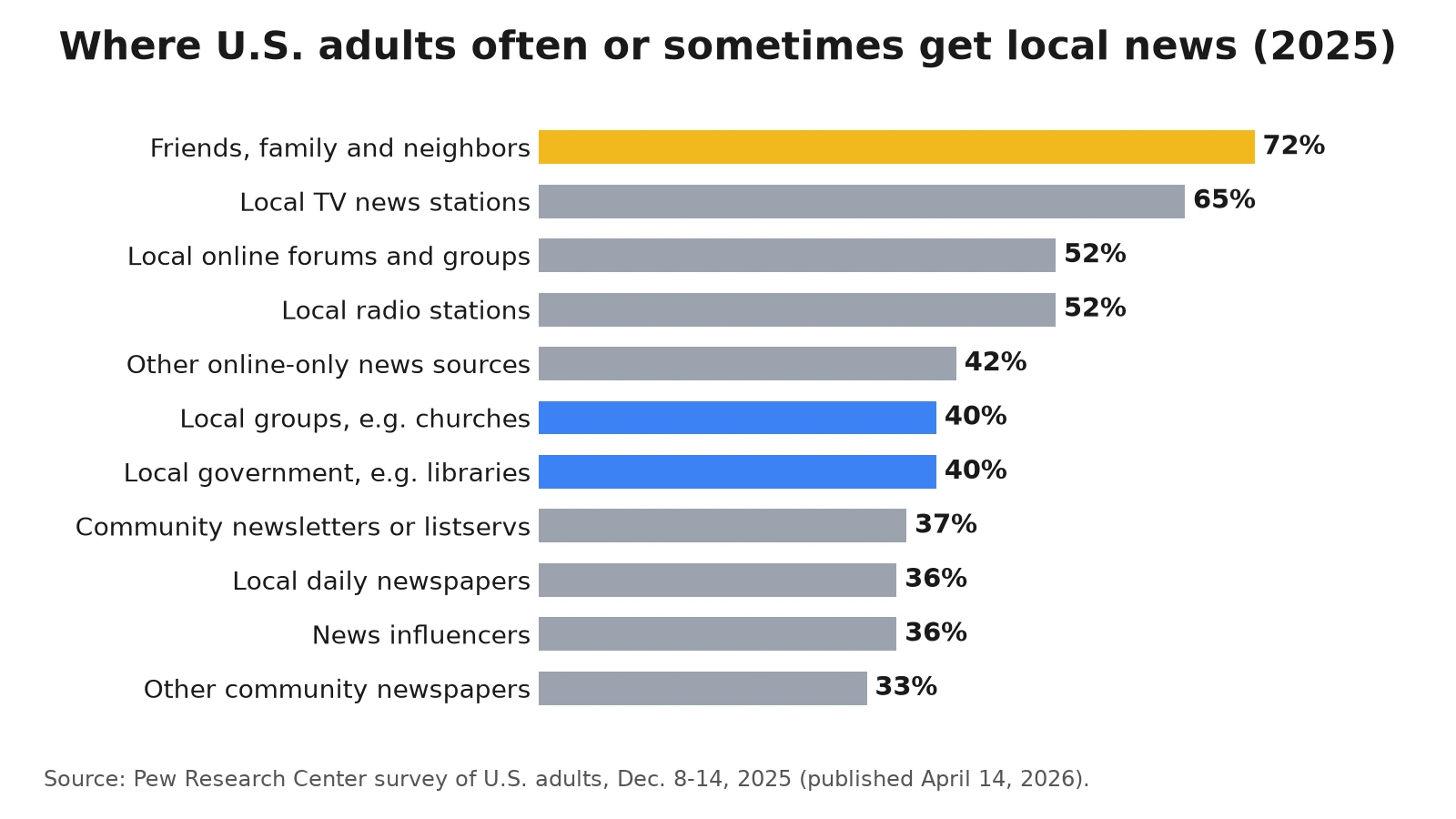
Local word of mouth is also how many Americans learn what is going on around them. In a Pew Research Center survey conducted December 8 to 14, 2025, 72% of U.S. adults said they often or sometimes get local news from friends, family and neighbors. The same survey found that 40% get local news from local organizations such as churches, school groups or political groups, and 40% from local government agencies or officials such as city council offices or libraries, both up from 2018.
The places where people already gather are where news about a new local doctor travels, so showing up there with something useful gives that word of mouth something to carry.
Which Community Events Bring In DPC Members?
The best fit depends on who you want on your panel. A practice that wants families should spend time with schools and parent groups, while a practice focused on working adults and employer contracts should be at the chamber and in break rooms. This table is a starting point.
| Where | Who you tend to meet | What to offer | How to follow up |
|---|---|---|---|
| Public library or community center | Adults and retirees who like to learn | A 30 to 45 minute talk on a common worry | Slides by email to people who asked |
| Chamber of commerce, Rotary or Lions club | Local business owners | A short talk on what DPC means for small employers | A one-to-one coffee or a lunch-and-learn offer |
| Small employer lunch-and-learn | Employees and the owner | Questions answered over lunch, with prices in writing | An individual or group enrollment link |
| Gym or fitness studio | Active adults who already invest in their health | A talk on injuries, sleep or labs | A tour or meet-and-greet invitation |
| Church or faith community | Families and older adults | A practical talk after a service or at a group meeting | A sign-up sheet through the host |
| School, parent group or youth sports league | Parents | Sports physicals or a talk for parents | Family pricing and a booking link |
| Farmers market or street fair | A broad mix of neighbors | A friendly table, a handout and a sign-up sheet | A welcome email and an open house invitation |
How to Give a Health Talk at a Library or Community Center
Pick a topic people already worry about
Pick talks about everyday problems, not about direct primary care. Good examples include blood pressure you can actually bring down, what to do when your child spikes a fever at night, sleep, prediabetes, and how to pay for care with an HSA. Since January 1, 2026, a DPC membership can sit alongside an HSA within IRS limits, and many people still have not heard. Our guide to DPC HSA rules for 2027 has the details if you want to make that your topic.
Explain how your practice works for five minutes near the end, once people have seen how you think, and put our explainer on what direct primary care is on your handout.
Ask the right person, with a short proposal
Libraries and community centers usually have someone who books programs. Send them a short note with the talk title, a two-sentence description, your credentials and two or three dates that work. Ask what they allow for promotion, because many public venues limit sales pitches in their rooms, and plan to keep the talk educational either way. Ask, too, whether the venue will list the talk in its event calendar.
What to bring
Bring a one-page handout with your membership prices in plain text, your address, your phone number and a QR code that opens your signup or tour page. Bring a sign-up sheet or a tablet form for people who want the slides (more on what to ask below). If you have a medical assistant, bring them along so one of you can talk with people while the other answers enrollment questions.
Chambers of Commerce, Rotary and Small-Employer Lunch-and-Learns
Small businesses make up most local employers. The Census Bureau's Statistics of U.S. Businesses for 2022 counted about 6.4 million employer firms in the United States. About 5.7 million of them, roughly 89%, had fewer than 20 employees, and about 1.2 million, a good size for a lunch-and-learn, had between 10 and 99 employees.
Chamber breakfasts and Rotary lunches are one place to meet their owners. A short talk at one of those meetings about what direct primary care means for a small employer, followed by a coffee with anyone who is curious, is a natural first step.
The lunch-and-learn is the next step. You bring or arrange lunch, talk for twenty minutes about how the practice works, and spend the rest of the time answering questions from employees. Keep prices in writing, explain clearly what is and is not included, and leave a simple enrollment link. Our guide to selling direct primary care to employers covers pricing models, contracts and the reports employers want, and our guide to employer group enrollment tracking covers keeping group sign-ups in order.
Before you sign a group, decide how many members you can add from a single employer without squeezing your existing patients. Access is the reason people join, and one large contract can use up a panel faster than most founders expect.
Gyms, Churches, Schools and Youth Sports Physicals
Gyms and fitness studios
Gym members already invest in their health and often have questions a trainer cannot answer, such as what their labs mean or whether a nagging injury needs imaging. A short talk or a monthly "ask the doctor" hour works well, as long as you keep it to general education and invite anyone with a personal question to book a visit.
Churches and faith communities
Many congregations run health ministries, senior groups or parent groups that welcome a practical talk. Work through the person who leads that group, follow the community's own norms about promotion, and let the host decide how to share a sign-up sheet. Older members may be on Medicare, so be ready to explain how membership works for them, which our guide to DPC for seniors on Medicare covers.
Schools, parent groups and youth sports physicals
Sports physical season is one of the best chances a DPC has to meet local families, because parents need the form signed before the season starts. Some practices run a physicals day each summer, and others offer a talk for parents at a PTA or league meeting. Our family and child pricing guide and our guide to DPC for families help you explain what a family membership costs once the physical is done.
Think carefully before making physicals free. Federal law treats free or below-market services offered to Medicare or Medicaid beneficiaries as possible inducements when they are likely to influence the choice of a provider for services those programs pay for, under 42 U.S.C. 1320a-7a, and many children are covered by Medicaid or CHIP. The OIG's policy statement on gifts of nominal value sets out what counts as small enough not to matter.
Cash or cash equivalents never qualify as gifts of nominal value.
OIG's nominal value threshold is a retail value of no more than $15 per item or $75 in total per patient per year.
A clinical exam is usually worth more than that, so a modest flat fee for event physicals is the simpler alternative. Talk to a health care attorney in your state before you advertise anything free, and our DPC anti-kickback and Stark basics explain the rules in more depth.
Farmers markets and street fairs
A market table is the most casual of these events and the easiest to repeat. Bring a sign that says who you are and what membership costs, a handout and a sign-up sheet, and spend the morning chatting. Be thoughtful about clinical work at the table, because taking blood pressures or advising individuals is patient care, with questions about documentation and whether your malpractice policy covers off-site events. Our guide to insurance for a new DPC practice covers coverage, and a quick call to your carrier settles most of it.
Can a DPC Partner With Physical Therapists or Pharmacies?
Yes, as long as the partnership is about patients and events, not about paying for referrals. A local physical therapist, independent pharmacy, dietitian or mental health counselor often serves the same people you want to reach, and a joint talk on back pain or medication costs can be more useful to an audience than either of you alone. The care needed is in how money and referrals move between you.
The federal anti-kickback statute (42 U.S.C. 1320a-7b) makes it a crime to offer or pay anything of value to induce referrals of business that federal health care programs pay for, and states have their own patient-brokering and fee-splitting laws, such as Florida's section 817.505, so ask your attorney how they apply to cash-pay care. Our anti-kickback and Stark guide walks through how each rule applies to a DPC. A few habits keep a local partnership on the right side of those lines:
- Split the real costs of a shared event fairly, such as the room, printing and food, and do not let one partner cover more than its share.
- Never pay or accept anything per patient referred, including free months, discounts, gift cards or free services to each other.
- Refer based on what each patient needs, tell patients they are free to choose another provider, and keep a simple record of why you referred.
- Put any ongoing business arrangement, like renting space or buying services, in writing at fair market value.
- Be extra careful with ownership. If you own part of the PT clinic, lab or pharmacy, that is exactly the situation the Stark Law and many state laws focus on.
Because many DPCs dispense common medications themselves, our guide to DPC dispensing, medications and labs explains how practices usually work with outside pharmacies and labs. This is general information, not legal advice, so have a health care attorney look at any partnership before you sign it.
How to Collect Interest at an Event Without a Privacy Problem
An event only turns into members if you can reach the people who were interested, and how you collect their details matters. The safest approach is to collect as little as possible. Ask for a name, an email address or phone number, and a checkbox for what they would like from you, such as the slides, a tour invitation or news when you open. Leave health questions off the sheet entirely.
HHS's guidance on patient sign-in sheets is a useful model even at an event. It says a sign-in sheet is fine as long as it does not show medical information that is not needed, such as the reason for a visit. If a sheet at your table says "Jane, worried about her thyroid," everyone who signs after her can read it. A tablet form or individual cards avoid that problem.
A few more habits keep event data tidy:
- Keep paper sheets and tablets with you during the event, and never leave them on an unattended table.
- Move entries into your system the same day and shred the paper.
- If an online form asks anything health-related, use a form tool that will sign a business associate agreement, the same test our guide to HIPAA-compliant texting applies to messaging apps.
- If you want to share a patient's story or photo from an event later, get written permission first. When HIPAA applies, 45 CFR 164.508 requires a signed authorization before using protected health information for marketing.
Consent matters for texts too. The FCC's guide to unwanted robocalls and texts says its rules ban texts sent to a mobile phone with an autodialer unless the owner consented first, and 47 CFR 64.1200(a)(2) requires prior express written consent for autodialed telemarketing. Put a clear consent line next to the phone number box rather than assuming that sharing a number means yes.
How to Follow Up After a Community Event
Follow up within a few days, while people still remember your face and what you talked about. The best follow-up is one helpful message, not a sales sequence. Thank them for coming, attach the slides or handout you promised, link your price page, and offer one easy next step, such as a tour, an open house or a short meet-and-greet call. If you are still pre-opening, invite them to your founding-member list, which our founding-member presale guide covers.
Marketing email has its own rules. The FTC's CAN-SPAM compliance guide says every commercial email must include your valid physical postal address and a clear way to opt out, and that opt-outs must be honored within 10 business days.
The FTC says each email that violates CAN-SPAM can bring penalties of up to $53,088.
After that first message, add event contacts to the regular update you already send, and stop there unless they reply. Interested people come back when the timing is right for them, and when they join, a strong start keeps them, as our guide to DPC retention and churn explains.
How to Tell Which Events Are Worth Repeating
There is no reliable published benchmark for how many members a DPC talk or market table should bring in, so measure your own. For each event, write down the hours it took, how many people left their details, how many booked a tour or call, and how many joined within the next three months. A required "How did you hear about us?" question on your enrollment form, with each event type as an option, makes the last number easy to fill in.
After two or three quarters, keep the events that bring in members and drop the ones that only fill an afternoon, remembering that some results show up later as referrals. Our list of DPC metrics to track in 2027 covers the numbers that sit alongside these, and a strong Google Business Profile gives people who heard your name at an event somewhere to look you up.
Keeping Event Follow-Up From Slipping
Community marketing usually slips in the days after the event. The sign-up sheet sits in a bag, the follow-up email waits for a quiet afternoon that never comes, and the work lives between your inbox, your EHR, your billing tool and a stack of paper, which makes it easy to lose once your days fill up with patients.
That is the kind of work Tabflows takes off a clinic's plate. We are a dedicated tech team that connects the tools a DPC practice already uses, like the EHR, membership billing and messaging, so event contacts get their follow-up, tours land on the right calendar and every new member's context is in one place when they walk in. If you are building your panel one talk at a time, keeping that follow-through steady means every room you speak in has a fair chance to turn into members.
FAQs
What kinds of local events bring in members for a DPC practice?
Look for events that put the doctor in front of a small group long enough to answer real questions. Options include health talks at public libraries and community centers, chamber of commerce and Rotary meetings, lunch-and-learns at small local employers, talks for church groups, parent groups and gyms, and a table at a farmers market or street fair. Pick the places your future members already go, give them something useful, and follow up with everyone who asked to hear from you.
How do you get invited to give a health talk at a library or community center?
Contact the person who books programs, often called the adult programming or events coordinator, and offer a free, educational talk on a topic people already worry about, such as blood pressure, sleep, a sick child at night or how to use an HSA with a membership. Send a short description, your credentials and two or three possible dates. Ask what the venue allows for promotion, since many public venues limit sales pitches, and keep the talk educational either way.
Can a DPC practice offer free sports physicals or free screenings at an event?
It can, with some care. If any of the people you serve are on Medicaid, Medicare or another federal program, free services that are likely to influence their choice of provider can raise beneficiary inducement and anti-kickback questions, and state rules vary. OIG treats gifts of nominal value as acceptable, and a free physical is usually worth more than that. A small flat fee is one alternative, and anyone planning free clinical services at events should check with a health care attorney and their malpractice carrier first. OIG's nominal value limit is no more than $15 per item and $75 per year per patient.
Can a DPC partner with a physical therapist or pharmacy to send each other patients?
You can co-host events and refer patients to each other based on what each patient needs, but no one should pay or receive anything of value for those referrals. Split shared event costs fairly, put any business arrangement in writing at fair market value, give patients a real choice of provider, and have a health care attorney review the arrangement, because federal and state anti-kickback and fee-splitting laws apply.
How should a DPC collect contact information at a community event?
Ask only for a name, an email address or phone number, and a checkbox showing what the person agreed to receive. Leave health questions off the sheet, keep the sheet or tablet under your control during the event, move the entries into your system the same day and securely destroy paper copies. If you plan to send marketing texts, get clear written consent, because the FCC's TCPA rules require prior express written consent for autodialed marketing messages, and the FCC says texts sent with an autodialer need the owner's consent.
Are small employers worth a lunch-and-learn for a DPC practice?
They can be. Census Bureau data for 2022 shows about 89% of U.S. employer firms had fewer than 20 employees, and about 1.2 million firms had between 10 and 99. A 30-minute lunch talk lets their employees meet you before anyone signs a contract.
How soon should you follow up after a DPC community event?
Follow up within a few days, while people still remember your face and your talk. Send one helpful message with the slides or handout, your prices, and an easy way to book a tour or a meet-and-greet. Marketing emails need your postal address and an opt-out link under the CAN-SPAM Act, and opt-outs must be honored within 10 business days.