How Do You Raise DPC Membership Prices the Right Way?
To raise DPC membership prices well, pick one effective date, check your membership agreement and your state's DPC law for the required notice (often 60 days), make sure every tier still fits under the 2027 HSA fee cap, and send members a warm, plain letter that explains what changed and what stays the same. Decide in advance who, if anyone, keeps the old price and for how long. Then follow up personally with anyone who has questions, and handle employer contracts separately at their renewal dates.

Asking members to pay more can feel like breaking a promise, but telling members early, yourself, with honest reasons, gives them time to plan and a chance to ask you about it. This guide covers the timing, the rules, the letter and the conversations. If you are still setting your first prices, start with how much to charge for a DPC membership and the 2027 DPC pricing report.
When Should a DPC Practice Raise Its Prices?
There is no standard schedule, but three signals are worth checking. Your costs have risen since you last set prices, your panel is close to the size you can care for well, and your price sits below practices nearby that offer similar access. Any one of these can justify a review. All three together make a strong case for one.
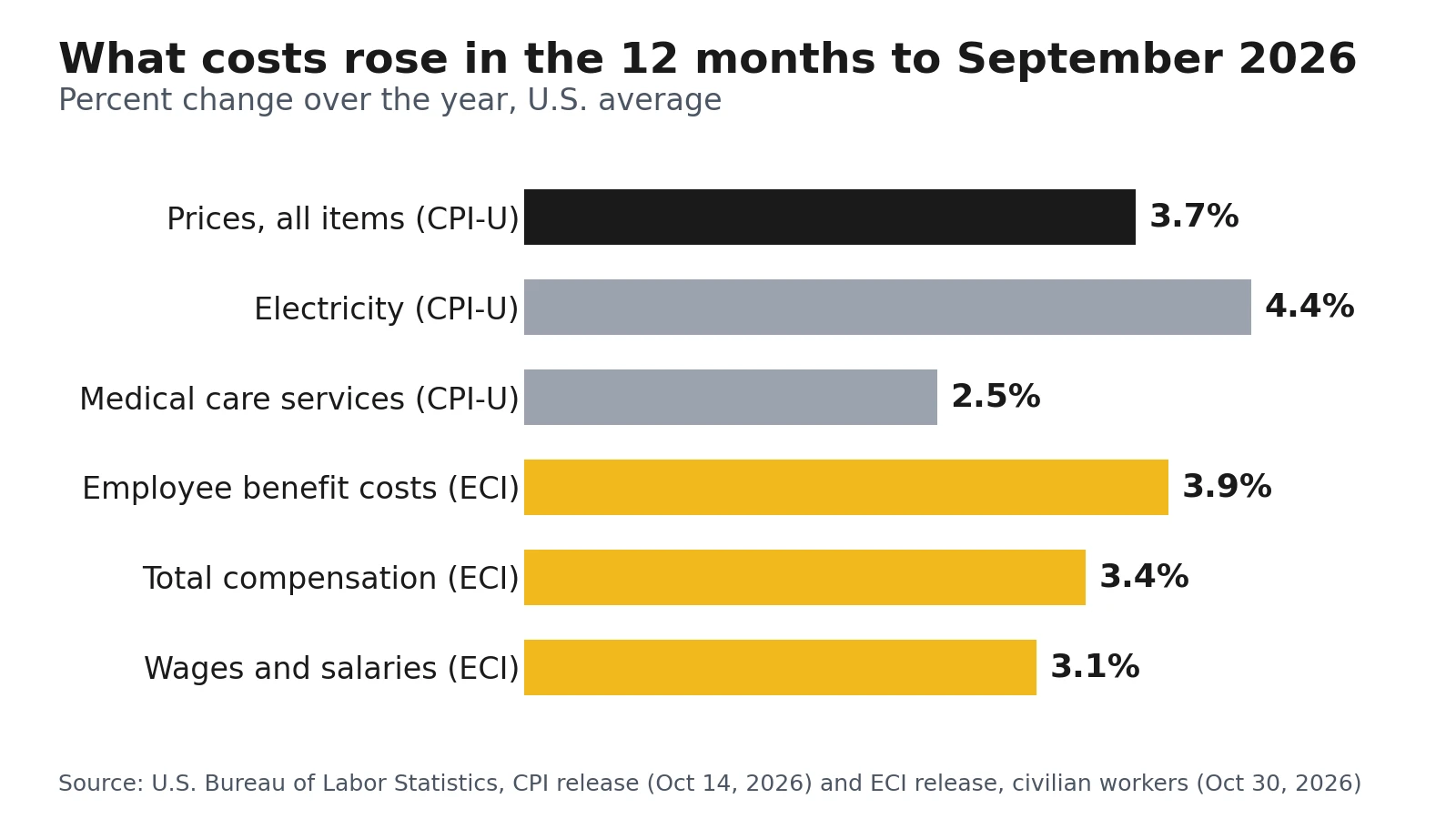
The cost side is easy to document right now. The U.S. Bureau of Labor Statistics Consumer Price Index release for September 2026 shows prices for all items up 3.7% over the previous twelve months, with electricity up 4.4% and medical care services up 2.5%. The BLS Employment Cost Index release for the same period shows total compensation for civilian workers up 3.4%, with wages and salaries up 3.1% and benefit costs up 3.9%. If you employ staff, the compensation figures are the ones to watch.
DPC prices have moved too, just not every year at every practice. Hint Health's Trends in DPC 2026 report says the median retail membership on its platform rose 32% from 2020 to 2025, and that from 2017 to 2025 median household income rose 36% while retail membership prices rose 38%. In other words, DPC prices have broadly kept pace with what households earn.
The median retail price in Hint's data reached $99 a month in 2025, up from the mid-$70s in 2020.
The DPC Alliance's State of DPC 2026 report adds a useful warning. It found that practices with larger panels tend to charge less, and suggests one reason may be older practices not raising prices over time. A price that was right at launch can quietly fall behind, and the practice ends up carrying more members at a lower fee than it planned.
A simple test before you decide
Do the math on how many members you could lose before the increase stops paying for itself. Divide the size of the increase by the new price. The result is the share of members who could leave with monthly revenue staying where it started.
For example, a practice raising its adult price from $85 to $90 could lose about 5.6% of those members (5 divided by 90) and still bring in the same monthly revenue as before.
That is arithmetic, not a forecast, but it shows a modest increase carries less risk than it feels like, especially with a full panel and a waitlist. Run your own numbers with the break-even panel size math.
What Notice Does a DPC Practice Have to Give Before a Price Increase?
Three layers decide your notice period, and your notice has to meet each of them, including any window that sets a latest date as well as an earliest one. The first is your own membership agreement, which may promise a specific number of days. The second is your state's DPC statute, if it has one. The third is any general consumer law on auto-renewing services that reaches your agreement.
Two state DPC laws show how specific these rules can be:
- Washington. RCW 48.150.030 requires a direct practice to give existing patients at least sixty days' advance notice of any change in the fee, and says the fee for an existing patient may not be increased more often than once a year.
- Iowa. Iowa Code 135N.1 requires at least a sixty-calendar-day advance written notice of any change in the service charge, along with changes to covered services, locations, renewal terms and termination terms. The notice has to be a letter mailed to the patient's last known address, and the postmark date is the first day of the sixty-day period. An email alone does not satisfy it.
Auto-renewal laws can add their own timing. California's Business and Professions Code section 17602, subdivision (g)(2), says that when the fee changes under an existing automatic renewal or continuous service offer, the business must give clear notice of the change, with information on how to cancel, no less than 7 and no more than 30 days before the change takes effect. Whether a given DPC agreement falls under that law is a question for a health care attorney, but a practice that sends an early letter and a short reminder in the final month covers both kinds of timing.
Our state-by-state guide to DPC laws shows which states have a DPC statute, and a short call with a health care attorney before you send anything is money well spent.
A notice timeline that works in most states
| When | What to do | Why |
|---|---|---|
| 120 days before | Decide the new prices, check the HSA cap, read your agreement and state law | Leaves room to adjust before anything goes out |
| 90 days before | Tell your team, update scripts and FAQs, prepare employer notices | Staff hear it first and can answer questions |
| 60 to 90 days before | Send the letter by mail and email, and post the new prices for new members | Meets 60-day statutes such as Washington's and Iowa's |
| 7 to 30 days before | Send a short reminder with the date, the new amount and how to cancel | Fits windows like California's auto-renewal rule |
| Effective date | Apply the new price on each member's normal billing date | No partial-month surprises |
| 30 to 60 days after | Review cancellations, pauses and questions | Shows whether the change landed as planned |
How to Stay Under the HSA Fee Cap When You Raise Prices
Since January 1, 2026, a qualifying DPC membership no longer blocks a person from contributing to a health savings account, as long as the fees stay under a monthly limit. IRS Rev. Proc. 2026-24 sets the 2027 limit on a person's total monthly DPC fees.
The 2027 limit is $150 a month for one person, or $300 a month if the person is covered by an arrangement that covers more than one individual.
Those are the same figures as 2026. Before you announce new prices, check every tier against the limit, including senior tiers, infant tiers and family caps, which are the ones most likely to sit close to it. A price that crosses the line does not break any rule for the practice, but members in that tier lose the ability to make new HSA contributions while enrolled, and some of them chose you partly for that reason. If a tier would cross the cap, consider holding that tier at the limit, splitting it or telling affected members plainly. Our DPC HSA rules for 2027 cover what counts toward the cap and how annual billing is measured.
Should You Grandfather Existing DPC Members?
Grandfathering means some existing members keep their old price after new members start paying the new one. It is a real thank-you to the people who joined early, but every grandfathered member is revenue the increase was meant to bring in, and two price lists are harder to run than one.
Here are five approaches to choose from:
| Approach | How it works | Best for | Watch out for |
|---|---|---|---|
| No grandfathering | Everyone moves to the new price on one date | Simple pricing, modest increases | Needs the most careful letter |
| Time-limited hold | Existing members keep the old price for 6 or 12 months | A first increase | Put the end date in writing from day one |
| Founding-member hold | Only the first members keep the old price for a set term | Practices that promised a founding rate | Honor exactly what you promised |
| Phased increase | Half the increase now, the other half 12 months later | Larger jumps | Two notices instead of one, and steps at least 12 months apart where fees may rise only once a year, such as Washington |
| Annual prepay lock | Members who prepay a year keep today's price until renewal | Practices that offer annual billing | Refunds for a member who leaves mid-term follow your agreement and state law |
If you offered a founding rate, the terms you published then decide what you owe now. Our guide to the founding-member presale suggests locking founding rates for a term rather than forever, which is exactly what makes a later increase easier. Members who prepaid a year should keep their prepaid price until that term ends, and our guide to annual versus monthly billing covers how prepaid terms and refunds work.
Whatever you choose, write down who qualifies and when the hold ends, and apply it the same way to everyone in that group. Washington's statute bars fees for comparable services from varying by health status or sex, and a written rule protects you from even the appearance of favoring some members.

How to Write a DPC Price Increase Letter
A good price increase letter is short, warm and specific. It comes from the physician, names the new amount and the date, gives one or two honest reasons, says what stays the same, and tells members exactly what to do if they have questions or want to make a change. It never apologizes for running a sustainable practice and never hides the number in the third paragraph.
Here is a sample you can adapt. Replace everything in brackets, and have your attorney check it against your agreement and your state's rules.
Dear [first name],
Thank you for being part of [practice name]. Caring for you and your family is the reason this practice exists, and I wanted you to hear this from me first.
Starting [effective date], the monthly membership for [tier, for example adults 18 to 64] will change from [old amount] to [new amount]. This is our first change since [year we opened or last changed], and it reflects what has happened to the cost of keeping our team, our office and our supplies in place over that time.
What you get does not change. You will still be able to text or call me directly, get same-day or next-day visits, and use the same at-cost labs and medications. We are keeping our panel small on purpose, so you get time with me when you need it, and this change is what lets us keep doing that.
If you pay once a year, your current price holds until your renewal date. If you would like to switch to annual billing, move to a household plan or talk through any concern, just reply to this letter or call us at [phone]. If you decide the membership is no longer right for you, you can cancel any time by [how to cancel], and we will make sure your records go wherever you need them.
Thank you for trusting us with your care. It means more than I can say in a letter.
Warmly, [Doctor name]
Send it by mail and by email or your patient portal, so it reaches people however they read. If your state requires mailed notice, as Iowa's does, keep a record of the mailing date. Post the new prices on your website for new members on the same day, and update your agreement template so new members sign the right number.
Tell your team before you tell members
Your front desk and medical assistant will get the first questions. Walk them through the reasons, the options members have and the words you want them to use, and let them pass any hard conversation to you. Our guide to hiring your first DPC medical assistant covers preparing a new team member for moments like this.
How to Raise Prices on Employer DPC Contracts
Employer memberships follow the contract, not your public price list. Read each agreement for its term, any rate lock, the renewal date and any notice clause, and plan increases for renewal rather than mid-term. Employers usually set next year's benefits budget months before their plan year starts, so the useful notice date is before that budget closes, which can be well ahead of any statutory minimum.
Employers also tend to expect stable rates. Hint's Trends in DPC 2026 report found employer-sponsored prices grew 18% from 2020 to 2025 while retail prices grew 32%, and describes that steadiness as part of what employers value.
In Hint's data, employer-sponsored rates held within a range of $55 to $66 a month over that period.
Bring the employer a short summary of what their employees used over the year, without personal health details, alongside the new rate. Offer a two- or three-year rate schedule so their finance team can plan, and send the new terms for signature well before renewal. Our guides to selling DPC to employers and employer group enrollment tracking cover the rest of the relationship.
How to Handle Members Who Push Back on a Price Increase
Some members will be upset, and most of them are telling you something true about their budget. Start by thanking them for coming to you rather than quietly cancelling, and listen to the whole concern before you answer. Then explain plainly what changed and what the membership still includes, without defending yourself or pressing them to stay.
After that, offer the real options you have:
- Annual billing, if it lowers their effective monthly cost or locks today's price until renewal.
- A household plan or family cap, if several people in the family are members. Our guide to family and child pricing tiers covers how these work.
- A pause, for members with a temporary squeeze, with a clear restart date.
- A written hardship policy, if you have one, applied the same way to everyone who qualifies. If any of your members are on Medicare or Medicaid, ask a health care attorney before offering them a discount, as our anti-kickback and Stark basics explain.
If a member still decides to leave, make it easy. Process the cancellation promptly, refund any prepaid unearned fees as your agreement and state law require, and send their records. People remember how a practice treated them on the way out, and some come back. Our guide to DPC patient retention and churn covers exit conversations.
Watch failed payments in the first two billing cycles too. A card that declines at the new amount is not a member choosing to leave, and a friendly decline follow-up gives the member a chance to fix it.
A Checklist for Your Next DPC Price Increase
Before you send anything, run through this list:
- Confirm your costs and your local market justify the change, and set one effective date.
- Read your membership agreement and your state's DPC law for notice periods and frequency limits.
- Check every tier, including senior, infant and family tiers, against the 2027 HSA fee cap.
- Decide who keeps the old price, for how long, and write the rule down.
- Update your billing system so each member's new price starts on their normal billing date.
- Brief your team and give them the words to use.
- Send the letter by mail and email at least 60 days ahead, and a short reminder in the final month.
- Send employer notices before their budgets close, and renew contracts in writing.
- Follow up personally with every member who replies, and track cancellations and failed payments for two months.
The hard part of a price increase is rarely the decision. It is the dozens of small follow-ups afterward, the replies to answer, the employer renewals to chase, the declined cards to fix and the grandfathered members whose hold ends next spring, spread across your billing system, your inbox and your EHR. Tabflows is a dedicated tech team that connects the tools your clinic already uses, so those follow-ups land in one place with the member's context beside them and get done on time.
If you want to see how other practices price their memberships before you settle on your new numbers, browse the DPC Finder, and for the full sequence of running a practice in 2027, start with our guide to starting a DPC practice.
FAQs
How much notice should a DPC practice give before raising membership prices?
Give at least as much notice as your membership agreement and your state require, and 60 days is a sensible floor everywhere. Washington's DPC law (RCW 48.150.030) requires at least sixty days' advance notice of any fee change, and Iowa's (Iowa Code 135N.1) requires a sixty-calendar-day written notice mailed to the patient's last known address. Giving 90 days lets members plan, and some states have auto-renewal laws with their own timing windows.
How often can a DPC practice raise its prices?
Your agreement sets the first limit, and some states set another. Washington's DPC statute says the fee for an existing patient may not be increased more often than once a year. Even where no law limits it, one planned increase a year at most, on a date members can expect, is easier for members to accept than several small surprises.
Should DPC practices grandfather existing members at the old price?
You can hold founding or long-time members at their old price for a set period, such as six or twelve months, rather than forever. A time-limited hold rewards loyalty without leaving the practice with two price lists for years. If you grandfather anyone, write down who qualifies and when the hold ends, and apply the rule the same way to every member in that group.
Can raising my DPC price affect members' HSA eligibility?
Yes. IRS Rev. Proc. 2026-24 says a direct primary care service arrangement is not treated as a health plan for 2027 if a person's total DPC fees are no more than 150 dollars a month, or 300 dollars a month for an arrangement covering more than one person. If a price increase pushes a membership over that limit, members in it can no longer make new HSA contributions while enrolled, so check every tier against the cap before you announce new prices.
How do you raise prices on employer DPC contracts?
Follow the rate and renewal terms in each employer contract, and raise prices at renewal rather than mid-term. Tell the employer well before the date they finalize their benefits budget for the next plan year, explain what changed, and consider a multi-year rate schedule so they can plan ahead. Hint Health's Trends in DPC 2026 report found employer-sponsored prices grew far more slowly than retail prices from 2020 to 2025, so employers tend to expect stability.
What should I say to a DPC member who is upset about a price increase?
Thank them for telling you, listen to the whole concern and explain plainly what has changed in your costs and what the membership still includes. Offer any real options you have, such as annual billing, a pause or a household plan, and if your practice has a written hardship policy, apply it the same way for everyone. If they still decide to leave, make it easy, send their records and part on good terms.