When Should a DPC Practice Hire Its First Medical Assistant?
Hire your first medical assistant when the work that doesn't need a physician starts taking your clinical hours. That can show up as rooming, vitals, lab draws, refills, inventory and phone follow-ups pushing into visit time or into your evenings. The honest trigger is your calendar rather than a set member count, and the hire only makes sense once membership revenue can carry the payroll.

Plenty of DPC physicians run solo for a long time, and that is a normal path rather than a sign that the practice is falling behind. A DPC Alliance survey collected in late 2024 and summarized by Hint found that, among single-location practices, about one-third ran with no support staff and another third with a single staff member (Hint). The AAFP's 2026 DPC data brief, a survey of 313 respondents of whom 53% were practicing in a DPC setting, reports across all respondents an average panel of 504 patients in 2025, about 40 patient encounters a week, and a 42.3 hour workweek with 24.5 of those hours face to face.
That same brief lists nonvisit care burden as a top challenge for 33% of DPC respondents. That is the work a good medical assistant absorbs first, so it is the clearest signal to watch.
Signs it's time
You are probably ready to hire when several of these are true at once:
- Your visits regularly start late because you are rooming patients, taking vitals and setting up the room yourself.
- Charting, refill requests and lab result calls routinely spill into nights or weekends.
- New members wait more than a few days for their first visit because you can't fit intake around existing patients.
- Inventory for dispensed medications and supplies runs out because nobody has time to count and reorder.
- Membership revenue covers your fixed overhead with room to spare, so a new paycheck won't put the practice underwater.
If the last item isn't true yet, the DPC break-even guide and the break-even calculator show how much a staff line moves your member target. If you are still raising money for the launch, the 2027 DPC financing guide covers how to budget early payroll.
How Much Does a Medical Assistant Cost in 2027?
The best public benchmark is the Bureau of Labor Statistics. Its Occupational Outlook Handbook uses May 2025 wage data, the most recent available for 2027 planning.
The median annual wage for medical assistants was $45,690 in May 2025, or $21.97 an hour. The lowest 10% earned less than $36,050 and the highest 10% earned more than $59,310. In offices of physicians, where 56% of medical assistants work, the median was $45,520.
Pay varies a lot by state
Where you practice matters. Using the BLS May 2025 state estimates for medical assistants (SOC 31-9092), the median in the highest paying state is about 68% higher than in the lowest.
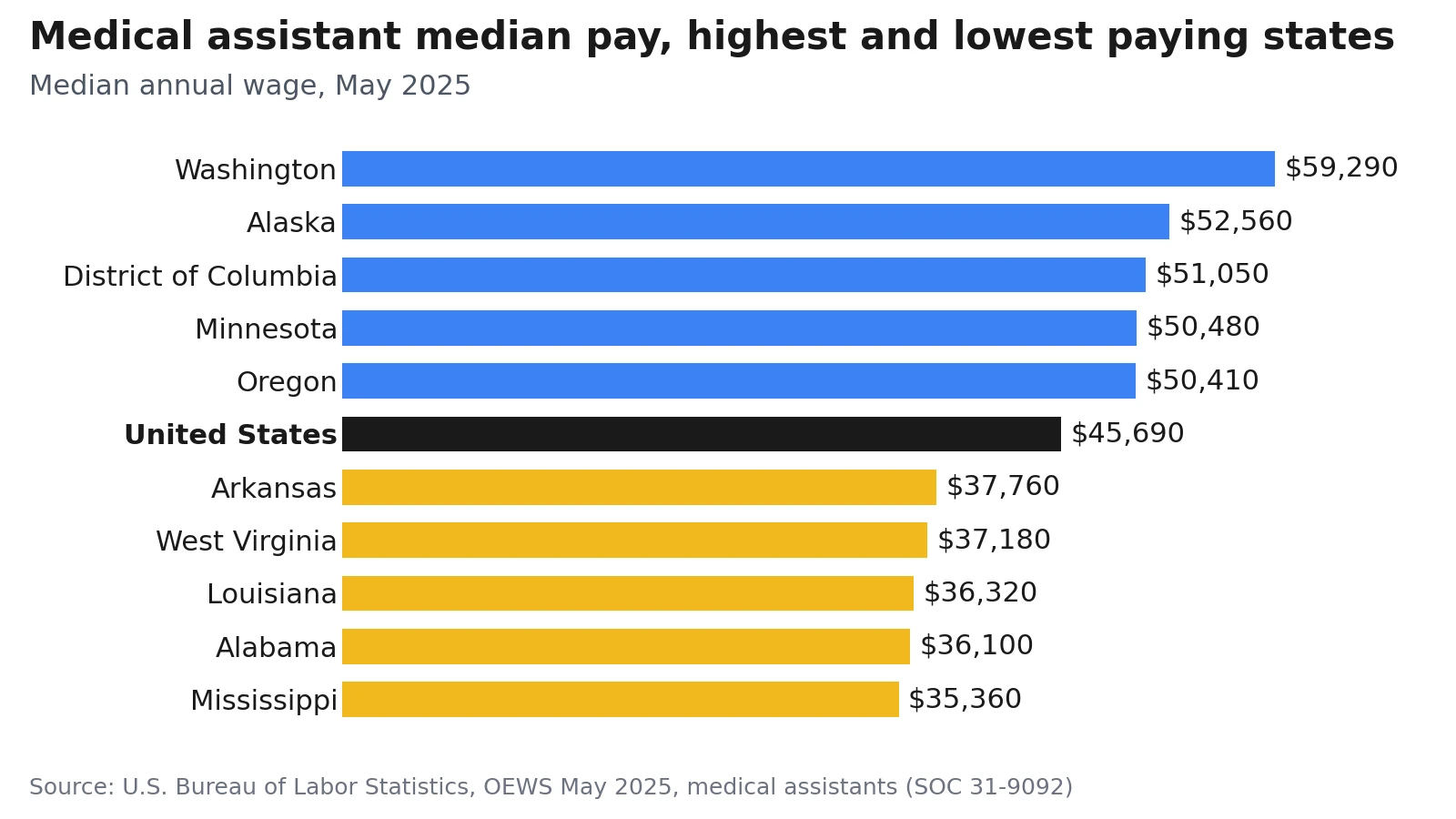
Washington had the highest state median at $59,290, followed by Alaska at $52,560. Mississippi had the lowest at $35,360, with Alabama at $36,100.
For your own metro area, the BLS OEWS data search breaks the same numbers down by city, which is closer to what local candidates will expect.
Budget for more than the wage
Your payroll cost is higher than the paycheck. Employers pay 6.2% Social Security tax and 1.45% Medicare tax on wages (IRS Topic 751), plus federal and state unemployment taxes, workers' compensation insurance and whatever benefits you offer.
At the national median wage, the employer share of Social Security and Medicare alone adds about $3,495 a year.
Paying for a certification exam or renewal is a modest recruiting perk next to the cost of replacing someone who leaves. The break-even calculator has a monthly staff cost field, so you can see the effect.
What Does a Medical Assistant Do in a DPC Practice?
The BLS describes the job as a mix of clinical and administrative work, including taking vital signs, recording history, giving injections "as permitted by state law," collecting lab specimens and scheduling (BLS). In a membership practice the mix tilts differently than in a fee-for-service clinic, because there are no claims to code and the visits are longer.
| Task area | Example fee-for-service clinic | Example DPC practice |
|---|---|---|
| Front desk | Insurance verification, copays, prior auth paperwork | Membership sign-ups, payment questions, booking longer visits |
| Rooming | Fast turns to keep a full schedule moving | Fewer, longer visits with time for a thorough intake |
| Labs | Draws sent out under each patient's insurance | Draws sent to the practice's contracted lab at cash prices |
| Medications | Mostly e-prescriptions to outside pharmacies | In-office dispensing if you offer it, so counting, logging and reordering |
| Follow-up | Callbacks tied to the next billable visit | Messages, refills and result calls between visits, all included in the membership |
| Coding and billing | Part of the job | Little or none |
That last row is why a DPC medical assistant can grow into a care coordinator. When messaging between visits is part of the membership, someone has to make sure every lab result, refill and referral closes the loop. If you dispense or run tests in house, the guide to dispensing medications and labs covers the state and CLIA questions your assistant will be working inside.
Should your first hire be clinical or front desk?
In a solo practice, one person who can do both usually makes the most sense, because there isn't yet enough work for two specialists. Look for someone comfortable rooming a patient, drawing blood and then answering the phone warmly in the same hour. If your bottleneck is mostly messages, scheduling and paperwork rather than hands-on care, a remote helper may fit better, and the post on what to sort out before hiring a medical VA walks through that choice.

Do Medical Assistants Need to Be Certified? (CMA vs RMA vs CCMA)
The BLS notes that most states don't require certification, but many employers prefer it and some states require a credential, a training program or other prerequisites (BLS). Three national certifications cover most of the candidates you'll see.
| Credential | CMA (AAMA) | RMA (AMT) | CCMA (NHA) |
|---|---|---|---|
| Issued by | American Association of Medical Assistants | American Medical Technologists | National Healthcareer Association |
| Main way to qualify | Graduate of a CAAHEP- or ABHES-accredited program, or a qualifying alternative pathway | Recent graduate of an accredited program, a hybrid or apprenticeship program, 3 years of work in the past 7, or military training | High school diploma plus a training program in the past 5 years, or 1 year of supervised work in the past 3 (2 years in the past 5) |
| Renewal | Every 60 months, by 60 continuing education units or by exam | Annual fee plus 30 points over a 3-year cycle | Every 2 years with 10 continuing education credits |
| Good signal for | Formal, accredited training | Flexible routes, including experienced assistants without a degree | Entry-level clinical skills, often from shorter programs |
Sources are the AAMA eligibility page and recertification page, the AMT medical assistant page and maintenance page, and the NHA CCMA page.
The CMA (AAMA) exam costs $125 for AAMA members and $250 for nonmembers. The RMA application is $150, which AMT says includes the exam and the first annual fee, and the annual RMA renewal fee is $75, rising to $85 for dues on or after February 1, 2027. The NHA store lists the CCMA exam application at $169.
None of these makes one candidate better than another on its own. A certification tells you someone passed a standardized exam, while a skills check in your own exam room tells you whether they can do the job your way. Once you have more than one credentialed person, keeping renewal dates in one place helps, and the staff certification tracking guide shows a simple way to do it.
What Can a Medical Assistant Do in Your State?
Scope rules for medical assistants are set state by state, and they differ more than most new owners expect. Three examples show the range.
| State | What the law says | Source |
|---|---|---|
| Washington | Nobody may practice as a medical assistant-certified or medical assistant-registered without the matching Department of Health credential. A medical assistant-certified may give intradermal, subcutaneous and intramuscular injections and do venipuncture under delegation and supervision. | RCW 18.360.020, RCW 18.360.050 |
| California | Medical assistants are unlicensed and need no certification, but must be at least 18 and complete minimum training set by the Medical Board. The employer keeps a copy of the training certificate, and the supervising clinician must be physically present for injections and similar tasks. | Bus. & Prof. Code 2069, Medical Board of California |
| Arizona | Injections and body fluid specimens require direct supervision by a doctor of medicine, physician assistant or nurse practitioner. Scheduling, vitals, history and communicating documented orders do not. Training requirements are set by board rule and may be met through a physician-designed program. Arizona's osteopathic chapter has its own section on medical assistants. | A.R.S. 32-1456, A.R.S. 32-1859 |
This is general information, not legal advice. Before you write the job post, read your state medical board's page on medical assistants or ask a health care attorney, because the answer decides whether you can hire someone without a credential and train them yourself. The state guides to starting a DPC cover each state's DPC law status and nurse practitioner practice rating, and the credentialing and licenses checklist covers the rest of the paperwork for your practice.
How to Hire a Medical Assistant for a DPC Practice
Write the job post around the membership model
Candidates from busy fee-for-service clinics may not know what DPC is, and the ones who will love it are the people who wanted more time with each patient. Say plainly that visits are longer, that there is little or no insurance billing, and that the job includes keeping in touch with members between visits. List the clinical skills your state allows and you actually need, such as phlebotomy, injections, EKGs and point-of-care tests, so candidates can tell right away whether they fit.
Questions worth asking
Good interview questions ask for real stories, not opinions:
- Tell me about a time a lab result or referral almost fell through the cracks. What did you do?
- A member messages at quarter to five on a Friday asking for a refill you can't approve. Walk me through your next ten minutes.
- What do you like about working with the same patients over and over?
- How do you keep track of tasks when the phone, the inbox and a patient in the room all need you at once?
- Which clinical skills are you confident doing today, and which would you want more practice on?
Use a working interview and check credentials
A paid half-day working interview tells you more than an hour of questions. Let the candidate room a volunteer, take vitals and handle a mock phone call while you watch. If a candidate lists a certification, verify it with the issuing organization, and check references with a former supervisor rather than a coworker.
Onboarding Your First Medical Assistant in 30 Days
Week one covers paperwork and safety
A few federal rules have real deadlines:
- Form I-9. You must complete Section 2 within 3 business days of the employee's first day of work for pay (USCIS).
- New hire report. Federal law requires you to report new hires to your state within 20 days, and some states require it sooner (ACF Office of Child Support Services).
- HIPAA training. Covered entities must train each new workforce member on privacy policies within a reasonable period after they join (45 CFR 164.530(b)). Some purely cash DPC practices aren't covered entities, but training to the standard is still sensible, and the 2027 HIPAA Security Rule guide explains how coverage works.
- Bloodborne pathogens. OSHA requires training at initial assignment to any task with exposure risk and at least annually after that, and the hepatitis B vaccine must be offered within 10 working days of initial assignment (29 CFR 1910.1030).
Weeks two through four build skills and routines
Spend the rest of the month on supervised skills checks for every clinical task you plan to delegate, and write down the result. Walk through your standing orders, how you want refill requests handled, and which messages your assistant can answer alone and which come to you. Then teach the membership side, including how a new member is welcomed, how labs are ordered and followed, and how a missed payment is handled kindly.
By day 30, your assistant should be able to run a normal clinic day with you nearby and know exactly where to look when something is still open. That second part is where a small practice can struggle, because patient context is split across the EHR, the billing system, the phone inbox and a few sticky notes.
Making the First Hire Count
A first medical assistant is one of the biggest decisions a DPC owner makes, and the payoff to aim for is more of your day spent with patients. The hire works best when the tasks you hand over have a clear owner and a clear finish line, so nothing waits on you to remember it.
That is where Tabflows fits. We are a dedicated tech team that connects the tools your practice already uses, such as your EHR, billing and messaging, so follow-ups, tasks and patient context live in one shared place your new assistant can work from on day one. If you are still mapping the whole launch, the 2027 guide to starting a DPC practice puts hiring in context with everything else on your list.
FAQs
When should a DPC practice hire its first medical assistant?
Hire when the work that does not need a physician starts eating your clinical hours, usually when rooming, vitals, refills, lab draws, inventory and phone follow-ups crowd out visit time or push charting into your evenings. The trigger is your schedule rather than a set member count, and the hire makes sense once membership revenue can carry the payroll. A DPC Alliance survey collected in late 2024 and summarized by Hint found that about one-third of single-location practices ran with no support staff and another third with one staff member.
How much does a medical assistant cost per year?
The BLS reports a median annual wage of $45,690 for medical assistants in May 2025, or $21.97 an hour, with the lowest 10% earning less than $36,050 and the highest 10% more than $59,310. In offices of physicians the median was $45,520. State medians ranged from $35,360 in Mississippi to $59,290 in Washington. Add the employer share of Social Security and Medicare (7.65%), plus any benefits you offer.
What is the difference between a CMA, RMA and CCMA?
They are national certifications from three different organizations. The CMA (AAMA) requires graduation from a CAAHEP- or ABHES-accredited program or a qualifying alternative pathway, and is renewed every 60 months. The RMA from American Medical Technologists accepts education, work experience or military routes and renews on a 3-year points cycle with an annual fee. The CCMA from the National Healthcareer Association requires a high school diploma plus either a training program or supervised work experience, and is renewed every two years.
Does a medical assistant have to be certified?
Most states do not require certification, but some regulate medical assistants directly. Washington requires a state credential from the Department of Health before someone can practice as a medical assistant. California does not require certification but sets minimum training for tasks like injections and requires the supervising clinician to be physically present. Arizona requires direct supervision for injections and specimen collection and sets training standards by rule. Check your state medical board before you write the job post.
Can a medical assistant give injections in a DPC practice?
Often yes, within state rules. Washington allows a medical assistant-certified to give intradermal, subcutaneous and intramuscular injections under delegation and supervision, California allows injections after the training its regulations require and with a supervisor physically present, and Arizona allows injections under the direct supervision of a doctor of medicine, physician assistant or nurse practitioner; for osteopathic doctors, a separate section lets medical assistants assist under board rules. Rules differ by state and by credential, so confirm with your medical board.
What should a DPC medical assistant do in the first 30 days?
Week one covers paperwork and safety, which means Form I-9 within 3 business days of the first paid day, your state's new hire report within 20 days or sooner, HIPAA privacy training if your practice is a covered entity, and OSHA bloodborne pathogens training before any task with exposure risk. The rest of the month is supervised skills checks, your standing orders, your phone and messaging routines, and the membership side of the practice, such as onboarding new members and following up on labs and refills.