Should a DPC Practice Charge an Enrollment Fee?
A one-time enrollment fee is common in direct primary care and it is a reasonable choice, but it is not required, and in 2027 it deserves more thought than it used to. The fee helps pay for the long first visit, records transfer and chart setup, and it nudges people to join for the long run rather than only when sick. Against that, it adds cost at the exact moment someone is deciding to join, the IRS has not said how a one-time fee fits the HSA rules for DPC, and a few state DPC laws describe the fee as monthly and all-inclusive.

This guide walks through what practices actually charge on their own price pages, the usual waivers, re-enrollment fees for members who leave and come back, and where the HSA and state rules leave open questions. If you are still setting your monthly price, start with how much to charge for a DPC membership, then come back here to decide whether a one-time fee belongs on top of it.
What Does a DPC Enrollment Fee Pay For?
Most practices describe the fee as covering the work of bringing a new member in, which is real work that the first month's membership often does not cover. A new member usually needs outside records requested and read, a chart built, a long first visit, account setup in the billing system and, for many practices, a welcome call or orientation.
Practices say this on their own pages in plain words. Planted Direct Primary Care in East Rochester, New York, says on its membership page that its one-time fee "covers the time needed to obtain your health records and create your new patient chart." Coral DPC in North Myrtle Beach, South Carolina, takes a different approach on its member benefits page, where the enrollment fee covers care until the end of the month you join and the monthly charge starts on the first of the following month.
The second reason is behavioral. A fee at signup discourages people from joining for one sick visit and canceling once they feel better, which matters in a model that depends on members who stay. Our guide to DPC patient retention and churn covers the bigger picture of why members leave.
How Much Do DPC Practices Charge to Enroll?
We read the published price pages of nine DPC practices on November 3, 2026. This is not a survey, and we chose pages that show the range of approaches rather than a random sample. The DPC Alliance's State of DPC 2026 report and Hint Health's Trends in DPC 2026 report do not report how many practices charge an enrollment fee, so we are not quoting a share here. Our DPC pricing report tracks how many practices in the DPC Finder list one.
| Practice | First-time enrollment fee | Waiver or discount on the page | Re-enrollment fee |
|---|---|---|---|
| Triad DPC | Yes, per person or per family | Special pricing for businesses enrolling 5+ employees | Yes |
| Planted Direct Primary Care (NY) | Yes, for new registrations | 5% off when paying for the year in full | Yes, based on availability |
| Weatherly Direct Primary Care (RI) | Yes | None listed | Yes, for returning patients |
| Kaimana Hila Direct Primary Care | Yes, per patient or per family, nonrefundable | Family discounts on the monthly fee | Yes, to reactivate a lapsed account |
| Coral DPC (SC) | Yes, individual or family, covers the rest of the first month | None listed | Yes, per person |
| Anchor Primary Care (TX) | Yes | Waived for the first 50 founding members | None listed |
| Foundations Direct Care (OK) | Yes, per person with a family maximum | Lower per-person fee for employers enrolling 5+ employees | None listed |
| Fort Wayne DPC (IN), employer plan | No | Employer page lists no enrollment fees | Not applicable |
| Montrose DPC | No | Membership page says no enrollment fees | Not applicable |
The amounts listed on those pages were as follows:
- Triad DPC lists $85 per person or $150 per family.
- Planted lists $99, and Weatherly lists $100.
- Kaimana Hila lists $100 per patient or $150 per family.
- Coral DPC lists $100 for an individual and $200 for a family.
- Anchor Primary Care lists $125.
- Foundations lists $99 per person with a $250 family maximum, and $50 per person for employer groups of five or more.
The first-time fees cluster tightly, and several practices cap the fee per family, so a household of five does not face five fees on day one. Per-family caps matter most for the families a practice most wants to keep for years, and our guide to DPC family and child pricing tiers covers how household caps work on the monthly side.
The Case For and Against an Enrollment Fee
Both choices are defensible, and the practices above land on each side.
| Question | Charging a fee | Not charging a fee |
|---|---|---|
| Covers onboarding work | Yes, the records, chart and first visit are paid for up front | The cost is spread across the monthly fee |
| Discourages join-when-sick, leave-when-well | Somewhat, since joining has a cost | Relies on the agreement and a re-enrollment rule instead |
| Friction at signup | Higher, the first payment is larger | Lower, the first payment is just the monthly fee |
| HSA rules in 2027 | Open question, see the HSA section below | Simpler, one fixed periodic fee |
| State DPC laws | Needs a check in states that describe a monthly, all-inclusive fee | Fits the common statutory wording |
| Employer sales | Often waived or reduced anyway | Matches what many employer offers already look like |
A useful test is to ask what the fee is really for. If it is about covering onboarding work, you can also cover that by building it into the monthly price or by billing annually, which our post on annual vs monthly DPC membership billing compares. If it is about discouraging people who leave and come back, a re-enrollment fee does that job more directly, because it only touches the people whose behavior you want to change.
How Do DPC Practices Waive the Enrollment Fee?
Waivers are where most of the strategy lives. A fee waived for your first members and your employer groups can still do its job for everyone else, as long as the rules are written down and applied the same way every time.
For founding members
Waiving the fee is one of the simplest founding-member perks, because it gives early joiners a clear reason to sign now without lowering your monthly price. Anchor Primary Care in Flower Mound, Texas, says on its membership page that its first 50 members will have their one-time enrollment fee waived, alongside founding-member monthly rates. A cap like Anchor's 50 makes the window real. Our guide to running a DPC founding-member presale covers waitlists, deposits and what to promise.
For employer groups
Employer pricing can drop or reduce the fee, because the employer is buying many memberships at once and the onboarding happens in a batch. Foundations Direct Care in Oklahoma City lists a lower per-person enrollment fee for employers enrolling five or more employees on its pricing page, and Fort Wayne DPC's employer page lists "No enrollment fees" for its employer plan. Our guide on how to sell direct primary care to employers covers contracts and pricing models in more depth.
Keep waivers consistent, and separate from referrals
A waiver offered to everyone who joins in a given window or through a given employer reads as your price, while one offered only to people a current member referred can look like a reward for the referral. The federal anti-kickback statute (42 U.S.C. 1320a-7b) applies to remuneration tied to business paid for by federal health care programs, and some states have their own patient-brokering rules. Our guides to the DPC member referral program and DPC anti-kickback and Stark basics explain where the lines sit. This post is general information, not legal advice, so check any waiver tied to referrals with a health care attorney.

Should You Charge a Re-Enrollment Fee When a Member Comes Back?
A re-enrollment fee is charged when a member cancels and later asks to rejoin. Of the nine pages we checked, five list one, and at each of those five practices it is higher than the first-time fee. The aim is plain on the pages themselves. Triad DPC says the fee applies "for those who cancel, then re-join," and Kaimana Hila says it must be paid "to reactivate an account that is allowed to lapse without payment."
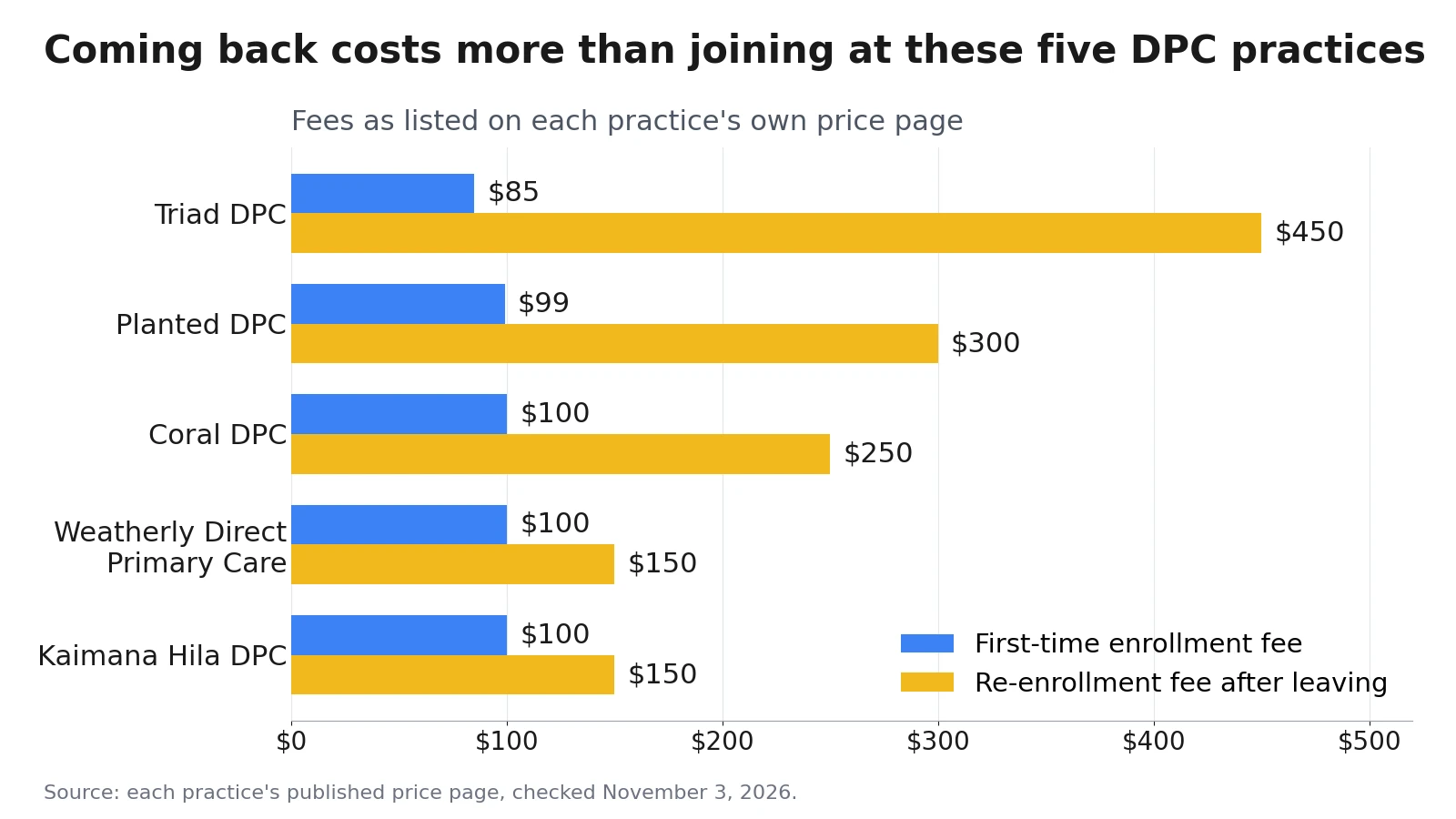
On those pages, re-enrollment fees ran from $150 at Weatherly and Kaimana Hila to $250 per person at Coral, $300 at Planted and $450 at Triad.
Planted adds a second condition that is easy to miss, saying re-enrollment "is based on availability." Once a panel fills, a member who left may not get their spot back, and saying so up front is kinder than surprising them later.
When to waive the re-enrollment fee
The fee is meant for people who leave while well and come back when sick. Plenty of members leave for reasons that have nothing to do with that, such as a move, a job change that ends an employer membership, or a short stretch of tight money. You can waive the fee in those cases, and a few cleaner tools help too:
- A pause option. A written pause, with a maximum length, keeps members with a temporary reason connected without a cancellation at all. Our retention guide covers how to set one up.
- An employer transition rule. When an employer contract ends, offer those members a window to move to an individual membership with no enrollment or re-enrollment fee.
- A failed-payment grace period. A card that expires should not trigger a re-enrollment fee. Catch failed payments within days so a lapse never happens by accident, and see our guide to DPC payment processing fees for the billing side.
Does a DPC Enrollment Fee Count Toward the HSA Fee Cap?
The honest answer is that the IRS has not said. Since January 1, 2026, a qualifying direct primary care service arrangement no longer blocks HSA contributions, and the fee can be paid from an HSA, under section 71308 of Public Law 119-21. IRS Notice 2026-5 defines a qualifying arrangement as one where "the sole compensation for such care is a fixed periodic fee," and it caps the aggregate fees for all of a person's DPC arrangements each month. Rev. Proc. 2026-24 keeps that cap the same for 2027.
For 2027 the cap is $150 a month for one person and $300 a month for a person covered by an arrangement that covers more than one individual.
We read the full text of both documents on November 3, 2026, and neither mentions enrollment, registration, setup or other one-time fees. That leaves two open questions for a practice that charges one:
- Is a one-time fee part of a "fixed periodic fee"? A fee charged once at signup is not obviously periodic. If it pays for care under the membership, it could be read as compensation outside the periodic fee.
- Does it count toward the month it is charged? If it does, the first month's total is the monthly fee plus the enrollment fee, which can push that month over the cap even when the monthly price sits well under it.
Notice 2026-5 also says (Q-12) that a practice may sell items and services outside the membership as long as they are offered to members and non-members alike. An enrollment fee is tied to joining, so that answer does not obviously cover it.
If HSA holders are a big part of your market, you can drop the fee and build onboarding costs into the monthly price, or fold them into an annual price, which Q-13 of the notice allows for periods of up to a year as long as the fees stay fixed, periodic and within the cap on an annualized basis. Either way, have a CPA review your price sheet and say plainly on your pricing page which options keep members HSA eligible. Our DPC HSA rules for 2027 cover the excluded services and employer-paid memberships.
What Do State DPC Laws Say About Extra Fees?
State DPC laws are generally written around a periodic fee, and a few are specific enough that a one-time fee needs a second look. These are the provisions we read on November 3, 2026.
| State | Statute | What it says about the fee |
|---|---|---|
| Washington | RCW 48.150.030 | The practice "must charge a direct fee on a monthly basis," and the fee "must represent the total amount due for all primary care services specified in the direct agreement." Unearned prepaid fees are refunded promptly after written notice. |
| Virginia | Va. Code 54.1-2997 | A DPC agreement is for primary care "in exchange for the payment of a monthly periodic fee," and is not insurance provided the provider does not require patients to pay monthly periodic fees before the coverage period begins. |
| North Carolina | G.S. 58-3-8 | The agreement must specify the periodic fee and the primary care services covered by it. |
Washington's wording is the most direct. If the monthly fee must represent the total amount due for the primary care services in the agreement, a separate fee for the first visit or chart setup is worth reviewing with a Washington attorney before you charge it. The same section also says (subsection 6) that fees for comparable services may not vary from patient to patient based on health status or sex, which is one more reason to apply any waiver by a clear, neutral rule.
Virginia's condition is about timing. A fee collected before coverage starts is worth checking against that wording, especially during a presale. Rules differ in every state, so read your own statute in our guide to direct primary care laws by state, and check the state pages under /start-a-dpc if you are still choosing where to open.
How to Write the Enrollment Fee Into Your Agreement and Price Page
The fee should be just as clear on your website as it is in your agreement, because a fee patients discover at checkout feels like a surprise even when it is fair. It is on our list of questions patients ask before joining a DPC for that reason.
A clear enrollment fee section covers these points:
- The amount, per person and per family, written as text on your pricing page, not inside an image, so search engines and answer engines can read it.
- What it covers, in one sentence, such as records, chart setup and the first long visit.
- Who it is waived for, such as founding members, employer groups or family members after the first.
- Whether it is refundable, and when, matching your state's refund rules.
- The re-enrollment rule, including the amount, whether a spot is guaranteed and the reasons you waive it.
- How it interacts with HSAs, in plain words and reviewed by your CPA.
List the fee in any good faith estimate you give self-pay patients too. Our guide to good faith estimates for DPC covers when one is due and what goes in it.
Keeping the Fee Easy to Run
An enrollment fee looks simple on a price page and gets busier in practice. Someone has to apply the right waiver, charge the family cap correctly, flag a returning member for the re-enrollment rule and make sure the records request the fee pays for actually goes out. Those steps live between the billing tool, the EHR and the inbox, which is why they slip when the front desk is busy.
That is the work Tabflows does. We are a dedicated tech team that connects the tools a DPC clinic already uses, like the EHR, membership billing and messaging, so follow-ups get sent, tasks land with the right person and patient context sits in one place. If you charge an enrollment fee, that means the onboarding it pays for happens every time, for every new member.
This article summarizes published practice price pages, IRS Notice 2026-5, IRS Rev. Proc. 2026-24 and the state statutes linked above as of November 3, 2026. It is general information, not tax or legal advice, so talk to a CPA about HSA questions and a health care attorney about your membership agreement.
Spot a wrong fact? Email a correction.
FAQs
Should a DPC practice charge an enrollment fee?
It can, and many do, but it is a choice rather than a requirement. A one-time enrollment fee helps pay for the long first visit, records transfer and chart setup, and it discourages people from joining only when sick. It also adds a cost at the exact moment someone is deciding, can complicate HSA eligibility, and sits awkwardly with some state DPC laws, so weigh it against your market, your employer plans and your state statute.
What does a DPC enrollment fee cover?
Practices usually describe it as paying for the work of bringing a new member in. Planted Direct Primary Care in New York, for example, says its one-time fee covers the time needed to obtain health records and create a new patient chart. Other practices point to the long first visit and account setup. Coral DPC in South Carolina uses its enrollment fee to cover care through the end of the month you join, with monthly billing starting on the first of the next month.
Do DPC practices waive the enrollment fee?
Often. Common waivers include founding members (Anchor Primary Care in Texas waives it for its first 50 members), employer groups (Foundations Direct Care in Oklahoma lists a lower per-person fee for employers enrolling five or more employees, and Fort Wayne DPC's employer page lists no enrollment fees) and family caps on the fee. Whatever you waive, write the rule down and apply it the same way to everyone it covers.
What is a DPC re-enrollment fee?
A re-enrollment fee is charged when a member cancels and later wants to rejoin. On the price pages we checked on November 3, 2026, re-enrollment fees ran from 150 to 450 dollars and were always higher than the same practice's first-time fee. Practices use them to discourage people from leaving when they feel well and rejoining when they need care.
Does a DPC enrollment fee count toward the HSA fee cap?
The IRS has not said. IRS Notice 2026-5 and Rev. Proc. 2026-24 define a qualifying arrangement as one paid for solely by a fixed periodic fee, with aggregate fees of no more than 150 dollars a month for one person or 300 dollars for a membership covering more than one person in 2027, and neither document mentions enrollment or registration fees. A one-time fee is not obviously a fixed periodic fee, so ask a CPA before charging one to members who want to stay HSA eligible.
Is a DPC enrollment fee refundable?
That depends on your agreement and your state. Some practices state that the fee is nonrefundable. Washington's DPC law, RCW 48.150.030, requires practices to charge the direct fee on a monthly basis and to promptly refund unearned prepaid fees after a patient gives written notice, so a Washington practice should have an attorney review any one-time fee before it charges one.