How Do You Get a DPC Practice Found on Google and in Answer Engines in 2027?
A direct primary care practice gets found in 2027 by giving search engines one clear, consistent, readable picture of itself. That means a verified Google Business Profile, a website with a page for each question patients ask (above all, a price page written in plain text), structured data that describes the practice and its doctors, and listings in DPC directories that match your website exactly. Google and Bing read those same sources, and Bing says its guidelines also cover Microsoft Copilot, so the same work helps in more than one place.
None of it rewards a big budget. Google says there is no way to request or pay for a better local ranking, and its guidance for AI Overviews and AI Mode (Google's names for its answer boxes) says there are no additional requirements or special optimizations needed to appear there. The work below is accuracy and completeness, not spending.
This guide focuses on your website and the search tools around it. If you want the patient's side of the story, including how ChatGPT and Perplexity crawl the web, start with how patients find a DPC in 2027. For where SEO sits in your first year, see the 2027 DPC marketing plan.
The DPC SEO Checklist for 2027 at a Glance
| Task | Where it lives | Why it matters |
|---|---|---|
| A unique, descriptive title on every page | Website | Google uses titles to understand and label each page |
| A price page with prices as plain text | Website | Answer engines can only repeat numbers they can read |
| One page per real office location | Website | Matches local searches without breaking Google's doorway rules |
| MedicalClinic and Physician structured data | Website code | Describes the practice and doctors in a standard format |
| FAQ pages with question headings and short answers | Website | The shape search engines and patients both find easiest to use |
| Verified Google Business Profile | The main source for Maps and local results | |
| A fair, steady review habit | Google and others | Google says reviews can help local ranking |
| DPC directory listings that match your site | Directories | Where patients searching for DPC by name can find you |
| Google Search Console and a sitemap | Shows what Google indexed and which searches bring visits | |
| Bing Webmaster Tools and IndexNow | Bing | Bing's index feeds Bing, Copilot and its grounding results |
What Pages Does a DPC Website Need for SEO?
A DPC website does not need dozens of pages. It needs one strong page for each question a patient has before they join, because each page can then rank for and answer that question on its own. Most practices are well served by the set below.
| Page | What patients search | What the page should say in text |
|---|---|---|
| Home | "direct primary care near me", your practice name | What DPC is, where you are, the price range, how to join |
| Pricing | "how much is direct primary care in [town]" | Every membership price, age bands, family pricing, fees, what is included |
| How it works | "what is direct primary care", "do I still need insurance" | How membership works with insurance, HSAs and labs |
| About the doctor | the doctor's name, "DPC doctor [town]" | Training, board certification, why they started the practice |
| Location | "[town] primary care doctor" | Address, hours, parking, directions, towns nearby |
| FAQ | the exact questions patients ask | One question per heading, short answer underneath |
| Join or contact | "sign up for [practice name]" | A booking or enrollment link that works on a phone |
Give each of these pages its own title. Google's title link guidance asks for descriptive, concise text that is distinct on every page, warns against repeating the same words, and suggests branding titles concisely with your site name at the start or end. "Membership Pricing, Example Direct Primary Care" tells Google and the patient exactly what the page is, where "Home" or "Services" tells them nothing.
Most website builders have a field for this, often called the SEO title or page title. If you are still choosing a builder, our comparison of the best DPC website builders covers which ones make these settings easy, and how to build a direct primary care website walks through the structure.
How to Write a DPC Price Page Search Engines Can Read
Your price page is likely the most valuable page on your site, because "how much does it cost" is the question every prospective member asks. Google's answer-feature guidance asks site owners to make sure important content is available in textual form. A price inside a graphic, a downloadable PDF or a calculator that only shows a number after someone clicks is often invisible to a crawler.
Write the page as ordinary text, and include the details patients compare.
- Each membership price, by age band, written out on the page.
- Family and child pricing, including any family cap. Our guide to DPC family and child pricing tiers covers the common structures.
- Any enrollment fee, and whether it is waived for founding members. See DPC enrollment fees.
- Monthly and annual options, if you offer both, as explained in annual vs monthly DPC membership billing.
- What is included and what costs extra, such as wholesale labs and medications.
- Whether membership works with an HSA, since that changed in 2026. The 2027 DPC HSA rules explain the monthly fee cap.
A line like this one, written as text, is exactly what an answer engine can quote when someone asks about prices in your town.
"Adult memberships are $89 a month, children under 18 are $45 a month, and a family of four or more is capped at $250 a month."
Those numbers are only an example. If you are still deciding what to charge, the DPC pricing report shows what practices in our DPC Finder list, and how to raise DPC membership prices covers changing them later. Add a short "prices updated" date to the page whenever you change it, so patients and search engines can see it is current.
Should a DPC Make Separate Pages for Each Town It Serves?
Only for towns where you really have an office. It is tempting to publish a page for every suburb within driving distance, each saying nearly the same thing with the town name swapped. Google's spam policies name this as doorway abuse, and their examples include "multiple domain names or pages targeted at specific regions or cities that funnel users to one page" and "substantially similar pages that are closer to search results than a clearly defined, browseable hierarchy."
The approach that holds up is one page per real location. Each office page carries its own address, hours, phone number, parking and directions, a photo of the actual building, and the doctors who see patients there. Google's local business structured data guide expects the same, asking for a url that points to that specific location's page.
On that page, list the nearby towns and neighborhoods you serve in a sentence or two of plain text. Patients in those places still find you, and the page stays genuinely useful. If you offer virtual visits to members across your state, say so on the How it works page, and check the rules in direct primary care laws by state and telehealth prescribing rules for 2027 before promising it.
If you are still choosing where to open, our guide to DPC office space in 2027 covers shared and home-based offices, which also affect how your Google Business Profile can be set up.
How to Add Schema Markup to a DPC Website
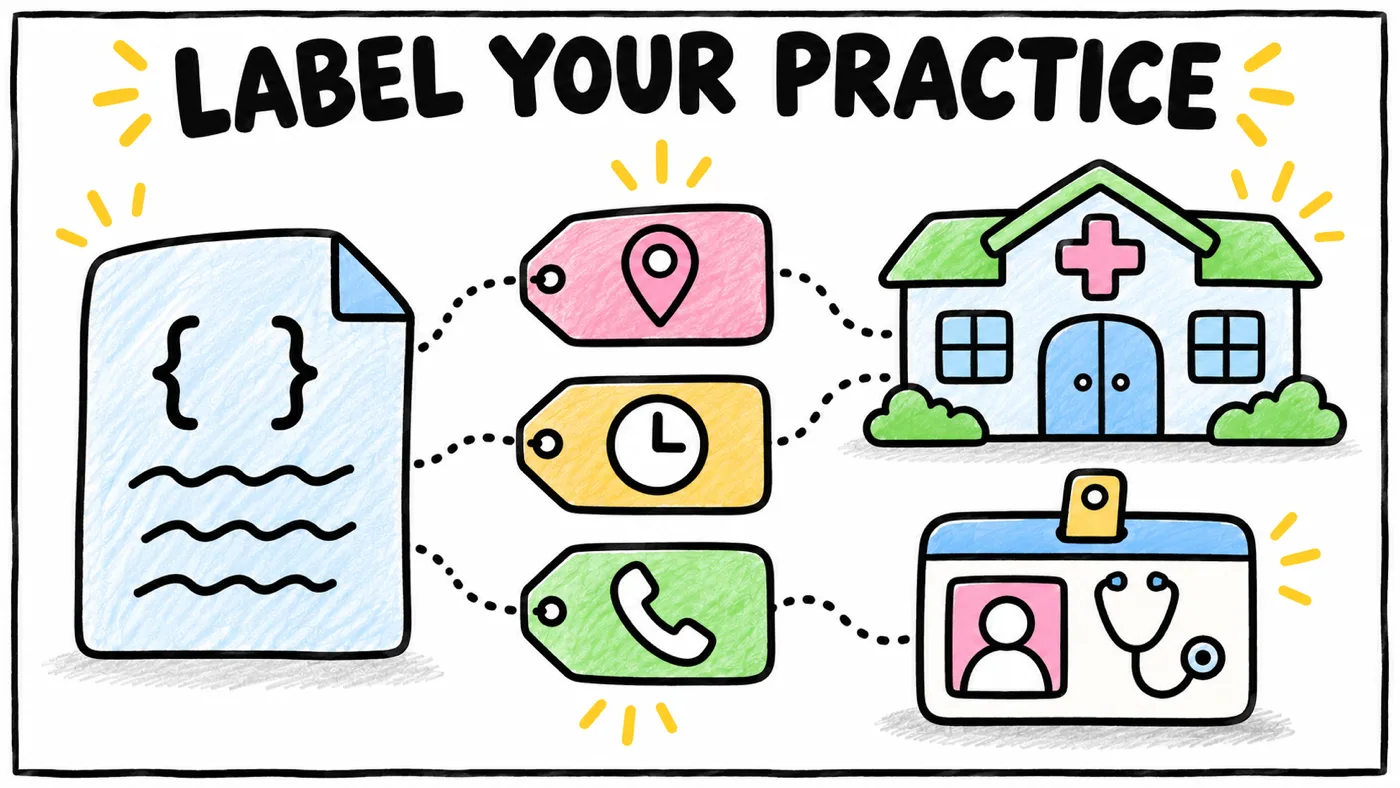
Schema markup, also called structured data, is a short block of code in your page that states facts about your practice in a format search engines share. It will not lift a weak page, and Google says there is no special schema.org structured data needed for its answer features. It does help search engines connect your name, address, hours and doctors correctly, which matters when several sources describe you.
Which schema types fit a DPC practice
Schema.org has two types made for this.
- MedicalClinic for the practice. Schema.org places it under both MedicalBusiness (a kind of LocalBusiness) and MedicalOrganization, so it can carry local details like opening hours and medical ones like isAcceptingNewPatients and medicalSpecialty.
- Physician for a doctor. Schema.org describes it as "an individual physician or a physician's office" and lists more specific types, including IndividualPhysician, "an individual medical practitioner," whose practicesAt property points to the clinic where they work. Physician also has a usNPI property for the doctor's 10-digit National Provider Identifier.
Google's local business guide requires only a name and an address, and recommends telephone (with country and area code), url, geo coordinates accurate to at least five decimal places and openingHoursSpecification. It also says to use the most specific type possible.
A simple example for a one-office DPC
This is the shape of the code for a home page or location page. Replace every value with your own, and keep it in step with the words on the page.
{
  "@context": "https://schema.org",
  "@graph": [
    {
      "@type": "MedicalClinic",
      "@id": "https://example.com/locations/springfield#clinic",
      "name": "Example Direct Primary Care",
      "url": "https://example.com/locations/springfield",
      "telephone": "+1-555-555-0142",
      "address": {
        "@type": "PostalAddress",
        "streetAddress": "120 Main Street, Suite 200",
        "addressLocality": "Springfield",
        "addressRegion": "IL",
        "postalCode": "62701",
        "addressCountry": "US"
      },
      "geo": { "@type": "GeoCoordinates", "latitude": 39.79923, "longitude": -89.64401 },
      "openingHoursSpecification": [{
        "@type": "OpeningHoursSpecification",
        "dayOfWeek": ["Monday", "Tuesday", "Wednesday", "Thursday", "Friday"],
        "opens": "08:00",
        "closes": "17:00"
      }],
      "isAcceptingNewPatients": true
    },
    {
      "@type": "IndividualPhysician",
      "name": "Dr. Jane Doe",
      "practicesAt": { "@id": "https://example.com/locations/springfield#clinic" }
    }
  ]
}
The doctor sits in the same block as a second item, linked to the clinic by its @id, because schema.org's employee property expects a Person, while schema.org files IndividualPhysician under Organization.
The code goes in a script tag of type application/ld+json, and most website builders have a place to paste it in a page's header settings. Google's Rich Results Test will tell you whether it reads correctly.
Two mistakes to avoid
First, keep the markup honest and current. Google's answer-feature guidance says structured data should match the visible text on the page, so if your panel fills up, change isAcceptingNewPatients to false at the same time you update the website.
Second, do not mark up your own star rating. Google's guide recommends review and aggregateRating markup only for sites that capture reviews about other local businesses. Let your reviews live on Google and the other review sites, where patients already look.
Do FAQ Pages Still Help DPC SEO in 2027?
Yes, though for a different reason than a few years ago. Google stopped showing FAQ rich results, the expandable questions that used to appear under some listings. Its FAQPage documentation notes say the feature would no longer appear in Google Search starting May 7, 2026, and the documentation itself was later removed. Adding FAQPage markup now earns nothing visible in Google.
The pages themselves are as useful as ever. A patient who wonders "Can I keep my insurance with direct primary care?" or "Do you see kids?" types or speaks that exact question, and a page with that question as a heading and a two to four sentence answer directly under it is the easiest possible thing for a search engine or answer engine to match and quote. It is also the easiest thing for a busy parent to skim on a phone.
A few habits make FAQ pages work harder.
- Use the patient's words for headings. Your Google Business Profile's performance view shows the searches that led people to your profile, and those phrases make good questions.
- Answer first, then explain. Put the direct answer in the first sentence, and the nuance after it.
- One topic per answer. Link to a fuller page (pricing, how it works, the doctor's page) instead of repeating it.
- Keep it current. An old answer about hours or prices is worse than none, because it gets quoted.
Our post on DPC website copy without walls of text has more on writing pages people actually read.
How Google Business Profile, Reviews and Directories Fit In
Your website is half the picture. The other half is how you are described elsewhere, starting with three places.
Google Business Profile is the main source for Google Maps and the local results on Google Search. Google says local results are based mainly on relevance, distance and prominence. The setup details for a medical practice, including verification, categories, practice versus doctor profiles and adding your membership prices, are in our Google Business Profile guide for DPC practices.
Reviews feed prominence, and Google says more reviews and positive ratings can help local ranking. The rules matter here, because Google prohibits incentives and selective asking, and review replies can create HIPAA problems. Our guide to how DPC practices get more reviews covers asking every member the same way and replying safely, and the DPC member referral program post covers word of mouth.
Directories catch the patients who already know they want direct primary care. Submit your practice to the DPC Finder and the others in our comparison of DPC finder directories. Use the exact same name, address and phone number on every listing, your website footer and your Google profile, so every source describes you the same way.
Why a DPC Should Set Up Bing Webmaster Tools
Bing is worth setting up alongside Google Search Console, because its index reaches further than Bing.com. Bing's Webmaster Guidelines open by saying they describe how Bing surfaces content "across Bing search experiences, Copilot, and grounding API results," meaning Microsoft's own chat assistant and other products that draw on Bing for answers. If Bing has not indexed your price page, those tools cannot cite it.
Setup is quick if you already use Google Search Console. Bing's Add and Verify site help explains that you can import sites from Search Console, and the imported sites are verified automatically along with their sitemaps. Bing says data usually appears within about 48 hours of adding a site.
Once you are in, three things are worth doing.
- Turn on IndexNow. Bing's guidelines recommend IndexNow to tell Bing when a page is added, updated or removed, which helps it avoid citing outdated pages in Copilot answers. Many website builders and SEO plugins can send these pings for you.
- Check that Bingbot is allowed. The guidelines list blocking Bingbot in robots.txt and hiding key content behind scripts that must run in the browser as things to avoid.
- Watch citations. Since February 10, 2026, Bing Webmaster Tools has offered a public preview report it calls AI Performance, which shows how often your pages are cited in Microsoft Copilot and Bing's generated summaries, which pages are cited, and a sample of the phrases used to find them.
While you are there, claim Bing Places too, so your listing on Bing Maps matches your Google profile.
Technical Basics That Quietly Matter
A few settings sit underneath everything above, and most website builders handle them if you check once.
A sitemap. Google's sitemap guide recommends submitting it in Search Console's Sitemaps report and adding a Sitemap line to robots.txt. Google uses the lastmod date when it is consistently accurate and ignores priority and changefreq, and it notes that a sitemap is a hint, not a guarantee. Bing asks for the same thing, listing only your canonical pages.
Crawlers allowed. A security setting that blocks "bots" can quietly block search engines too. Google asks that crawling be allowed in robots.txt and by any CDN or hosting setup. The crawler names for ChatGPT search and Perplexity are in how patients find a DPC.
Speed and phones. Patients may look you up on a phone, so check your site on one. Google's web.dev team sets the "good" Core Web Vitals targets at a Largest Contentful Paint within 2.5 seconds, an Interaction to Next Paint of 200 milliseconds or less and a Cumulative Layout Shift of 0.1 or less, measured at the 75th percentile of visits. The DPC website speed checklist shows how to get there, and why your booking button might be too hard to find covers the last step to signing up.
One address per page. If the same page loads at several addresses (with and without "www", or with tracking codes), pick one and redirect the rest. Bing's guidelines say duplicate URLs dilute signals and recommend 301 redirects for permanent moves.
How to Tell If Your DPC SEO Is Working
Four free sources tell you most of what you need, so check them once a month.
- Google Search Console. What it shows: Searches you appear for, clicks per page, indexing problems. What to do with it: Confirm new pages are indexed, add FAQ answers for common searches.
- Bing Webmaster Tools. What it shows: Bing searches, indexing, and citations in Copilot and Bing summaries. What to do with it: Check your price and FAQ pages are indexed and cited.
- Google Business Profile performance. What it shows: Calls, direction requests, website clicks, search terms. What to do with it: See which words patients use to find you.
- Your enrollment form. What it shows: "How did you hear about us?" answers. What to do with it: Learn which channels bring real members.
Google says appearances in AI Overviews and AI Mode are counted in Search Console's Performance report under the Web search type, so you do not need a separate tool for them. Once a month, it also helps to ask Google, Copilot and ChatGPT the questions your patients ask, such as "direct primary care near [your town]" or "how much is DPC in [your town]," and fix any wrong answer at the page it came from. Our list of DPC metrics to track in 2027 covers the numbers that sit alongside these, and DPC patient retention and churn covers keeping the members search brings you.
Keeping Your Site Accurate as the Practice Changes
The setup above is done once. Keeping it true is the harder part, because a DPC practice changes all the time. Prices go up, hours shift, a second doctor joins, the panel fills and reopens, and each change has to reach the price page, the schema, the Google profile, Bing Places and every directory listing. When one of them lags, the outdated version is the one that gets quoted.
Those updates live between your tools rather than inside any one of them, which is why they slip once the practice is busy. That is the kind of work Tabflows does. We are a dedicated tech team that connects the tools a DPC clinic already uses, like the EHR, membership billing and messaging, so follow-ups get sent, tasks land with the right person and patient context sits in one place, including the small listing tasks that keep you findable. If you are still early, the 2027 guide to starting a DPC practice puts all of this in order alongside everything else you need to open.
FAQs
How do I get my DPC practice to show up on Google in 2027?
Start with a verified Google Business Profile and a website that has a page for each thing patients ask about, especially your prices, written as plain text. Give every page a clear, unique title, add MedicalClinic or Physician structured data that matches what the page says, submit a sitemap in Google Search Console and keep your name, address and phone number identical everywhere. Google says there is no way to pay for a better local ranking, so accuracy and completeness do the work.
Do I need special markup to appear in Google's answer boxes and chat assistants?
No. Google's documentation for AI Overviews and AI Mode says there are no additional requirements or special optimizations needed to appear there, and no special schema.org structured data to add. What it asks for is the same as regular search, which is pages that can be crawled, important content written as text, and structured data that matches the visible page.
Which schema markup should a direct primary care practice use?
Use schema.org's MedicalClinic type for the practice and Physician, or its more specific IndividualPhysician type, for each doctor. MedicalClinic is a kind of LocalBusiness, so Google's local business guidance applies, which requires a name and address and recommends telephone, url, geo coordinates and opening hours. Useful extras include isAcceptingNewPatients, medicalSpecialty and, for a doctor, usNPI. Do not mark up your own star rating, because Google reserves review markup for sites that review other businesses.
Are FAQ rich results still worth adding to a DPC website?
Google stopped showing FAQ rich results in Google Search on May 7, 2026, so FAQPage markup no longer earns the expandable questions under your listing. FAQ pages still help, because a clear question as a heading with a short, direct answer underneath is easy for patients to read and easy for search engines and answer engines to quote.
Why should a DPC practice use Bing Webmaster Tools?
Bing's Webmaster Guidelines say they cover Bing search, Microsoft Copilot and Bing's grounding results, so being indexed well in Bing matters for some chat assistants as well as for Bing itself. Setup is quick if you already use Google Search Console, because Bing lets you import a site already verified in Google Search Console. Since February 2026 its AI Performance report, a public preview, also shows how often your pages are cited in Copilot and Bing's generated summaries.
Should a DPC create a separate page for every town it serves?
Only for places where you really see patients. Google's spam policies name doorway abuse, including pages targeted at specific regions or cities that funnel users to one page. Give each real office its own page with its own address, hours and directions, and list the nearby towns you serve on that page in plain text instead of making near-copies for each one.
How long does SEO take for a new DPC practice?
There is no reliable published timeline, and Google says submitting a sitemap is a hint rather than a guarantee of crawling. What you can control is getting the basics live before you open, then checking Google Search Console and Bing Webmaster Tools each month to confirm your pages are indexed and to see which searches bring patients in. Bing says new sites usually take about 48 hours to show data in Webmaster Tools.