Can I prescribe controlled substances via telehealth in 2027?
As of October 29, 2026, the answer depends on what the DEA publishes before December 31. The current telemedicine flexibilities let DEA-registered practitioners prescribe Schedule II-V controlled medications by audio-video visit without ever seeing the patient in person, but they run only through December 31, 2026. The DEA's permanent replacement, a special registration for telemedicine, went to White House review on August 25, 2026 and had not been published as of today. Buprenorphine for opioid use disorder and VA continuity of care already have their own permanent rules, and non-controlled prescribing by telehealth is governed by your state, not the DEA.

For a DPC or concierge practice, telehealth is part of the membership promise. Patients text in the evening, hop on a video visit from work, and expect refills without a drive across town. This guide walks through where each federal and state rule stands right now, what changes if the flexibilities end, and how to keep your practice ready for either outcome. It is a plain-language summary, not legal advice, so confirm anything that affects your prescribing with your state board and a healthcare attorney.
What the Ryan Haight Act requires (and why it keeps coming up)
The Ryan Haight Online Pharmacy Consumer Protection Act of 2008 is the federal law behind all of this. In plain terms, it says a controlled substance prescription issued over the internet generally requires at least one in-person medical evaluation by the prescriber first, with a short list of exceptions for the "practice of telemedicine." One of those exceptions is a special registration that DEA was supposed to create, and in the 2018 SUPPORT Act Congress gave DEA one year to finish that work.
During the COVID-19 public health emergency, DEA and HHS waived the in-person requirement. When the emergency ended in May 2023, the two agencies kept the waiver alive with a series of temporary rules instead of letting it lapse. That is why you keep seeing the word "extension" in headlines, and why the date on the current one matters so much for 2027 planning.
When do the DEA telemedicine flexibilities end?
The Fourth Temporary Extension, published December 31, 2025, runs from January 1, 2026 through December 31, 2026. HHS announced it on January 2, 2026, saying the extra year gives the agencies time to finalize permanent rules, including the special registration.
Under the extension, the DEA says registered practitioners may prescribe Schedule II-V controlled medications through audio-video telemedicine, and Schedule III-V narcotic medications approved for opioid use disorder through audio-only visits, without ever having done an in-person evaluation. The prescription still has to meet every other DEA requirement and applicable state law.
As of October 29, 2026, no fifth extension had been announced. That could change quickly, since the last extension was published on the final day of the prior one. Put a reminder on your calendar for mid-December to check DEA.gov and the Telehealth.HHS.gov controlled substances page.
Where does the special registration for telemedicine stand?
In January 2025, DEA published a proposed rule called "Special Registrations for Telemedicine and Limited State Telemedicine Registrations." As summarized by Frier Levitt, the proposal described three registrations:
- A telemedicine prescribing registration for qualified clinicians prescribing Schedule III-V medications by telemedicine.
- An advanced telemedicine prescribing registration for certain specialists, such as psychiatrists and hospice physicians, to prescribe Schedule II-V.
- A telemedicine platform registration for covered online platforms.
DEA received more than 6,400 comments. On August 25, 2026, DEA sent a final rule to the Office of Information and Regulatory Affairs, which is usually the last stop before publication, and the OIRA meeting log shows stakeholder meetings continuing into the fall. The final text is not public, and given the volume of comments and the change in administration, it may look different from the proposal.
For a primary care practice, the practical point is that the proposal treated Schedule II differently from Schedule III-V. If the final rule keeps that split, most primary care telehealth prescribing of Schedule II stimulants and opioids would require either an in-person visit or a registration type that most family physicians would not qualify for. That is worth knowing before you promise a new patient a fully virtual ADHD workup.
Is the buprenorphine telehealth rule in effect?
Yes. DEA and HHS published two final rules on January 17, 2025, Expansion of Buprenorphine Treatment via Telemedicine Encounter and Continuity of Care via Telemedicine for Veterans Affairs Patients. After two delays, both took effect December 31, 2025. Unlike the temporary flexibilities, these are permanent rules, so they do not end on December 31, 2026.
The buprenorphine rule, now at 21 CFR 1306.51, works like this:
- You may prescribe FDA-approved Schedule III-V medications for opioid use disorder, such as buprenorphine, through a telemedicine visit, including audio-only.
- Before prescribing, you review the patient's controlled substance history in the PDMP of the state where the patient is located, covering the past year, and note the date and time of that review in the chart.
- If the PDMP is unavailable, you document the attempt and the reason, and you may prescribe a seven-day supply at a time until you can complete a review. Each seven-day supply counts toward the six-month limit below, per 21 CFR 1306.51(b)(3).
- Telemedicine-only prescribing under this rule is limited to six calendar months from the first prescription. After that, you need an in-person evaluation or another pathway the law allows.
If your practice treats opioid use disorder, the PDMP step is the one most likely to slip on a busy day. Our guide to a controlled substance PDMP check workflow covers how clinics build that check into the visit so the timestamp lands in the chart every time.
The VA rule applies to VA practitioners who prescribe to patients another VA practitioner has already seen in person. It rarely touches a private DPC or concierge practice, but it is part of the same package, so you will see it mentioned alongside the buprenorphine rule.
Telehealth prescribing scenarios at a glance
The table below sums up where common primary care scenarios stand as of October 29, 2026, and what changes if the temporary flexibilities end without a replacement.
| Scenario | Allowed now? | Source | What changes when flexibilities end |
|---|---|---|---|
| Non-controlled prescription (blood pressure, antibiotics, refills) by video | Yes, if your state's telehealth standard of care is met and you are licensed where the patient is | State law, for example Fla. Stat. 456.47 | Nothing. The DEA flexibilities do not cover non-controlled drugs. |
| Schedule II (stimulants, opioids) to a new patient never seen in person | Yes, by audio-video, through December 31, 2026 | Fourth Temporary Extension | In-person evaluation required unless the special registration or another Ryan Haight exception applies |
| Schedule III-V (for example, many sleep and anxiety medications) to a new patient | Yes, by audio-video, through December 31, 2026 | Fourth Temporary Extension | In-person evaluation required unless the final special registration rule covers it |
| Controlled prescription to an established patient you have examined in person | Yes | Ryan Haight Act in-person evaluation rule | Little, since the prior in-person exam satisfies the federal requirement. State rules may add limits. |
| Buprenorphine for opioid use disorder, including audio-only | Yes, for up to six calendar months from the first prescription, with a PDMP check before prescribing, then in-person or another pathway | 21 CFR 1306.51 | Nothing. This is a permanent rule in effect since December 31, 2025. |
| Any prescription to a patient located in a state where you hold no license | Generally no, unless that state has an exception or telehealth registration | State medical practice acts, IMLC | Nothing. Licensure follows the patient's location either way. |
Do DPC doctors need a license where the patient is?
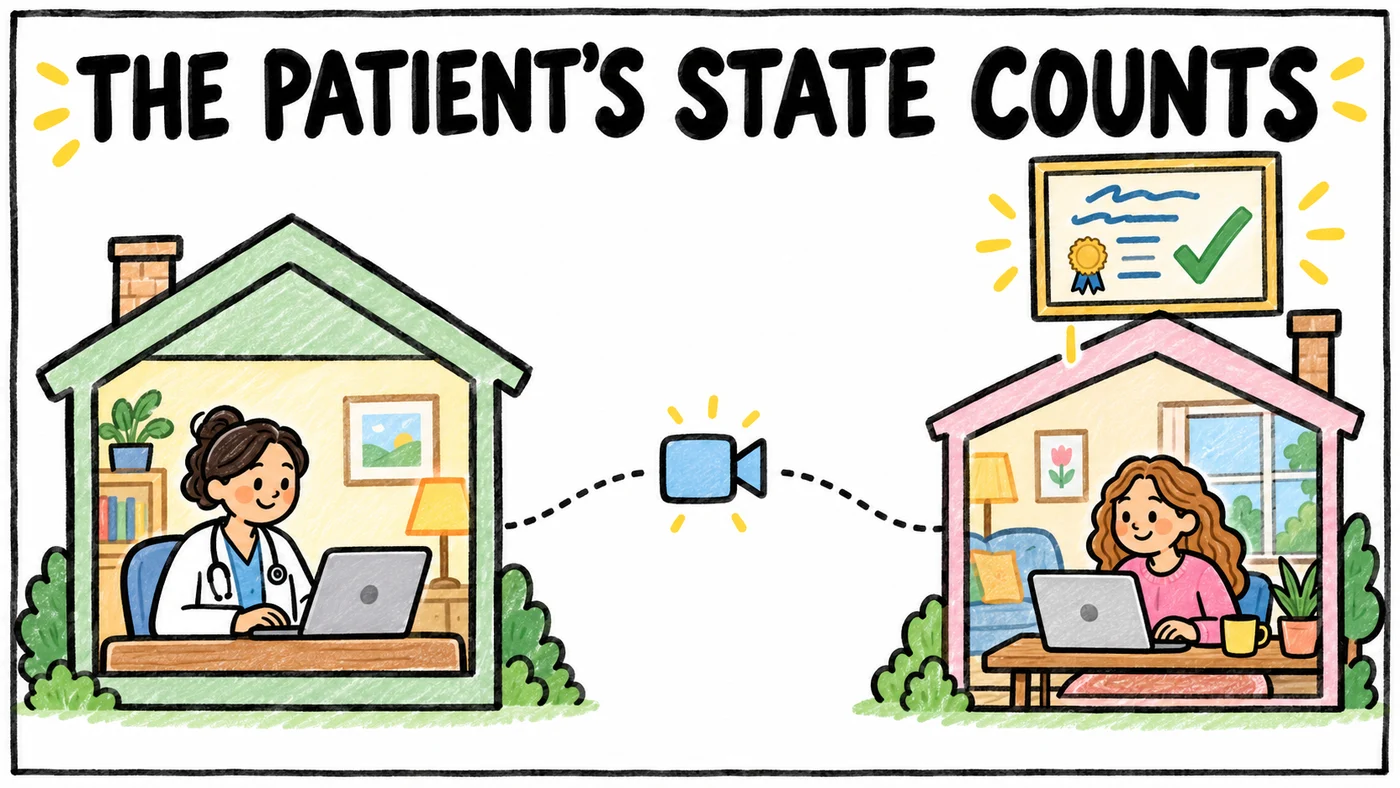
Yes, in almost every case. State medical boards treat the practice of medicine as taking place where the patient is physically located during the visit, not where the physician sits. If your member texts from a lake house two states away and asks for a refill, you are practicing in that state for that encounter. This is one of the most common places where a DPC membership that feels local quietly becomes multistate, and our overview of direct primary care laws by state is a good place to check how your own state frames DPC.
Some states offer a narrower path for out-of-state clinicians. Florida, for example, lets out-of-state providers register as telehealth providers instead of holding a full Florida license, with conditions. Other states allow limited follow-up care for existing patients who travel. These exceptions vary widely, so check the specific state before you rely on one.
How the Interstate Medical Licensure Compact helps
The Interstate Medical Licensure Compact is a voluntary, expedited pathway for eligible physicians to get licenses in additional member states. As of October 2026, its participation map shows 39 states plus DC and Guam processing applications as a state of principal license, Hawaii and Vermont issuing licenses only, and Alaska, New Mexico and Rhode Island with the compact passed but implementation still in process.
The compact speeds up the paperwork, but it does not create a single license that works everywhere. You still hold, renew and pay for a separate license in each state, and each one carries its own continuing education and renewal dates. A DEA and medical license renewal tracking system matters more once you are juggling three or four of them, because your DEA registration is also tied to each state where you prescribe controlled substances.
What are the rules for non-controlled prescribing by telehealth?
For medications that are not controlled substances, the DEA is not involved at all. State law sets the rules, and most states use some version of the same idea, which is that a telehealth visit must meet the same standard of care as an in-person visit for the same problem.
Florida's statute is a good example of how this reads in practice.
- Florida. Section 456.47 holds telehealth providers to the prevailing standard of practice for in-person care in Florida. It also limits telehealth prescribing of Schedule II controlled substances to specific situations, such as psychiatric disorders, inpatient hospital care and hospice.
In practice, that means a video visit is usually enough for a refill of a stable blood pressure medication or a straightforward urinary tract infection, and not enough when the condition really needs hands-on examination. Your own clinical judgment, documented in the chart, is what the standard of care relies on.
Do Medicare telehealth rules apply to DPC and concierge practices?
For a DPC physician who has opted out of Medicare, the Medicare telehealth flexibilities mostly do not apply, because you do not bill Medicare for any service. The DEA and state rules above still apply to every patient regardless of age or coverage. If you are weighing that decision, our comparison of DPC vs. concierge medicine explains how Medicare participation differs between the two models.
Concierge practices that still bill Medicare are in a different position. Telehealth.HHS.gov says recent legislation extended many Medicare telehealth flexibilities through December 31, 2027. Those include:
- Telehealth for non-behavioral health care delivered to patients in their homes, with no geographic restrictions on where the patient is.
- Audio-only delivery for non-behavioral health services.
- No requirement for an in-person visit within six months of starting telehealth mental health care.
These Medicare billing rules are separate from the DEA's prescribing rules. A visit can be billable to Medicare as telehealth and still fall short of what the DEA requires to prescribe a controlled substance from it, so keep the two calendars separate in your planning.
How to prepare your practice for January 1, 2027
You do not need to guess which way the DEA will go to get ready. A few steps make either outcome manageable.
- List your telehealth-only patients on controlled medications. Pull everyone who has a current controlled prescription and has never had an in-person visit with a prescriber in your practice. These are the patients whose care changes if the flexibilities end without a replacement.
- Schedule in-person visits early. If a patient is local, an in-person evaluation before year end satisfies the Ryan Haight requirement no matter what DEA publishes. Spreading these over November and December avoids a January crunch.
- Check licensure for patients who travel or moved. Compare where your members actually are during visits against the states where you hold licenses and DEA registrations.
- Tighten your PDMP documentation. The buprenorphine rule already requires a timestamped PDMP review, and the proposed special registration rule leaned heavily on PDMP checks as well.
- Watch for the final rule in December. Read the special registration rule when it publishes and decide whether any clinician in your practice should apply.
This is the kind of work that slips between tools rather than between people. The prescription lives in the EHR, the PDMP check lives in a state portal, the patient's travel plans live in a text thread, and the license renewal lives in someone's inbox. Tabflows is a dedicated tech team that connects the tools a clinic already uses, so follow-ups like "book an in-person visit before December 31" become tasks with patient context attached instead of sticky notes. If you are still setting up your practice, the how to start a DPC practice guide covers where telehealth fits in the bigger plan.
The bottom line for 2027
Through December 31, 2026, you can prescribe controlled medications by audio-video telehealth without a prior in-person visit, as long as you meet DEA and state requirements. From January 1, 2027, that depends on a special registration rule that is under White House review or on a fifth extension, neither of which was public as of October 29, 2026. Buprenorphine for opioid use disorder has its own permanent rule, non-controlled prescribing is a state standard of care question, and licensure always follows the patient. Check DEA.gov in December, plan in-person visits for the patients who need them, and talk with a healthcare attorney about anything specific to your practice.
FAQs
Can I prescribe controlled substances via telehealth in 2027?
As of October 29, 2026, DEA-registered practitioners can prescribe Schedule II-V controlled medications by audio-video telehealth without a prior in-person visit only through December 31, 2026, under the DEA and HHS Fourth Temporary Extension. What applies on January 1, 2027 depends on the DEA's special registration final rule, which went to White House review in August 2026 but had not been published, or on another extension. Plan for both outcomes and check DEA.gov in December.
When do the DEA telemedicine flexibilities expire?
The Fourth Temporary Extension, published in the Federal Register on December 31, 2025, runs from January 1, 2026 through December 31, 2026. No fifth extension had been announced as of October 29, 2026.
What is the DEA special registration for telemedicine?
It is a registration the Ryan Haight Act allows as an exception to the in-person exam requirement. DEA proposed it in January 2025 with three types: a telemedicine prescribing registration for Schedule III-V, an advanced registration for Schedule II-V for certain specialists, and a platform registration. DEA sent a final rule to the Office of Information and Regulatory Affairs on August 25, 2026. Its final text was not public as of October 29, 2026.
Can I prescribe buprenorphine by telehealth without an in-person visit?
Yes. The DEA's buprenorphine telemedicine rule took effect December 31, 2025. It lets a practitioner prescribe FDA-approved Schedule III-V medications for opioid use disorder, including by audio-only, for up to six calendar months beginning on the date the first prescription is issued, with a PDMP review in the patient's state before prescribing. After six months you need an in-person evaluation or another pathway the law allows. This rule does not expire with the temporary flexibilities.
Do I need a license in the patient's state for a telehealth visit?
Generally yes. State law treats the practice of medicine as happening where the patient is located, so a DPC or concierge physician needs a license, or a recognized exception or telehealth registration, in the patient's state. The Interstate Medical Licensure Compact offers an expedited path to additional state licenses for eligible physicians but does not create a single multistate license.
Do the Medicare telehealth flexibilities matter for a DPC practice?
Mostly no for DPC doctors who have opted out of Medicare, because they do not bill Medicare for any service. They matter for concierge practices that still bill Medicare. Telehealth.HHS.gov says recent legislation extended many Medicare telehealth flexibilities, including home visits and no geographic limits, through December 31, 2027.
Is this legal advice?
No. This is a plain-language summary of public rules as of October 29, 2026. Telehealth prescribing rules change often and vary by state, so confirm with your state medical board, the DEA and a healthcare attorney before changing how you prescribe.