What Should a First-Year DPC Marketing Plan Include?
A first-year DPC marketing plan for 2027 starts before you open, with a verified Google Business Profile, a website that shows your prices in plain text and a founding-member list built from people who already know you. In the months after opening, it adds local talks, employer conversations, a steady habit of asking for reviews and referrals, and one or two social channels your patients already use. Every month, you check where new members came from and put more time into what is working.
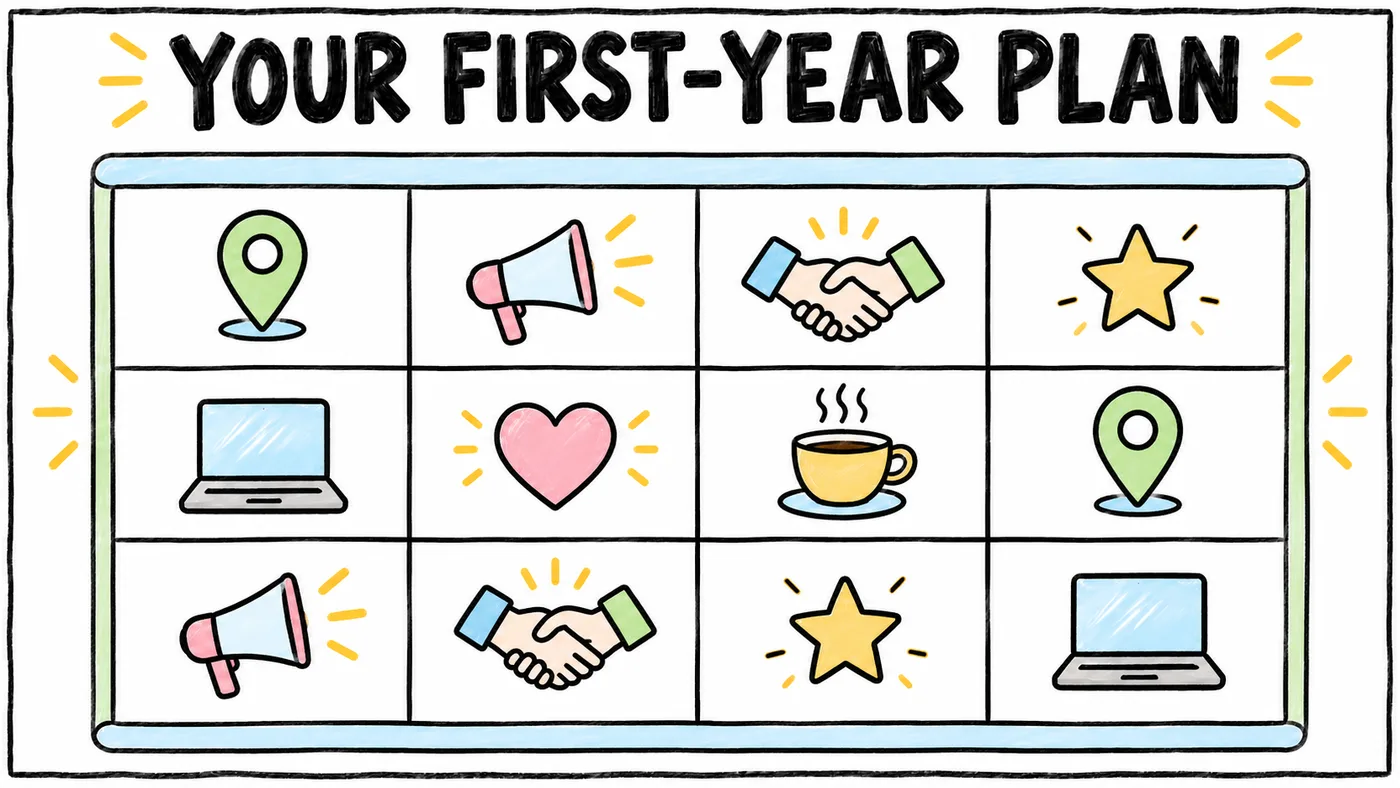
None of this needs an agency or a big budget. Most of the work is setup in the first quarter and then small, repeated tasks, which is exactly why it helps to have the year laid out ahead of time. The plan below assumes you open somewhere around month three, so adjust the months to match your own timeline from the DPC startup guide.
The 2027 DPC Marketing Plan at a Glance
| Months | Main focus | What you do | What to watch |
|---|---|---|---|
| 1 to 3 (before opening) | Get findable | Google Business Profile, website with prices, founding-member list, directory listings | Waitlist signups, profile views |
| 3 to 4 (opening) | Convert your network | Founding-member window, opening announcement, first reviews | New members per week |
| 4 to 6 | Show up locally | Talks at libraries, churches, gyms, chambers and parent groups | Signups after each talk |
| 4 to 9 | Start employer sales | Visits to small local employers and brokers | Meetings booked, employer groups signed |
| 6 to 12 | Build the referral habit | Ask every member for reviews and introductions the same way | Reviews per month, "how did you hear" answers |
| All year | Stay visible | One or two social channels, monthly profile and website updates | Calls, direction requests, website clicks |
Months 1 to 3, Get Found Before You Open
Set up your Google Business Profile
The Google Business Profile costs nothing. Google's own Business Profile page says plainly that "creating a Business Profile and listing your business on Google is free."
Google says local results are based mainly on relevance, distance and popularity, that more reviews and positive ratings can help your local ranking, and that "there's no way to request or pay for a better local ranking." That means the work is about accuracy and completeness. Use your real practice name, the most specific category that fits, your hours, your phone number and a link to your website, and verify the profile early because verification can take time.
Our guide to how patients find a DPC in 2027 goes through the profile setup step by step, along with what helps you show up when people ask ChatGPT or Perplexity for a practice nearby.
Put your prices on your website, in text
Every channel in this plan eventually sends someone to your website, where they decide whether to join. A new DPC website needs four things on day one, which are what direct primary care is, what your membership costs, where you are and how to sign up. Write the prices as text rather than inside an image so search engines and answer engines can read them, and keep the signup button easy to find on a phone.
If you are still setting a price, the DPC pricing report shows what practices listed in our DPC Finder charge. For the site itself, start with how to build a direct primary care website.
Start a founding-member list
Start with people who already know you, including former patients you are allowed to contact, colleagues, neighbors and friends of friends. A simple interest form on your website, shared personally, turns that goodwill into a list. When you are ready to take commitments, our guide to running a DPC founding-member presale covers waitlists, deposits and what to promise.
Before you contact former patients from a previous employer, check your employment contract and any notice rules in your state, because that question is about your agreement and your old practice's records more than about marketing.
List your practice in DPC directories
Some people who already know they want direct primary care look in a directory. Submit your practice to the DPC Finder and the other directories in our comparison of DPC finders, and keep your name, address and phone number identical everywhere.
Months 3 and 4, Open With Your Own Network
Opening month is when your personal network does the heavy lifting. Send a personal note to everyone on your interest list, open your founding-member window with a real end date, and ask your first members whether they would be willing to leave an honest review once they have been seen.
Treat the opening as news. Local papers, neighborhood newsletters and community Facebook groups may cover a new doctor in town.
Months 4 to 6, Show Up in Your Community
Local talks take time to arrange. A thirty-minute talk on a topic people already worry about, like managing blood pressure, what to do about a sick child at night, or how to use an HSA with a membership, lets people meet you before they ever visit your website.
Good places to ask include public libraries, churches, gyms, chambers of commerce, Rotary and Lions clubs, school parent groups, and senior centers. Bring a one-page handout with your prices and a QR code to your signup page, and ask the host whether you can collect emails from people who want the slides.
Keep the talk educational rather than a pitch, because a room that leaves feeling helped will remember who helped them.
Months 4 to 9, Start Talking to Local Employers
Employers already pay for a large share of DPC memberships, at least among practices on Hint's platform. Hint Health's Trends in DPC 2026 report found that nearly 60% of active memberships on its platform were paid for by an employer in 2025, up from 18% in 2017.
Employers are also looking for relief. KFF's 2026 Employer Health Benefits Survey, released October 22, 2026, found that average family premiums rose 5% in a year and that workers' own share rose 9%.
KFF put the average family premium at $28,303 in 2026, with workers paying $7,471 of it.
In your first year, start small, especially with local businesses whose owners you already know. Local benefits brokers are worth a coffee too, because one broker can introduce you to several employers. Set a capacity limit for each employer before you sign anything, so one contract cannot fill your panel overnight. Our guide on how to sell direct primary care to employers covers pricing models, contracts and what employers want to see in reports.
Since January 1, 2026, DPC memberships can work alongside HSAs within IRS limits, which makes the pitch easier for employers with high-deductible plans. Our DPC HSA rules for 2027 explain the fee cap and what it covers.
How Do You Get Referrals and Reviews for a New DPC? (Months 6 to 12)
DPC patients tend to be enthusiastic about their care. Hint's DPC Patient Experience Benchmark, which surveyed 1,534 patients at 12 DPC clinics, reported a Net Promoter Score of 85, as Medical Economics summarized in February 2026. The job is to make it easy for happy members to tell someone.
Ask everyone, the same way, every time
Pick one moment to ask, such as a follow-up message a week after a member's first visit, and ask every member then. That consistency matters for more than habit. Google's contributed content policy prohibits offering incentives for reviews and selectively asking only happy customers.
The FTC's final rule on fake reviews and testimonials (16 CFR Part 465) also bans incentives conditioned on a review expressing a particular sentiment, and undisclosed reviews written by a business's officers or managers. It can also reach undisclosed reviews they ask employees, agents or immediate relatives to write.
Get written permission before you share a patient's story
Member stories make the best marketing, and they need care. If HIPAA applies to your practice, 45 CFR 164.508 requires a signed authorization before you use or disclose protected health information for marketing, so a patient's quote, photo or story on your website or social accounts needs their written permission first. It is a sensible standard even if you are unsure whether HIPAA applies.
When you reply to reviews, never confirm that the reviewer is a patient or mention their care. The reasons, and the HHS settlements behind them, are in our guide to how patients find a DPC.
Think before you reward referrals
A free month for every friend a member brings in sounds harmless, and it can raise legal questions. The federal anti-kickback statute (42 U.S.C. 1320a-7b) applies to remuneration tied to business paid for by federal health care programs, and some states have their own patient-brokering or fee-splitting rules. Our DPC anti-kickback and Stark basics explain where the lines sit. This post is general information, not legal advice, so talk to a health care attorney in your state before you offer any referral reward. A sincere thank-you note costs nothing and carries no risk.
Which Social Media Should a DPC Practice Use?
Use the one or two channels your patients already open every day, and do them well. Pew Research Center's 2026 social media fact sheet, based on a survey conducted January 30 to June 18, 2026, reports these shares of U.S. adults using each platform in its topline results:
| Channel | Share of U.S. adults who use it (2026) | Good fit for a DPC when |
|---|---|---|
| YouTube | 84% | You can answer common patient questions in short videos |
| 70% | Your patients are in local community and parent groups | |
| 51% | You are comfortable showing the practice and the people in it | |
| TikTok | 37% | You enjoy quick, casual explainers |
| 31% | You are reaching employers and brokers | |
| Nextdoor | 18% | Your neighborhood is active there |
Short videos of the doctor answering a real question, like "Can I use my HSA for a membership?" or "What does a DPC visit look like?", can be reused on your website's FAQ page.
How Much Should a New DPC Spend on Marketing?
We could not find a reliable published figure for what a new DPC practice typically spends on marketing, so this plan does not give you one. The better approach is to work backward from your own numbers. Use the DPC break-even calculator to see how many members you need, and decide how much you can spend to reach them. Our post on DPC startup financing for 2027 covers where that money can come from.
Several of the most useful channels cost only your time, including the Google Business Profile, directory listings, local talks, employer visits and organic social posts. For paid channels, these published prices and limits help you set a ceiling.
| Channel | What it costs, per its own published terms | Source |
|---|---|---|
| Google Business Profile | Free to create and list | |
| Google Ads | You set an average daily budget, and you are never charged more than 30.4 times that in a billing period | Google Ads Help |
| USPS Every Door Direct Mail | Retail postage per piece, with 200 to 5,000 pieces per day per ZIP Code at retail | USPS |
USPS lists EDDM Retail postage at $0.26 per piece, so 1,000 postcards cost $260 in postage before printing.
Google's own example of the Ads limit is a $10 daily budget, where the most you would pay is $304 for the month.
Start paid channels only after the free ones are running, and give each one a fixed trial budget and a clear question to answer, such as "did this bring in at least a few members in 60 days?"
How Fast Should a New DPC Expect to Grow?
Growth can continue for years. Hint's Trends in DPC 2026 report, looking at practices active on its platform for at least six months, found median panel growth of 89% by year one, 250% by year two and 386% by year three, measured from month six. In Hint's own example, a practice with 45 members at month six would reach about 218 members by year three at the median rate.
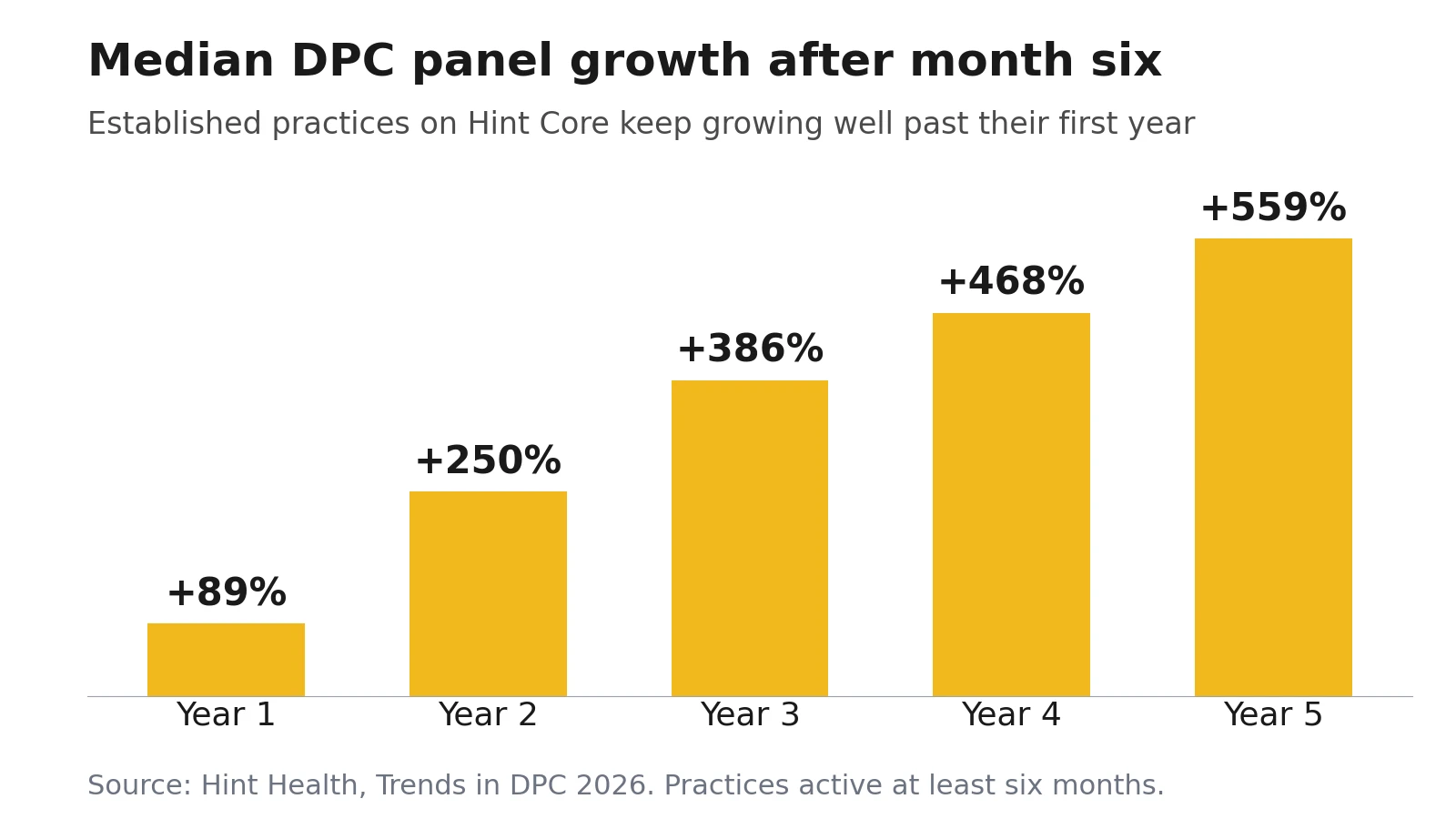
Hint also found that practices in a network grew faster, with median panel growth of 465% by year three compared with roughly 330% for independent practices, and it credits shared referral channels and marketing reach. For a solo practice, the lesson is that marketing is a multi-year habit, not a launch campaign. Use your break-even panel size to decide how much runway you need while the panel builds.
What Should You Measure Each Month?
Check three numbers each month.
- Where new members came from. Add a required "How did you hear about us?" question to your enrollment form, with options that match the channels in this plan.
- Google Business Profile performance. Google's performance view shows calls, direction requests, website clicks and the searches that led people to your profile.
- Reviews and referrals per month. Count them, and check that you are asking every member the same way.
At the end of each quarter, move time away from the channel that brought in the fewest members and toward the one that brought in the most. Our list of DPC metrics to track in 2027 covers the operational numbers that sit alongside these.
Keeping the Plan Running After You Get Busy
The plan above is easy to start and hard to keep up, because the steady parts, like review requests, employer follow-ups, listing updates and checking where members came from, live between your EHR, your billing tool and your inbox rather than inside any one of them. Those are the tasks that slip once the panel is full of real patients who need you.
That is the work Tabflows does. We are a dedicated tech team that connects the tools a DPC clinic already uses, like the EHR, membership billing and messaging, so follow-ups get sent, tasks land with the right person and patient context sits in one place. If your first-year plan depends on steady new enrollments, keeping the follow-through running in the background lets you spend your time where it matters most, with your members.
FAQs
What should a first-year DPC marketing plan include?
A first-year DPC marketing plan should cover six things in order. Set up a verified Google Business Profile and a website that states your prices in plain text before you open, sign founding members from your existing network, give local talks, start employer conversations, build a fair and consistent review and referral habit, and post on one or two social channels your patients already use. Measure each month and drop what is not bringing in members.
How much should a new DPC spend on marketing?
There is no sourced industry figure for what a new DPC should spend, so set your budget from your own break-even math. Several core channels cost nothing but time. Google says creating a Business Profile is free and that there is no way to pay for a better local ranking. Paid channels can be capped, since Google Ads never charges more than 30.4 times your average daily budget in a billing period, and USPS lists Every Door Direct Mail retail postage at $0.26 per piece.
How fast does a new DPC practice grow?
Hint Health's Trends in DPC 2026 report, based on practices on its platform for at least six months, found median panel growth of 89% by year one, 250% by year two and 386% by year three, measured from month six. In Hint's own example, a practice with 45 members at month six would reach about 218 members by year three at the median rate.
Can a DPC practice offer patients a reward for referrals or reviews?
Be careful with both. Google's contributed content policy prohibits incentives for reviews, and the FTC's rule on consumer reviews and testimonials (16 CFR Part 465) bans incentives conditioned on a review expressing a particular sentiment. Referral rewards can raise anti-kickback questions if any of your patients are covered by a federal health care program, and some states have their own rules, so check with a health care attorney before offering one.
Which social media platforms should a DPC practice use?
Pick one or two where your patients already are. Pew Research Center's 2026 survey found that 84% of U.S. adults use YouTube, 70% use Facebook, 51% use Instagram, 37% use TikTok and 18% use Nextdoor.
Should a new DPC market to employers in its first year?
Yes, if you have room on your panel. Hint Health found that nearly 60% of active memberships on its platform were paid for by an employer in 2025, and KFF's 2026 Employer Health Benefits Survey found family premiums rose 5% in a year. Start with small local employers you already know, and set a capacity limit per employer so one contract cannot fill your panel overnight.