Where Should a New DPC Practice See Patients in 2027?
Most new direct primary care practices in 2027 should start in the smallest space that still lets them see patients well, then grow into a lease once the membership pays for it. The five common paths are a traditional lease, a sublease from another practice, shared or part-time space, an executive suite or medical coworking room, and starting with home visits or telehealth before taking any space at all. Medical office rent hit a record national average in 2026, so the cheapest square foot is often the one you don't sign for until your panel is ready.
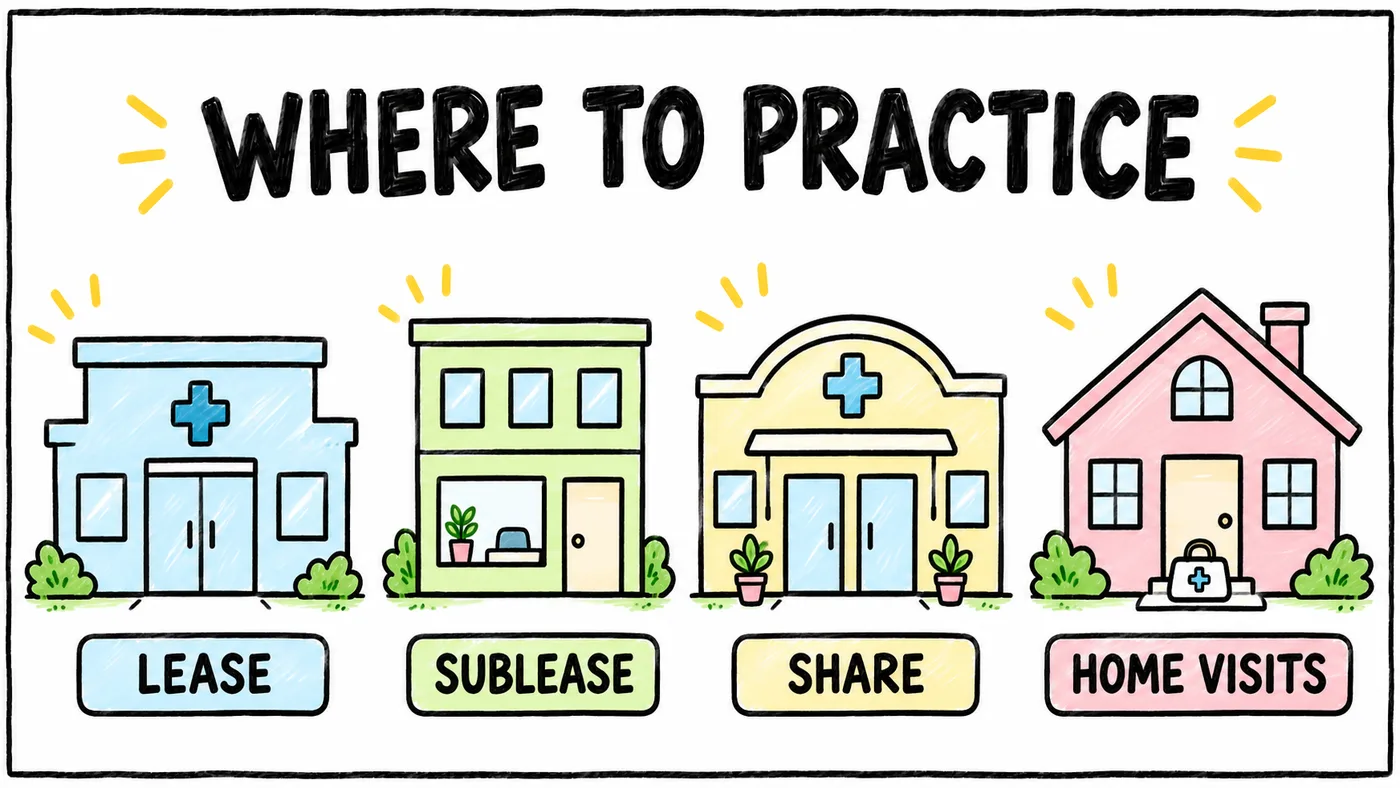
The right choice depends less on what looks like a "real" clinic and more on three numbers you can estimate now, which are how many members you expect in your first year, how many of them you will see in the same hour, and how much monthly overhead your membership revenue can carry. If you are still building those numbers, the DPC startup cost calculator and the break-even calculator are good places to start, and our guide to how much it costs to start a DPC shows how rent fits into the whole budget.
How Much Does Medical Office Space Cost in 2027?
Medical office rent kept climbing in the first half of 2026 while new construction slowed. CBRE's Q2 2026 medical outpatient report says the average asking rent rose 1.3% year over year to a record high, and the full report puts vacancy at 9.8%.
CBRE's national average asking rent was $25.46 per square foot in Q2 2026.
Cushman & Wakefield's 2026 Vital Signs report tells the same story from a different sample. Across the top 50 US markets, occupancy reached 92.5% and average rent rose 1.9% year over year, with the fastest growth in suburban and Sun Belt markets in Florida, North Carolina and Texas. It also reports that construction activity fell 10% year over year.
Cushman & Wakefield's top 50 market average was $26.64 per square foot.
Commercial rent in the US is quoted per square foot per year, so it helps to translate those averages into a monthly number you can put in a budget. At the CBRE average, here is what two example suite sizes would cost before taxes, insurance, common area charges and utilities.
An 800 square foot suite works out to about $20,368 a year, or about $1,697 a month.
A 1,200 square foot suite works out to about $30,552 a year, or about $2,546 a month.
Treat those as a sanity check, not a quote. Rents in your own neighborhood can sit far above or below a national average, and the same building can quote very differently depending on whether the lease is gross (the landlord pays most operating costs) or net (you pay your share of taxes, insurance and maintenance on top of base rent). Always ask a broker which kind of number you are looking at.
Your Five Options at a Glance
Each path trades cost against control. The table below is meant to help you rule options in or out quickly before you tour anything.
| Space | Upfront cost | Commitment | Control over the space | Best for | Watch out for |
|---|---|---|---|---|---|
| Traditional lease | Highest (deposit, build-out, furniture, equipment) | Usually multi-year | Full | Practices with a clear panel forecast or a converting patient base | Personal guarantees, build-out overruns, net lease charges |
| Sublease from a practice | Low to moderate | Tied to the master lease | Partial | Doctors who want a real clinic feel without a long lease | Landlord consent, schedule conflicts, referral relationships |
| Shared or part-time rooms | Low | Often month to month | Limited to your hours | Testing a neighborhood or starting part-time | Storage, privacy, signage, patient confusion about hours |
| Executive suite or medical coworking | Low | Monthly or by the half day | Limited | A bridge while your panel grows | Clinical use limits, sinks, medication and sharps storage |
| Home visits and telehealth first | Lowest | None | Your own schedule | Doctors with a small, local starting panel | Licensure in the patient's state, lab draws, drive time |
Should You Sign a Traditional Lease?
A lease makes sense when you can see the panel that will pay for it. Doctors converting an existing practice, or those who bring a waitlist from a previous job, often reach that point quickly. Our guides to converting a practice to DPC and leaving employed medicine for DPC cover how to estimate that early panel honestly.
If you go this route, a few lease terms matter more for a small DPC than for a typical office tenant:
- Term and options. A shorter initial term with options to renew protects you if growth is slower than planned, while still giving you the right to stay.
- Build-out and tenant improvement allowance. Exam rooms need sinks, plumbing and sometimes extra electrical work, so ask who pays and get the landlord's contribution in writing.
- Use clause. Make sure the lease and local zoning both allow medical use, including drawing blood and dispensing medication if you plan to do either.
- Accessibility. The lease should say who is responsible for which accessibility features (more on this below).
- Personal guarantee. A landlord may ask a new practice owner to guarantee the lease personally, so read that clause with your attorney before you sign.
If you are financing the build-out, our sibling guide to DPC startup financing in 2027 walks through loans and lines of credit, and insurance for a new DPC practice covers the property and liability coverage most landlords will ask to see.
Can You Sublease or Share Space With Another Practice?
Subleasing an exam room, or renting a few half days a week from an established practice, is a way to start without a long lease. You get a finished clinic, a waiting room and often a sink and lab corner on day one, and the other practice gets help covering its rent.
The paperwork deserves more care than a handshake. A master lease may require the landlord's written consent before a tenant can sublease, so ask for it early. Then put the arrangement in a signed agreement that names the rooms, the exact days and hours, the rent, who supplies what, and how either side can end it.
There is one federal rule worth knowing if referrals are involved. The federal Anti-Kickback Statute's space rental safe harbor at 42 CFR 1001.952(b) protects a lease that is in writing and signed, covers all the space and lists exact schedules for part-time use, runs at least one year, sets rent in advance at fair market value without regard to referrals or business generated between the parties, and rents no more space than is reasonably necessary for the commercially reasonable business purpose of the rental. It applies to business paid by Medicare, Medicaid and other federal health care programs, so it matters most when you sublease from a practice that bills those programs and could send patients your way, or the reverse.
Our guide to Anti-Kickback and Stark basics for DPC explains when these rules touch a membership practice. This article is general information, not legal advice, so have a health care attorney review any sublease with a possible referral source.
Executive suites and medical coworking
Executive suites and medical coworking spaces rent furnished rooms by the month or by the half day. You skip the build-out, the furniture and the multi-year commitment, which can be the right trade while your panel grows, but check the price per square foot against a lease.
Before you sign, walk the space with a clinical eye. Confirm the operator allows medical use, that there is a sink with running water in or near your exam room, that you can lock up medications and dispose of sharps properly, and that patients can talk with you without being overheard in a shared hallway.
Can You Start a DPC With Home Visits or Telehealth First?
Yes, and for a doctor with a small local starting panel it is often the leanest way to begin. With no rent at all, every early membership goes toward your own salary and supplies, and you can choose your eventual office based on where your members actually live.
A home visit or telehealth start still needs a few pieces of real infrastructure:
- A medical license in each state where your patients are located during a telehealth visit, and a plan for prescribing (see telehealth prescribing rules for 2027).
- A secure place to store supplies, vaccines and any medications you dispense, plus a way to transport them safely (our guide to dispensing medications and labs in DPC covers the rules).
- A lab draw plan, whether that is drawing in the home or sending patients to a patient service center.
- A scheduling and routing system that accounts for drive time, which our house call logistics guide covers in detail.
- A business mailing address, which you may want to keep separate from home for privacy.
You can pair this with a founding member presale, so you know how many members are waiting before you commit to a lease.
What Does the ADA Require for a DPC Exam Room?
Accessibility is easy to skip when picking a space quickly, and it applies whether you lease, sublease or share. The Department of Justice's guide, Access to Medical Care for Individuals with Mobility Disabilities, says private medical offices are covered by Title III of the ADA as places of public accommodation. It also says any private entity that owns, leases or operates a public accommodation is responsible, and that tenants and landlords are equally responsible, though the lease can divide the work between them. Often the tenant handles the exam rooms and reception area and the landlord handles shared spaces like common restrooms.
The same guide describes what makes an exam room accessible:
- An entry door with a clear opening of at least 32 inches when opened to 90 degrees, with hardware that doesn't require tight grasping or twisting.
- A clear floor space of at least 30 by 48 inches next to the exam table so a patient using a wheelchair can transfer from the side, and ideally space on both sides of the table.
- Enough room for a 180 degree turn, either a 60 inch circle or a 60 by 60 inch T-shaped space.
- An exam table that adjusts down to about 17 to 19 inches from the floor.
You don't need every room to meet all of this. The DOJ guide says one accessible exam room may be enough in a small practice, which is useful when you are choosing between two similar suites. Pick the one where at least one room can fit a lowering table with clear space beside it.
The HHS accessible equipment rule
The Department of Health and Human Services added a separate equipment rule under Section 504 for recipients of federal financial assistance, which the DOJ guide notes can include Medicare and Medicaid payments. Under 45 CFR 84.92, recipients had to have at least one accessible exam table and one accessible weight scale within two years after July 8, 2024, and at least 10 percent (and no fewer than one) of each type of diagnostic equipment they use must meet the federal accessibility standards. Whether this rule reaches a particular DPC depends on whether the practice receives federal financial assistance, so ask your attorney, but an adjustable table and an accessible scale are sensible purchases for any new office either way.
Help paying for accessibility work
The IRS offers two tax benefits that can offset the cost. The Disabled Access Credit is a credit for eligible small businesses, and the architectural barrier removal deduction is open to businesses of any size. The IRS says the two can be used together in the same year when the expenses qualify for both.
A business qualifies for the Disabled Access Credit if it earned $1 million or less or had no more than 30 full-time employees in the previous year.
The IRS says the barrier removal deduction allows up to $15,000 a year for qualified expenses.
What Else Does a DPC Office Need?
Beyond accessibility, a few federal rules shape the rooms themselves.
Handwashing and clean areas. If anyone on your team could be exposed to blood, OSHA's bloodborne pathogens standard requires a written exposure control plan and handwashing facilities that are readily accessible to employees. It also bans eating and drinking in work areas where exposure is reasonably likely and keeps food out of refrigerators where specimens are stored, so plan a separate break spot and a separate fridge for lab samples. This becomes especially relevant once you hire your first medical assistant.
Privacy in the layout. If your practice is a HIPAA covered entity, HHS guidance on incidental uses and disclosures says the Privacy Rule doesn't require eliminating every chance of being overheard, but it does require reasonable safeguards. In a small or shared space that means a check-in spot where other patients can't read a screen or a sign-in sheet, exam room doors that close, and a locked place for any paper records.
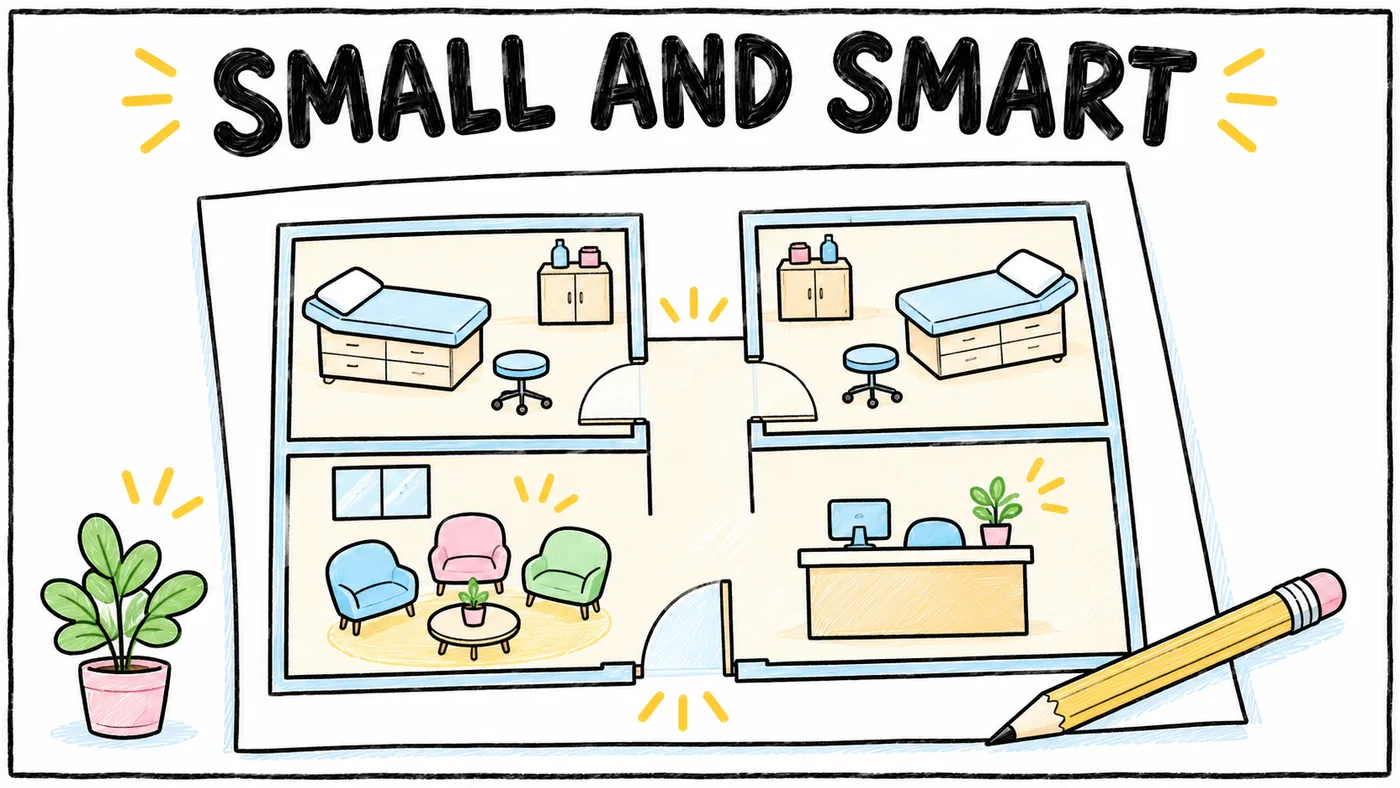
Room count. Two exam rooms let you room the next patient while finishing a note, and a small waiting area, a restroom, a lab and supply corner and a place to work can round out the space. Size the space by how many patients you will see in the same hour, and check the panel capacity calculator to see how many members that schedule can support.
A Simple Way to Decide
If you're torn between options, work through these questions in order:
- How many members do you realistically expect by month six and month twelve? A presale or waitlist turns this from a guess into a number.
- What monthly rent can that panel carry while still paying you? Run it through the break-even calculator with rent as a fixed cost.
- Where do your first members live and work? Office location is a marketing decision too, so pick a spot your first members can reach easily.
- Can at least one room meet the accessibility basics above?
- How hard is it to leave if you outgrow the space or it doesn't work?
One answer is a sequence rather than a single choice. Start with home visits, telehealth or a few half days in someone else's clinic, sign a sublease or coworking agreement when the schedule fills, and take a lease of your own when the panel and the state rules for your practice are settled. You can also browse practices near you in the DPC Finder to see where other direct primary care clinics have set up.
Keeping the Work Organized Across Locations
Whichever path you choose, a young DPC often ends up working from more than one place at once, with a home visit in the morning, telehealth at lunch and a half day in shared rooms in the afternoon. The tools you rely on (your EHR, membership billing and patient messaging) each hold part of the picture, and follow-ups tend to slip in the gaps between them when you are on the move.
Tabflows is a dedicated tech team that connects the tools your clinic already uses, so the work between them gets done. Lab follow-ups, refill tasks and patient context land in one place your whole team can see, wherever each of you is working that day. When you are ready to choose your space, start with the numbers, pick the smallest room that serves your patients well, and grow into the rest.
FAQs
How much does medical office space cost in 2027?
CBRE's Q2 2026 report put the average US medical outpatient building asking rent at a record $25.46 per sq. ft., up 1.3% from a year earlier, and Cushman & Wakefield's 2026 Vital Signs report put the top 50 market average at $26.64 per sq. ft. Commercial rent is quoted per sq. ft. per year, so a 1,200 sq. ft. suite at the CBRE average works out to roughly $30,552 a year, or about $2,546 a month, before any extra charges for taxes, insurance and maintenance. Your local market can be well above or below these averages.
Do I need an office to start a DPC practice?
Not on day one. A direct primary care doctor can start with home visits, telehealth or a few half days in shared space, then sign a lease once the panel is large enough to pay for it. You still need somewhere to store supplies and medications, a lab draw plan, a business address, and a medical license in every state where your telehealth patients are located.
Can I sublease space from another doctor for my DPC?
Yes, subleasing an exam room or a few half days a week from another practice is a way to start. Get the landlord's written consent if the master lease requires it, put the schedule and rent in a signed agreement, and set the rent at fair market value. If either side bills Medicare, Medicaid or another federal program and could refer patients to the other, the federal space rental safe harbor at 42 CFR 1001.952(b) is worth reading with a health care attorney.
What does the ADA require for a DPC exam room?
A private medical office is a public accommodation under Title III of the ADA, and both tenants and landlords are responsible for compliance. Federal guidance describes an accessible exam room as having a door with at least 32 inches of clear width, a clear floor space of at least 30 by 48 inches beside the exam table, a 60 inch turning space, and ideally an exam table that lowers to about 17 to 19 inches from the floor. One accessible exam room may be enough for a small practice.
How big should a DPC office be?
Two exam rooms, a small waiting area, a restroom, a lab and supply corner and a place to work can be enough. Count your rooms by how many patients you expect to see in the same hour, not by how many members you have.
Is an executive suite or medical coworking space a good option for DPC?
It can be a good bridge. Executive suites and medical coworking spaces rent furnished rooms by the month or by the half day, so you trade a long lease and build-out for a short commitment. Before you sign, confirm the space allows clinical use, has a sink in or near the exam room, lets you store medications and sharps securely, and gives patients enough privacy to talk.