The Short Answer
A sustainable direct primary care schedule protects three things on purpose: visit length, a fixed home for inbox and message work, and real coverage when you are away. The AAFP's 2026 DPC data brief, the best recent survey data we found, reports a 42.3-hour average week with 24.5 hours face to face across all its respondents (about half of them in DPC), and 54% of those practicing in DPC run visits longer than 30 minutes. A small peer-reviewed study and AAFP survey data both find less burnout in DPC, but a third of DPC respondents in the 2026 brief still name the work between visits as a major challenge, so the schedule has to make room for that work instead of hoping it fits in the evenings.
This guide walks through what the research says about DPC and burnout, how to set visit length, how to keep messages from eating your nights, how to arrange coverage, and which numbers tell you the schedule is starting to slip. It is written for physicians planning a DPC and for owners whose practice has grown faster than their calendar.
Do Direct Primary Care Physicians Have Less Burnout?
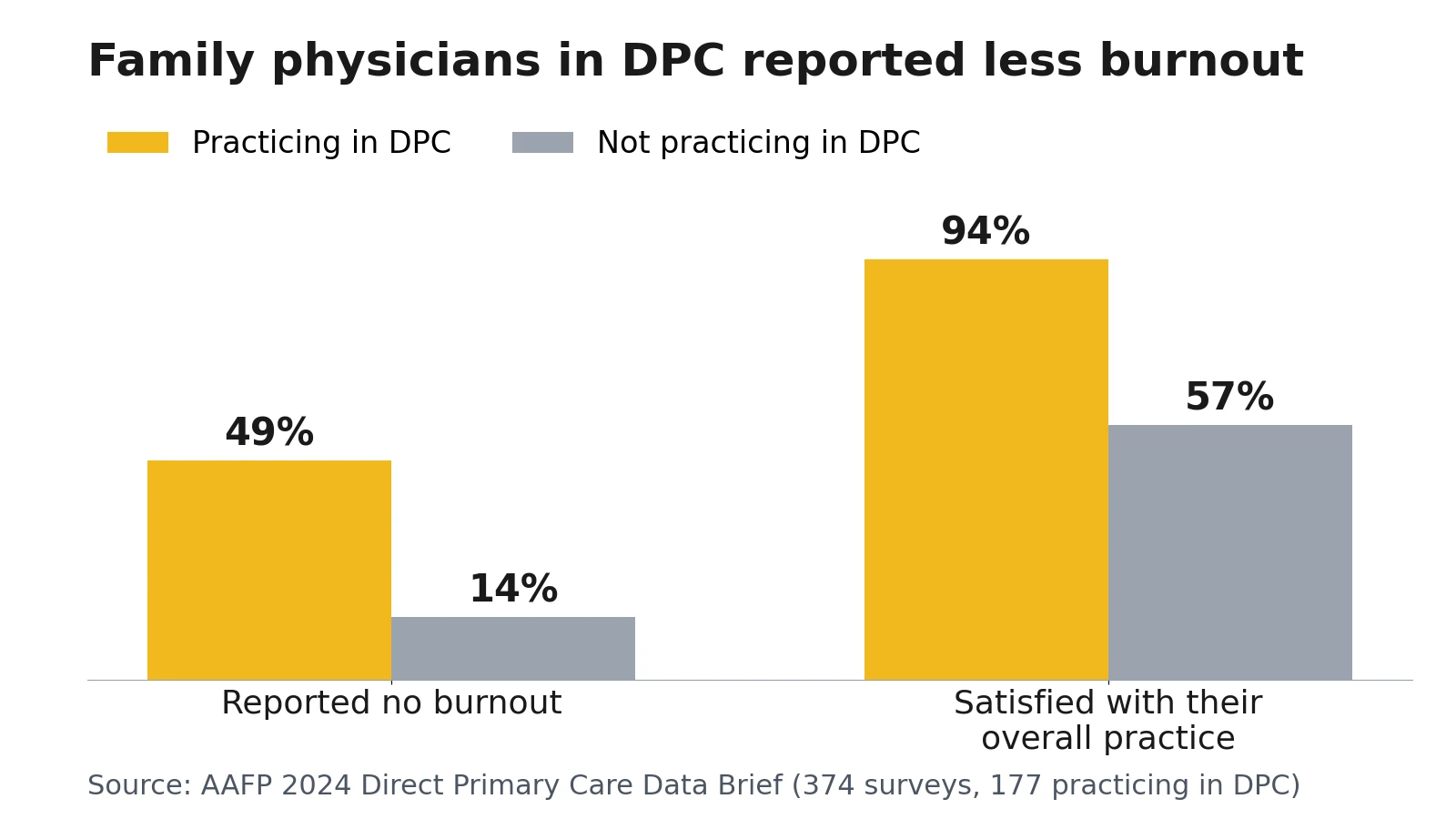
The data we found says yes, with some honest caveats about sample size. In the AAFP's 2024 direct primary care data brief, drawn from 374 surveys, 177 of them from physicians practicing in DPC, 49% of DPC physicians reported no burnout, compared with 14% of respondents not practicing in DPC. Among those reporting burnout, 12% of the DPC group felt it once a week or more, against 46% of the non-DPC group, and 94% of DPC respondents were satisfied with their overall practice, compared with 57% of the others. That survey went to family physicians practicing in or interested in DPC and to a random sample of AAFP members, so its non-DPC group includes physicians interested in switching and isn't a cross-section of family medicine.
A peer-reviewed study adds weight. In a 2025 Southern Medical Journal study, researchers used the Stanford Professional Fulfillment Index with primary care physicians in the southeastern United States and found that DPC physicians had significantly lower burnout and higher fulfillment than non-DPC physicians, despite working a similar number of hours a week. The DPC group saw fewer patients per day and was more likely to own its practice. The authors note their sample was small and call for larger studies. The study describes its sample as a select population, and its lead author is a practicing DPC family physician and practice owner.
The newer AAFP numbers point the same way. In its 2026 DPC data brief, which surveyed physicians about 2025, 89% of respondents practicing in DPC said the model improved their work-life balance and 86% reported an improvement in paperwork burden. The one exception the brief names is earnings, with 47% reporting lower earnings in DPC and only 30% higher.
For context on the wider profession, a national study in Mayo Clinic Proceedings, surveying US physicians between October 2023 and March 2024, found that 45.2% reported at least one symptom of burnout in 2023, down from 62.8% in 2021. Physicians remained at higher risk of burnout than other US workers. The two surveys measure burnout differently, so these percentages don't compare directly with the AAFP figures.
Why the hours may matter less than where they go
That Southern Medical Journal finding is the useful one for scheduling. DPC physicians in that study were not working fewer hours. They saw fewer patients a day and more often owned their practice. The abstract doesn't show how those hours were spent, so this is our reading: the total on the timesheet may matter less than whether the work inside it is work you chose and planned for. A sustainable DPC week is one where messages, results and refills have a home in the day, so they stop spilling into the night.
How Long Should DPC Appointments Be?
Longer visits are common in DPC, and the survey data shows it. In the AAFP's 2026 brief, 54% of respondents practicing in DPC reported an average in-office appointment longer than 30 minutes, and only 4% reported an average under 15 minutes. Across all respondents, the average week held 40 patient encounters and 42.3 work hours, up from 39.8 hours in 2024, with 24.5 hours of face-to-face contact. Respondents averaged 13 e-visits a week, up from 11 in 2024 and 7 in 2022.
There is no single right visit length, because it depends on your panel's age, how much chronic disease you manage and how much of your care happens by message. A few practical choices make the decision easier:
- Set a standard length and a long length. A standard slot covers most follow-ups and acute visits, and a longer slot covers annual physicals, new members and complex chronic care. Decide in advance which visit types get which slot so you are not making the call fresh every time someone books.
- Hold same-day time open. In the AAFP's 2024 brief, 98% of DPC practices included same-day appointments in the membership fee. Keep a few slots each day that only same-day requests can fill, so the promise holds when the schedule gets busy.
- Budget time for virtual visits. If you see members by video or phone, put those visits on the calendar as real appointments rather than squeezing them between in-person visits.
- Leave buffer after long visits. A long visit that runs over pushes every later appointment back, and that time comes out of your lunch or your evening.
The reason DPC panels are small comes down to time math. A 2023 simulation in the Journal of General Internal Medicine estimated that a primary care physician would need 26.7 hours a day to deliver guideline-recommended preventive, chronic and acute care to a panel of 2,500 adults, including 3.2 hours a day for documentation and inbox management. With team-based care the estimate fell to 9.3 hours a day, which the authors still called excessive. A smaller panel is how DPC makes that math work, and it is worth running your own numbers through the DPC panel capacity calculator before you set an enrollment cap.
How Do You Keep the Inbox From Taking Over Your Evenings?
The work between visits can break a primary care schedule, in DPC and outside it. A study of 142 family physicians, using data from July 2013 to June 2016, in Annals of Family Medicine found they spent 5.9 hours of an 11.4-hour workday in the EHR, including 1.4 hours after clinic hours, and inbox management alone took 85 minutes a day, or 23.7% of their EHR time. The study was in a traditional health system, not DPC, but desk work that follows physicians home is exactly the kind of load DPC is meant to lighten, and the AAFP's 2026 brief lists reduced administrative burden (91%) among the reasons physicians choose DPC.
Message volume also grew. Across 366 health systems, a study in the Journal of the American Medical Informatics Association found that patient messages rose to 157% of their prepandemic average during 2020, and each additional patient message was linked to 2.32 more minutes of EHR time per day. And the source of messages matters. A 2019 Health Affairs study found that messages generated by the EHR itself made up almost half of the 243 weekly in-basket messages physicians received, and receiving more than the average number of those system messages was associated with a 40% higher probability of burnout.
DPC is not immune. In the AAFP's 2026 brief, 33% of respondents practicing in DPC named nonvisit care burden as a major challenge. Direct access by text and phone is part of what members pay for, and the 2024 brief found 98% of DPC practices included phone, text or consults in the fee, so the goal is not fewer messages. The goal is a system where each message lands in the right place and gets finished.
Give messages a home in the day
- Block inbox time on the calendar. Two short blocks a day, one late morning and one at the end of clinic, give messages a predictable home and keep you from answering between every visit. Keep a separate route for urgent daytime messages so they don't wait for the next block.
- Let a team member sort first. In most cases a registered nurse can triage incoming messages. Where your state allows, a medical assistant can take messages, handle scheduling, pass along routine refill requests and gather what you need by following protocols you set that call for no independent clinical judgment, and anything clinical goes to a licensed clinician. California, for one, says medical assistants "may not independently perform telephone triage." Our guide to hiring your first DPC medical assistant covers that role.
- Turn off the noise. Since system-generated messages were the biggest single source in the Health Affairs study, review which automatic notifications your tools send you and route or switch off the ones that do not need a physician.
- Use one shared, compliant channel. A team inbox that everyone can see beats texts scattered across personal phones. Our guide to HIPAA-compliant texting for DPC covers the setup.
Set after-hours expectations in writing
After-hours access is a promise, and promises are easier to keep when they are specific. We found no recent national figure for how many DPC practices offer 24-hour access. The most direct survey we found is small and old, a 2015 survey published in the Kansas Journal of Medicine in which 76% of the 38 responding DPC practices reported 24-hour access and 82% offered email access to the physician.
Whatever you offer, write it down in the membership agreement and the welcome message:
- which channel members should use for an urgent question after hours, and which channel is for routine requests
- how quickly members can expect a reply during business hours and after hours
- which requests wait for the next business day, such as refills, forms and scheduling
- that a medical emergency means calling 911, not sending a message
Clear wording protects members, and it protects your evenings, because members who know a refill request waits until morning have less reason to send it at 10 p.m. Our guide to what a DPC membership covers when something urgent happens goes deeper on emergency language.
Who Covers a DPC Practice When the Doctor Is Away?
A schedule you can sustain for years includes weeks off, and weeks off need someone to answer members. The AAFP's 2026 brief found that 69% of DPC practices ran a single physician panel, so for a single-physician practice coverage is something to build on purpose rather than something a large group provides. The one survey we found is small and limited to pediatrics. In a 2023 national survey of 73 pediatric DPC physicians, published in Cureus in 2025, 44% said another pediatric DPC doctor covers in-person needs during vacation, 16% another DPC doctor, 21% others in the practice and 11% a locum. Another 32% said no one does, and they send families to urgent care or the emergency department when clinically indicated. The answers add to more than 100%. That shows what these physicians do, not what works best, so the options below are structures to consider rather than a ranking.
| Coverage option | How it works | What to settle first |
|---|---|---|
| Reciprocal coverage with another DPC physician | Two nearby practices cover each other's members during vacations and conferences | Chart access, a written agreement, malpractice coverage for the covering physician, how messages are routed |
| Part-time or locum physician | A physician works your days while you are away | Licensing in your state, credentialing with your malpractice carrier, how they will be paid |
| Nurse practitioner or physician assistant on your team | Your NP or PA keeps seeing members, with a physician on call as your state requires | Your state's scope of practice and supervision or collaboration rules |
| Reduced service week | The practice stays open for messages and urgent questions only, with routine visits paused | Clear notice to members, what counts as urgent, who answers |
Whichever you choose, a few things hold across the options. The covering clinician generally needs a license, or a recognized exception or registration, in the state where the member is located, which also matters for any visit by phone or video (see our guide to telehealth prescribing rules for 2027). They need chart access set up to fit HIPAA, which HHS says doesn't call for a business associate agreement when information goes to another provider for treatment, and a written coverage agreement is the place to record it. And your malpractice carrier should confirm in writing that the covering work is insured. Rules on scope of practice and supervision differ by state, so check with your state's medical and nursing boards and have a healthcare attorney review the arrangement.
Members should hear about coverage before you leave, not when they message. A short note a week or two before, saying who is covering, how to reach them and what will wait until you return, keeps trust intact. If you are thinking about a longer-term partner for coverage, our guides to adding an NP or PA to a DPC and when to hire a second DPC physician walk through the next step.
How to Build Your Week, Step by Step
We found no research-backed template for the ideal DPC week, so the most useful thing we can offer is an order of decisions. Make them in this order, because each one constrains the next.
- Decide your total hours first. Pick the number of clinical and desk hours you want to work in a normal week, and treat it as a limit the schedule has to respect. The AAFP's 42.3-hour average is a reference point, not a target.
- Block the work around visits. Put inbox blocks, results review and charting time on the calendar before you open any appointment slots, because this is the work that otherwise moves into the evening.
- Hold same-day slots. Reserve the time that only same-day requests can fill.
- Fill the rest with visit types. Assign standard and long slots, and decide how many new-member visits you can take in a week without crowding out the members you already have.
- Protect one non-clinical block. Owners also run a business, and payroll, hiring and planning need a home in the week too.
- Plan time away for the year. Put vacations and conferences on the calendar early and arrange coverage for each.
Then set your enrollment cap from the schedule, rather than setting a panel target and hoping the schedule stretches to fit. Our guide to DPC break-even panel size shows how to check that the cap also pays the bills.
Warning Signs Your Schedule Is Drifting
A schedule can break slowly, one extra hour of evening messages at a time. A few numbers make the drift visible early. Check message response time and days to the next routine visit weekly, and the rest monthly:
| What to track | How to measure it | What a rising number tells you |
|---|---|---|
| Hours of desk work after clinic | Your own log, or your EHR's activity report if it offers one | Messages and charting have outgrown their blocks |
| Message response time | Hours from a member's message to the reply | Nonvisit work is crowding the day |
| Same-day requests that wait | Same-day requests not seen that day, divided by all same-day requests | Routine work is taking the slots members value most |
| Days to the next routine visit | Days until the third open routine slot | Demand is outrunning your hours |
| Total weekly hours | Your calendar plus desk time | The week has grown past what you planned |
Our guide to DPC metrics to track in 2027 covers how to keep these alongside your business numbers. When two or three of them rise together, the fix is structural, and it can mean a nurse, or a medical assistant working within what your state allows, who sorts messages, an NP or PA who takes on part of the panel, closing enrollment for a season, or a second physician.
Much of that lost time sits in small handoffs between tools, such as a lab result that needs a message, a refill that needs a chart check, or a member question that needs context from three places. Tabflows is a dedicated tech team that connects the tools your clinic already uses, like your EHR, billing and messaging, so follow-ups, tasks and patient context live in one place and the work between them gets finished during the day. It is one way to give the inbox a home that does not depend on your evenings.
The Bottom Line
The evidence so far links DPC with less burnout, in AAFP survey data and one small peer-reviewed study, and with more satisfaction in the AAFP data and more fulfillment in that study. It does not yet show longer careers. That advantage is not automatic. It depends on a schedule that protects visit length, gives messages a home in the day, sets clear after-hours expectations, and arranges coverage so time off is real. Build the week around those things first, set your panel size from the schedule, and check a few numbers each month so you can add help before the hours creep back.
If you are still planning your practice, our 2027 guide to starting a DPC practice and our guide to leaving employed medicine for DPC cover the decisions that come before the schedule.
FAQs
Do direct primary care physicians have less burnout?
The research so far points that way, with limits. In the AAFP's 2024 DPC data brief, 49% of physicians working in a DPC practice reported no burnout, compared with 14% of those not in DPC. A 2025 study in the Southern Medical Journal, using the Stanford Professional Fulfillment Index with primary care physicians in the southeastern United States, found significantly lower burnout and higher fulfillment in DPC physicians even though they worked a similar number of hours a week. The authors called their sample small and asked for larger studies, so treat the finding as encouraging rather than settled.
How long are DPC appointments?
In the AAFP's 2026 DPC data brief, which surveyed physicians about 2025, 54% of respondents practicing in DPC reported an average in-office appointment longer than 30 minutes, and only 4% reported an average under 15 minutes. Across all 313 respondents, about half of them practicing in DPC, the averages were 40 patient encounters and 42.3 work hours a week, with 24.5 of those hours face to face.
How many hours a week do DPC physicians work?
The AAFP's 2026 DPC data brief reports an average physician workweek of 42.3 hours across all 313 respondents, 53% of whom practice in DPC (the brief gives no DPC-only figure), up from 39.8 hours in 2024, with 24.5 hours of direct face-to-face patient contact. The brief does not break down the other 17.8 hours. It lists nonvisit care burden among the top challenges, named by 33% of respondents practicing in DPC.
How should a DPC practice handle after-hours texts and calls?
Decide in writing what after-hours access means before members join, then put it in the membership agreement and the welcome message. Say which channel to use for urgent questions, how quickly members can expect a reply, which requests wait for the next business day, and that a true emergency means calling 911. In most cases a registered nurse can triage routine daytime messages. Where your state allows, a medical assistant can sort them by protocols you set that call for no independent clinical judgment, sending anything clinical to a licensed clinician, and a shared team inbox keeps one person from carrying every thread.
Who covers a solo DPC practice when the doctor is on vacation?
Options include a reciprocal arrangement with another DPC physician nearby, a part-time or locum physician, or a nurse practitioner or physician assistant within your state's scope of practice rules. Whoever covers generally needs a license, or a recognized exception or registration, in the state where the patient is, chart access set up to fit HIPAA and recorded in a written coverage agreement, and malpractice coverage that includes the covering work. Tell members ahead of time who is covering and how to reach them, and have a healthcare attorney and your malpractice carrier review the arrangement.
What are the warning signs that a DPC schedule is not sustainable?
Watch for hours of charting and messages after clinic, a growing gap between when members write and when they hear back, same-day slots taken by routine follow-ups, and a workweek that keeps creeping past what you planned when you opened. Track message response time and days to the next routine visit weekly, and the rest monthly, so you can add help, close enrollment or change the schedule before the strain shows up in your health or your members' experience.