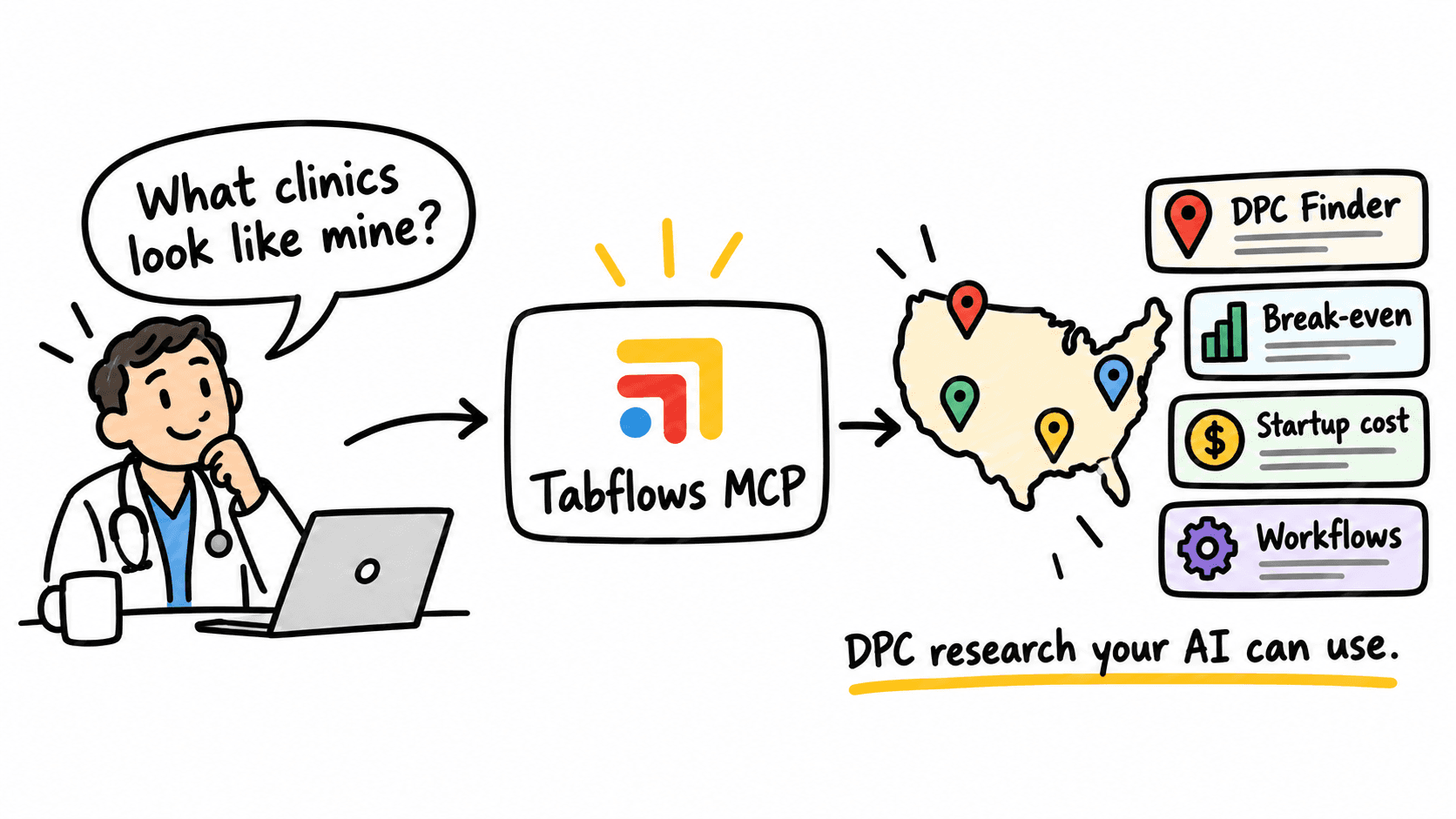
DPC has different questions
Direct Primary Care is not normal healthcare operations with a nicer website.
The model is different. The patient relationship is different. The economics are different. The software stack is usually lighter, messier, and more founder-driven than a big health system stack.
That means the AI questions are different too.
A DPC founder is not only asking, "What does this diagnosis mean?"
They are asking:
- Who else is practicing near me?
- How crowded is this market?
- How many members do I need to break even?
- Which tools should I start with?
- Which workflows are going to burn staff time?
- Where do patient messages, billing, labs, forms, and follow-ups actually land?
- What should I fix before I hire another person?
Those are not generic healthcare questions.
They are DPC operating questions.
Agents can do the first pass
The old version of DPC research was a scavenger hunt.
Search Google. Open a few directories. Find clinic websites. Compare cities. Guess whether the clinic is pure DPC, hybrid, concierge, employer-focused, or something else. Build a spreadsheet. Lose the spreadsheet. Start again.
An AI agent can make that first pass faster, but only if it has a reliable source to ask.
That is where MCP helps.
The Tabflows MCP server lets compatible AI agents query structured Tabflows tools instead of scraping random pages.
For DPC, that starts with the DPC Finder.
What the Tabflows MCP gives a DPC agent
The Tabflows MCP server gives an AI agent access to practical DPC context:
- search the DPC Finder
- read specific practice listings
- look up workflows
- list integrations
- quote pricing
- estimate startup costs
- run break-even math
- search public Tabflows pages
- return demo and sign-up links
That is not a replacement for judgment.
It is a better starting point.
The agent can collect the map. The human still decides what the map means.
Better market research
If you are opening a DPC in Tennessee, Texas, Ohio, or California, the first useful question is not abstract.
It is: who is already there?
With DPC Finder exposed through MCP, an agent can ask for clinics in a state, city, or region, then group the answer by location or practice model.
That makes the first pass of market research less annoying.
It also makes the next question better.
Instead of "what is DPC?" you can ask, "show me practices near me that look similar to the clinic I want to build."
That is a much more useful conversation.
Better workflow decisions
DPC clinics usually do not fail because they picked one wrong app.
They struggle because work keeps landing between apps.
The patient message comes in through Spruce. The chart lives in Elation, Cerbo, Atlas.md, or another EHR. Billing context is somewhere else. Lab results arrive in a portal. The follow-up is a task. The policy is in a doc. The patient expects one calm answer.
That is the workflow problem Tabflows is built around.
An MCP server makes those workflows easier for agents to understand.
Not because the agent becomes the clinic.
Because it can finally ask the clinic's operating layer better questions.
A practical DPC prompt set
Once you add the Tabflows MCP server to a compatible AI tool, try prompts like:
Find DPC practices in Austin and summarize the local market.Estimate startup costs for a solo DPC opening with lean overhead.Run break-even math for a clinic charging $85 per member per month with $32,000 in monthly overhead.What Tabflows workflows would help a DPC reduce message follow-up chaos?Find integrations related to patient communication and explain how they fit into DPC operations.
Those are the kinds of questions DPC founders and operators actually ask.
And they are much better when the agent can call the source.
The point is not more AI
DPC does not need more software theater.
It needs less busywork, fewer dropped handoffs, and better visibility into the work around the patient relationship.
MCP is useful when it serves that goal.
For Direct Primary Care, the win is simple: give AI agents a better map of the clinics, workflows, tools, and economics that shape the model.
Then let the human build the practice.
FAQs
How can a DPC clinic use MCP?
A DPC clinic can use MCP through compatible AI tools to search structured context, compare markets, inspect workflows, estimate practice economics, find integrations, and pull public Tabflows information without relying on stale web guesses.
What makes MCP useful for Direct Primary Care?
DPC questions are often operational: where clinics are located, what the market looks like, what workflows save staff time, what tools need to connect, and what economics make the model work.
Can the Tabflows MCP server search the DPC Finder?
Yes. The Tabflows MCP server exposes DPC Finder search and practice details so compatible AI agents can query DPC clinics by state, city, practice name, model, and slug.