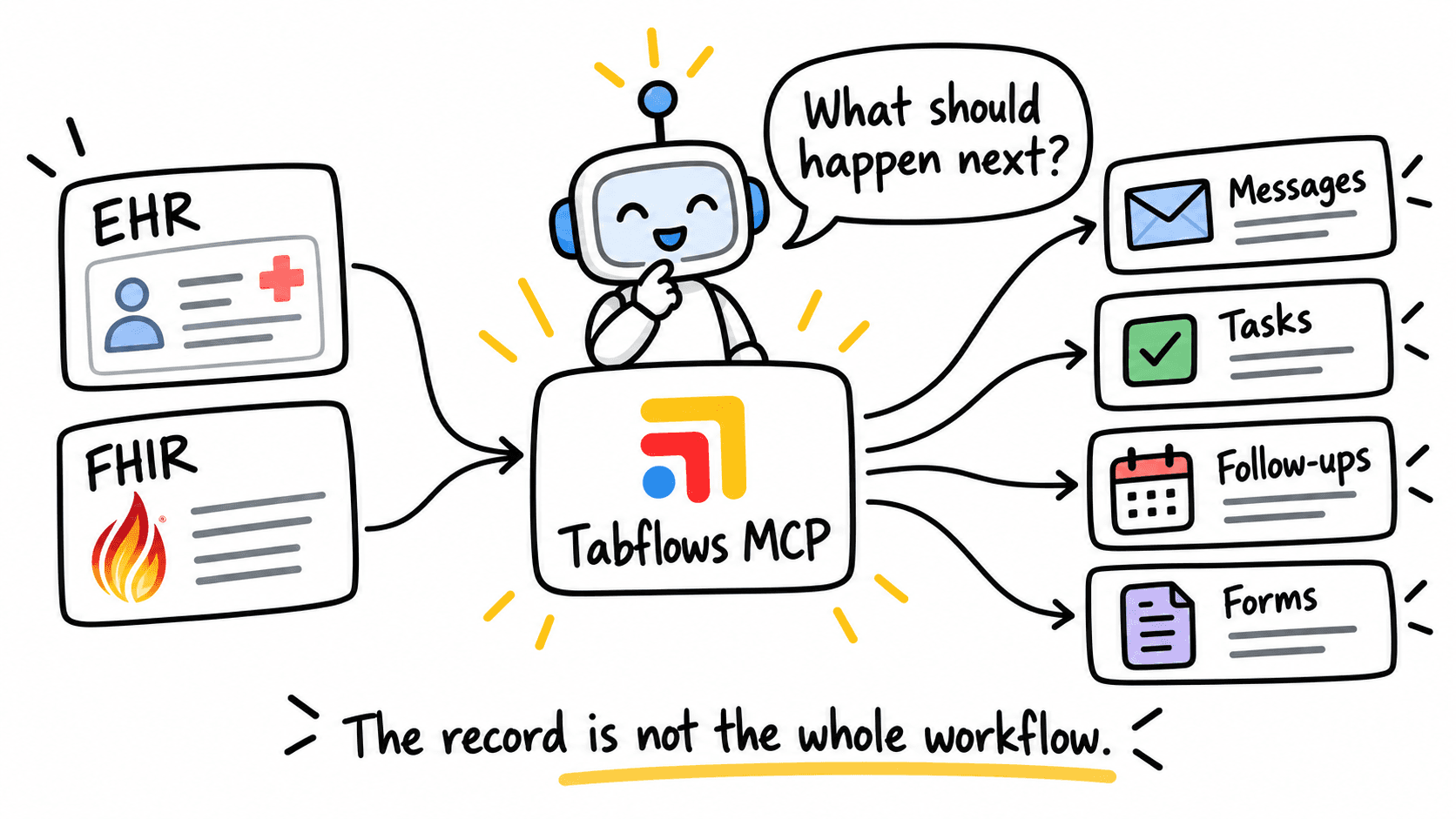
The missing context is usually operational
Most healthcare AI conversations start with the record.
That makes sense. The record matters. Diagnoses, meds, allergies, labs, visit notes, history - all of that belongs in the clinical system of record.
But clinic work does not only happen inside the record.
It happens in the inbox. The calendar. The billing system. The lab portal. The form tool. The fax pile. The spreadsheet someone made because the official workflow did not quite cover reality.
That is why a healthcare AI MCP cannot only think about clinical data.
The record explains the patient.
The workflow explains what happens next.
Clinical data and workflow context are different
Clinical data is the chart: problems, medications, labs, allergies, notes, immunizations, orders, and encounters.
Workflow context is the living state of the work: the open task, the unanswered message, the lab that needs review, the patient waiting on a form, the handoff from the MA to the provider, the billing question that blocks scheduling, the follow-up that should happen in three weeks.
An AI agent can have a perfect summary of the chart and still miss the real operational problem.
If the patient asked a scheduling question inside Spruce, the invoice detail sits in Hint, the refill history is in the EHR, and the next step needs provider approval, the useful question is not just "what does the chart say?"
It is "what is the safest next action for this clinic workflow?"
What a healthcare AI MCP should return
A useful MCP server should not flood the model with everything.
It should expose tools that answer specific questions.
For workflow-heavy healthcare AI, that can mean:
- what workflows exist
- which system owns the source of truth
- what context is required before an action
- which integrations are involved
- which tasks are open, blocked, waiting, or done
- what pricing or practice rules apply
- what public documentation supports the answer
- what the agent should not do without human review
That last part matters.
Healthcare AI does not get safer by being more confident. It gets safer when the tools define the boundary clearly.
Where Tabflows sits
Tabflows is built for the work around the record.
That means patient context, tasks, follow-ups, handoffs, messages, forms, admin loops, and the tools a DPC or private clinic already uses.
The Tabflows MCP server makes that context easier for compatible AI agents to query.
An agent can search the DPC Finder, inspect workflows, list integrations, quote pricing, run DPC calculators, and find public Tabflows pages without inventing an answer from stale search results.
That is the point.
The agent should not have to guess what Tabflows does, what a workflow supports, what a DPC calculator returns, or where the relevant page lives.
It should ask the tool.
This is not clinical autopilot
Healthcare AI gets weird when people make it sound like the model is the doctor, the administrator, the biller, and the practice manager.
That is not the practical path.
The practical path is narrower and more useful.
Let the record stay the record. Let the clinician stay the clinician. Let the system expose the context an AI agent is allowed to use. Then let the agent help with the work that wastes the most time: finding context, comparing options, drafting the next step, and keeping loops from disappearing.
That is where workflow context matters.
It does not make the agent magical.
It makes the answer less detached from how the clinic actually works.
The better healthcare AI question
The old AI question was: "Can it summarize this?"
The better question is: "Can it see enough context to help the team move the work forward?"
For a clinic, that difference is everything.
A summary is useful.
A next step is better.
And a next step grounded in the right tools, workflows, and boundaries is where healthcare AI starts to feel practical.
That is why healthcare AI needs MCP.
And it is why healthcare MCP needs workflow context, not just clinical data.
FAQs
Why does healthcare AI need workflow context?
Clinical data can explain the patient, but workflow context explains the next step: who owns the task, what system created it, what is waiting, and what needs to happen before the loop is closed.
Does a healthcare AI MCP replace the EHR?
No. The EHR remains the clinical record. A healthcare AI MCP can expose context and tools around the record, such as messages, workflows, follow-ups, integrations, calculators, and public operational knowledge.
How does Tabflows use MCP for workflow context?
The Tabflows MCP server exposes DPC Finder data, workflows, integrations, pricing logic, calculators, public pages, and links so compatible AI agents can answer operational questions from structured source context.