
How Much Does It Cost a DPC Practice to Process Membership Payments?
At published flat rates, collecting a monthly direct primary care membership by credit or debit card costs from 2.1% + $0.30 per card payment at Atlas.md to 3.5% + $0.15 for a card-on-file payment on Square, and ACH bank debit rates run from 0.6% + $0.25 per ACH payment on Hint Scale, the lowest percentage, to 1.1% + $0.30 per ACH payment at Atlas.md, often with a cap. On a typical membership, the bank payment costs a fraction of the card payment, but it confirms more slowly and can be disputed by the patient for longer. The rest of your cost comes from failed payments, chargebacks and whether you pay a flat rate or interchange plus.
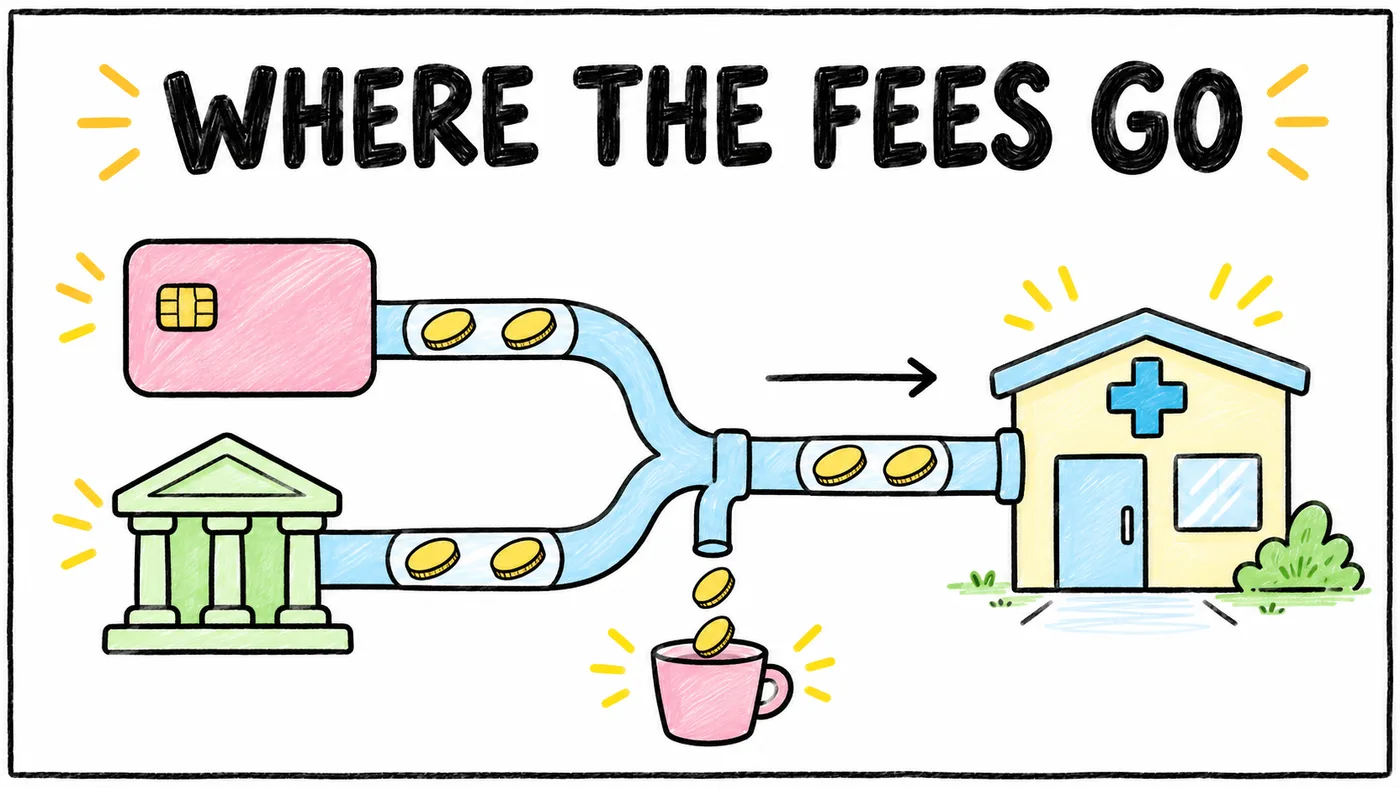
To make that concrete, we used the median retail DPC membership from Hint's Trends in DPC 2026 report for 2025 as our example payment.
That median was $99 a month.
At Stripe's published rate of 2.9% + $0.30 per card payment, one payment of that size costs $3.17 to collect. The same payment by ACH Direct Debit through Stripe costs $0.79. That gap looks small on one payment and large over a year. A practice with 400 members paying monthly runs about 4,800 payments a year, and the difference between all-card and all-ACH at Stripe's standard rates adds up quickly.
All-card collection would cost about $15,221 a year at Stripe's card rate, against about $3,802 all by ACH.
None of this means card payments are a mistake. Patients like them, they confirm instantly, and members may pay with an HSA card now that DPC arrangements can be HSA-compatible (our DPC HSA rules for 2027 guide covers the caps). It means the payment mix deserves the same attention as your price.
What Stripe, Square, Hint and Atlas.md Charge for DPC Memberships
Here is what each processor or DPC platform lists on its own pricing page, and the Checked row or each cell says when we read it. These are standard published rates. Stripe and Square both invite larger businesses to ask about custom rates.
The two processors:
| Stripe | Square | |
|---|---|---|
| Card rate | 2.9% + $0.30 per successful domestic card transaction (stripe.com/pricing, November 4, 2026) | 3.3% + $0.30 per online or invoice card payment on Square Free |
| Card rate on a higher plan | 2.9% + $0.30 per online or invoice card payment on Square Plus or Premium | |
| Card on file or keyed in | 3.5% + $0.15 per manually entered or card-on-file payment, on every plan | |
| Keyed-in card surcharge | 0.5% per manually entered card payment, on top of the card rate (stripe.com/pricing, November 4, 2026) | |
| ACH rate | 0.8% per ACH Direct Debit payment (stripe.com/pricing, November 4, 2026) | 1% per ACH bank transfer paid by invoice |
| ACH with two-day settlement | 1.2% per ACH Direct Debit payment with two-day settlement (stripe.com/pricing/local-payment-methods, November 4, 2026) | |
| ACH minimum | $1 per ACH invoice payment at least | |
| ACH cap | $5 per ACH Direct Debit payment at most (stripe.com/pricing, November 4, 2026) | $10 per ACH invoice payment at most, on Square Plus or Premium |
| Failed or returned ACH | $4 per failed ACH Direct Debit payment (stripe.com/pricing/local-payment-methods, November 4, 2026) | |
| Card dispute | $15 per card dispute received (stripe.com/pricing, November 4, 2026) | |
| Checked | squareup.com/help/us/en/article/5068-what-are-square-s-fees, November 4, 2026 |
The two DPC platforms:
| Hint | Atlas.md | |
|---|---|---|
| Card rate | 3% + $0.30 per card payment on Launch | 2.1% + $0.30 per card payment (atlas.md/pricing, November 4, 2026) |
| Card rate on Pro | 2.75% + $0.30 per card payment on Pro | |
| Card rate on Scale | 2.6% + $0.30 per card payment on Scale | |
| Amex surcharge | 1% per American Express payment, on top of the card rate | |
| ACH rate | 1% + $0.25 per ACH payment on Launch | 1.1% + $0.30 per ACH payment (atlas.md/pricing, November 4, 2026) |
| ACH rate on Pro | 0.75% + $0.25 per ACH payment on Pro | |
| ACH rate on Scale | 0.6% + $0.25 per ACH payment on Scale | |
| ACH cap | $5 per ACH payment at most | |
| Failed or returned ACH | $7.50 per ACH return on Pro | $5 per failed ACH payment (atlas.md/help/view/additional-atlasmd-fees, November 4, 2026) |
| Card dispute | $7.50 per dispute or chargeback on Pro | $15 per card chargeback, plus the processing fee (atlas.md/help/view/additional-atlasmd-fees, November 4, 2026) |
| Works with Tabflows | Hint integration | Atlas.md integration |
| Checked | hint.com/pricing, November 4, 2026 |
A blank cell means the pages we read list no such fee. Hint lists its return and dispute fees in the plan builder for the Pro plan, so ask about them for Launch and Scale on a demo call, and Square's pages list neither fee, so ask Square too. Stripe Billing, if you build memberships on Stripe directly, adds 0.7% of billing volume on its pay-as-you-go plan on top of the card and ACH rates above.
On one $99 monthly membership payment, those standard rates come to these fees, before Amex, international, dispute and failed-payment fees:
- Square, card on file: $3.62
- Hint Launch, card: $3.27
- Stripe, card: $3.17
- Hint Pro, card: $3.02
- Atlas.md, card: $2.38
- Atlas.md, ACH: $1.39
- Hint Launch, ACH: $1.24
- Square, ACH by invoice: $1, its minimum, since 1% of the payment comes to less
- Hint Pro, ACH: $0.99
- Stripe, ACH: $0.79
Two details in these fees matter more than they first appear. Square's help center groups card on file payments with manual entry at its highest card rate, so ask which rate your monthly charges to a saved card would fall under. And on most platforms, the fixed per-payment fee (the part after the plus sign) is charged every month, so it weighs more on a low monthly price than on a high one.
For a deeper look at the billing tools themselves, including family plans and employer invoicing, see our DPC membership billing software comparison.
Interchange Plus vs Flat Rate, Which Is Cheaper for a DPC Practice?
Every card payment carries an interchange fee that the card network sets and that flows to the bank that issued the patient's card. Visa's own regulations and fees page explains that merchants never pay interchange directly. Instead, merchants negotiate and pay a "merchant discount" to their financial institution, and Visa says processing services may be included in that rate.
Flat rate pricing rolls all of that into one number, like Stripe's 2.9% + $0.30 per card payment. You pay the same rate whether a patient uses a basic debit card or a premium rewards card. It is simple, predictable and easy to model in a break-even calculator.
Interchange plus pricing passes through the actual interchange on each payment and adds a fixed markup. Visa's published interchange table, with rates effective April 18, 2026, lists recurring card-not-present consumer credit at 1.53% plus 5 cents for most cards and 2.30% plus 5 cents for Visa Signature Preferred and spend-qualified Visa Infinite cards, with lower rates in its separate performance tiers. Network fees and the processor's markup come on top of that, so your all-in rate is higher than interchange alone.
Debit cards are where the gap is widest. For large banks, federal rules at 12 CFR 235.3 cap debit interchange at 21 cents plus 0.05% of the payment, and issuers that meet the Federal Reserve's fraud-prevention standards can add one more cent. On a flat rate plan, a debit payment costs you the same as a credit payment. On interchange plus, you keep most of that difference.
That debit cap is also in motion. On October 26, 2026, the Eighth Circuit affirmed a decision vacating the 21-cent cap and sent it back to the Federal Reserve to set a new fee structure, effective once the court issues its mandate. The rule is still printed in the eCFR as of late October 2026, so watch for the Federal Reserve's next step in 2027.
When to ask for interchange plus
Flat rate pricing is a sensible place to start while your panel is small. Once your monthly volume grows, it is worth asking for a quote. Stripe's pricing page lists interchange plus as part of its custom packages for businesses with large volume, and Square's payments pricing page invites larger businesses to ask about custom rates.
Square sets that threshold at $250,000 a year in processing, and the 400-member example above processes nearly twice that.
A practice that size is well past the point where a pricing conversation makes sense. If your billing runs inside a DPC platform like Hint or Atlas.md, the rate is set by the platform's plan, so compare the fee line when you compare plans, the same way you compare features.
Why ACH Costs Less, and What It Costs When an ACH Payment Fails
ACH Direct Debit pulls the payment straight from the patient's bank account. There is no card network in the middle, which is why the fees are lower and often capped. It suits monthly memberships well because the amount is the same every month.
The trade-offs are timing and disputes. Stripe's ACH Direct Debit documentation says a payment can take up to 4 business days to confirm success or failure. It also says patients can generally dispute a debit from a personal account for up to 60 calendar days, and that those disputes are final and cannot be contested through the ACH network. Atlas.md's fee page says the same in plain terms, that clinics cannot challenge ACH chargebacks.
Failed ACH payments also carry their own fee, and it varies by vendor.
Stripe charges $4 per failed ACH payment, Atlas.md charges $5 per failed ACH transaction, and Hint lists a $7.50 ACH return fee with its Pro plan.
So a bank account that fails every month can cost more than a card would have. The fix is usually simple. Verify the account at signup (Stripe lists instant bank account validation as a separate fee), remind members a few days before the draft when the amount changes, and move a member to a card after a second failure.
Employers are the other big ACH use case. Hint's Trends report says employer-sponsored memberships reached nearly 60% of memberships in its data for 2025, and an employer paying one monthly invoice for many employees is a natural fit for bank transfer. If you are building employer contracts, our guide to selling DPC to employers covers the billing side.
What Happens When a Monthly Membership Payment Fails?
A failed card payment isn't always a patient trying to leave. It can be an expired or replaced card, a temporary hold or a low balance, and your billing tool may retry it on its own.
Stripe is a useful reference because it documents its behavior in detail:
- Automatic card updates. Stripe's card documentation says it works with the card networks to update saved cards when a bank issues a replacement, and that this is widely supported for US Visa, Mastercard, American Express and Discover cards.
- Smart retries. Stripe's retry documentation says Stripe recommends Smart Retries and, on new accounts, turns them on by default with up to 8 retries within 2 weeks for failed subscription payments.
- Hard declines. Codes such as a lost card, a stolen card or an incorrect number cannot be retried until the patient adds a new payment method.
- ACH retries. Stripe retries ACH Direct Debit only for insufficient funds, at most 2 times within 40 days, and only if you turn it on.
- What happens next. When retries run out you choose whether the subscription cancels, is marked unpaid, stays past due or pauses.
Other DPC platforms handle retries their own way, and many do not publish the details. Ask each vendor three questions on a demo call. How many times does it retry and over how many days? Who gets notified, the patient, the team or both? And does the membership pause, cancel or stay active while you sort it out?
The retry schedule is only half the job. A short, friendly note from the practice ("your card on file was declined, here is a link to update it") is the next step, and our membership billing decline follow-up guide walks through who should send it and when.
Can a DPC Practice Charge Patients a Credit Card Surcharge?
Where your state allows it, yes, but only on credit cards and only by following both the card network rules and your state's law. This section is general information, not legal advice, so check your state's current statute or ask a lawyer before you add a surcharge.
Card network rules
Visa's merchant surcharging Q&A sets these conditions:
- Notify your acquirer (your processor) at least 30 days before you start.
- Surcharge credit cards only. Visa debit and prepaid cards cannot be surcharged, even when the patient chooses "credit" on a terminal.
- Keep the surcharge at or below the lower of your merchant discount rate for that card or 3%.
- Disclose it at the point of entry, at the point of sale, and as a separate line on every receipt, online and in person.
Mastercard's merchant surcharge rules are similar. They allow surcharges on Mastercard credit cards only (never debit or prepaid), require notice to both Mastercard and your acquirer at least 30 days ahead, and cap the surcharge at your cost of acceptance or a maximum of 4%. Because Visa's cap is lower, a practice that takes both networks and wants one simple rule usually lands at 3% or its actual cost.
That debit rule matters more for DPC than for most businesses. Some patients pay with debit cards, and an HSA card that runs as a debit or prepaid card falls under the same rule, so a blanket surcharge on every card payment would break the network rules for those members.
State laws that ban or limit surcharges
| State | What the law says | Statute |
|---|---|---|
| Massachusetts | No seller may impose a surcharge on a cardholder who pays by credit card instead of cash or check. Cash discounts are allowed. | G.L. c. 140D, s. 28A |
| Connecticut | No person may impose a surcharge on any transaction. Discounts for other payment methods are not prohibited. | Conn. Gen. Stat. s. 42-133ff |
| Colorado | Surcharge capped at 2%, or at the actual fee you pay your processor, with required signage wording and none on cash, check or debit. | C.R.S. 5-2-212 |
| New York | You must clearly post the total price for paying by credit card, and the surcharge may not exceed what the card company charges you. | N.Y. Gen. Bus. Law s. 518 |
Visa's Q&A adds that, as of February 15, 2024, it understood Maine, Oklahoma and Puerto Rico to prohibit surcharging and Minnesota and New Jersey to have their own requirements, while noting its list may contain errors. Treat that as a reason to read your own state's statute, not as the final word. Our DPC laws by state guide is a good starting point for the rest of your state's DPC rules.
Who Should Pay the Processing Fee, the Practice or the Patient?
There is no single right answer. The choice is really about which trade-off you prefer, and it is worth deciding before you open enrollment so every member hears the same thing.
The common approaches look like this:
- Build it into the price. Set your membership with processing in mind and take every payment type at the same price. This is the simplest for members and avoids surcharge rules entirely. Our guide on how much to charge for a DPC membership walks through pricing.
- Make ACH the default. Offer bank payment first at signup and cards as the alternative. You keep the lower fee without adding any charge.
- Offer a discount for bank payment. Massachusetts' statute expressly allows cash discounts, and Connecticut's section heading says discounts are not prohibited. A small bank-payment discount reaches the same place as a surcharge with a friendlier message, but check your state's rules on how it must be offered.
- Surcharge credit cards only. Where your state allows it, follow the network rules above, skip debit and prepaid cards, and disclose it everywhere.
- Offer annual prepayment. One charge a year means one fixed per-payment fee instead of twelve.
On that last point, the savings on the $99-a-month example membership are real but modest, because only the fixed fee drops away.
Paid upfront for the year, it costs $34.75 to collect at Stripe's card rate, against about $38 for twelve monthly card payments.
If you are collecting founding-member payments before you open, the same choices apply to your presale, and our founding member presale guide covers how to set those up. Whatever you choose, keep HSA members in mind, and check with your tax advisor whether an added fee changes how a membership sits against the HSA monthly cap.
A Short Checklist Before You Choose a Processor
- Pick Stripe if you have someone technical and are comfortable building your own billing. Where it wins: recurring subscriptions with custom billing logic.
- Pick Square if you want simple invoices and payments, with no membership software to run. Where it wins: invoices paid by card, wallet or bank transfer.
- Pick Hint if you sell to employers, take eligibility files from a TPA, or want to keep your EHR and run only memberships and billing. Where it wins: employer billing and eligibility feeds; billing sold on its own, beside another EHR.
- Pick Atlas.md if you run a solo or small self-pay practice and want charting, billing, labs and an in-house pharmacy in one system at one per-provider price. Where it wins: one per-provider price with unlimited patients; an in-house pharmacy with unlimited inventory.
- What Tabflows does not do: bill memberships or charge cards; chart visits or prescribe.
Before you sign up, gather these answers from each vendor's pricing page or a demo call:
- The card rate, the ACH rate and any cap, for the plan you would actually buy
- Whether recurring or card-on-file payments carry a higher rate than online checkout
- Extra fees for Amex, international cards, failed ACH payments, refunds and disputes
- Whether the processing fee is refunded when you refund a payment (Atlas.md's fee page says it is not)
- How retries work, who is notified, and what happens to the membership after the last retry
- Whether interchange plus or custom pricing is available at your expected volume
- What the vendor needs from you before you can surcharge, if you plan to
The fees themselves are easy to compare once they sit side by side. The harder part is everything that happens after a payment fails, when the billing system flags it, someone has to notice, message the patient, update the card and close the loop. Tabflows is a dedicated tech team that connects the tools a clinic already uses, like the EHR, billing and messaging, so a declined payment turns into a follow-up with an owner and the patient's context attached instead of a line in a report that's easy to miss.
If you are still mapping out your startup costs, our DPC startup cost calculator and financing guide pair well with this one.
Sources
Checked on November 5, 2026: stripe.com/billing and squareup.com/us/en/invoices. Checked on November 4, 2026: atlas.md/pricing, squareup.com/help/us/en/article/5068-what-are-square-s-fees, hint.com/pricing, stripe.com/pricing, stripe.com/pricing/local-payment-methods, atlas.md/help/view/additional-atlasmd-fees, stripe.com/billing/pricing, squareup.com/us/en/payments/pricing and hint.com/core/find-your-price. Spot a wrong fact? Email a correction.
FAQs
How much are credit card processing fees for a DPC membership?
It depends on the processor and the plan. Our example is a $99 monthly payment, the median retail DPC membership for 2025. At published flat rates, collecting that payment by card costs from $2.38 at Atlas.md to $3.62 for a card-on-file payment on Square. Stripe's standard card rate is 2.9% + $0.30, Atlas.md lists 2.1% + $0.30 per card payment, Hint lists 3% + $0.30 per card payment on Launch and 2.75% + $0.30 on Pro, and Square's help center lists 3.5% + $0.15 for card-on-file payments on every plan.
Is ACH cheaper than credit cards for DPC memberships?
Yes, usually by a wide margin. Our example is a $99 monthly membership payment. Stripe lists ACH Direct Debit at 0.8% with a $5 cap, so that payment costs $0.79 by ACH, against $3.17 by card. Hint lists ACH at 0.75% + $0.25 on Pro and Atlas.md at 1.1% + $0.30 per ACH payment. The trade-offs are slower confirmation (Stripe says up to 4 business days), failed-payment fees from $4 at Stripe to $7.50 on Hint Pro, and a 60-day window in which patients can dispute a debit from a personal account.
Can a DPC practice add a credit card surcharge?
Where your state allows it, yes, on credit cards only and within card network rules. Visa caps a surcharge at the lower of your merchant discount rate or 3% and requires 30 days' notice to your acquirer plus disclosure at the point of entry, the point of sale and on every receipt. Mastercard caps it at 4% or your cost. Neither network allows surcharges on debit or prepaid cards. Massachusetts and Connecticut ban surcharges by statute, Colorado caps them at 2% or your actual processing fee, and New York requires posting the total card price. This is general information, not legal advice.
What is the difference between interchange plus and flat rate pricing?
Flat rate pricing charges one blended rate, such as Stripe's 2.9% + $0.30 per card payment, no matter which card a patient uses. Interchange plus passes through the actual interchange fee set by the card network for each card, then adds a fixed processor markup. Visa's published rates effective April 18, 2026 put recurring card-not-present credit interchange at 1.53% plus 5 cents for most consumer cards and 2.30% plus 5 cents for Visa Signature Preferred and spend-qualified Visa Infinite cards. Stripe and Square both offer custom pricing to larger businesses.
What happens when a DPC membership payment fails?
Stripe can retry automatically. On new accounts its Smart Retries default is up to 8 tries within 2 weeks for card payments, but it cannot retry hard declines such as a lost or stolen card until the patient adds a new card. For ACH, Stripe retries only insufficient-funds failures, at most 2 times within 40 days, and only if you turn those retries on. When retries run out you choose whether the membership cancels, stays past due or pauses, and a quick, friendly message to the patient is the next step.
Can patients pay DPC memberships with an HSA card?
Since January 1, 2026, DPC arrangements can be HSA-compatible within a monthly fee cap, so members may pay with HSA cards. Card network rules forbid surcharging debit and prepaid cards, so if an HSA card runs as a debit or prepaid card, you cannot add a surcharge to it. See our guide to DPC HSA rules for 2027 for the fee caps.