Can a nurse practitioner open a DPC practice?
Yes. A nurse practitioner can open and own a direct primary care practice in most of the country, and in 27 states plus the District of Columbia the NP can do it without any physician agreement, because those states give NPs full practice authority. In the other 23 states an NP can often still own the practice, but state law requires a collaborative agreement or physician supervision, and a few states have ownership rules that need careful structuring. The DPC model itself (a flat monthly membership, no insurance billing) works the same way for NPs as it does for physicians.
This guide walks through what decides the answer in your state for 2027, including practice authority, collaboration rules, the corporate practice of medicine, your state's DPC statute, Medicare, HSAs, DEA registration and malpractice. There is also a short section for physician assistants. It is general information, not legal advice, and every state rule here should be confirmed with your board and a health care attorney before you commit to a lease or a launch date. For the full launch sequence, see how to start a DPC practice in 2027.
Which states give nurse practitioners full practice authority?
The American Association of Nurse Practitioners (AANP) State Practice Environment map sorts every state into one of three groups. The page was last updated in May 2026, and the counts below come straight from the map's state data as we read it on October 29, 2026.
- Full practice. NPs can evaluate patients, diagnose, order and interpret tests, and start and manage treatment, including prescribing controlled substances, under the exclusive licensure authority of the state board of nursing.
- Reduced practice. State law limits at least one element of NP practice and requires a career-long regulated collaborative agreement with another health provider, or limits the setting of one or more elements of practice.
- Restricted practice. State law requires career-long supervision, delegation or team management by another health provider.
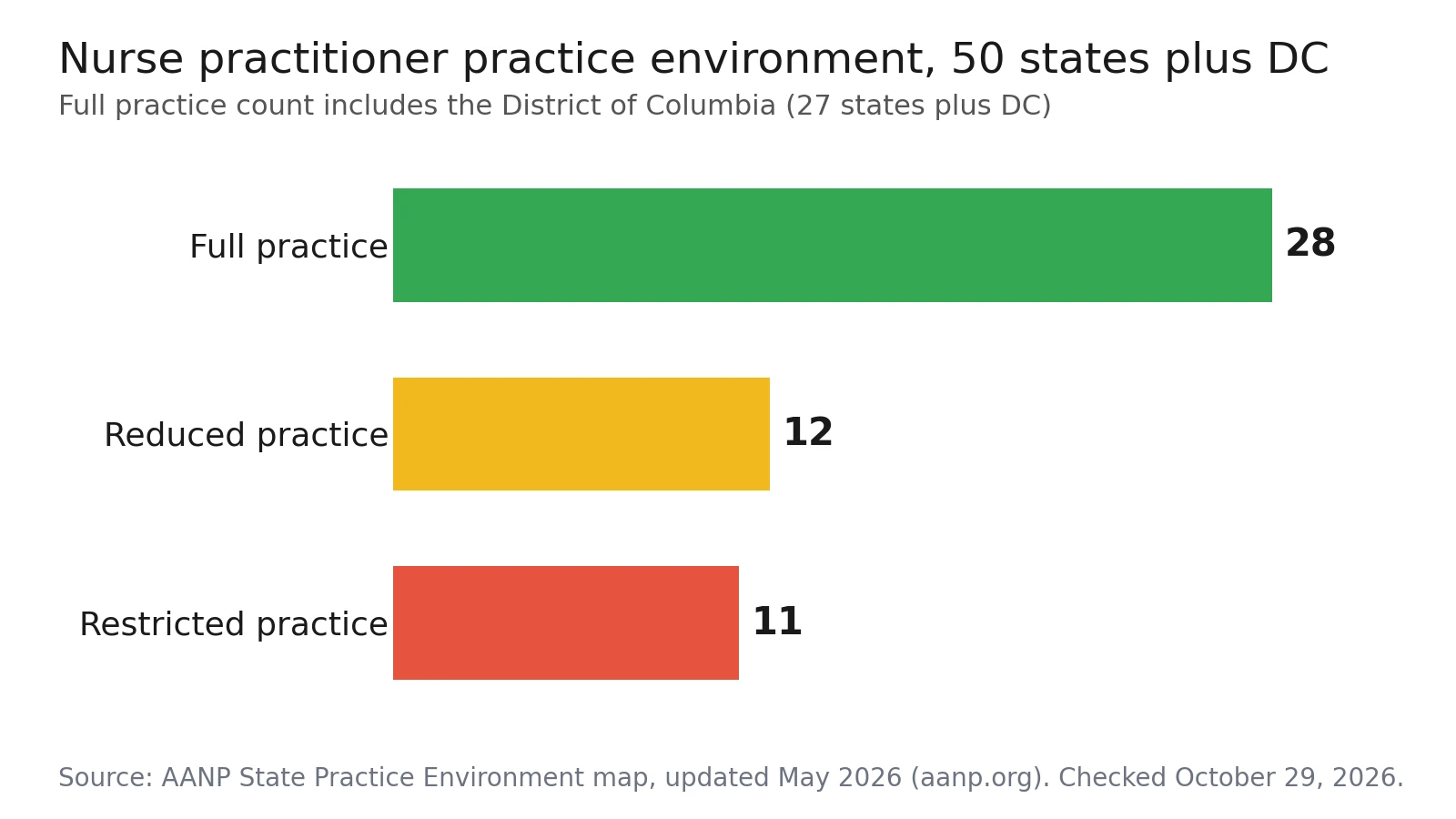
Across the 50 states and DC, that is 28 full practice jurisdictions (27 states plus DC), 12 reduced practice states and 11 restricted practice states. Guam and the Northern Mariana Islands are also full practice on the map.
Nurse practitioner practice environment by state
The table lists every state and DC as shown on the AANP map. Laws move during legislative sessions, so treat this as a starting point and check the live map and your board of nursing before you plan around it.
| State | Practice environment (AANP, May 2026) |
|---|---|
| Alabama | Reduced Practice |
| Alaska | Full Practice |
| Arizona | Full Practice |
| Arkansas | Reduced Practice |
| California | Restricted Practice |
| Colorado | Full Practice |
| Connecticut | Full Practice |
| Delaware | Full Practice |
| District of Columbia | Full Practice |
| Florida | Restricted Practice |
| Georgia | Restricted Practice |
| Hawaii | Full Practice |
| Idaho | Full Practice |
| Illinois | Reduced Practice |
| Indiana | Reduced Practice |
| Iowa | Full Practice |
| Kansas | Full Practice |
| Kentucky | Reduced Practice |
| Louisiana | Reduced Practice |
| Maine | Full Practice |
| Maryland | Full Practice |
| Massachusetts | Full Practice |
| Michigan | Restricted Practice |
| Minnesota | Full Practice |
| Mississippi | Reduced Practice |
| Missouri | Restricted Practice |
| Montana | Full Practice |
| Nebraska | Full Practice |
| Nevada | Full Practice |
| New Hampshire | Full Practice |
| New Jersey | Reduced Practice |
| New Mexico | Full Practice |
| New York | Full Practice |
| North Carolina | Restricted Practice |
| North Dakota | Full Practice |
| Ohio | Reduced Practice |
| Oklahoma | Restricted Practice |
| Oregon | Full Practice |
| Pennsylvania | Reduced Practice |
| Rhode Island | Full Practice |
| South Carolina | Restricted Practice |
| South Dakota | Full Practice |
| Tennessee | Restricted Practice |
| Texas | Restricted Practice |
| Utah | Full Practice |
| Vermont | Full Practice |
| Virginia | Restricted Practice |
| Washington | Full Practice |
| West Virginia | Reduced Practice |
| Wisconsin | Reduced Practice |
| Wyoming | Full Practice |
A full practice label does not always mean day one independence. Some full practice states ask newly licensed NPs to complete a set number of supervised or collaborative hours before practicing on their own, so read your state's transition-to-practice rule if you are early in your career.
The labels also simplify some state laws. Florida is listed as restricted, yet Florida Statutes 464.0123 lets an APRN register for autonomous practice after at least 3,000 clinical practice hours, and that autonomous practice is limited to primary care, including family medicine, general pediatrics and general internal medicine. For an NP planning a DPC in Florida, that pathway matters more than the map color.
Do NP-owned DPC practices need a collaborative agreement?
Only where your state requires one, and the requirement comes from your nursing license, not from how you get paid. Dropping insurance does not change it. If you practice in a reduced practice state, you need the collaborative agreement the state describes, and in a restricted practice state you need the supervision or delegation arrangement the state describes, whether your patients pay a membership or a copay.
For a DPC owner, the practical questions are who the collaborating physician is, what the agreement requires (chart review, meetings, prescribing protocols, proximity), and what it costs. Collaboration fees are usually negotiated privately, so budget for them in your break-even math rather than assuming a number. Some NPs pair with a nearby DPC physician, which can keep the clinical philosophy aligned.
Can a nurse practitioner own a medical practice? (corporate practice of medicine)
Many states follow some version of the corporate practice of medicine (CPOM) doctrine, which limits who can own a business that practices medicine or employs physicians. How it applies to NPs varies a lot by state, which is why this is the question to bring to a health care attorney first.
McCluan Law's April 2025 overview of NP practice ownership is a good example of how the analysis works in one reduced practice state. It explains that NPs in Pennsylvania can own practices with or without a physician co-owner, that the NP must still comply with the collaborative agreement, and that an NP-owned business should not employ a physician under the state's CPOM case law. It also notes that a management services agreement has to leave clinical control with the practice owner.
The lessons travel well even though the details do not. Pick an entity type your state allows nurses to form, keep clinical decisions with licensed clinicians, and be careful before an NP-owned company hires a physician. If you are looking at a management company or an investor, have the agreement reviewed against your state's CPOM rules before you sign.
Do state DPC laws include nurse practitioners?
Most states have a law that says a direct primary care or direct health care agreement is not insurance. Whether an NP fits under it depends on how the statute defines the provider, so read the definition section of yours. Two examples show how broad some definitions are.
- Florida. Florida Statutes 624.27 defines "health care provider" for direct health care agreements to include providers licensed under chapter 464, the nursing chapter, alongside physicians and several other professions.
- Washington. RCW 48.150.010 defines "health care provider" as a person regulated under Title 18 RCW, the title that covers the health professions, including nursing.
Other states write the definition around physicians only, which can leave an NP-owned membership practice in a grey area under the insurance code. Our direct primary care laws by state guide links each state's statute, so you can check the definition section directly.
Do nurse practitioners have to opt out of Medicare for DPC?
The same Medicare rules apply to NPs as to physicians. The Medicare private contracting rule at 42 CFR 405.400 defines "practitioner" to include physician assistants, nurse practitioners and clinical nurse specialists, among others. That means an NP who wants to charge Medicare beneficiaries a membership that covers Medicare-covered services generally goes through the same opt-out and private contract process a physician does.
Opting out applies to all of your Medicare billing for the whole opt-out period, so it is a real decision for an NP who also works shifts elsewhere. If you are converting from a practice that bills Medicare today, our guide to converting a practice to direct primary care covers the sequence.
Can patients pay an NP-led DPC with their HSA?
Yes, as long as the membership otherwise qualifies. Section 71308 of the One Big Beautiful Bill Act (Public Law 119-21) allows HSA holders to have a direct primary care service arrangement starting in 2026, and it requires that care come from primary care practitioners as defined in Social Security Act section 1833(x)(2)(A).
That definition, codified at 42 U.S.C. 1395l(x)(2)(A), names physicians with a primary specialty of family, internal, geriatric or pediatric medicine, and also nurse practitioners, clinical nurse specialists and physician assistants. An NP-led membership can qualify on the practitioner test.
The fee cap still applies to contributions. For 2027, IRS Rev. Proc. 2026-24 keeps the cap at 150 dollars a month for one person and 300 dollars a month for a membership covering more than one person, and a member whose membership fees go over it cannot contribute to an HSA while enrolled.
The DPC HSA rules for 2027 explain the excluded services and what to put on your pricing page. If you are still setting your fee, see how much to charge for a DPC membership.
DEA registration and prescribing in an NP-owned DPC
Prescriptive authority follows your state license. Federal regulations at 21 CFR 1300.01 call nurse practitioners, clinical nurse specialists and physician assistants "mid-level practitioners," meaning practitioners permitted by the jurisdiction where they practice to dispense controlled substances. In practice, your DEA registration can only cover the controlled substance schedules your state lets you prescribe, so a state that limits NP prescribing of certain schedules limits your DEA registration the same way.
Plan for a DEA registration in each state where you prescribe controlled substances, plus any state controlled substance registration your state requires. If you plan to dispense medications in the clinic, which many DPC practices do, check whether your state allows NP dispensing and what permits it needs. The DPC dispensing guide covers that topic in more depth.
Malpractice insurance for an NP-owned DPC
An NP who owns a practice needs their own professional liability policy rather than relying on an employer's coverage. Ask carriers specifically about direct primary care, because a membership practice with text access, home visits or in-office dispensing can look different from a standard clinic on an application.
In reduced and restricted practice states, ask how the policy treats your collaborating or supervising physician, and whether that physician's own policy covers the oversight work. It is also worth asking about entity coverage for the practice itself and about tail coverage if you ever close or sell. Our guide to insurance for a new DPC practice walks through the full set of policies.
Can a physician assistant open a DPC practice?
The answer for physician assistants is moving, but most states still require a defined relationship with a physician. The American Academy of Physician Assistants (AAPA) tracks state changes on its PA practice modernization page, and the direction of travel is toward collaboration in place of supervision.
North Carolina is a recent example. According to AAPA's July 2025 report, Governor Josh Stein signed House Bill 67 on July 1, 2025, removing the requirement for PAs with at least 4,000 clinical hours to have a specific relationship with a physician when working in a team-based setting. The same law made North Carolina the 19th state to join the PA Licensure Compact.
The "team-based setting" detail matters for a solo DPC, so read your state's definition before assuming it covers a PA-owned practice. PAs face the same corporate practice, Medicare opt-out and HSA questions covered above, and the HSA definition in 1833(x)(2)(A) includes PAs.
A practical checklist for NPs planning a DPC in 2027
Before you sign anything, work through these questions in order:
- Confirm your state's practice environment on the AANP map and read the actual nurse practice act, including any transition-to-practice hours.
- If your state requires collaboration or supervision, find the physician and get the agreement terms in writing.
- Ask a health care attorney whether an NP can own the entity you plan to form and whether any management or investor agreement fits your state's CPOM rules.
- Read your state's DPC statute definition to see whether it covers NPs.
- Decide on Medicare opt-out, DEA and state controlled substance registration, dispensing permits and malpractice coverage.
- Set your fee with the HSA cap in mind and run the numbers on your panel size.
When the doors open, the hard part shifts from the law to the day-to-day work. A solo NP owner is the clinician, the front desk and the billing office at once, and the follow-ups that live between the EHR, the billing tool and the patient inbox are what slip first. Tabflows is a dedicated tech team that connects the tools a clinic already uses so those follow-ups, tasks and patient context sit in one place. When you are ready to be found, list the practice on the DPC Finder so patients searching for an NP-led membership can see you.
FAQs
Can a nurse practitioner open a direct primary care practice?
Yes, in many states. As of the AANP State Practice Environment map updated in May 2026, 27 states and the District of Columbia give nurse practitioners full practice authority, so an NP can own and run a DPC practice without a physician agreement. In the 12 reduced practice and 11 restricted practice states, an NP can often still own a practice but must keep a collaborative or supervisory relationship with a physician, and some states limit who may own a medical business. Check your board of nursing and a health care attorney before you sign a lease.
How many states have full practice authority for nurse practitioners in 2027?
AANP's State Practice Environment map, updated May 2026, lists 27 states plus the District of Columbia as full practice. They are Alaska, Arizona, Colorado, Connecticut, Delaware, Hawaii, Idaho, Iowa, Kansas, Maine, Maryland, Massachusetts, Minnesota, Montana, Nebraska, Nevada, New Hampshire, New Mexico, New York, North Dakota, Oregon, Rhode Island, South Dakota, Utah, Vermont, Washington and Wyoming. Guam and the Northern Mariana Islands are also full practice. Laws change, so check the live map before planning for 2027.
Does an NP-owned DPC need a collaborative agreement?
Only if your state requires one. In AANP's full practice states, NPs practice under the board of nursing without a career-long physician agreement, although some of those states require a transition period of supervised hours for new NPs. In reduced practice states the law requires a career-long collaborative agreement, and in restricted practice states it requires supervision, delegation or team management by another provider. The agreement is a licensing rule, so it applies whether or not you take insurance.
Can patients use their HSA for an NP-led DPC membership?
Yes, if the membership otherwise qualifies. Section 71308 of Public Law 119-21 lets HSA holders have a direct primary care service arrangement when care comes from primary care practitioners as defined in Social Security Act section 1833(x)(2)(A), which names nurse practitioners, clinical nurse specialists and physician assistants alongside primary care physicians. The 2027 fee caps, which also decide whether members can keep contributing to an HSA, are covered in the Tabflows guide to DPC HSA rules.
Do nurse practitioners have to opt out of Medicare to run a DPC?
Not always, but the same Medicare rules apply to NPs as to physicians. The Medicare private contracting rule at 42 CFR 405.400 defines practitioner to include nurse practitioners, clinical nurse specialists and physician assistants, so an NP who wants to charge Medicare patients a membership for covered services generally opts out and signs private contracts. Many DPC owners talk to a health care attorney before deciding, because opting out covers all of your Medicare billing for the whole opt-out period.
Can a physician assistant open a DPC practice?
It depends heavily on the state. Most states still tie PA practice to a supervising or collaborating physician, but the rules are changing. North Carolina, for example, enacted House Bill 67 in July 2025, removing the specific physician relationship requirement for PAs with at least 4,000 clinical hours who work in a team-based setting. A PA planning a DPC should read the current state PA practice act and corporate practice rules with an attorney.