
Does Elation Do Billing?
Yes, Elation does billing, so a practice on Elation doesn't have to add a separate billing system. Elation sells a practice management and billing system on the same platform as its EHR, with real-time eligibility checks, automated claims processing, flexible payment options and reporting, so a practice that bills insurance can chart and bill in one place. For membership practices, Elation also has built-in Membership Management for recurring patient membership plans and fees, which runs on a Stripe account. A direct primary care practice adds a separate billing system like Hint Core mainly when memberships and employer contracts are the core of the business, or when it wants billing that stays put if it ever changes EHRs.
The rest of this guide covers what Elation's billing includes, what its memberships cost to run, when a second system earns its place, and what still falls between the chart and the billing tool either way.
What Elation's Billing Includes
Elation calls it the Practice Management and Billing System, and its own page describes it as integrating with the EHR so that scheduling, patient registration, document management, billing and reporting sit in one platform. On the billing side, the page lists four pieces.
- Real-time eligibility checks. The front desk can see a patient's coverage before the visit, not after a claim bounces.
- Automated claims processing. Claims go out from the same record the clinician charted in, without retyping codes into another system.
- Flexible payment options. Patients can pay their part in more than one way.
- Comprehensive reporting. The practice can see what was billed and collected.
Elation also puts a number on it. Its practice management page says practices get reimbursed for 98% of commercial and government claims within 90 days (checked November 16, 2026). That's Elation's own figure, so treat it as the vendor's claim and ask on a demo how it's measured for a practice your size.
Billing isn't sold on its own. Elation's product guide sells it with the EHR and lists Standard EHR + Billing at $699 per provider per month (checked November 16, 2026), against $425 for the Standard EHR alone.
Can Elation Bill Memberships for a DPC or Concierge Practice?
Yes. Elation's help center describes Membership Management as a way to create and manage recurring patient membership plans or fees directly within Elation. It needs a Stripe account, since that's how the card and bank payments are collected.
Elation's product guide lists Membership Management at 2.99% of collected credit card payments and 1% + $0.25 of collected ACH payments, with ACH capped at $5 per transaction (checked November 4, 2026). The same guide lists the Standard DPC Provider plan at $375 per provider per month and the Standard Provider plan at $425.
For a hybrid practice, that's the strongest case for staying in one system. Insurance claims and membership fees run on the same patient record, so nobody has to reconcile two lists of who owes what.
When Do You Need a Separate Billing System Alongside Elation?
A separate billing system is a choice, not a requirement. DPC and concierge clinics usually add one for one of three reasons.
- Memberships are the whole business. A membership-only DPC may want a tool built around enrollment, plan changes, pauses and renewals first, with the chart beside it.
- You sell to employers. Employer-sponsored memberships come with rosters, eligibility files and group invoices, which a dedicated membership platform handles as its main job.
- You want billing that doesn't move with your EHR. If you might change charts in a few years, keeping memberships in their own system means your members' payment details and plan history stay put.
Hint Core is a separate system DPC clinics often pair with Elation, and Hint has its own Elation sync. Hint sells membership and billing on its own, without its EMR, and its Core Growth plan starts at $110 per month with 100 members (checked November 4, 2026). Hint says it and Elation sync patient records and contact and demographic information, and that each member's membership status and plan name come across to Elation as tags. Employer billing comes with every Hint Core plan, starting with Core Growth.
Elation Billing vs Elation Plus a Separate System
Here is how the two setups compare for a small practice.
- Insurance claims. Elation alone: integrated billing with eligibility checks and automated claims. Elation plus Hint Core: still Elation's billing, since Hint Core is for memberships.
- Membership billing. Elation alone: built-in Membership Management on Stripe. Elation plus Hint Core: Hint Core runs enrollment, recurring billing and payments.
- Employer contracts. Elation alone: ask Elation how group memberships handle employer billing. Elation plus Hint Core: employer billing on every Core plan, from Core Growth up.
- Where patients pay. Elation alone: one system. Elation plus Hint Core: memberships in Hint, anything insurance in Elation.
- Changing EHRs later. Elation alone: memberships have to move when the chart does. Elation plus Hint Core: memberships stay in Hint.
- What syncs. Elation alone: nothing to sync. Elation plus Hint Core: patients, demographics and membership tags, but not lab orders or charges.
That last line is where most of the day-to-day friction lives. If a lab is ordered in Elation and the patient owes for it, someone has to make sure the charge lands in Hint. Our post on whether an Elation lab order can create a Hint invoice walks through that one in detail.
Questions to Ask Before You Decide
Before you add a second system or commit to one, it's worth asking a few plain questions on each demo.
- How do you bill a patient who has both a membership and an insurance claim in the same month?
- What happens to a member's payment method and plan history if we change EHRs?
- How do employer rosters and group invoices work, and who updates them?
- Which charges sync between the two systems, and which does the team enter by hand?
- What are the card and ACH fees on the plan we would actually buy?
The answers usually make the choice for you. A hybrid practice that bills a lot of insurance tends to stay in Elation alone, and a membership-first DPC with employer contracts tends to add Hint Core.
What Still Falls Between the Chart and the Billing Tool
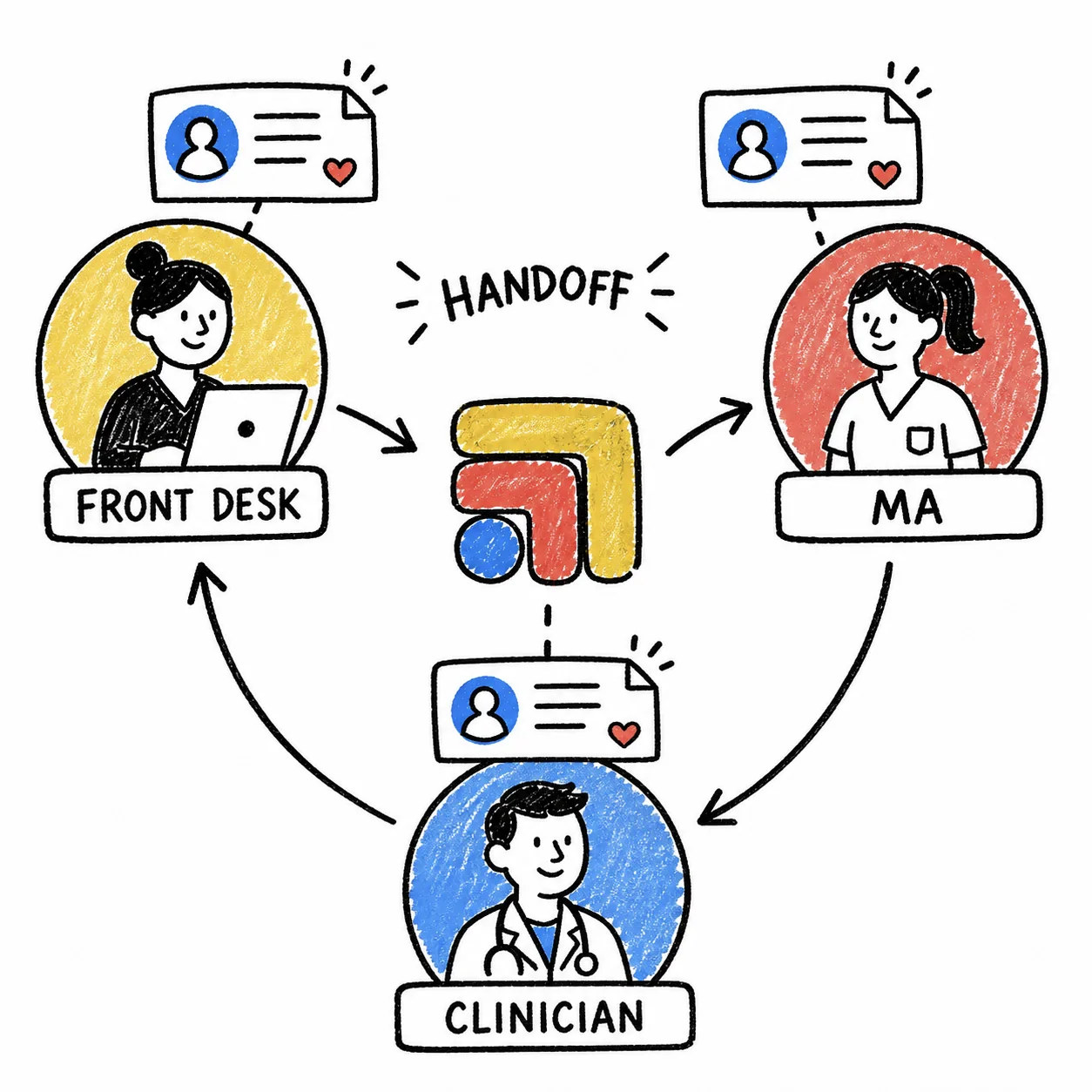
Whichever setup you choose, some work lives between the systems, and it's the work that leaks revenue quietly. A patient's insurance information is missing when the claim is due. A lab or vaccine was given but never charged. A membership payment failed and nobody followed up. None of these are billing-system bugs. They're handoffs between the chart, the billing tool and the person who notices.
Where Tabflows Fits
Tabflows is not a billing system, and it doesn't send claims or charge cards. It is a dedicated tech team that works across the tools your clinic already uses, including Elation, Hint and Spruce. On request, our team builds custom workflows for handoffs like these on the accounts you already have, such as following up on missing insurance information, or a charge audit like the one that compares Cerbo and Hint to catch missed or mismatched charges and hands your team a short list of flags to review.
Sources
Checked on November 16, 2026: elationhealth.com/platform/practice-management-system. Checked on November 4, 2026: elationhealth.com/ehr-product-guide and hint.com/core/find-your-price. Spot a wrong fact? Email a correction.
FAQs
Does Elation do billing?
Yes. Elation sells a practice management and billing system that sits on the same platform as its EHR, with real-time eligibility checks, automated claims processing, flexible payment options and reporting. It also has built-in Membership Management for recurring patient membership plans and fees, which runs on a Stripe account.
Do I need a separate billing system alongside Elation?
Not necessarily. A practice that bills insurance can use Elation's integrated billing, and a membership practice can use Elation's Membership Management. A separate system makes sense when your memberships are the core of the business and you want them to stand on their own, when you sell to employers and take eligibility files, or when you want billing that stays put if you ever change EHRs. Hint Core is a separate system DPC clinics often pair with Elation, and Hint has its own Elation sync.
Can Elation bill memberships for a direct primary care practice?
Yes. Elation's Membership Management lets a practice create and manage recurring patient membership plans or fees directly within Elation. It requires a Stripe account, and Elation's product guide lists fees as a percentage of collected card payments and a percentage plus a per-transaction fee on ACH payments, with a cap per ACH transaction.
Does Hint Core work with Elation?
Yes. Hint says it and Elation sync patient records, contact and demographic information, and keep them up to date, and that each member's membership status and plan name come across to Elation. Lab orders and charges are not part of that standard sync.
Is Tabflows a billing system?
No. Tabflows is a dedicated tech team that works between the tools a clinic already uses, such as Elation, Hint and Spruce. It doesn't send claims or charge cards. Its team builds custom workflows for the work that falls between the chart and the billing tool, like following up on missing insurance information or auditing charges across two systems.