
How do DPC practices get outside records in 2027?
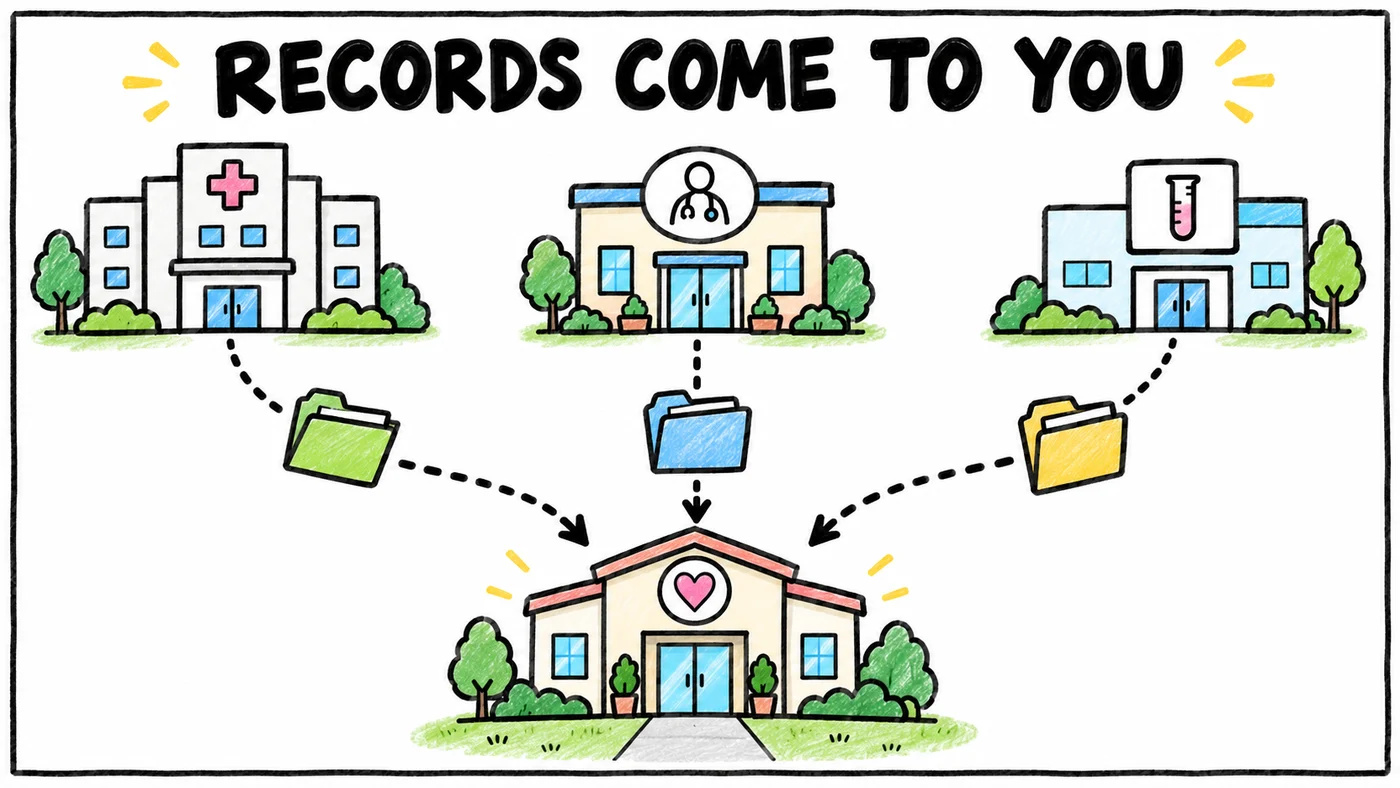
In 2027 a direct primary care practice gets outside records through four routes, usually in this order. First comes a national network query from inside the EHR (Carequality, CommonWell or TEFCA, depending on the vendor), then a state or regional health information exchange, then the patient's own access through a portal or app, and finally a fax or records request for whatever is left. Network queries often return hospital and large health system records within minutes. Small specialty offices, imaging centers and older records still tend to arrive by fax, so the practices that do this well treat every route as part of one tracked workflow.
None of this depends on taking insurance. A cash-pay DPC clinic is a treating provider like any other, and the networks care about why you are asking (treatment) rather than how you get paid. What it does depend on is your EHR, how its network connection is set up, and how carefully the team handles what comes back.
The routes at a glance
| Route | What you get | Cost and effort | Best for |
|---|---|---|---|
| National network query in your EHR (Carequality, CommonWell, TEFCA) | Summary documents (CCDs) from hospitals and large groups, sometimes discrete labs, problems and meds | Often included in the EHR subscription or sold as an add-on. Low effort per patient once switched on | New members with hospital or health system history |
| State or regional HIE | Labs, admission and discharge notices, results from local hospitals | Varies by state. Some free, some paid. Setup takes paperwork and an agreement | Practices in states with a strong HIE and local hospital admissions |
| Patient-directed access (portal, app, TEFCA Individual Access Services) | Whatever the patient can download, often a full record from each portal | No cost to the practice. Effort sits with the patient | Members who already use portals, and records your network query missed |
| Fax and formal records request | Exactly what you asked for, on paper or PDF | Staff time, follow-up calls, days to weeks | Small specialists, imaging, therapy notes, older paper charts |
| Lab and imaging interfaces | Results flowing straight into the chart | Interface setup per lab, sometimes a fee | Your own orders going forward |
The first three routes cover most of what a new member's history looks like. The fax line covers the long tail, and it is the one that quietly eats the most staff time.
What is TEFCA, and can a small practice use it?
TEFCA (the Trusted Exchange Framework and Common Agreement) is the national "network of networks" run under the federal health IT office, ASTP/ONC. The day-to-day governance is handled by a Recognized Coordinating Entity, which is The Sequoia Project. Large networks sign the Common Agreement and become Qualified Health Information Networks (QHINs), and everyone else connects through one of them.
As of October 2026 the RCE lists 11 Designated QHINs, which are CommonWell Health Alliance, eClinicalWorks PRISMA, eHealth Exchange, Epic Nexus, Health Gorilla, Kno2, KONZA, MedAllies, Netsmart, Oracle Health Information Network and Surescripts. More organizations sit in the candidate stage, and the list changes as they finish onboarding.
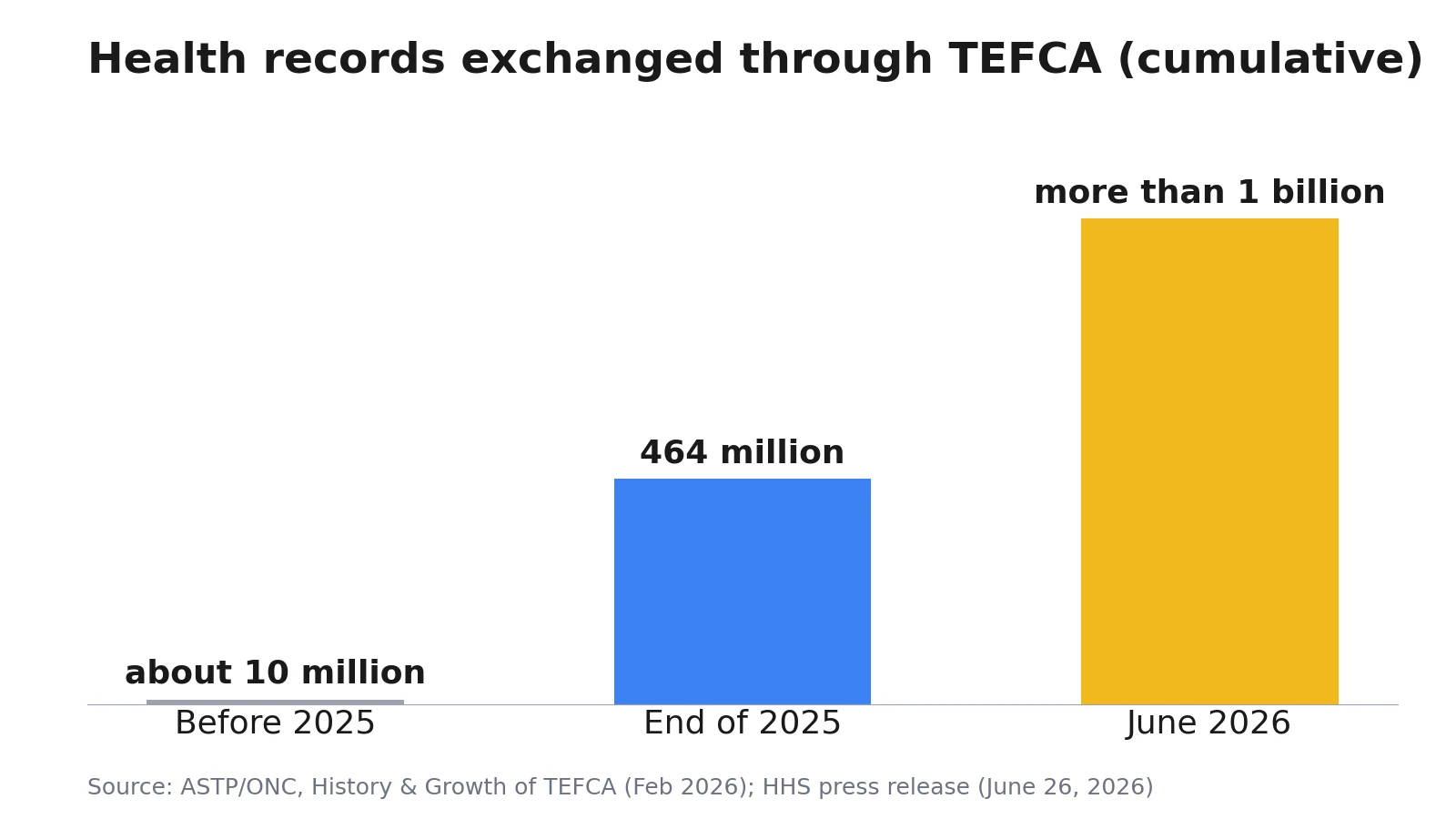
Volume has grown fast. ASTP/ONC reported that about 10 million documents moved across TEFCA before 2025 and 464 million by the end of 2025. In June 2026 HHS announced that the count had passed 1 billion health records, and said it had added a new oversight contract and extra reviews of QHINs and their participants.
So can a three-person DPC clinic use TEFCA? Yes, but you will almost never sign anything with a QHIN yourself. You reach it through your EHR vendor or a network partner the vendor works with. The useful question to ask your vendor is a short one. "When I query for a new patient, which networks does that query reach, and is it switched on for my account?"
TEFCA exchange purposes that matter to DPC
TEFCA sorts every request by an exchange purpose, which is the reason the data is being asked for. Two of them matter most to a primary care practice:
- Treatment, which is the one your EHR uses when it queries for a patient you are caring for. Responding to treatment queries is expected of participants, which is why the network works at all.
- Individual Access Services (IAS), which lets a patient use an app connected to a QHIN that offers IAS to request their own records from across the network after verifying who they are. The RCE publishes an IAS standard operating procedure, and QHINs that offer IAS have extra privacy and security duties under 45 CFR 172.202.
IAS is worth knowing about because it gives your members a way to collect their own history and hand it to you, even when your EHR's connection misses something.
Carequality and CommonWell for DPC practices
Before TEFCA, two national frameworks did most of this work, and they still do a large share of it. Carequality is a vendor-neutral framework of shared legal, technical and policy rules that lets separate networks and EHR vendors query each other. CommonWell Health Alliance is a network that vendors join directly. The two agreed in 2016 to connect, and CommonWell's own Carequality connectivity page explains how its members reach Carequality participants. CommonWell is also now a Designated QHIN, so its members sit inside TEFCA as well.
For a DPC owner the practical upshot is that the brand name on the connection matters less than whether your queries reach the hospitals your members actually use. Epic Nexus and Oracle Health Information Network, for example, are both Designated QHINs, which is why a working national connection often returns something for members who have been seen at a large hospital.
Which DPC EHRs connect to national networks?
Here is what each vendor says on its own pages, checked on October 29, 2026. We only list what we could verify, so if your EHR is missing, ask the vendor directly. Our DPC EHR comparison for 2027 covers the rest of each product.
- Elation Health. Elation announced in August 2026 that its Carequality integration is available to all Standard EHR subscribers at no additional cost, that it retrieves outside records automatically, and that discrete clinical data can be imported into the chart. Elation also notes that practices on the connection share their records with the network. For TEFCA specifically, Elation's MIPS 2026 help article says it offers an integration with Zus Health at an extra cost, and that Zus participates in TEFCA by querying the CommonWell QHIN.
- Akute Health. Akute's help center describes an "HIE Record Request" button in the patient summary bar. Matched records arrive as diagnostic reports under Documents/Tasks, and labs land in the Labs tab where they can be trended. Akute is clear that records are generally regional, that the feature is not Epic's Care Everywhere, that it keeps pulling new data after the first request, and that it has to be enabled by contacting support.
- athenahealth. athena's interoperability page says athenaOne connects to other EHRs through CommonWell and Carequality and offers a network that is automatically connected to TEFCA.
- Hint and Atlas.md. We could not verify a national network connection on either vendor's own pages as of this check, so ask on a demo call rather than assume either way.
If you are weighing a move between systems for this reason, read how to switch EHRs without losing patient data first. Changing EHRs does not move the outside records you already filed, so plan the export before you plan the network.
How to get hospital records into your EHR, step by step
A network connection is only as good as the habits around it. These are the steps that make the difference for a small team.
- Switch it on and confirm the scope. Ask your vendor which networks your queries reach (Carequality, CommonWell, a TEFCA QHIN, a regional HIE), whether there is a fee, and whether you need to sign a participation agreement.
- Get demographics right at signup. Matching runs on legal name, date of birth, sex and current address, and Akute notes that a patient who recently moved may return fewer records. Ask new members for a prior address and any former last names.
- Query at enrollment, not at the first visit. Running the query when someone joins gives the records time to arrive and gives you time to read them before you meet.
- Review before you import. A CCD from a hospital can carry dozens of stale medications and resolved problems. Reconcile meds, allergies and problems by hand, then file the document.
- Write down what came back and what did not. If the hospital stay shows up but the cardiologist does not, that gap becomes a records request.
The last step is where most of the work hides. Our guide to medical records request tracking walks through how to keep those open requests visible until they are filed.
State and regional HIEs
State and regional health information exchanges are older than TEFCA and still useful, especially for admission, discharge and transfer notices from local hospitals and for lab results from regional labs. Some feed national networks too, so a regional HIE may show up as one of the sources your EHR query reaches.
What they offer, what they charge and how much paperwork they need varies a lot from state to state, and some are built mainly around hospitals and insured practices. Call your state's HIE, explain that you are an independent primary care practice, and ask three things. Do they accept practices that do not bill insurance, do they offer a free or low-cost portal login for small practices, and can they send you event notifications when one of your members is admitted or discharged?
The CMS Interoperability Framework and "kill the clipboard"
On July 30, 2025, CMS and the White House announced the Health Tech Ecosystem. More than 60 companies pledged to deliver results in the first quarter of 2026. Twenty-one networks pledged to meet the CMS Interoperability Framework criteria and become CMS Aligned Networks, eleven health systems or providers committed to take part, and seven EHRs committed to help "kill the clipboard."
The Kill the Clipboard pledge commits signers to let patients retrieve their records from CMS Aligned Networks or personal health record apps and share them with providers by QR code or SMART Health Cards and Links using FHIR bundles. Early adopters listed on the CMS page include Apple, Google, Samsung, CVS Health, UnitedHealth Group, Zocdoc, b.well, Flexpa and Fasten Health.
This is a voluntary pledge, not a rule for your practice. The useful part for DPC is the direction it points. More members will arrive with a phone that can hand you their history, so it is worth asking your EHR vendor whether it can receive a SMART Health Link or a FHIR bundle and file it to the chart.
Patient-directed access, the route you already have
Every patient has a HIPAA right to get their own records, and the HHS Office for Civil Rights right of access guidance gives covered entities 30 calendar days to respond, with one 30-day extension in limited cases. When a provider is slow to fax records to you, asking the patient to request them for themselves is often faster.
In practice this looks like asking new members, during onboarding, to log into each hospital or specialist portal they have and download or forward their records. Many hospital portals let the patient download a summary of their record or send it to another provider. Apps that use TEFCA Individual Access Services or patient-access APIs can pull records from many places at once. The patient then shares the file with you through your portal or secure messaging, and you review and file it like any other outside document.
The trade-off is that it moves work to the patient, and some members will not get to it. Offer it as an option alongside your own network query, not a replacement for it.
What still arrives by fax, and how to handle it
Even with every network switched on, a DPC practice in 2027 will still receive faxes. The usual sources are small independent specialists, physical therapy and behavioral health offices, imaging centers, some labs, records departments answering a formal request, and anyone whose system is not connected to the network your EHR queries.
A few habits keep the fax line from turning into a stack:
- Use a cloud fax number that lands in a shared inbox the whole team can see, rather than one person's email.
- File each fax to the right patient chart the same day, with a document type (consult note, imaging, labs, records) so it can be found later.
- Close the loop on every outbound request. A records request or referral that was sent and never answered should show up somewhere as still open.
- Tell the clinician when something important arrives, instead of trusting that they will see it in the chart.
Consult notes are the faxes that matter most clinically. The specialist referral tracking workflow covers how to make sure the note from a referral actually comes back and gets read.
Where the work between tools gets lost
The networks have improved a lot, but the gaps that remain sit between tools. A query runs in the EHR, a fax lands in the messaging app, a patient sends a PDF through the portal, and a follow-up call to a specialist's office lives on a sticky note. Each tool does its job, and the missing piece is the follow-up that spans all of them.
That is the part Tabflows helps with. Tabflows is a dedicated tech team that connects the EHR, billing and messaging tools a clinic already uses, so open records requests, incoming outside documents and the tasks attached to them live in one place with the patient's context. It is not an EHR or a fax service, and it works alongside whichever network connection your EHR offers.
If you are still choosing tools for a new practice, start with how to start a DPC practice and plan your records workflow alongside your EHR choice, because the network your EHR reaches will shape how much of your week goes to the fax line.
FAQs
Can a small DPC practice use TEFCA?
Yes, but not by joining directly. Small practices reach TEFCA through their EHR vendor or a network partner that participates under one of the Designated QHINs, such as CommonWell, eHealth Exchange, Health Gorilla or Kno2. The practical question for a DPC owner is whether your EHR offers a TEFCA, Carequality or CommonWell connection and whether it is switched on for your account.
How do I get hospital records into my EHR without faxing?
Turn on your EHR's national network query (Carequality, CommonWell or TEFCA, depending on the vendor), make sure each patient chart has a clean name, date of birth and address, and query when the patient joins. Hospital records from large health systems usually come back as summary documents you can review and import. Anything the network misses can still be requested by fax or through the patient's own portal access.
What is the difference between Carequality and CommonWell?
Carequality is a framework of shared legal and technical rules that lets separate networks and EHR vendors query each other. CommonWell Health Alliance is a network that vendors join directly. The two have been connected since a 2016 agreement, and CommonWell is now also a Designated QHIN under TEFCA, so a query through one can reach providers on the other.
What are TEFCA Individual Access Services?
Individual Access Services (IAS) is the TEFCA exchange purpose that lets a patient, through an app connected to a QHIN that offers IAS, request their own health records from across the network after verifying their identity. For a DPC practice it is a second route: a patient can pull their own records and share them with you.
Do DPC practices still need a fax line in 2027?
Most do. Small specialty offices, imaging centers, some labs, records departments answering formal requests, and records from before a provider joined a network often still arrive by fax. A cloud fax number that lands in a shared inbox, with each fax filed to the patient chart and tracked to completion, keeps this route from becoming a pile.
Does joining a health information exchange mean I share my patients' records too?
Usually yes. Most national networks expect reciprocity, which means a practice that queries for treatment also responds to queries for treatment. Akute's help center says plainly that requesting records for a patient also shares that patient's records with other practices that ask, and Elation says practices on its Carequality connection share records with the network. Tell patients this in your notice of privacy practices and membership paperwork.
Is the CMS kill the clipboard pledge a requirement for my practice?
No. The CMS Health Tech Ecosystem announced in July 2025 is a voluntary pledge by companies, networks, EHRs and health systems. It is not a rule that applies to independent DPC practices. Its practical effect is that more patient apps and networks are working on letting patients bring their records to a visit digitally.