Can a DPC practice add a nurse practitioner or physician assistant?
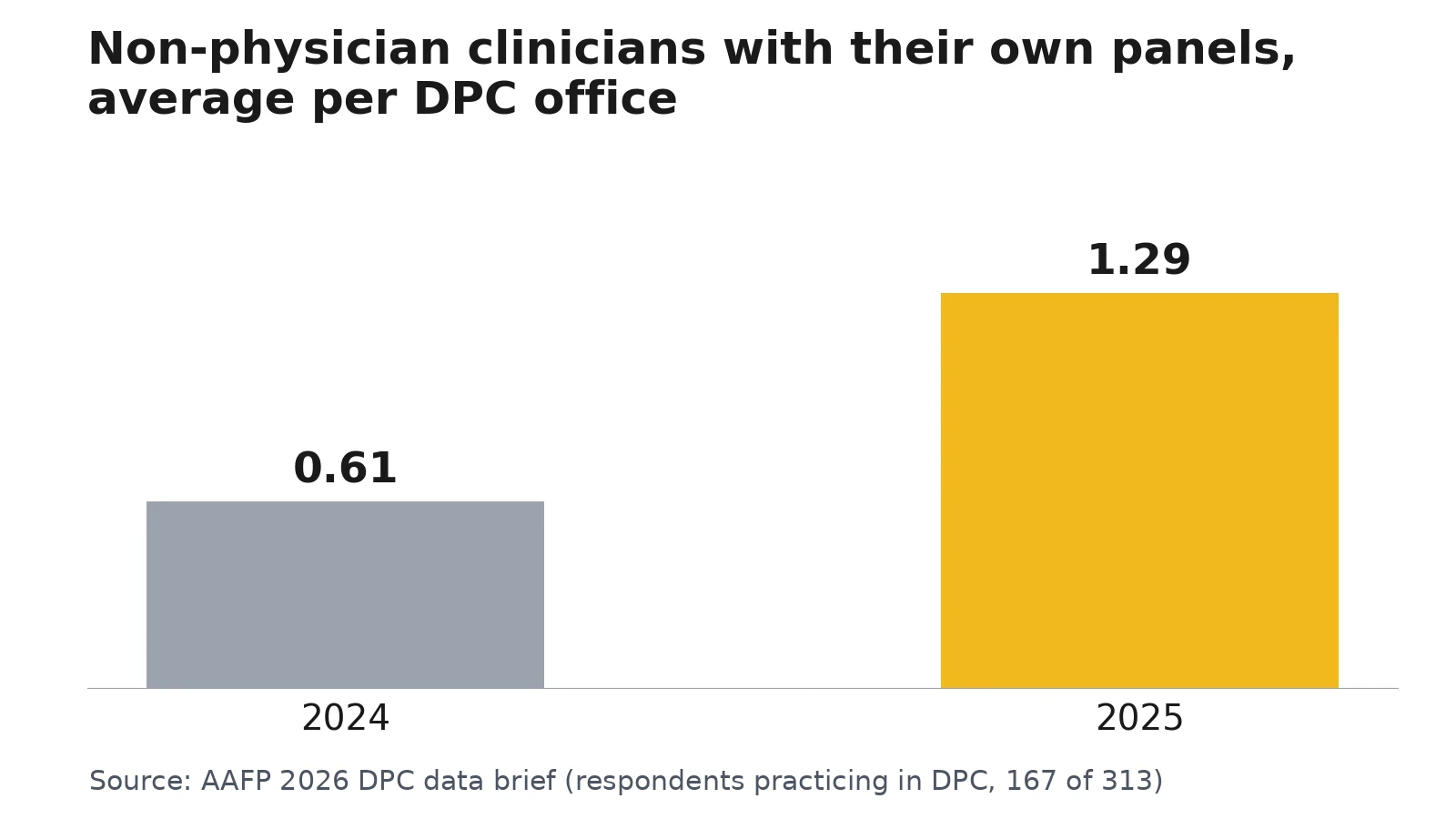
Yes. A physician-owned direct primary care practice can hire a nurse practitioner (NP) or physician assistant (PA), and the AAFP reports that the average number of non-physician clinicians carrying their own panels per DPC office more than doubled between 2024 and 2025. The membership model works the same with an NP or PA on the team, and patients can still pay with an HSA, within the fee cap and the rule's other limits, because federal law counts NPs and PAs as primary care practitioners. What you have to get right is the state rule on supervision or collaboration, how the panels split, Medicare opt-out for the new clinician, and the cost of the hire.

This guide is for physicians who own a DPC and are weighing their first NP or PA hire in 2027. It covers what the state boards require, how to design the panel, what the federal rules on Medicare, HSAs and controlled substances mean for the new clinician, and what to put in the offer. It is general information, not legal advice, so have a health care attorney read your state's practice acts and your agreement before anyone signs. If you are an NP or PA thinking about opening your own practice instead, see can a nurse practitioner open a DPC practice.
What the surveys show
The numbers below come from the AAFP's 2026 DPC data brief, which summarizes the 2026 DPC Practice Information Survey of family physicians about their 2025 practices. The survey went to family physicians who had engaged with DPC-related content. The final sample was 313 respondents (a 9.3% response rate), 53% of them practicing in a DPC setting, so read it as a picture of family physicians engaged with DPC rather than a census.
Sixty-nine percent of DPC practices in that survey ran a single physician panel. At the same time, the average number of non-physician clinicians with independent panels per office rose from 0.61 in 2024 to 1.29 in 2025. The brief also found an average panel of 504 patients across all respondents in 2025, up from 402 in 2024, and 40% of respondents practicing in DPC called panel growth a major challenge. The DPC Alliance's State of DPC report, from a survey collected October to November 2024, found that 87.5% of the single-location practices in its sample had no PA or NP.
The workforce is there to hire from. AANP's 2025 nurse practitioner count, published November 11, 2025, found more than 461,000 NPs with active licenses in the U.S. AANP's position statement on NPs in primary care, revised in October 2025, says about 87% of them were educated in programs focused on primary care, and it cites research finding that 53.4% of U.S. primary care practices employed NPs in 2023.
For physician assistants, the Bureau of Labor Statistics counts about 168,900 PA jobs in 2025 and projects 21% growth from 2025 to 2035. It counts 336,300 nurse practitioner jobs in 2025, with 41% projected growth over the same period.
NP or PA? How the two roles compare for a DPC
Both professions can carry a primary care panel, and both count as primary care practitioners for the DPC HSA rule. The differences that matter to an owner are who licenses them and what relationship your state requires with a physician.
| Question | Nurse practitioner | Physician assistant |
|---|---|---|
| Licensed by | State board of nursing (jointly with the medical board in some states, such as Virginia) | State medical board or PA board, depending on the state |
| Relationship with a physician | None in full practice states once any transition period for new NPs ends; in reduced practice states, a career-long collaborative agreement or limits on the setting of some elements of practice; in restricted states, career-long supervision, delegation or team management (AANP) | Set by the state PA practice act; AAPA counted more than 30 state legislative wins for PAs in 2026 by late August (AAPA) |
| Medicare opt-out | Listed as a practitioner in 42 CFR 405.400, so opts out individually | Listed as a practitioner in 42 CFR 405.400, so opts out individually |
| DPC HSA practitioner test | Included in 42 U.S.C. 1395l(x)(2)(A) | Included in 42 U.S.C. 1395l(x)(2)(A) |
| Controlled substances | A "mid-level practitioner" under 21 CFR 1300.01, within the schedules the state allows | A "mid-level practitioner" under 21 CFR 1300.01, within the schedules the state allows |
| National median pay, May 2025 (BLS) | $132,300 | $135,880 |
Pay figures are the BLS national medians across all settings, not DPC pay. We found no public pay data specific to direct primary care.
What do the state supervision and collaboration rules require?
The answer depends on your state and on which profession you hire. Nothing about the membership model changes it, because these are licensing rules that apply whether patients pay a membership or a copay.
Nurse practitioners and the AANP practice categories
The AANP State Practice Environment map, updated in May 2026, places each state in one of three groups. In full practice states, NPs evaluate, diagnose, order and interpret tests, and treat under the exclusive licensure authority of the state board of nursing. Reduced practice states require a career-long regulated collaborative agreement with another health provider, or limit the setting of one or more elements of NP practice. Restricted practice states require career-long supervision, delegation or team management by another health provider.
Our sibling guide on NP-owned DPC practices lists every state's category from AANP's map, last updated in May 2026, as we read it on October 29, 2026. A full practice label does not always mean independence from the first day of licensure, so check whether your state sets a transition period of supervised or collaborative hours for new NPs. The date your hire was licensed can matter as much as the map color.
Physician assistants and the move toward collaboration
PA practice is set state by state. AAPA's interactive state practice maps, launched in August 2026, use a four-tier scale (Optimal, Advanced, Moderate and Reduced) built on criteria such as collaboration in place of supervision, no physician to PA ratio, adaptable proximity rules, no chart signature mandates and scope determined at the practice level.
Kansas shows how quickly this moves. According to AAPA's April 2026 report, Kansas HB 2702 reclassifies PA practice agreements from supervision to collaboration once a PA attests to 4,000 hours or more of postgraduate clinical experience and has had no disciplinary action taken against their license, as the enrolled bill sets out. It also leaves the number of PAs a physician may collaborate with to the practice, and says collaboration does not require the physician to be present when the PA sees a patient. The changes take effect January 1, 2027.
An example of what an agreement asks of the physician
Texas is a useful example of the work a delegating physician takes on. The Texas Medical Board's prescribing and supervision page says a physician who delegates prescriptive authority must register with the board and have a prescriptive authority agreement with each APRN or PA. Outside facility-based hospital practices and practices serving medically underserved populations, one physician may delegate to no more than seven full-time equivalent APRNs and PAs.
Meetings under those agreements must happen at least monthly and be documented, although they no longer have to be face to face. The agreement's quality plan must require chart reviews, and the board says the law sets no number or percentage of charts, leaving it to the parties based on the clinician's experience and the complexity of the patients. The board adds that the number or percentage of charts reviewed may be an important factor in judging the quality of the physician's supervision. That time comes out of the physician's week, so plan for it in your schedule.
Every state writes these rules differently. Read your own state's practice acts and board rules, and use our direct primary care laws by state guide to see whether your state has a DPC statute, then read its definitions to confirm it covers the clinician you hire.
How do you split patient panels with an NP or PA?
There are three designs to choose from, and each one changes what you promise members.
- Independent panel. The NP or PA has their own members, is the named clinician on the membership, and covers their own messages and visits. This is the closest match to the independent panels the AAFP brief counts.
- Shared team panel. Members belong to the practice and see either clinician. The physician's panel can grow because the NP or PA absorbs same-day visits, follow-ups and messages, but members need to know up front who will answer.
- Shared, then independent. The new clinician starts on the shared panel to learn the practice, then takes a panel of their own as new members join. Existing members who chose the physician stay with the physician.
We found no published data on the typical panel size for an NP or PA in a DPC. The AAFP's 504 figure is an average across all its survey respondents, only 53% of them practicing in DPC, so it is a reference point and not a target for a new hire. Set the target from your own numbers (visits per member per year, message volume and the hours the new clinician will work), and revisit it after six months.
A few decisions are worth writing down before the first patient is assigned:
- Whether the membership price is the same for every clinician, and how you will explain it on your pricing page.
- How existing members are told about the new clinician, and whether anyone is moved without asking. Your retention plan should cover this.
- Who answers after-hours texts and calls, and how coverage rotates.
- How chronic conditions are shared between the two clinicians, so nothing in chronic disease management depends on one person remembering.
- What the panel cap is for the new clinician and when you will review it, using your break-even panel math.
Medicare, HSAs and controlled substances for the new clinician
Medicare opt-out is personal
If your practice has opted out of Medicare and charges Medicare patients a membership for covered services, the new clinician has to sort out their own status. The Medicare private contracting rule at 42 CFR 405.400 defines a practitioner to include physician assistants, nurse practitioners and clinical nurse specialists. Under 42 CFR 405.405, a physician or practitioner who signs at least one private contract and files the required affidavit opts out.
The opt-out period is 2 years from the date the affidavit is signed, if it is filed within 10 days after the clinician signs their first private contract (otherwise from when the last required affidavit is filed), and it renews for each following 2-year period unless the clinician properly cancels. That matters to an NP or PA who also works shifts somewhere that bills Medicare, so raise it at the interview. Our guide on how to opt out of Medicare for DPC walks through the steps.
HSAs still work
Public Law 119-21 made DPC memberships compatible with HSAs from 2026 when care comes from primary care practitioners as defined in 42 U.S.C. 1395l(x)(2)(A). That definition names physicians in family, internal, geriatric and pediatric medicine, and also nurse practitioners, clinical nurse specialists and physician assistants, so adding an NP or PA does not by itself break HSA eligibility.
The fee cap still applies. For 2027, IRS Rev. Proc. 2026-24 keeps it at $150 a month for one person and $300 for a membership covering more than one person. Details on excluded services and pricing pages are in our 2027 DPC HSA rules guide.
DEA and prescribing
Federal rules at 21 CFR 1300.01 call nurse practitioners and physician assistants "mid-level practitioners," meaning clinicians permitted by their state to dispense controlled substances. Their DEA registration can only cover what their state allows, so check whether your state also requires its own controlled substance registration, and build both into the start date.
What to budget and put in the offer
The BLS puts the median annual wage for nurse practitioners at $132,300 as of May 2025. For physician assistants, the BLS median was $135,880 in May 2025.
Those are national medians across hospitals, clinics and every other setting, so local pay can differ. Beyond salary, the offer and your budget should account for the following:
- Benefits and paid time off, including CME time and dues.
- Malpractice coverage. Ask your carrier how adding an NP or PA changes the practice's policy and whether the collaborating or supervising physician's oversight work is covered. Our guide to insurance for a new DPC practice lists the policies to review.
- Licensing and registrations. State license, NPI, DEA and any state controlled substance registration, plus any delegation registration your board requires. The DPC credentialing and licenses checklist covers the physician versions of these steps.
- Physician time. In states that require collaboration or supervision, the meetings and chart reviews are real hours. The public figures we found for what collaboration costs when it is bought from an outside physician come from companies that run collaborating-physician marketplaces or healthcare staffing, and they describe NPs, not PAs, so treat them as rough and get quotes in writing.
- Ramp time. A new clinician starting an independent panel will not be full on day one. Model the months before their panel covers their cost.
Employment agreement terms such as restrictive covenants, panel ownership when someone leaves and productivity bonuses are governed by state law and by fraud and abuse rules, so have your attorney draft them. Our primer on anti-kickback and Stark basics for DPC explains why compensation design deserves a careful look. If you are also deciding whether the next hire should be a physician instead, read when to hire a second DPC physician.
A checklist for adding an NP or PA in 2027
- Read your state's nurse practice act or PA practice act and the board rules on collaboration, supervision, ratios and proximity, and confirm any changes taking effect in 2027.
- Decide on the panel design (independent, shared or shared then independent) and write down the target panel size and review date.
- Draft the collaboration, supervision or prescriptive authority agreement your state requires, and schedule the meetings and chart reviews.
- Settle the new clinician's Medicare status, DEA and state registrations, NPI and malpractice coverage before the first visit.
- Update membership agreements, your website and your pricing page so members know who they will see.
- Tell existing members personally, and give anyone who wants to stay with the physician a clear answer.
The day-to-day work grows the moment a second clinician joins. Messages, lab results, refills and follow-ups that one physician used to hold in their head now have to reach the right person every time, across the EHR, the billing tool and the patient inbox. Tabflows is a dedicated tech team that connects the tools your clinic already uses, so those tasks, follow-ups and patient context sit in one place both clinicians can see. When the new clinician is ready for members, check that your listing on the DPC Finder is current, and see how to start a DPC practice for the rest of the 2027 playbook.
FAQs
Can a direct primary care practice hire a nurse practitioner or physician assistant?
Yes. A physician-owned DPC can employ an NP or a PA, and the AAFP's 2026 DPC data brief found that the average number of non-physician clinicians with their own panels per DPC office rose from 0.61 in 2024 to 1.29 in 2025. What changes from state to state is the relationship the law requires between that clinician and a physician, which ranges from none for NPs past any transition period in full practice states to a written collaboration or supervision agreement elsewhere. Some states have loosened this for experienced PAs: North Carolina no longer requires a named supervising physician for a PA who practices in a team-based setting, has more than 4,000 hours of clinical practice as a licensed PA and more than 1,000 in the specialty with a physician in that specialty, and submits proof the Board accepts. Check your state's nursing board, medical board and PA practice act before you post the job.
Does the DPC physician have to supervise the NP or PA?
It depends on the state and the profession. For nurse practitioners, AANP sorts states into full practice (no career-long physician agreement), reduced practice (a career-long collaborative agreement, or limits on the setting of some elements of NP practice) and restricted practice (career-long supervision, delegation or team management). For physician assistants, AAPA classifies states on a four-tier scale that rewards collaboration in place of supervision. Texas, for example, requires a physician who delegates prescribing to an NP or PA to have a prescriptive authority agreement with at least monthly meetings and chart review, and Kansas moves experienced PAs from supervision to collaboration on January 1, 2027.
How do you split patient panels when you add an NP or PA to a DPC?
There are three ways to design it. The new clinician can carry an independent panel of their own members, share one team panel with the physician, or start shared and move to an independent panel once they are established. The AAFP's 2026 DPC data brief found that 69% of DPC practices ran a single physician panel, and we found no published data on how large an NP or PA panel in DPC runs, so set the target from your own visit data and hours.
Can patients use an HSA for a DPC membership with an NP or PA?
Yes, on the practitioner test. The HSA rule for direct primary care added by Public Law 119-21 points to the primary care practitioner definition in 42 U.S.C. 1395l(x)(2)(A), which names nurse practitioners, clinical nurse specialists and physician assistants alongside primary care physicians. The monthly fee cap still applies, and for 2027 IRS Rev. Proc. 2026-24 keeps it at $150 for one person and $300 for a membership covering more than one person.
Does an NP or PA need to opt out of Medicare to join an opted-out DPC?
If they will see Medicare patients under the practice's membership for Medicare-covered services, generally yes, because opt-out is personal. The Medicare private contracting rule at 42 CFR 405.400 lists physician assistants, nurse practitioners and clinical nurse specialists as practitioners, and each physician or practitioner who signs private contracts and files the affidavit opts out for a 2-year period that renews unless cancelled. Have the new clinician talk this through with a health care attorney before their start date.
How much does it cost to hire a nurse practitioner or physician assistant?
The Bureau of Labor Statistics reports a median annual wage of $132,300 for nurse practitioners and $135,880 for physician assistants, both as of May 2025 and across all settings. We found no public pay data specific to DPC practices. Add benefits, malpractice coverage, licensing and DEA fees, and any collaborating physician time your state requires.