Can a DPC Practice Do Remote Patient Monitoring?
Yes. A direct primary care practice can do remote patient monitoring (RPM), but it usually cannot bill Medicare for it, because most DPC physicians have opted out of Medicare. That makes RPM a membership value-add rather than a revenue line, which frees the practice to choose devices, review schedules and alert rules based on what helps the patient. Concierge practices that still participate in Medicare can bill the Medicare RPM codes for eligible patients, including two new codes added for 2026.
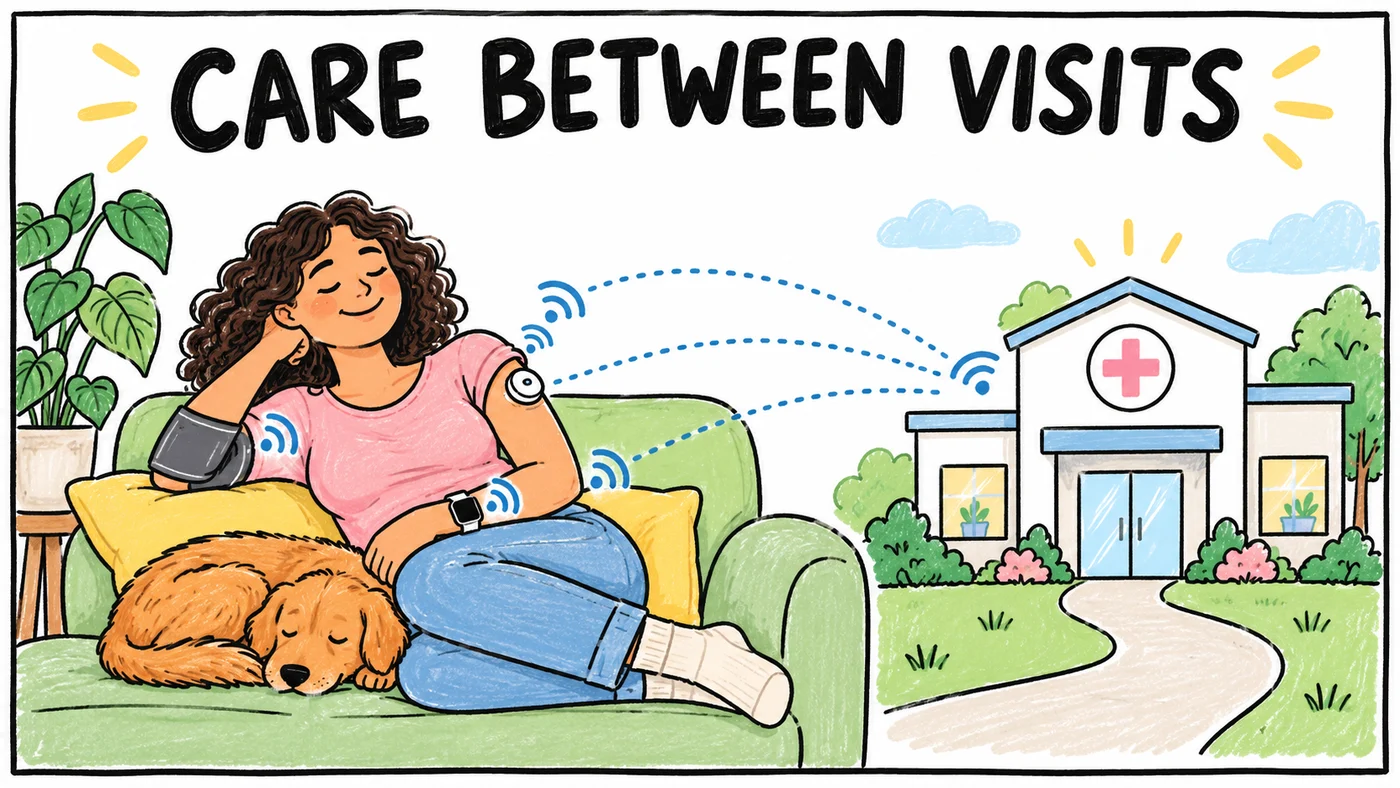
In practice, DPC remote monitoring tends to look simpler than the hospital-style RPM programs you may have seen. It is a validated home blood pressure cuff for a patient with new hypertension, a two-week CGM for a patient with prediabetes who wants to see what breakfast does, or a smartwatch summary a patient shares before a visit. The hard part is rarely the device. It is getting the readings to the right person, deciding who looks at them, and making sure a worrying number turns into a follow-up.
This guide covers the devices, the evidence, how data reaches you, the billing rules for practices still in Medicare, HIPAA, and a simple review workflow. It is general information, not medical or legal advice.
Why RPM Is Different for DPC and Concierge Practices
The billing question splits the two models. If you are still sorting out where your practice sits, our comparison of DPC vs. concierge medicine covers the Medicare differences in more depth.
Direct primary care (opted out of Medicare)
A physician who opts out of Medicare signs private contracts with Medicare patients and cannot bill Medicare for any service during the opt-out period. That includes the remote physiologic monitoring codes. Most DPC members are not on Medicare anyway, and commercial insurers are not being billed by the practice, so RPM simply becomes part of the care the membership already pays for.
That is a real advantage. You do not need 16 days of readings to justify a claim, you do not need to log minutes, and you can stop monitoring the moment it has answered the clinical question. A patient can wear a CGM for two weeks, review it with you, and be done. If you are pricing a tier that includes devices or a monitoring program, how much to charge for a DPC membership walks through how practices build fees around what is included.
Concierge medicine (still billing Medicare)
Many concierge practices charge an annual fee and still bill Medicare and insurers for covered services. Those practices can bill RPM for eligible Medicare patients when they meet CMS's requirements, as long as the concierge fee is not charging the patient again for something Medicare already pays for. That line is worth reviewing with a healthcare attorney before you add RPM to a concierge program.
What Are the Medicare RPM Codes in 2026 and 2027?
Remote physiologic monitoring is billed with a small set of CPT codes. CMS's Telehealth and Remote Monitoring booklet summarizes the core requirements, which include using a device that meets the FDA definition of a medical device, data that is collected and transmitted digitally rather than typed in by the patient, and patient consent.
The CY 2026 Physician Fee Schedule final rule adopted the CPT Editorial Panel's new structure. Before 2026, device supply required at least 16 days of data in a 30-day period. CPT added codes for shorter monitoring and shorter management time, and CMS finalized them.
| Code | What it covers | Notes |
|---|---|---|
| 99453 | Initial setup and patient education on the device | Billed once per episode of care |
| 99445 (new for 2026) | Device supply with 2 to 15 days of data in 30 days | Valued the same as 99454, since the device is supplied for the full period |
| 99454 | Device supply with 16 to 30 days of data in 30 days | Not additive with 99445, bill one or the other |
| 99470 (new for 2026) | First 10 minutes of treatment management in a calendar month | Work RVU finalized at 0.31 |
| 99457 | First 20 minutes of treatment management in a calendar month | Not additive with 99470 |
| 99458 | Each additional 20 minutes after 99457 | Add-on to 99457 |
CMS was explicit that the 2 to 15 day code and the 16 to 30 day code "are not additive and are not a base and add-on code structure," and the same goes for the 10-minute and 20-minute management codes. CMS also adopted CPT's language that the management codes require a live, interactive communication with the patient or caregiver, which counts toward total time without needing to fill all of it.
The rule notes that all RPM codes are expected to be reviewed again at the January 2028 RUC meeting, so values may shift again. Each year's fee schedule is the place to confirm current rates before you build a concierge RPM program around them.
Which Home Monitoring Devices Do DPC Practices Use?
Most practices start with one or two device types tied to the conditions they see most. Here is how the common categories compare.
| Device type | What it measures | Who it helps | How data reaches you |
|---|---|---|---|
| Connected blood pressure cuff | Systolic and diastolic BP, pulse | New or uncontrolled hypertension, suspected white-coat or masked hypertension, medication changes | Bluetooth to the maker's app, then a shared report, Apple Health or Health Connect, or a practice platform |
| Cellular blood pressure cuff | Same as above | Patients who don't use smartphones | Sends readings over a cellular connection straight to a vendor platform the practice logs into |
| Prescription CGM | Interstitial glucose every few minutes | Insulin users, type 1 and type 2 diabetes | Manufacturer app with a clinic sharing portal |
| Over-the-counter CGM (Stelo, Lingo, Libre Rio) | Interstitial glucose trends | Adults not on insulin, prediabetes, type 2 managed without insulin, lifestyle coaching | Patient's phone app, shared reports or screenshots, some health platform syncing |
| Smartwatch or fitness wearable | Heart rate, rhythm notifications, activity, sleep | Patients motivated by activity goals, palpitations, sleep concerns | Apple Health or Health Connect, exported summaries, patient-shared screens |
| Smart scale | Weight, sometimes body composition | Heart failure, weight management, GLP-1 follow-up | Maker's app, Apple Health or Health Connect |
| Pulse oximeter | Oxygen saturation, pulse | Chronic lung disease, post-illness checks | Often manual unless the device is connected |
Home blood pressure cuffs
Home blood pressure monitoring has the strongest evidence base of any device on this list. The AHA and AMA joint policy statement on self-measured blood pressure says out-of-office readings help diagnose white-coat and masked hypertension, and that meta-analyses of randomized trials link self-measured monitoring to lower blood pressure and better control, with the largest benefit when it comes with other support such as medication adjustment or coaching. The USPSTF hypertension screening recommendation also recommends confirming a diagnosis with measurements taken outside the clinical setting before starting treatment.
The same statement prefers validated oscillometric devices. The simplest way to check a model is the AMA's Validated Device Listing at validatebp.org, which lists blood pressure devices that have been tested for clinical accuracy. Many practices keep a short list of two or three validated, connected cuffs in different cuff sizes so patients aren't left guessing in a store aisle.
Over-the-counter CGMs
CGMs used to require a prescription. On March 5, 2024, the FDA cleared the Dexcom Stelo as the first over-the-counter CGM, for adults 18 and older who do not use insulin. The FDA's announcement notes that Stelo is not meant for people with problematic hypoglycemia because it is not designed to alert to low blood sugar, and that users should not make medical decisions from its readings without talking to their clinician. On June 10, 2024, Abbott announced FDA clearance for Lingo, a 14-day upper-arm biosensor for general wellness, and Libre Rio, for adults with type 2 diabetes who do not use insulin.
For DPC, the over-the-counter option removes the prescription and prior authorization step for a whole group of patients. A patient with prediabetes can buy a sensor, wear it for its full wear period, and bring the trends to a visit where you talk through meals, sleep and activity together. Stelo's own site now advertises 5-minute updates and a phone-free Apple Watch connection, which shows how quickly these consumer products are changing. Patients using insulin still belong on a prescription CGM with low-glucose alerts.
Wearables
Smartwatches and fitness bands produce a lot of data and only some of it is clinically useful. Practices that do well with wearables usually agree on one or two things to look at, such as resting heart rate trends, rhythm notifications or step counts, and treat the rest as background the patient can bring up if they want.
How Does Home Monitoring Data Reach the Practice?
There are four common routes, and most DPC practices use more than one.
- The device maker's app. Most connected cuffs and CGMs pair with the manufacturer's phone app. Many apps let the patient export a PDF or share a report, which is simple and works with any EHR as an attachment.
- Phone health platforms. On iPhone, Apple's HealthKit is the shared store that many health and fitness apps write to and read from. On Android, Health Connect plays the same role. If your EHR's patient app or a monitoring platform reads from these, a patient can share readings without juggling another app.
- Manufacturer clinic portals. Prescription CGM makers offer clinic-facing portals where a patient links their account to the practice. The data stays in the vendor's system and the practice logs in to view it.
- RPM platforms. Dedicated platforms ship cuffs, scales or cellular devices and collect readings in one dashboard. Some say they send summaries into specific EHRs. Confirm the exact EHR connection on the vendor's own documentation and on a demo with your EHR, because "integrates with" can mean anything from a full data feed to a PDF upload.
Whichever route you choose, write down where readings land and who checks that place. A cuff that syncs perfectly into a dashboard nobody opens is worse than a patient texting you a photo, because the patient believes someone is watching.
Do Consumer Health Apps Fall Under HIPAA?
Not usually. HHS has explained in its guidance on the access right, health apps and APIs and its health app developer scenarios that an app a patient chooses on their own, for their own use, is generally not a HIPAA business associate of the practice. Consumer health apps that fall outside HIPAA can still be covered by the FTC's Health Breach Notification Rule, which the FTC updated in 2024 to clarify that it applies to health apps.
The picture changes once the practice is involved. Readings that arrive in your EHR, your messaging tool or your inbox are protected health information in your hands. A monitoring platform that collects readings on your behalf is typically a business associate and should sign a BAA. Our guide to HIPAA-compliant workflow tools and our post on HIPAA-compliant texting for DPC cover the questions to ask vendors.
What Does Remote Monitoring Cost Patients in a DPC Practice?
Costs depend on the device and who pays. Many DPC practices take one of three approaches.
- Patient buys the device. You recommend validated cuffs or an over-the-counter CGM and the patient buys it at retail. This keeps the membership fee simple. Device prices change often, so link patients to the maker's own store rather than quoting a number.
- Practice lends or dispenses devices. Some practices keep a few cuffs to loan for a two-week diagnostic period, or buy devices at wholesale and sell them near cost. State rules on selling devices vary, so check your state's requirements.
- Higher membership tier. A tier that includes a monitoring program, with devices and regular reviews, can make sense for patients with several chronic conditions.
HSA and FSA eligibility for monitoring devices depends on the item and the plan, so patients should check with their plan administrator. For the 2026 changes that let qualifying DPC memberships work with HSAs, see DPC HSA rules for 2027.
Who Reviews Remote Monitoring Data, and How Do You Avoid Alert Fatigue?
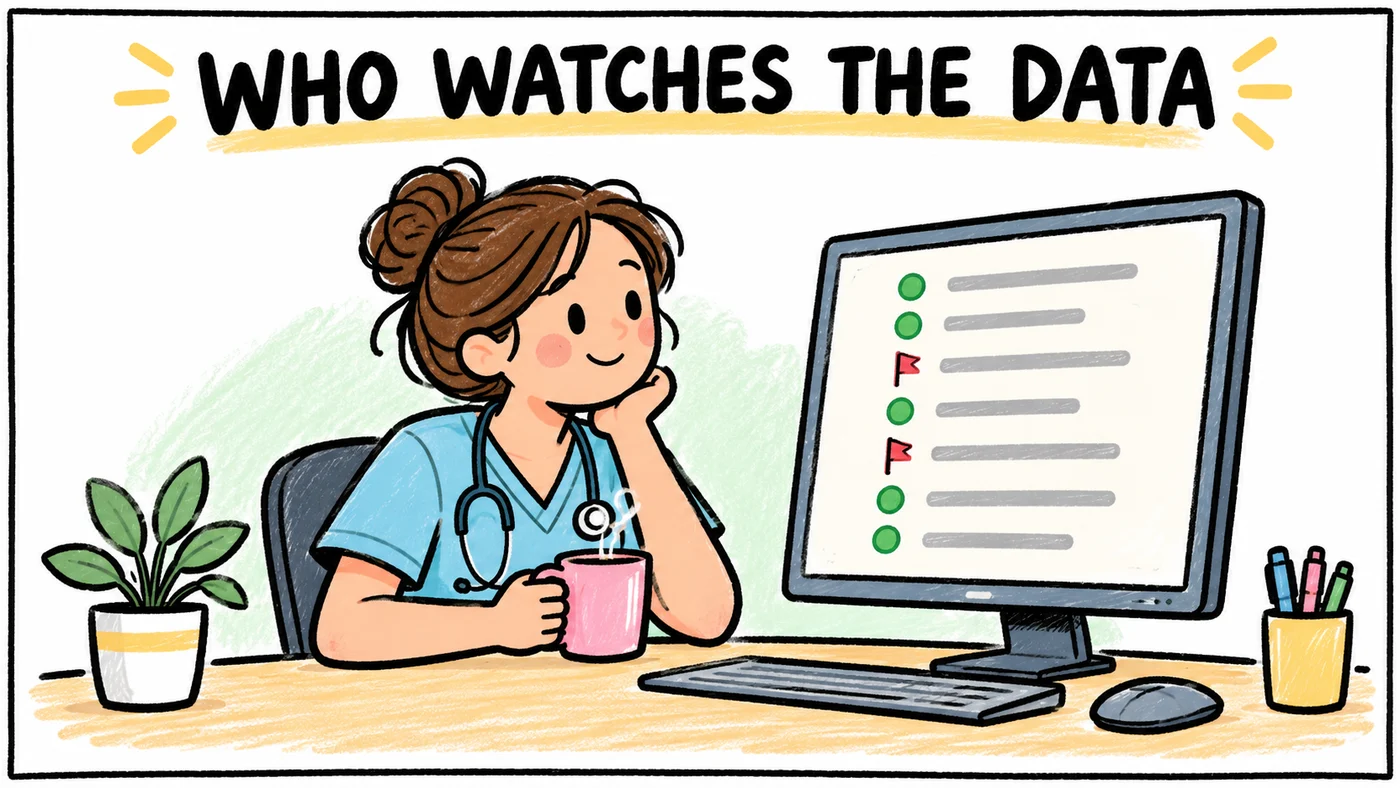
Once devices are in patients' hands, the workflow decides whether RPM helps or quietly adds risk. Alert fatigue happens when every reading creates a notification and the team learns to tune them out, which is a tool problem, not a people problem.
Set the review rhythm before the first device ships
Decide in advance how often readings are reviewed and by whom. A common pattern in small practices is a nurse or medical assistant who checks the dashboard on set days, with the physician reviewing anything outside agreed thresholds. Tell the patient exactly when someone will look, and tell them plainly that home monitoring is not an emergency service and what to do if they feel unwell.
Use thresholds you would actually act on
Set two levels for each patient. One level is "contact the patient this week" and a higher level is "contact the patient today." Readings in the normal range don't need to notify anyone. Thresholds should be individual, since a target that suits a 40-year-old after a medication change may not suit an 80-year-old with orthostatic symptoms.
Close the loop on every flagged reading
Every flagged reading should end in a task with an owner and a due date, and a note in the chart when it is done. This is the same discipline that makes chronic care management task tracking work, and it overlaps with preventive care gap tracking, since a home cuff often closes the "confirm out-of-office BP" gap that screening guidance calls for.
End monitoring on purpose
Write a stop point into the plan, such as two weeks of readings to confirm a diagnosis or a month after a dose change. Monitoring that never ends tends to become monitoring nobody reads.
A Simple Remote Monitoring Setup for a DPC Practice
If you are starting from zero, this order keeps it manageable.
- Pick one condition, usually hypertension, and one validated connected cuff from validatebp.org.
- Decide how readings reach you (shared report, phone health platform or a monitoring platform with a BAA).
- Name the reviewer, the review days and the two thresholds.
- Write a one-page patient handout with cuff technique, how many readings to take, and when someone will look at them.
- Add an over-the-counter CGM option for patients with prediabetes or type 2 diabetes not on insulin once the first workflow is steady.
- Review after three months and keep only what the team is actually using.
Most of the friction shows up between tools. A reading lands in a vendor dashboard, someone has to notice it, message the patient, adjust a prescription in the EHR and remember to check again next week. Tabflows is a dedicated tech team that connects the tools a clinic already uses, like the EHR, billing and messaging, so flagged readings turn into tasks with an owner and the patient context sits in one place for whoever picks them up.
If you are earlier in the process, our guide on how to start a DPC practice covers the bigger decisions, and the DPC finder shows how other practices describe what their memberships include.
This article is general information for clinicians and practice owners, not medical, legal or billing advice. Confirm Medicare rules with CMS and your MAC, and device instructions with the manufacturer.
FAQs
Can a direct primary care practice bill Medicare RPM codes?
Usually not. A DPC physician who has opted out of Medicare cannot bill Medicare for any service, including remote physiologic monitoring codes 99453, 99454, 99457 and 99458. For an opted-out DPC practice, remote monitoring is part of what the membership covers, so the practice decides which devices to support and how often someone reviews the readings.
Can a concierge medicine practice bill for remote patient monitoring?
A concierge practice that still bills Medicare can bill RPM codes for eligible Medicare patients when it meets CMS requirements, as long as the concierge fee does not cover services Medicare already pays for. Starting in 2026, Medicare also recognizes CPT 99445 for 2 to 15 days of device data in a 30-day period and CPT 99470 for the first 10 minutes of monthly treatment management.
What changed in Medicare RPM codes for 2026?
The CY 2026 Physician Fee Schedule final rule adopted two new CPT codes. CPT 99445 covers device supply with 2 to 15 days of data transmission in a 30-day period, and CPT 99470 covers the first 10 minutes of RPM treatment management in a calendar month. CMS said the 2 to 15 day and 16 to 30 day codes are not additive, so a practice bills only one of them per 30 days.
Are over-the-counter CGMs FDA cleared?
Yes. The FDA cleared the Dexcom Stelo on March 5, 2024 as the first over-the-counter continuous glucose monitor, for adults 18 and older who do not use insulin. Abbott announced FDA clearance for two over-the-counter CGMs, Lingo and Libre Rio, on June 10, 2024. Neither Stelo nor Lingo is meant for people with problematic hypoglycemia or insulin use.
How do I know if a patient's home blood pressure cuff is accurate?
Check the model on validatebp.org, the American Medical Association's Validated Device Listing of blood pressure monitors that have been tested for clinical accuracy. Then check cuff size and technique at an office visit by comparing the patient's device against your own reading.
Is remote monitoring data covered by HIPAA?
It depends on who holds it. Readings a patient keeps in a consumer app they chose are generally not covered by HIPAA. Once a practice receives readings, or uses a platform that collects them on the practice's behalf, the practice's HIPAA duties apply and that platform vendor usually needs to sign a business associate agreement.