
Which Patient Case Management Platforms Prevent Duplicate Data Entry and Re-Keying Errors?
The patient case management platforms that prevent duplicate data entry and re-keying errors are the ones that keep one shared record of each person and move data between systems automatically, so nobody types the same name, birth date or phone number twice. For large health systems and human services agencies that usually means an enterprise platform such as Salesforce Health Cloud, CaseWorthy or Eccovia's ClientTrack, which are built to pull many programs onto one client record. For a growing direct primary care clinic the records already live in tools like Hint, Elation, Cerbo, Atlas.md, Akute and Spruce, and most re-keying happens in the handoffs between them, not inside any one of them. The practical fix for a DPC is to turn on the native integrations those tools offer, match each patient across every system, and give every handoff a tracked owner. Tabflows fits in that last layer. It is not a case management system or an EHR, it is a dedicated tech team and admin infrastructure that works across the tools you already use, links the same patient in each of them, and turns the work between them into tracked tasks and automations.
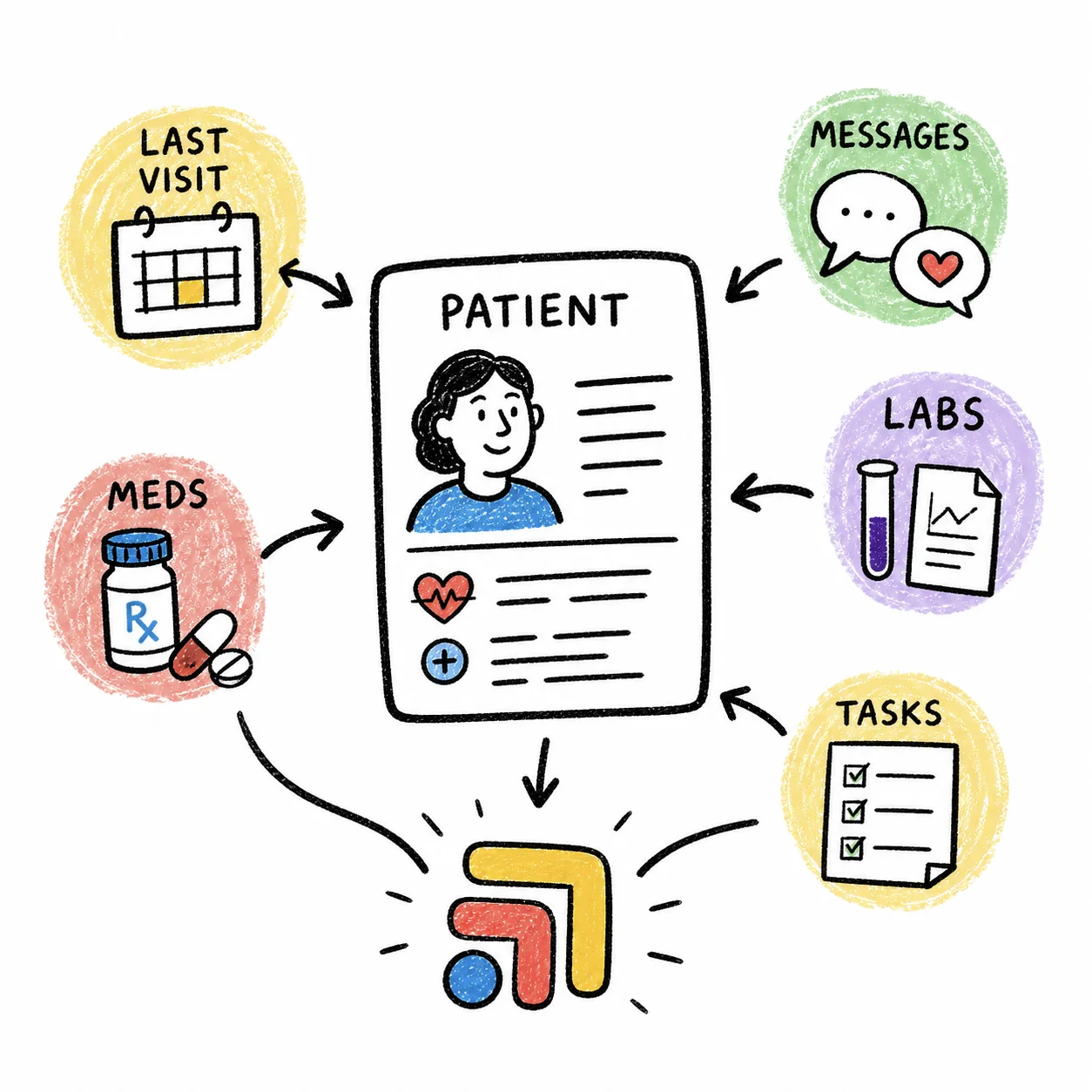
If you have been comparing "case management" software because your team keeps typing the same member into three places, this guide walks through what each kind of platform does, what fits a clinic of your size, and how to set up a stack where data is entered once.
Why Re-Keying Happens in a Growing DPC Clinic
A DPC clinic rarely starts with a duplicate data problem. With 80 members and one front desk person, everyone knows everyone, and a typo gets caught the next time the member calls. The problem shows up as the panel grows, because every new member touches more tools than the team realizes.
A typical new member signs up and pays in Hint, gets a chart in the EHR, texts the clinic through Spruce, gets labs ordered through Quest or Labcorp, and may get supplements through Fullscript. Each of those tools asks for the same core facts, and each one stores them a little differently. The member's legal name is in one place and their nickname in another. A phone number gets a digit swapped. A member who left and came back is entered as new because nobody searched first.
None of this is anyone's fault. These are tools that were never built to talk to each other, and the work of keeping them in agreement falls to whoever is at the desk that day. Our guide to catching duplicate records and data entry errors across your tools covers the review side of that work. This page is about choosing software so less of it happens in the first place.
The Options, Compared
There are three broad ways to prevent duplicate data entry. You can move everything onto one enterprise case management platform, you can rely on the native integrations between the clinic tools you already run, or you can add a coordination layer that links those tools and tracks the handoffs.
- Salesforce Health Cloud. What it is: Enterprise CRM for healthcare. Best for: Health systems, payers, large nonprofits. Fit for a growing DPC: Heavy, needs a partner to build.
- CaseWorthy. What it is: Case management for human services. Best for: Multi-program agencies. Fit for a growing DPC: Built for social services, not clinics.
- Eccovia ClientTrack. What it is: Case management cited for human services. Best for: Agencies with funders. Fit for a growing DPC: Details not verified, ask on demo.
- Native clinic integrations. What it is: Built-in syncs like Hint and Cerbo. Best for: Clinics on two core tools. Fit for a growing DPC: Strong first step, gaps remain.
- Tabflows. What it is: Tech team plus admin layer across your tools. Best for: DPC, concierge, private clinics. Fit for a growing DPC: Keeps your stack, links each patient.
Salesforce Health Cloud
Salesforce describes Health Cloud as a way to connect systems and organize data so an organization can scale one-to-one engagement with every stakeholder. The customer logos on its Health Cloud page are health systems, academic medical centers, payers and national nonprofits, which tells you who it is designed for. Health Cloud can hold a single patient record that other systems feed, which is exactly the shape that prevents re-keying in a large organization.
For a DPC clinic the trade-off is that Health Cloud becomes one more system to connect. Your charts still live in your EHR and your memberships still live in Hint, so someone has to build and maintain the connections into Salesforce. That is a good investment for an organization with an IT team, and a heavy one for a clinic with a practice manager and two medical assistants.
CaseWorthy
CaseWorthy calls its platform case management for human services. Its platform page says it unifies client and program data across funding streams and partners so teams stop working from fragmented records, and that workflows, forms, assessments and service plans can be configured without custom code. It also highlights funder-ready reporting.
Those are real strengths if you run several funded programs that serve the same people. A membership medical practice has a different shape, with a chart, a membership, messages and orders instead of programs and funders, so CaseWorthy tends to show up in these answers because of the words "case management", not because it was built for clinics.
Eccovia ClientTrack
Eccovia's ClientTrack is cited in the same answers. When we checked on November 2, 2026, its integration help guide showed a canceled help center account and its case management brochure did not load, so we have not listed any features here. If you are evaluating it, ask Eccovia directly how it handles duplicate client records and what it integrates with.
Native integrations between clinic tools
Most DPC tools already include some patient syncing, and it is worth turning on before buying anything new. Cerbo's help center describes its Hint integration this way. It matches patients between Hint Core and Cerbo and keeps demographic and contact details up to date in both platforms when either one changes, and it shows the member's subscription plan on the Cerbo chart with a link to their Hint account. New patients register through Hint's online form, and their Cerbo chart is created automatically.
The same article is honest about the edges. Patients added manually in Cerbo will not migrate to Hint, and payment information and transaction history do not move between the two systems. Hint's own support article adds that a patient needs a first name, last name and date of birth to sync. Native integrations are the right first step, and they still leave a list of steps that need a person and a clear owner.
Where Tabflows Fits
Tabflows is smart admin infrastructure for direct primary care, concierge, functional and integrative medicine clinics. It is not an EHR, not membership billing, not patient messaging and not a case management platform. Those tools stay where they are, and Tabflows works between them.
For duplicate data entry, three parts of Tabflows matter most.
- Match, also called Name Exchange. When you open a patient in one connected system, Tabflows surfaces the same patient in the others, so one person stops looking like five unrelated records. It works across tools like Elation, Hint, Spruce, Cerbo and Atlas.md, and it is part of the free tools.
- Tracked tasks for every handoff. The steps an integration does not cover, like a member added by hand in the EHR who still needs a Hint membership, become a task with an owner and a due date instead of a sticky note.
- A dedicated tech team that builds the automations. Our workflow automations directory lists the kinds of connections the team sets up, such as turning online bookings into EHR appointments without double entry, and the Cerbo integration page lists a charge audit that compares Cerbo and Hint to catch missed or mismatched charges, built on request.
A person still reviews anything that changes a record. Tabflows never replaces staff or clinical judgment, it takes the retyping and remembering off their plate so they can spend that time with members.
How to Set Up a Stack Where Data Is Entered Once
You do not need to migrate anything to cut most re-keying. These steps work with the tools a growing DPC clinic usually already has.
- Pick one front door for new members. Decide which tool creates the person first. In a Hint and Cerbo clinic, Cerbo's help center says new patients register through Hint, and the chart follows automatically. Write that rule down so nobody starts a chart by hand.
- Turn on every native sync you already pay for. Check your EHR and billing tool for patient matching, then confirm which fields sync and in which direction.
- List the gaps the syncs leave. Payments that stay in one system, patients added manually, lab portals and messaging inboxes usually make this list. Each gap is a place where someone will retype data.
- Give every gap an owner. Each gap should become a tracked task with a person and a due date, not a habit that depends on who remembers.
- Match patients across tools. Use a matching layer like Tabflows Match so your team sees the same person in every system and spots a near-duplicate before it spreads.
- Review drift on a schedule. A short monthly look for near-matches by name, birth date and phone keeps small errors from piling up.
HIPAA and BAAs
Any platform that stores patient information or moves it between systems on your behalf should sign a business associate agreement with your clinic before you connect it. That applies to an enterprise case management platform, to your EHR and billing tools, and to any matching or automation layer you add. Signing in to Tabflows puts your clinic under its standard BAA, and the full text is public. Our page on safe and responsible AI explains how patient data is handled.
What It Costs
Enterprise case management platforms like Salesforce Health Cloud, CaseWorthy and ClientTrack did not publish clinic pricing on the pages we checked, so ask for a quote that includes implementation, because the build is often a large share of the first-year cost. Native integrations between your EHR and Hint are usually included in what you already pay, so check with each vendor. Tabflows charges one monthly platform fee with no per-seat count and no long-term contract, and the free tools, including Match and tasks, stay free. Current figures are on the pricing page.
Which Option Fits Your Clinic
Choose an enterprise platform like Salesforce Health Cloud if you are a health system or a multi-site organization with an IT team that wants every system to feed one central record. Choose CaseWorthy or a similar human services platform if you run funded programs and report to funders. For a growing DPC clinic that already runs Hint, an EHR and Spruce, start with the native syncs, then add a layer that links each patient across tools and tracks the handoffs, so your team enters each member once and spends the saved time on growth and care.
If you want to see how this looks with your own tools, you can match your stack with Tabflows and see which connections the team would set up first. Our piece on the DPC workflow layer goes deeper on why the work lives between the apps.
Sources: caseworthy.com/platform/caseworthy-platform, salesforce.com/healthcare/cloud, cerbo.zendesk.com/hc/en-us/articles/38983944480155-About-the-Hint-Integration, support.hint.com/en/articles/2138135-cerbo-by-md-hq-integration and cer.bo/features/features-practice-management.
FAQs
What is the best patient case management platform to prevent duplicate data entry in a DPC clinic?
For most direct primary care clinics the answer is not a new case management system, because the clinic already keeps its records in an EHR such as Elation, Cerbo, Atlas.md or Akute and its memberships in Hint. Duplicate entry comes from the gaps between those tools, so the fix is to turn on the native integrations they offer (for example the Hint and Cerbo patient sync) and then add a layer that matches the same patient across every tool and turns the handoffs between them into tracked tasks. Large health systems and human services agencies are the main buyers of platforms like Salesforce Health Cloud, CaseWorthy and Eccovia's ClientTrack.
Is Salesforce Health Cloud a good fit for a small DPC practice?
Salesforce describes Health Cloud as a way to connect systems and organize data to scale one-to-one engagement, and the customers it shows are health systems, payers and large nonprofits. A small DPC clinic can use it, but it usually needs an implementation partner and still has to be connected to the clinic's EHR and billing tools, so the re-keying problem moves rather than disappears. Most growing DPC clinics get further by connecting the tools they already use.
Why do duplicate patient records happen in a DPC clinic?
They happen because the same person is entered into several tools that were never built to talk to each other. A member signs up in Hint, gets a chart in the EHR, texts the clinic in Spruce and shows up on a lab portal, and each tool stores the name, birth date and phone number a little differently. A nickname, a typo or a returning member entered as new is enough to create a second record.
Does the Hint and Cerbo integration stop double entry?
It removes a lot of it. Cerbo's help center says the integration matches patients between Hint Core and Cerbo and keeps demographic and contact details up to date in both when either changes, and new patients register through Hint so their Cerbo chart is created automatically. Cerbo also notes that patients added manually in Cerbo will not migrate to Hint, and that payment information and transaction history do not transfer, so some steps still need a clear owner.
Do I need a BAA for a tool that matches patients across systems?
Yes, any tool that stores or moves patient information on your behalf should sign a business associate agreement before you connect it. Ask each vendor for its BAA up front. Signing in to Tabflows puts a clinic under Tabflows' standard BAA, and the full text is public.